If you’re searching for the best air purifier for wildfire smoke with activated carbon, you probably already know a purifier helps. The harder question is whether the HEPA filter inside a standard unit is enough, or whether the carbon layer deserves as much of your attention. For smoke, it often does, and the carbon is the part most product pages describe in the vaguest terms.
This guide covers what smoke brings into a house, what each filter layer handles, how to judge a carbon filter by what it contains, and how to size, run and maintain a purifier through a smoke event without overspending.
What’s actually coming through your window
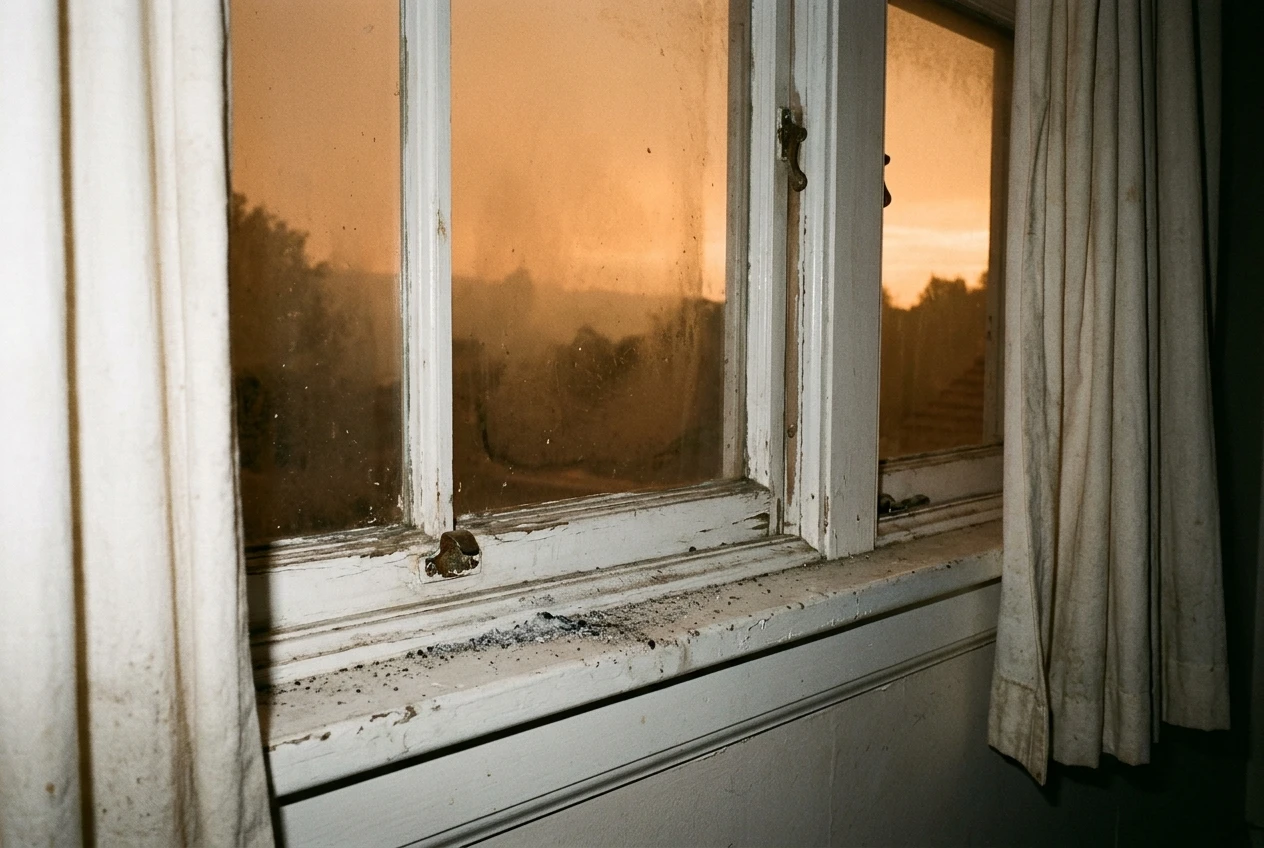
Wildfire haze is a mix. The visible part is fine particles: ash, soot and tiny droplets that stay airborne for a long time and slip through gaps around windows and doors. Those particles are what air quality apps report as PM2.5.
The rest you can’t see. Smoke also carries gases, including volatile organic compounds, and those produce most of the campfire smell that settles into curtains, couches and bedding. A room can look clear and still smell like smoke.
One gas deserves a separate mention. Carbon monoxide is not something a household purifier is built to remove, and a purifier is not a safety device for it. If you use a gas stove, a fireplace or any combustion appliance, your carbon monoxide alarm does a job no purifier can.
So there are two problems in your living room on a smoky day, particles and gases, and they are handled by different parts of the purifier.
What HEPA does well on smoke, and where it stops
A true HEPA filter is rated to capture 99.97 percent of particles at 0.3 microns, which is the size hardest for a filter to catch. Smoke particles span a range of sizes, and HEPA is very effective across it. If your concern is the particle load that shows up on an air quality reading, a well-sized unit with a genuine HEPA filter does that work.
HEPA is a physical mesh. It traps solid and liquid particles and has no ability to hold onto gas molecules. Smoke odor and the gases behind it pass straight through. That is why a purifier can bring your particle reading down while the room still smells like a burnt campsite.
Be careful with labels such as “HEPA-type” or “HEPA-style.” They describe filters that don’t meet the true HEPA standard, and a manufacturer may not state the efficiency at all. Look for “True HEPA” or a stated efficiency figure.
Why carbon weight matters more than the word “carbon” on the box
Activated carbon is a porous material with a huge internal surface area. Gas molecules stick to that surface, a process called adsorption. Once the surface is full, the carbon stops capturing anything and can even release some of what it held.
Capacity therefore depends on how much carbon is in the filter and how long the air stays in contact with it. The word “carbon” on the box tells you only that some is present. A thin sheet of fabric lightly dusted with carbon particles and a deep tray packed with carbon granules can both be called a “carbon filter,” yet they hold very different amounts.
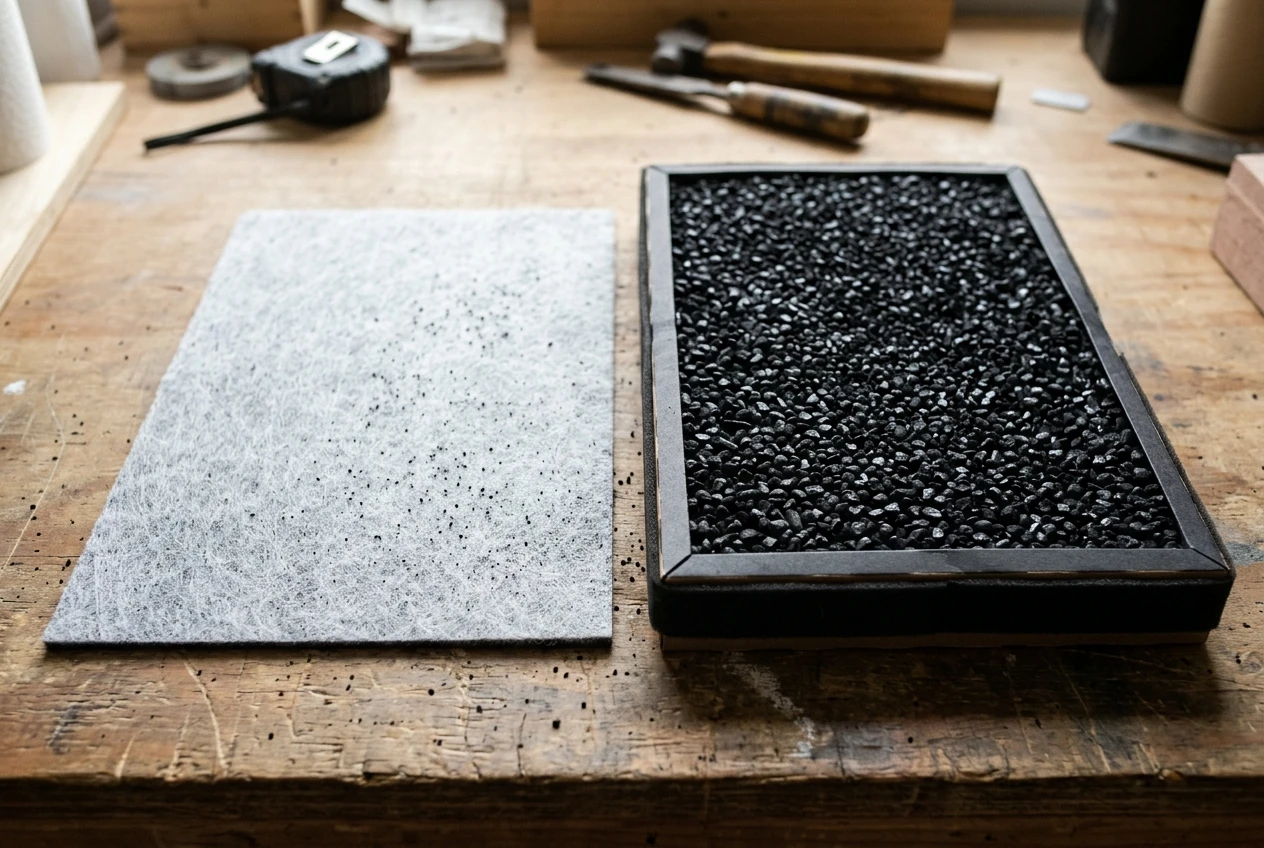
For smoke, the heavier and deeper filter is the better design. A thicker bed gives gases more time and more surface to be caught, and it takes longer to fill up. Many purifiers that advertise odor removal use a thin layer that does well on cooking smells for a few weeks and has little to give during a week of wildfire haze.
How to check a purifier’s carbon filter before you buy
Look for numbers on the product page, the manual or the replacement filter listing. Brands that built a serious carbon filter tend to say so, and brands that didn’t tend to stay vague.
- Weight of carbon. Look for pounds, ounces, grams or kilograms. A filter listed with an actual carbon weight is easier to compare than one described with adjectives. If you find a weight for one model and nothing for another, the missing figure is information too.
- Form of the carbon. Granular or pelletized carbon in a tray or cartridge generally holds more than a thin carbon-coated or carbon-impregnated sheet. Some purifiers fold a light carbon layer into the pre-filter, and that is a different thing from a dedicated carbon filter.
- Depth. Compare the thickness of the filter, not only its width and height. A thicker filter usually means more contact time.
- Whether the carbon is a separate, replaceable part. Some units combine HEPA and carbon into one cartridge, so you replace both when the carbon is spent even if the HEPA has life left. A separate carbon filter lets you replace only the part that wears out first.
If a product page gives no carbon weight, ask the manufacturer before buying. Useful questions are: How much activated carbon does the filter contain, by weight? Is it a dedicated layer or a coating? How often do you recommend replacing it in heavy smoke? What does a replacement cost?
Compare the answers across two or three models. For wildfire smoke, the unit with more documented carbon and a reasonable replacement price is generally a better choice than the one with the nicest app. If you’re also weighing smart features, the article on what the extra money for a smart unit actually buys covers that tradeoff.
Sizing for a smoky day: airflow, closed windows and the one room to protect first
Size by airflow, not by the square footage printed on the box. The number to use is the clean air delivery rate, or CADR, which measures how much filtered air the unit produces per minute. Many units list separate CADR figures for smoke, dust and pollen, and the smoke figure is the relevant one here.
To see how often a unit turns over a room’s air, multiply the smoke CADR by 60 and divide by the room’s volume in cubic feet. As an example, a 12 by 15 foot room with 8-foot ceilings holds 1,440 cubic feet. A purifier with a smoke CADR of 240 cubic feet per minute would give 240 × 60 ÷ 1,440, which is 10 air changes per hour. A bigger room or a lower CADR lowers that number. The guide on sizing a purifier for a large living room by airflow walks through this in more detail.
Higher airflow also lets you run the fan on a lower, quieter setting and still keep up with the room. Heavy carbon filters add resistance to the airflow, so check that the CADR you’re reading applies to the unit as sold, with its filters installed.
Choose one room to protect first. For most people that is the bedroom, since you spend the longest unbroken stretch of time there. If you work from home, your office may come first. Close that room’s windows and door, run the purifier there, and don’t try to cover the whole house with one unit.
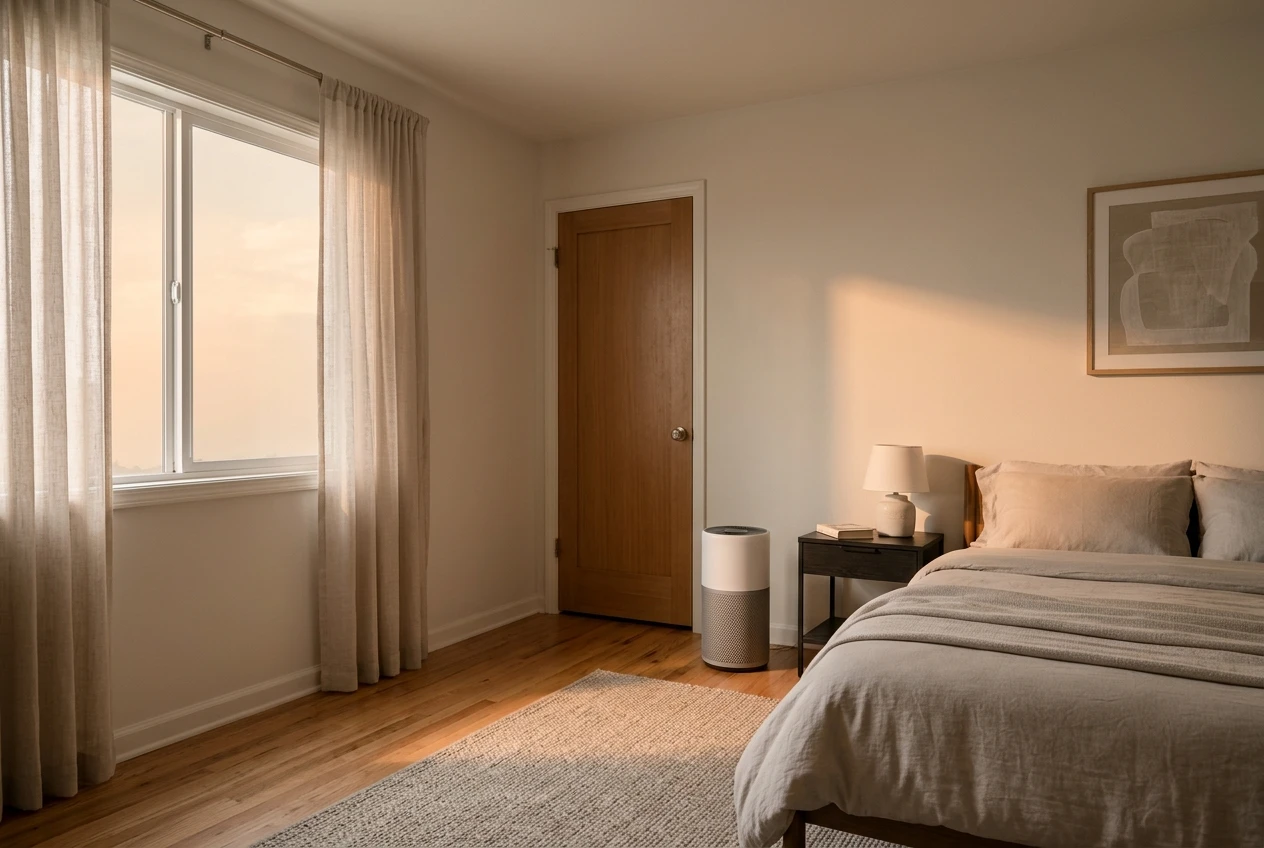
Placement affects how well the unit pulls in air. Keep it clear of walls and furniture, as covered in the placement rules for each room. If the bedroom is your priority, choosing a quiet purifier for the bedroom helps you balance noise and airflow.
Running it during a smoke event
Start the purifier before the smoke is at its worst. Closing the windows and running the unit while the air is still moderate keeps the particle load in the room low, and it’s easier to hold a low level than to clean up a high one.
Fan speed. On the heaviest smoke days, use a medium or high manual setting in the room you’re protecting. A purifier on its lowest speed may not keep up with smoke that keeps entering through door gaps and ventilation. Drop the speed for sleep if the noise bothers you, and use the highest setting you can tolerate while you’re awake in the room.
Auto mode. Auto mode adjusts fan speed based on the unit’s particle sensor. That works well for ordinary days. In smoke, the reading can fall as the filter clears particles, and the fan slows down while the smell, which the sensor isn’t measuring, is still in the room. If you notice that, switch to a fixed speed for the duration of the event. The article on whether to run a purifier all day or leave it on auto gets into how to decide.
What smart sensors can and can’t tell you. Most purifier sensors use a light-scattering sensor that detects particles and reports a PM2.5 estimate. It’s a useful trend line, and it is not a laboratory instrument. Some units add a VOC or “gas” sensor, which gives a rough indication of change and doesn’t tell you how much carbon capacity is left. No sensor reports the remaining life of your carbon filter. The filter-life indicator on most units counts hours of use, not what the carbon has absorbed.
Sensors can also drift when dust builds up on them. If your readings look off, see why a purifier reads high when the room looks clean and how to clean the dust sensor.
If your purifier loses its connection while you depend on the app, the unit still runs from its physical controls. Set the fan speed by hand and sort out the network later.
Why carbon filters wear out faster on smoky days
A HEPA filter loads with particles gradually and keeps working as it loads, until airflow drops. Carbon behaves differently. It has a fixed capacity for gas molecules, and a long smoke event, with a constant supply of gases and odor, uses that capacity much faster than normal household air does.
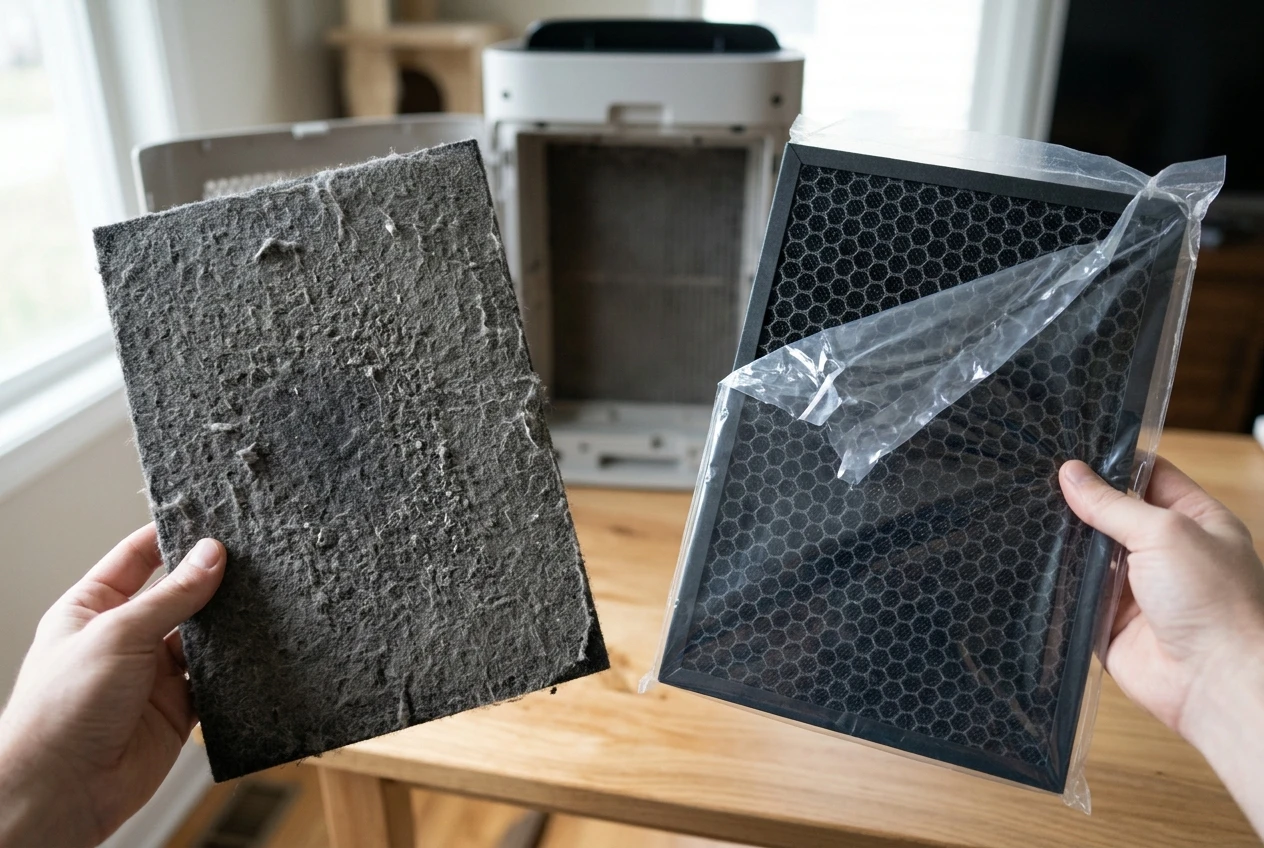
The sign that a carbon filter is saturated is that smoke or other odors return in a room where the purifier is running. There is no reliable way to see it by looking at the filter, and carbon can’t be washed or revived at home. When the smell comes back with the unit running properly, the carbon is the first thing to suspect.
That has a cost implication, and it’s best to plan for it before you buy. Heavier carbon filters usually cost more per replacement, and a smoky season may mean replacing the carbon sooner than the manufacturer’s standard interval. When comparing models, write down the replacement price for each filter, how often it is recommended, and whether HEPA and carbon are sold separately. Multiply that out across a few years. The article on what a smart air purifier really costs over three years shows how to do that calculation.
Two related questions come up at this point. If you’re considering third-party filters to save money, original versus compatible filters covers what to check, especially the carbon weight, since a compatible filter that fits but holds less carbon is a poor trade for smoke. If you’re thinking about stocking up, buying filters in bulk has five checks to run first.
A simple smoke-season checklist
Go through this before smoke arrives, because filters and supplies are harder to find in the middle of an event.
- Replacement filters on hand. Have at least one spare carbon filter, and a HEPA filter if yours is nearing the end of its recommended interval. Confirm the model number on the filter matches your purifier.
- Carbon filter status. Check the date of the last replacement. If the unit is set up with a filter-life counter, know how to reset it after you swap, using the steps in how to reset the filter light on your smart air purifier.
- Pre-filter cleaned. A clogged pre-filter cuts airflow and makes the whole unit work harder. How to clean your pre-filter, and how often explains the routine.
- Doors and windows sorted. Make sure the windows in your priority room close fully and latch. Check door gaps and any weatherstripping that has worn. Know which room you’ll close off, and keep the purifier’s path to a power outlet clear.
- Fan speed plan. Decide ahead of time when you’ll switch from auto to a fixed speed, and where the manual controls are on the unit.
- Carbon monoxide alarm working. Press the test button and replace the batteries if needed.
Line up your filters before the next smoke event
Smoke seasons are easier when the filters, the dates and the checklist are settled ahead of time. The filter-and-maintenance planner on this site is built for that: it lets you record your purifier’s filter models, line up replacement filters, and work through a smoke-season checklist before the next smoke event rather than during it.
If you’d like a reminder as smoke season approaches, join the email list and you’ll get one, along with practical guidance on choosing and maintaining your purifier.