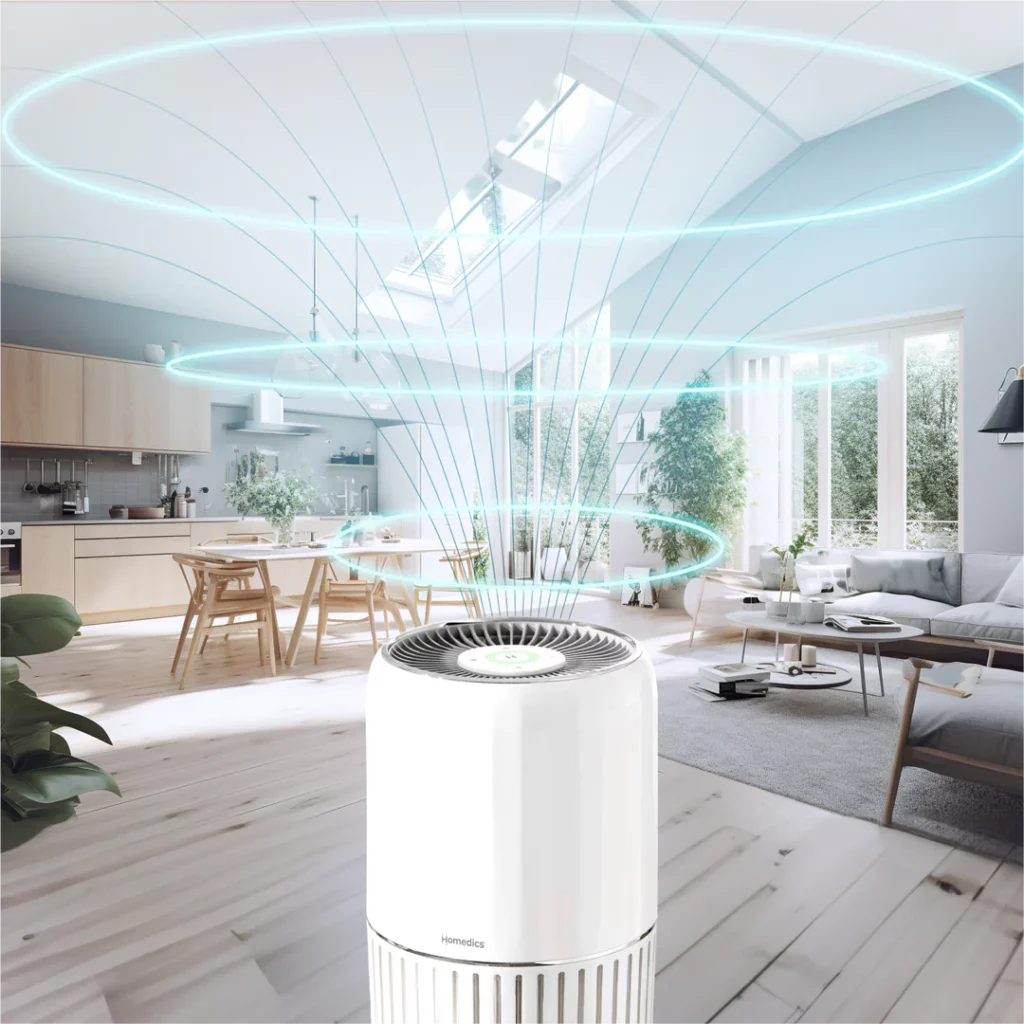
Air purifiers can reduce airborne particles and, with the right gas-focused media, help with some odors and gases. This guide explains how HEPA filtration, activated carbon, CADR, sensors, smart controls, energy use, and replacement filters work together—without treating an air purifier like a cure-all.
Reviewed and refreshed June 27, 2026. Product capabilities and smart-home compatibility can change, so verify current specifications before buying.
Quick Answer: What Does an Air Purifier Actually Do?
A portable air purifier pulls room air through one or more cleaning stages and returns filtered air to the same room. A particle filter can capture airborne dust, pollen, pet dander, smoke particles, and mold spores. A substantial activated-carbon or other gas-phase filter may help with certain odors and gases.
The best purifier is the one that delivers enough clean air for the room, targets the pollutant you care about, runs quietly enough to stay on, and uses replacement filters you can reliably obtain.
How a Modern Air Purifier Works
The basic job has not changed: move polluted room air through a cleaning system often enough to lower airborne contaminant levels. What has changed is the number of sensors, automation options, filter designs, and performance claims buyers must sort through.
Air enters the unit
A fan pulls room air through an intake. Blocked intakes, tight corners, and furniture can reduce airflow.
Particles are captured
A pre-filter catches larger debris while a higher-efficiency particle filter captures much smaller airborne particles.
Some gases are adsorbed
Activated carbon or specialized media can hold certain odor-causing molecules and gases until the media becomes saturated.
Cleaned air returns
The purifier repeats the cycle. Effective room cleaning depends on airflow, runtime, placement, room volume, and filter condition.
Air Purifier Technologies: What Each One Can and Cannot Do
No single technology handles every indoor air concern. Particle filtration and gas filtration perform different jobs, while electronic and light-based technologies require closer evaluation.
| Technology | Best suited for | Important limitation | What to verify |
|---|---|---|---|
| HEPA particle filter | Dust, pollen, pet dander, smoke particles, airborne mold spores, and other fine particles | Does not directly remove most gases or odors | True filter specification, CADR, seal quality, and replacement cost |
| Activated carbon | Certain odors, gases, and VOC-related concerns | Performance varies greatly with carbon amount, media design, pollutant, airflow, humidity, and saturation | Amount and type of media, replacement interval, and whether the claim names a specific gas |
| UV-C or UVGI | Supporting treatment for some microorganisms in properly designed systems | Effectiveness depends on dose and exposure time; it does not replace particle or gas filtration | Independent testing, lamp enclosure, maintenance, and ozone controls |
| Ionization or plasma | Charging particles as part of some electronic air-cleaning designs | May produce ozone or other byproducts; particles may settle on surfaces rather than being removed | CARB certification, independent ozone testing, and whether the feature can be disabled |
| Ozone generator | Not recommended for routine use in occupied homes | Ozone is a lung irritant and is generally ineffective for indoor pollution control at concentrations that meet public-health limits | Avoid products designed to intentionally release ozone |
HEPA Filtration: The Core Technology for Airborne Particles
HEPA stands for high-efficiency particulate air. Under the commonly cited U.S. definition, a HEPA filter can theoretically remove at least 99.97% of airborne particles measuring 0.3 microns as air passes through the filter.
That does not mean a small purifier will clean an entire large room, or that every product using the word “HEPA” performs equally. Real-world results depend on the purifier’s airflow, filter seal, fan speed, room size, placement, runtime, and filter condition.
HEPA can help capture
- Dust and fine household particles
- Seasonal pollen
- Airborne pet dander
- Smoke particles and PM2.5
- Airborne mold spores
HEPA does not solve by itself
- Most odors and gases
- Carbon monoxide
- Radon
- Moisture or active mold growth
- Pollution sources that remain in the home
Activated Carbon: Useful for Some Odors and Gases
Activated carbon works through adsorption: certain gas molecules adhere to the carbon’s large internal surface area. This is a different job from particle capture, which is why a purifier can perform well on dust yet disappoint on odors.
Carbon performance is difficult to compare because there is no widely used consumer rating equivalent to particle CADR for gas removal. A thin carbon-coated pad may provide limited odor support, while a deeper bed containing more adsorbent media may last longer or handle a heavier gas load.
Carbon also becomes saturated. Heavy cooking, smoke, solvents, fragrances, renovation work, and frequent odor exposure can shorten its useful life. Replacing a particle filter on schedule does not guarantee the carbon stage is still effective.
UV-C, Ionizers, Plasma, and Ozone: Read Beyond the Feature Name
UV-C can inactivate some microorganisms when the system delivers enough intensity for enough time. In a compact purifier, fast-moving air and a small lamp can limit exposure, so UV should normally be treated as a supporting feature rather than a substitute for adequate airflow and filtration.
Ionizers, electrostatic precipitators, bipolar ionization, and plasma systems use electrical processes. Some designs may improve particle collection, but the EPA warns that bipolar ionization is an emerging technology with less real-world evidence than established filtration and may generate ozone or other byproducts unless carefully designed and maintained.
CADR: The Number That Makes Room-Size Claims Easier to Compare
Clean Air Delivery Rate, or CADR, measures how quickly a purifier delivers filtered air for particle categories such as smoke, dust, and pollen. CADR combines airflow and particle-removal performance, making it more useful than a vague “covers up to” claim.
General particle sizing
AHAM’s practical rule is to choose a smoke CADR equal to at least two-thirds of the room’s square footage.
Example: A 300-square-foot room points to a smoke CADR of about 200 or higher.
Wildfire-smoke sizing
For wildfire smoke, AHAM recommends a smoke CADR approximately equal to the room’s square footage.
Example: A 300-square-foot room points toward a smoke CADR near 300.
Size up for ceilings higher than 8 feet, open floor plans, frequent door opening, heavy pollutant loads, or a quieter operating goal. A larger purifier running at a moderate speed can sometimes be more comfortable than an undersized unit operating at maximum speed.
Smart Air Purifiers: Which Connected Features Are Actually Useful?
Smart features do not make weak filtration strong. Their value is convenience: they can help a properly sized purifier respond sooner, run more consistently, and remind you when maintenance is due.
| Feature | Useful benefit | What to check |
|---|---|---|
| PM2.5 sensor | Shows changes in fine-particle levels and can support auto mode | Whether the display provides numbers or only broad color bands; sensor location and cleaning instructions |
| Auto mode | Adjusts fan speed when the onboard sensor detects a change | Response speed, minimum fan setting, and whether auto mode becomes too conservative |
| Filter reminder | Reduces the chance of running an overloaded filter indefinitely | Whether the estimate is based on elapsed time, runtime, resistance, or actual sensor data |
| App and schedules | Remote control, routines, air-quality history, and quieter overnight operation | App permissions, account requirements, cloud dependence, update history, and long-term support |
| Matter support | Can simplify setup and cross-platform control in supported smart-home ecosystems | Certified device status, controller compatibility, and which purifier controls are exposed to your platform |
Matter-certified air purifiers now exist, and the Connectivity Standards Alliance includes air purifiers and air-quality sensors in its certified-product ecosystem. Still, support is not uniform: a purifier may expose only basic controls on one platform while its manufacturer app provides more detailed sensor history or filter settings.
For a deeper look at connected controls, read the Smart Air Purifiers Guide to Automation, Sensors, and Home Integration.
How to Choose the Right Air Purifier: A Seven-Point Checklist
- Define the room. Measure floor area, note ceiling height, and decide whether doors usually stay open or closed.
- Name the main air problem. Particles, odors, gases, smoke, and moisture problems require different solutions.
- Match smoke CADR to the room. Use verified performance data instead of relying only on a maximum coverage claim.
- Check the filter stack. Choose particle filtration for airborne particles and meaningful gas-focused media when odors or gases matter.
- Review noise and energy use. Compare sound levels at the fan speed you are likely to use and consider ENERGY STAR-certified options.
- Calculate ownership cost. Include replacement filters, expected replacement frequency, electricity, and filter availability.
- Add smart features last. Sensors, auto mode, schedules, and Matter support should improve a capable purifier—not distract from weak basics.
The long-term cost often changes which purifier is the better value. See The True Cost of Owning a Smart Purifier before comparing purchase prices alone.
Choose by the Problem You Are Trying to Solve
Allergies and pollen
Prioritize verified particle performance, enough CADR, a well-sealed filter path, manageable noise, and consistent runtime.
Pets
Look for a cleanable pre-filter, strong particle filtration, easy maintenance, and more substantial carbon if odor matters.
Smoke
Choose high smoke CADR for particles and meaningful gas-phase media for odor support. Size more aggressively during wildfire events.
VOCs and chemical odors
Start with source control and ventilation when safe. Consider substantial gas-focused media, but do not expect one filter to remove every VOC.
Placement, Runtime, and Maintenance Decide Real-World Performance
Even a well-chosen purifier can underperform when it is pushed against furniture, placed far from the problem, run only occasionally, or fitted with an overdue filter.
Give it breathing room
Keep intakes and outlets clear. Follow the manufacturer’s minimum wall-clearance instructions rather than hiding the unit in a tight corner.
Run it consistently
Lower continuous operation often works better than short bursts. Increase fan speed during cooking, cleaning, smoke events, or particle spikes.
Maintain the whole system
Clean washable pre-filters, inspect sensor openings, replace filters as needed, and reset filter indicators only after maintenance.
What an Air Purifier Cannot Replace
Filtration is one layer of indoor-air management, not a substitute for correcting the source. A portable purifier does not replace a working smoke alarm or carbon-monoxide alarm, radon testing and mitigation, professional mold remediation, combustion-appliance repair, pest control, or safe ventilation practices.
If an indoor-air problem causes severe symptoms, involves a fuel-burning appliance, or may include carbon monoxide, leave the area when appropriate and seek qualified emergency or professional help. Do not rely on an air purifier to make an unsafe space safe.
To understand the broader picture, read Top 10 Air Pollutants in Your Home and How to Reduce Them.
How Best Smart Purifiers Evaluates Air-Cleaning Claims
BestSmartPurifiers.com uses a research-first approach. We compare manufacturer documentation with independent or official information when available, including CADR data, AHAM Verifide listings, ENERGY STAR product information, CARB certification, filter specifications, replacement availability, and current smart-home certification records.
Unless an article clearly states that a product was personally tested, coverage should be understood as research-based buying guidance rather than a laboratory test or hands-on review. Product specifications, apps, filters, certifications, prices, and platform support can change.
Frequently Asked Questions About Air Purifiers
Do air purifiers really work?
Yes. A properly sized purifier with appropriate filtration can reduce certain airborne pollutants in the room where it operates. Results depend on pollutant type, CADR, placement, fan speed, runtime, room conditions, and maintenance.
Is HEPA or activated carbon more important?
They perform different jobs. HEPA filtration is primarily for airborne particles. Activated carbon or other gas-phase media is used for certain odors and gases. Many households benefit from both, but the amount and design of each filter stage matter.
What CADR do I need?
For general particle filtration, AHAM recommends a smoke CADR equal to at least two-thirds of the room’s square footage. For wildfire smoke, use a smoke CADR approximately equal to the room’s square footage and size up for high ceilings or open layouts.
Can an air purifier remove VOCs?
Some gas-phase filters can reduce certain VOCs, but performance varies by pollutant, media type, amount of media, airflow, humidity, and saturation. HEPA alone is not designed for VOC removal, and source control or ventilation may be more important.
Should I avoid every purifier with an ionizer?
Not every electronic design has the same emissions, but caution is appropriate. Check current CARB certification, independent ozone information, and whether the feature can be turned off. Avoid products that intentionally generate ozone for occupied spaces.
Are Matter-compatible air purifiers worth it?
Matter can make setup and basic cross-platform control easier, but it does not improve filtration. Confirm that your preferred smart-home controller supports the purifier device type and the controls you expect before paying extra for compatibility.
How often should I replace the filter?
Follow the manufacturer’s guidance, then adjust for real conditions. Pets, smoke, renovation dust, frequent cooking, high pollen, and continuous operation can shorten filter life. Inspect filters when airflow drops, odors return, or the filter is visibly loaded.
The Bottom Line
Start with the room and the air problem—not the newest gadget. Choose enough CADR for particle concerns, meaningful gas-focused media when odors or gases matter, low-ozone operation, tolerable noise, reasonable energy use, and replacement filters you can continue to buy.
Smart sensors, app controls, auto mode, and Matter support can make a capable purifier easier to live with. They should never distract from airflow, filter design, verified performance, and maintenance.
Partner availability, prices, certifications, compatibility, and product specifications may change. Verify the model number, filter code, current manufacturer documentation, and retailer return policy before purchasing.