Air purifier reality check
The purifier is running. Its display is green. Yet the bedroom feels stale after a closed-door night, the home office feels heavy by midafternoon, or yesterday’s cooking odor still seems trapped indoors.
That does not automatically mean the purifier failed. It may be filtering some airborne particles while the room needs a different kind of air-quality action: source removal, outdoor exhaust, moisture control, or ventilation with cleaner outdoor air.
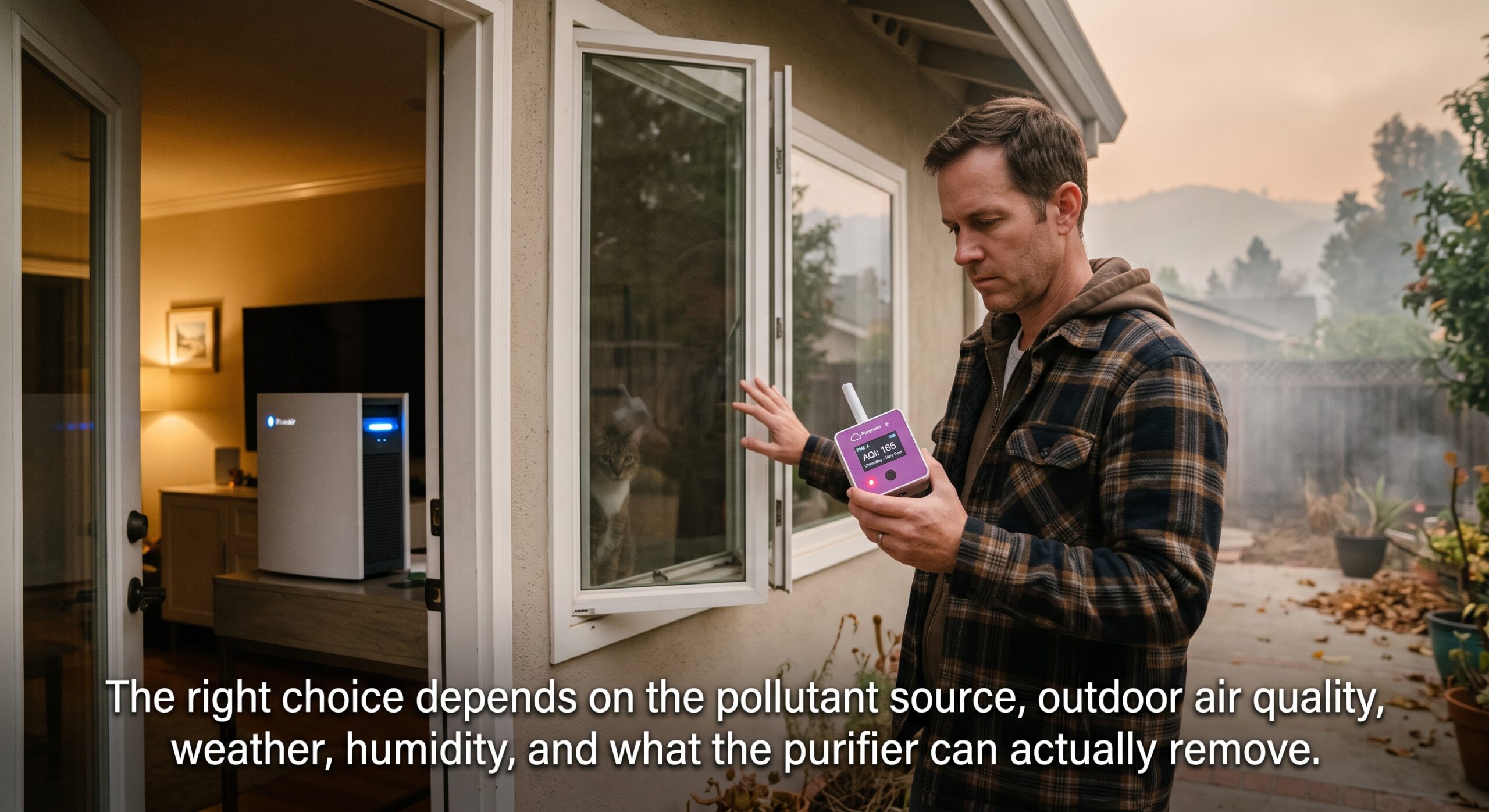
The practical decision is not “windows open” versus “windows closed” forever. It is whether the air outside is useful to bring in right now—and whether opening the room will introduce more smoke, pollen, humidity, heat, or other pollution than it removes.
Quick answer
Should You Open the Windows While an Air Purifier Is Running?
You can run an air purifier with a window open, but that is not always the right move. Open windows can bring in outdoor air and dilute some indoor-generated pollutants when outdoor air quality, pollen, weather, humidity, and safety conditions are acceptable. The purifier can continue filtering particles that reach it, but it is working on a constantly changing stream of air rather than a contained room.
Keep windows closed temporarily when wildfire smoke, high outdoor particle pollution, heavy pollen, blowing dust, extreme heat, excessive humidity, or another outdoor problem would make the indoor air worse. In that situation, reduce indoor sources, use recirculation where appropriate, and run a correctly sized particle-filtering purifier at a useful speed.
Filtration and Ventilation Do Different Jobs
A typical portable purifier pulls room air through one or more filters and returns that air to the same room. A particle filter can reduce dust, pollen, dander, and smoke particles that stay airborne long enough to reach the intake. Activated carbon or another gas-removal medium may reduce certain odors or gases, but performance depends on the pollutant, the amount of media, airflow, and saturation.
Ventilation brings outdoor air in and carries some indoor air out. When the incoming air is cleaner, this can dilute occupant-generated carbon dioxide, cooking emissions, odors, moisture, and gases that a particle filter does not address. The U.S. Environmental Protection Agency treats filtration as a supplement to source control and ventilation—not a replacement for them.
| Air problem | Portable purifier | Clean-air ventilation or exhaust | First question |
|---|---|---|---|
| Dust, pollen, dander, and fine particles | A properly sized particle filter can reduce the airborne share that reaches it. | Can dilute indoor particles, but an open window may also import outdoor particles. | Is the stronger source indoors or outdoors? |
| Cooking particles and odors | Particle filtration may help; meaningful carbon may reduce some odors. | An outdoor-venting range hood removes pollutants near the source; safe outdoor-air ventilation may help afterward. | Can the source be captured before it spreads? |
| Occupant-generated CO2 | Most room purifiers do not lower CO2 in a meaningful way. | Outdoor-air exchange addresses the ventilation-related buildup. | Is the occupied room receiving enough outdoor air? |
| Humidity and mustiness | Does not remove a meaningful amount of water vapor or repair a moisture source. | May help only when outdoor air is drier; bathroom exhaust and dehumidification may be more reliable. | Is the outdoor air actually drier, and where is the moisture coming from? |
| Wildfire smoke or high outdoor PM | A high smoke-CADR unit can reduce particles in a defined room. | Opening windows can rapidly bring the outdoor problem inside. | What does the current outdoor AQI and local guidance say? |
| Carbon monoxide, gas leak, radon, or immediate hazard | Not a safety control or emergency solution. | Do not improvise a window routine in place of alarms, evacuation, testing, repairs, or emergency guidance. | Do you need to leave and contact emergency or qualified help? |
Why a Filtered Room Can Still Feel Stale
The purifier recirculates air
Most portable units do not pull outdoor air into the home. They repeatedly treat the air that reaches their intake, so they can improve particle levels without increasing the room’s outdoor-air exchange.
People change a closed room
Occupants add carbon dioxide, heat, moisture, and odors. An indoor CO2 monitor may help reveal ventilation patterns, but EPA says those readings need careful interpretation rather than a single universal pass-or-fail number.
The odor may not be a particle
A HEPA-style filter targets particles. Cooking gases, fragrances, cleaning-product vapors, damp materials, and other odor sources require source control, exhaust, suitable gas-removal media, or ventilation when outdoor conditions permit.
The room boundary may be larger than it looks
An open bedroom door, hall, stairway, or connected bath expands the air volume the purifier is trying to serve. Review how bedroom door position changes the purifier’s real job before judging one room by the purifier’s display.
This distinction also explains why a purifier can run all day without solving every comfort complaint. The site’s 24/7 air-purifier plan helps choose a useful runtime and fan speed; this guide adds the missing ventilation decision.
The 60-Second Window Decision
Use these five checks before opening the window by habit or sealing the room by habit. The answer can change between morning and afternoon, from one season to another, and during a smoke event.
- Name the problem you are trying to solve. Is it airborne particles, stuffiness in an occupied room, a cooking event, a strong product odor, moisture, heat, smoke, pollen, or an immediate safety concern? A particle purifier should not be assigned a gas, moisture, or emergency job.
- Check the outdoor air before inviting it in. Review the current AirNow AQI, local smoke information, pollen conditions, wind, and nearby sources such as traffic, mowing, construction, or wood burning. Outdoor air can be the solution or the source.
- Check temperature, humidity, and weather. EPA advises against increasing home ventilation when outdoor pollution is high or when it would make the home too hot, cold, or humid. Security, rain, child safety, and equipment instructions also matter.
- Choose the narrowest effective action. Use an outdoor-venting range hood for cooking, a bathroom exhaust fan for shower moisture, source removal for a chemical or odor problem, a dehumidifier for persistent dampness, or room ventilation when clean outdoor air is the missing tool.
- Keep filtration in its proper role. Continue running a correctly sized purifier at a useful speed when airborne particles remain a concern. Close the window again if outdoor conditions worsen, the room becomes uncomfortable, or incoming particles rise.
Open or Closed? Start With the Scenario
| Situation | Window starting point | Purifier starting point | What to verify |
|---|---|---|---|
| Closed bedroom feels stale after sleep; outdoor air is clean and comfortable | Briefly ventilate safely; cross-flow may move air faster when the layout permits. | Keep a steady particle-filtration baseline. | Outdoor AQI, pollen, weather, room occupancy, door position, and CO2 trend if monitored. |
| Wildfire smoke or high outdoor PM2.5 | Keep closed as much as practical and follow local smoke and heat guidance. | Use a defined cleaner-air room and a high smoke-CADR purifier at a useful speed. | Outdoor AQI, indoor temperature, filter loading, smoke entry points, and evacuation information. |
| High-pollen day | Usually closed during the problematic period. | Run consistent particle filtration in the occupied room. | Local pollen conditions, pets and clothing carrying pollen indoors, filter fit, and cleaning routine. |
| Frying, searing, or burned food | Open only if outdoor conditions are suitable and it supports safe ventilation. | Increase particle filtration, but do not rely on it instead of source capture. | Outdoor-venting range hood, appliance safety, carbon media, nearby alarms, and outdoor AQI. |
| Cleaning product, paint, adhesive, or hobby fumes | Follow the product label and ventilate appropriately when outdoor air is suitable. | Do not assume a thin carbon sheet controls an unknown gas exposure. | Label precautions, source removal, exposure guidance, and whether qualified help is needed. |
| Musty basement or humid room | Open only when outdoor air is drier and conditions support drying. | Use filtration as a support layer, not moisture control. | Leaks, drainage, condensation, indoor and outdoor humidity, and dehumidifier need. |
There is no universal “open the window for exactly 15 minutes” rule. Wind, window size, cross-ventilation, indoor–outdoor temperature difference, room volume, mechanical exhaust, occupancy, and the strength of the pollutant source all change the air-exchange rate. Use a repeatable observation plan rather than a stopwatch promise.
Try a Controlled Window-and-Purifier Test
A controlled test can show whether the room benefits from clean outdoor air without changing every variable at once. This is an observation routine—not a certification of indoor-air safety.
- Record the starting conditions. Note the room dimensions, occupants, door position, purifier model, filter code, fan speed, outdoor AQI, pollen conditions, indoor temperature and humidity, and any available particle or CO2 trend.
- Remove or exhaust the obvious source. Stop the smoky cooking task, cap the product, take out the trash, run the appropriate outdoor-venting exhaust, or correct the moisture source before asking airflow to do all the work.
- Ventilate only when the incoming air is suitable. Use a safe window or door opening and cross-flow when practical. Do not aim a strong fan so that it creates a fall hazard, blows pollution toward another occupied area, or conflicts with combustion-appliance guidance.
- Keep the purifier’s setup steady. Leave the unit in the same location with the intake and outlet clear. A window next to the purifier may cause its sensor to sample the incoming stream rather than the occupied zone.
- Compare the same indicators. Look for changes in stuffiness, odor, temperature, humidity, particle readings, and CO2 trend where available. A better smell does not prove every pollutant is safe, and a low particle reading does not prove ventilation is adequate.
- Close, continue, or stop based on the full result. Close the opening when outdoor conditions worsen or comfort declines. Continue filtered recirculation for particle control. Stop and seek qualified help when the pattern points to a building, moisture, HVAC, combustion, or hazardous-material problem.
Put the Ventilation Decision Into the Fit & Filter Planner
The free 15-page Smart Air Purifier Fit & Filter Planner already helps you record the room, CADR target, filter stages, exact replacement-filter code, first-year cost, and maintenance plan. Add one small ventilation box beside the room worksheet:
- Main indoor source or complaint
- Normal number of occupants and occupied hours
- Usual door and window positions
- Outdoor AQI and pollen check used
- Temperature and humidity limits
- Available range hood, bathroom fan, or mechanical ventilation
- Purifier baseline and event fan speeds
- What improved—and what stayed the same
Build a Room Plan, Not a One-Setting Habit
Use the planner to match the purifier to the real room, then add the outdoor-air decision that a CADR number cannot make for you.
Open the Free Fit & Filter PlannerWhen the Filter or Whole-Home System Needs Attention
Opening a window is not the fix for a purifier with weak airflow, a blocked intake, or the wrong replacement filter. Confirm the full purifier model, manufacturer filter code, filter orientation, packaging removal, seal, fan speed, and maintenance instructions. If the room still accumulates visible dust, use the site’s airborne-versus-settled dust guide before buying a second unit.
Need a verified replacement filter?
Record the exact purifier model and filter code first. Then confirm compatibility, filter stages, package quantity, seller details, and return terms.
Considering whole-home air support?
Central filtration or ventilation affects the blower, ducts, filter resistance, humidity, outdoor-air controls, and installation. Review options, then involve a qualified HVAC professional.
Affiliate note: Partner status, product specifications, availability, filter compatibility, and pricing can change. Verify the current model documentation and seller terms before ordering.
Four-question interactive knowledge check
Can You Choose Between Filtration and Ventilation?
Select one answer for each question, then check your score.
Reader Check-In: What Makes Your Room Feel Stale?
Is the pattern strongest after sleep, during a crowded workday, after cooking, when the windows stay closed for smoke, or when the house becomes humid? Share the room dimensions, normal occupancy, purifier model, filter code, fan speed, door and window position, outdoor-air conditions, and what changed when you tested one variable.
Please avoid posting personal or medical information. A careful real-room observation may help another reader recognize whether the missing step is filtration, source control, exhaust, moisture correction, or clean-air ventilation.
Frequently Asked Questions
Does an air purifier work with the windows open?
Yes, it can continue filtering air that reaches the intake, but the room is no longer a contained space. If outdoor air is clean, opening a window may supply useful ventilation. If smoke, pollen, dust, or pollution is high outside, the opening can add particles faster and increase the purifier’s workload.
Should I close the window to make the purifier clean faster?
Closing the window can make particle filtration more predictable by limiting new outdoor particles and defining the room boundary. That does not solve indoor-generated gases, occupant-related CO2, moisture, or a strong pollutant source. Match the room boundary to the pollutant and current outdoor conditions.
Can an air purifier lower carbon dioxide in a bedroom?
Most residential portable air purifiers do not reduce occupant-generated CO2 in a meaningful way because they recirculate indoor air rather than replacing it with outdoor air. Ventilation addresses the air-exchange issue. Indoor CO2 readings can provide information about ventilation patterns, but EPA advises that they be interpreted carefully.
Why does the room smell stale when the purifier says the air is good?
The sensor may focus on particles and may sample air close to the purifier. It may not measure the odor-causing gas, humidity, CO2, damp material, trash, cooking residue, or another source. A green display describes a supported reading near the sensor; it is not a complete indoor-air assessment.
Should I open windows after cooking?
Use source capture first: an outdoor-venting range hood when available, appropriate appliance use, and prompt cleanup. Opening windows may help when outdoor air is suitable and the setup is safe, but it can be counterproductive during smoke, high pollution, heavy pollen, or extreme weather. The purifier can support particle removal but does not replace source control.
How long should I leave a window open?
There is no universal time. The result depends on wind, opening size, cross-flow, room volume, temperature difference, occupancy, exhaust fans, and pollutant strength. Record comparable before-and-after conditions and stop when outdoor air becomes unsuitable or the room becomes too hot, cold, or humid.
Can a purifier replace a bathroom or kitchen exhaust fan?
No. A purifier may reduce some particles or odors that reach it, but source exhaust removes moisture and pollutants closer to where they are generated. Use exhaust equipment according to its instructions and keep the purifier as a supplemental layer.
Authoritative Guidance Used for This Article
- U.S. EPA: Guide to Air Cleaners in the Home
- U.S. EPA: Increasing Ventilation at Home
- U.S. EPA: Using Indoor CO2 Information Carefully
- U.S. EPA: Sources of Indoor Particulate Matter
- AirNow: Current Outdoor Air Quality
- U.S. Department of Energy: Natural Ventilation and Cooling
Final takeaway
Do Not Ask the Purifier to Manufacture Fresh Air
A purifier can be doing useful particle work while the room still needs source removal, exhaust, humidity control, or outdoor-air exchange. Start with the pollutant. Check the outdoor air. Choose the narrowest effective action. Then let the purifier handle the part of the job it was designed to do.
If clean outdoor air is available, safe ventilation and filtration can work together. If smoke, pollen, or pollution is outside, close the opening, define a cleaner-air room, and filter deliberately. The smarter plan changes with the air—not with a permanent “open” or “closed” rule.
Build My Room Plan · Review the 24/7 Airflow Plan · Break the Dust Loop