City air & room-first filtration · Updated November 2, 2026
The traffic outside has eased. Your purifier’s light is green. But when you sit beside the window, you can still catch a trace of exhaust.
That does not necessarily mean the purifier is broken. It may be reducing particles while doing much less about gases—or reporting only the pollution its sensor can detect.
An air purifier for traffic pollution can be a useful part of a roadside home. The important question is what it is actually equipped to remove, at the speed you can live with.
Yes. A correctly sized particle-filtering purifier can reduce airborne traffic-related particles indoors. Suitable gas-filter media may reduce some gases and odors, but a HEPA filter alone does not remove gases. No household purifier removes every traffic pollutant or guarantees safe indoor air.
Start with particle-cleaning capacity, then evaluate gas-removal evidence separately. Combine filtration with sensible window habits, indoor source control, and appropriate ventilation.
Research-based guidance; no roadside-home testing is claimed. This article includes a FiltersFast affiliate link. Purchases through it may earn us a commission at no added cost to you.
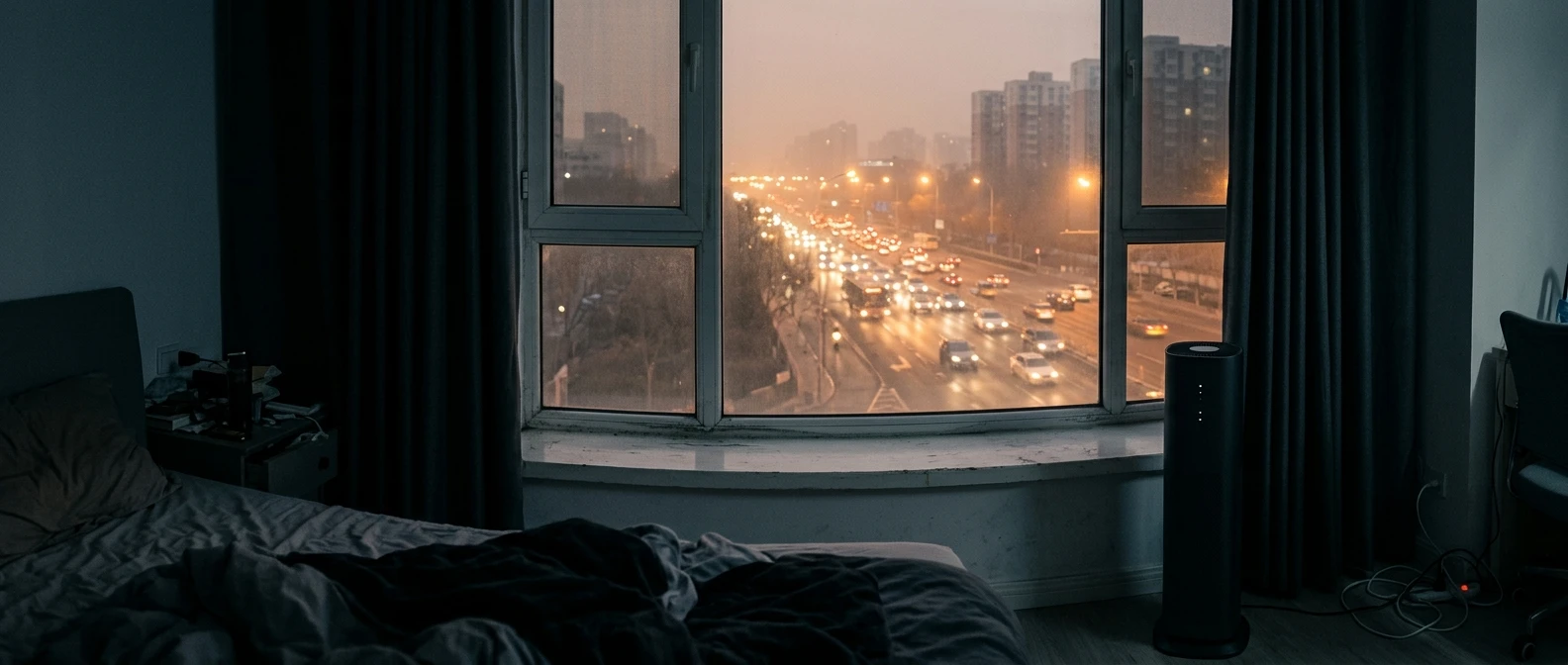
Traffic pollution is a mixture, not one thing called “fumes”
Roadway pollution includes particles from exhaust, brake and tire wear, and resuspended road dust. Gases can include nitrogen oxides, carbon monoxide, and compounds such as benzene. Traffic emissions also contribute to ozone formation through atmospheric reactions. Ozone is a gas, not a particle that HEPA captures.
The EPA’s transportation pollution guidance explains these differences. Nearby traffic and regional smog can overlap, but they are not interchangeable problems.
| Concern | What may help | Important limit |
|---|---|---|
| Airborne soot and other particles | Effective particle filtration with enough clean-air delivery. | It only filters air that reaches the unit; settled grime still needs cleaning. |
| Some exhaust odors and VOCs | Suitable activated carbon or other sorbent media. | Performance varies by compound, media, conditions, and remaining capacity. |
| Nitrogen dioxide and ozone | Reduce entry when outdoor pollution is elevated; evaluate pollutant-specific gas-control evidence. | HEPA does not remove these gases. Generic “carbon included” language is insufficient. |
| Carbon monoxide | Prevent combustion exposure and maintain appropriate CO alarms. | A household purifier is not a CO safety device. |
You do not need to dismiss a good particle purifier because it cannot solve every gas problem. Particle reduction is useful on its own. Just do not turn that benefit into a promise of complete exhaust removal.
Read the carbon claim before paying for it
“Activated carbon” can describe a light coating, a sheet, or a substantial bed of media. Those designs do not have equal capacity. However, picking the heaviest filter is not a complete gas-removal test.
California Air Resources Board guidance on odors and gases recommends checking whether a device can remove the chemicals of concern and explains the limitations of thin carbon filters.
- Ask which pollutants were tested. A deodorizing claim is not evidence of nitrogen dioxide or ozone removal.
- Look for media details. Type and quantity are useful information, but neither guarantees performance alone.
- Check the test conditions and duration. A short laboratory result does not establish months of performance in your apartment.
- Find the replacement cartridge first. Check its price, availability, and maintenance instructions.
If the manufacturer cannot provide relevant evidence, treat gas removal as uncertain. More carbon may offer more capacity for suitable compounds, but there is no universal carbon weight that makes a roadside room safe.
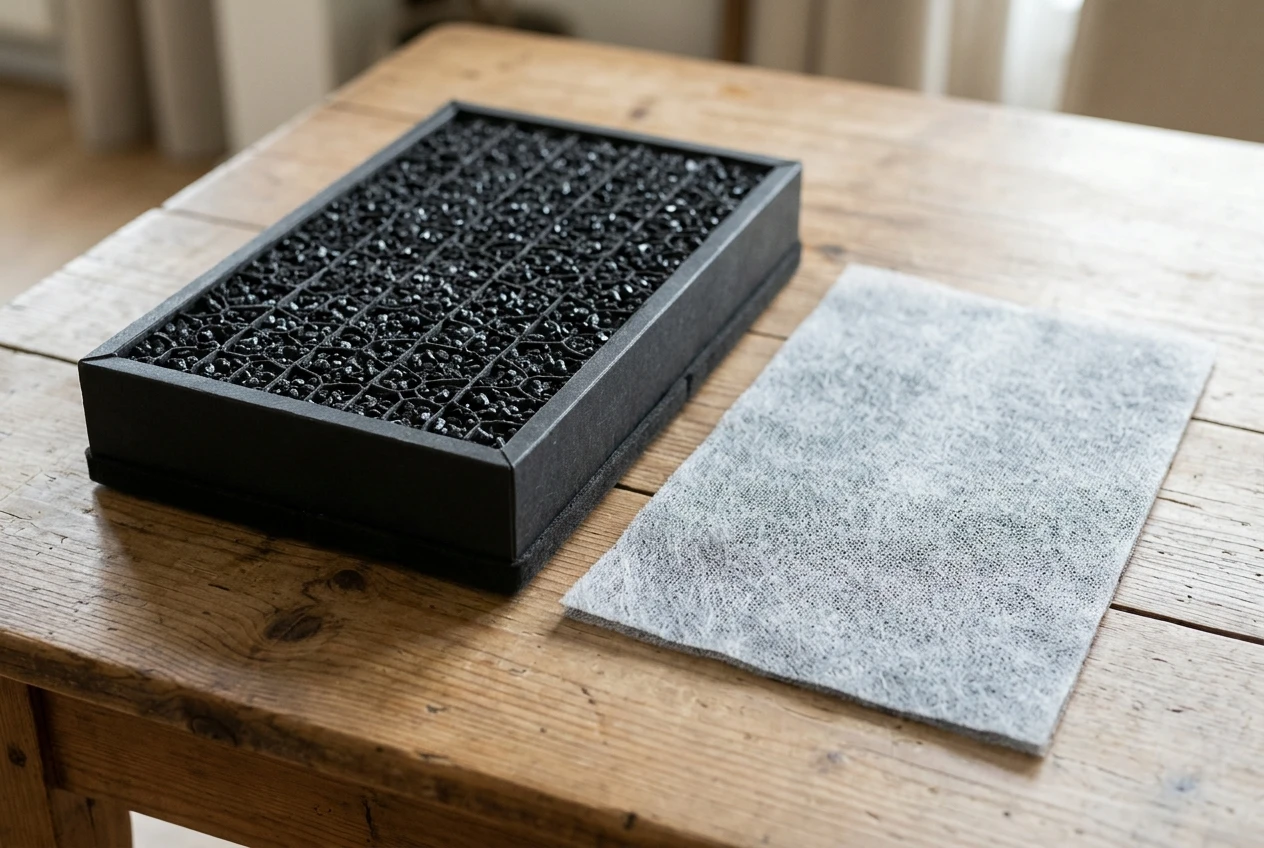
For the basic technology comparison, see our guide to HEPA, activated carbon, and other purifier technologies .
Size for the room and the speed you will actually use
The EPA’s home air-cleaner guide explains that CADR describes particle-cleaning performance. A large smoke CADR is not a rating for removing exhaust gases.
Measure the occupied space, including ceiling height. Then compare particle CADR, noise, and operating speeds. Do not substitute a fan’s raw airflow figure for CADR: airflow alone does not account for filtration efficiency.
Equivalent particle air changes per hour = CADR in cfm × 60 ÷ room volume in cubic feet.
For a 12 × 10 × 8-foot bedroom, the volume is 960 cubic feet. A CADR of 200 cfm gives 12.5 equivalent particle air changes per hour. If the actual CADR at your chosen quieter setting were 80 cfm, the figure would be 5.
These are illustrative calculations, not required targets. They estimate particle-cleaning contribution under simplified mixing conditions—not fresh-air ventilation, gas removal, or a safe-exposure threshold.
A larger unit may give you more options for balancing noise and cleaning, but verify performance at lower settings when data are available. Do not assume every larger machine is quieter at equivalent output.
Closed windows help sometimes. A permanently sealed room is not the goal.
Use AirNow and local air-quality advisories to understand outdoor conditions. Look at the pollutant behind the AQI, not only the color. A regional reading is useful context; it does not measure the air entering your particular street-facing window.
Fewer cars outside does not automatically mean cleaner air. Ozone often peaks in the afternoon or early evening, although the pattern varies by location. The EPA’s ozone and AQI guidance explains why time of day matters.
Repair unwanted window and door leaks where appropriate, but do not block required ventilation or combustion-air openings. In a rental, ask the landlord about damaged seals and building ventilation.
Keep heat and indoor pollution in the decision. A purifier does not remove occupant-generated carbon dioxide or replace necessary ventilation. If closing windows makes the home dangerously hot, use a safer cooled location rather than trying to solve the problem with a purifier.
Cooking may also be part of the indoor mixture. Use an externally vented range hood when available and follow appliance guidance. EPA’s indoor nitrogen dioxide guidance emphasizes controlling combustion sources; traffic is not the only possible source of NO₂ indoors.
Choose one priority room before promising whole-home coverage
Street-facing bedroom
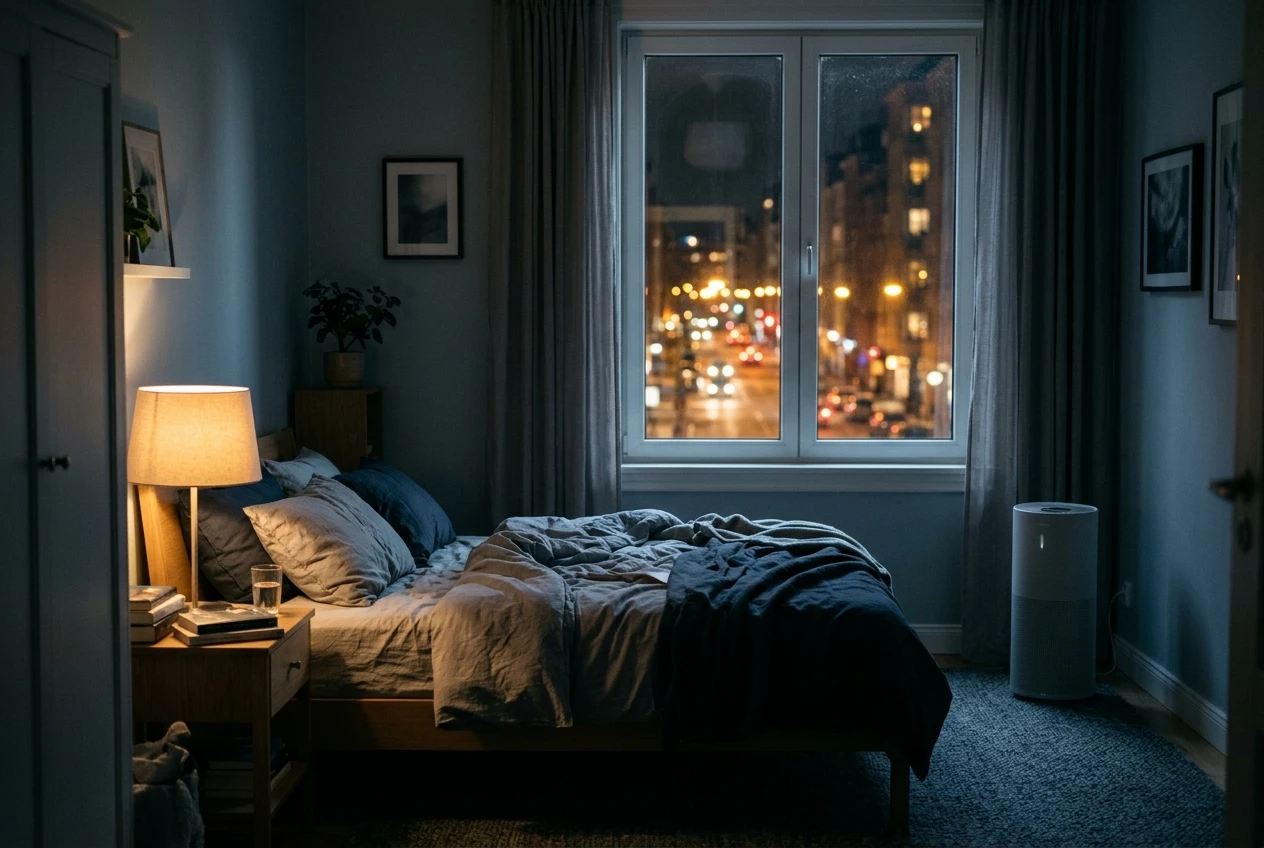
Prioritize enough cleaning at a tolerable nighttime speed. Keep curtains clear of the intake and follow the manufacturer’s clearance instructions. A purifier beside a window is not an invisible barrier that catches all incoming pollution.
Studio or small apartment
Account for the connected space the purifier actually serves. A separate bedroom behind a closed door will not necessarily benefit from a unit in the living room. Floor area alone cannot show how air travels between rooms.
Open-plan living area
A suitably sized unit or several distributed units may help. Adding their particle CADRs gives only a rough combined capacity estimate for shared, well-mixed air; it does not prove even coverage around corners or through doorways.
A green light answers a smaller question than you think
A PM2.5 sensor reports an estimate of certain airborne particles near the sensor. It does not measure all traffic gases or establish that ultrafine-particle exposure is controlled. A low reading can coexist with gases the device cannot detect.
EPA’s guidance on low-cost indoor monitors explains why sensor capabilities and limitations matter. Use readings to look for patterns, not as a complete safety verdict.
Likewise, odor is a clue to investigate—not a meter. Less exhaust smell does not prove that every relevant pollutant has been removed. A consumer VOC display is not a substitute for a carbon-monoxide alarm.
Avoid air cleaners that intentionally generate ozone. Adding an irritating gas indoors is not a solution to outdoor smog; see EPA’s explanation of ozone generators .
Track maintenance instead of assuming every city filter wears out early
Traffic exposure can add to the filter’s workload, but your address alone cannot predict replacement frequency. Building leakage, outdoor levels, indoor activities, running hours, and the filter design all matter.
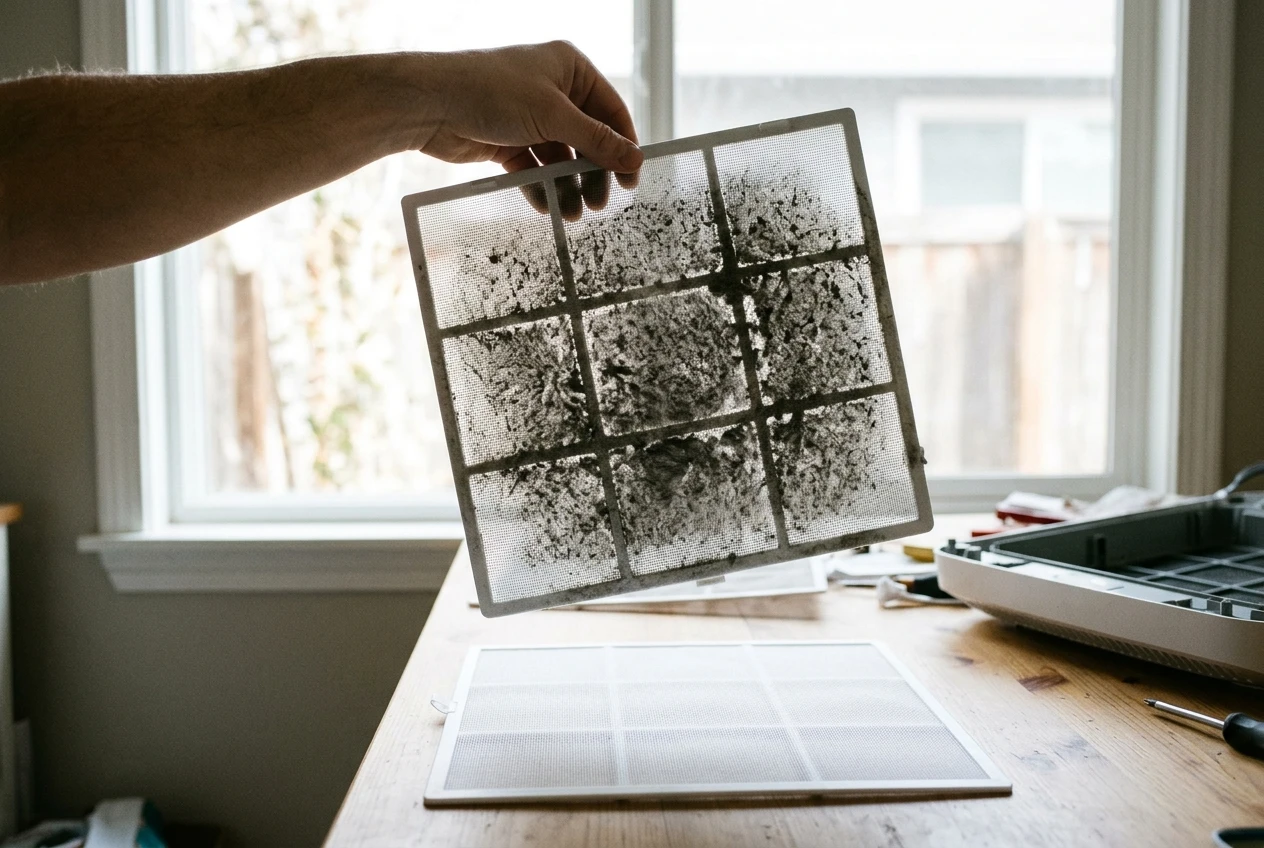
- Follow the manual. Inspect and replace as directed; wash only parts explicitly identified as washable.
- Record installation dates. Keep particle-filter and separate carbon-filter records if their schedules differ.
- Investigate changes. Weak airflow, unusual noise, or recurring odor can have several causes; they do not automatically prove a spent filter.
- Do not rely only on the reminder light. A timer-based alert does not directly measure carbon capacity.
Budget using the manufacturer’s replacement guidance first, then adjust using your actual maintenance history. Price the exact replacement model, including shipping, before choosing a machine.
Build a roadside-room plan with the S.M.A.R.T. Method
Size the occupied space. Match particle filtration and gas claims separately. Automate for convenience without treating the sensor as a safety monitor. Replace filters as directed. Test & Track conditions and maintenance within your tools’ limits.
Use the free Smart Air Purifier Fit & Filter Planner to organize room dimensions, filter compatibility, costs, and your maintenance plan.
The planner is available by email. It is a buying and maintenance workbook, not an indoor exposure assessment.
Once you have the exact model and filter code, you can compare replacement filters at FiltersFast (affiliate link). Confirm compatibility and current pricing; a generic carbon replacement does not establish traffic-gas protection.
Quick knowledge check: what is your purifier actually doing?
Choose an answer, then open the explanation.
1. Your purifier shows low PM2.5. What does that establish?
A. All exhaust gases are gone
B. A particle reading within the sensor’s capabilities
C. The carbon filter is fresh
Reveal answer
B. It is a particle reading, not a measurement of all traffic pollution.
2. Which specification establishes nitrogen dioxide removal?
A. A high smoke CADR
B. The word HEPA
C. Relevant gas-specific performance evidence
Reveal answer
C. CADR and HEPA describe particle filtration, not nitrogen dioxide removal.
3. When is the best time to open a roadside window?
A. Always at midday
B. Whenever traffic sounds quieter
C. When outdoor conditions and your ventilation needs support it
Reveal answer
C. Consider local conditions and advisories. Traffic noise alone does not describe outdoor air quality.
4. Does living near traffic mean every filter must be replaced early?
A. Yes, on a fixed city schedule
B. No; follow instructions and track actual conditions
C. Only when the filter turns black
Reveal answer
B. Maintenance needs vary. Neither the address nor filter color provides a universal replacement schedule.
Frequently asked questions
Is a HEPA purifier still useful without a large carbon filter?
Yes, for reducing airborne particles that reach it. It does not remove gases, but that does not make its particle-cleaning role worthless.
Can an air purifier remove nitrogen dioxide from traffic?
HEPA alone cannot. Some gas-treatment media may reduce nitrogen dioxide, but check evidence for the exact product and conditions. Do not assume a standard carbon sheet provides adequate removal.
Should I keep my windows closed all day?
Not automatically. Reduce polluted outdoor-air entry when appropriate while maintaining safe temperatures and necessary ventilation. Reassess as outdoor conditions change.
Will one purifier clean my whole apartment?
Not reliably in every layout. Walls, doors, airflow, and capacity determine which spaces receive useful cleaning. Start with a priority room.
Does less exhaust smell mean the room is safe?
No. Smell cannot identify or measure all relevant pollutants. A purifier is one exposure-reduction tool, not a safety guarantee.
Start with the room where cleaner air matters most
You cannot move a busy road, but you can make a better indoor plan: choose a priority room, check outdoor conditions, reduce avoidable entry, and match filtration to what it can actually do.
Does your main window face moving traffic, an intersection, or a place where vehicles idle? Share your room size and biggest concern—odor, particles, or purifier noise—in the comments. Avoid posting your exact address.