If your air purifier seems to do very little, the unit may not be the problem. Plenty of owners plug it in wherever the outlet is, usually behind a couch or in a corner, and then wonder why the room feels the same. A purifier cleans the air it can pull in, and where it sits decides how much of the room’s air that is.
This guide assumes you already own a unit and want better results without spending anything. You will need your manual (or its PDF), your phone, and about ten minutes of rearranging.
Start with your room: where the air moves and where you spend your time
Before you pick a spot, look at your room as a purifier would. Air travels from open windows, doors and vents toward wherever it can go, and the purifier works best when it sits in that traffic and close to where you breathe most.
Do a quick walk-through and note three things:
- Where you spend time. The bed, the spot on the couch, the desk chair.
- Where air comes in. Windows you open, the door to the hallway, the heating or cooling vent.
- What blocks airflow. Big furniture, floor-length curtains, closed-off alcoves.
The best position is usually somewhere between your seating or sleeping area and the main source of the problem. That might be the door that opens onto a dusty hallway, or the side of the room where the pet bed sits. A unit in a far corner behind furniture does clean air, but mostly the air in that corner.
The clearance rule: give the intake and outlet room
Every purifier pulls air in through one side and pushes it out another. Some towers draw from all around the base and blow out the top. Others take air in at the back or sides and send it out the front or top. If either opening faces a wall, couch or curtain, the unit recirculates the same small pocket of air and works harder for less benefit.
Your manual lists a minimum distance from walls and furniture, so use that number. If you cannot find it, a gap of about a foot on every intake and outlet side is a reasonable starting point. Check the layout of your own unit first:
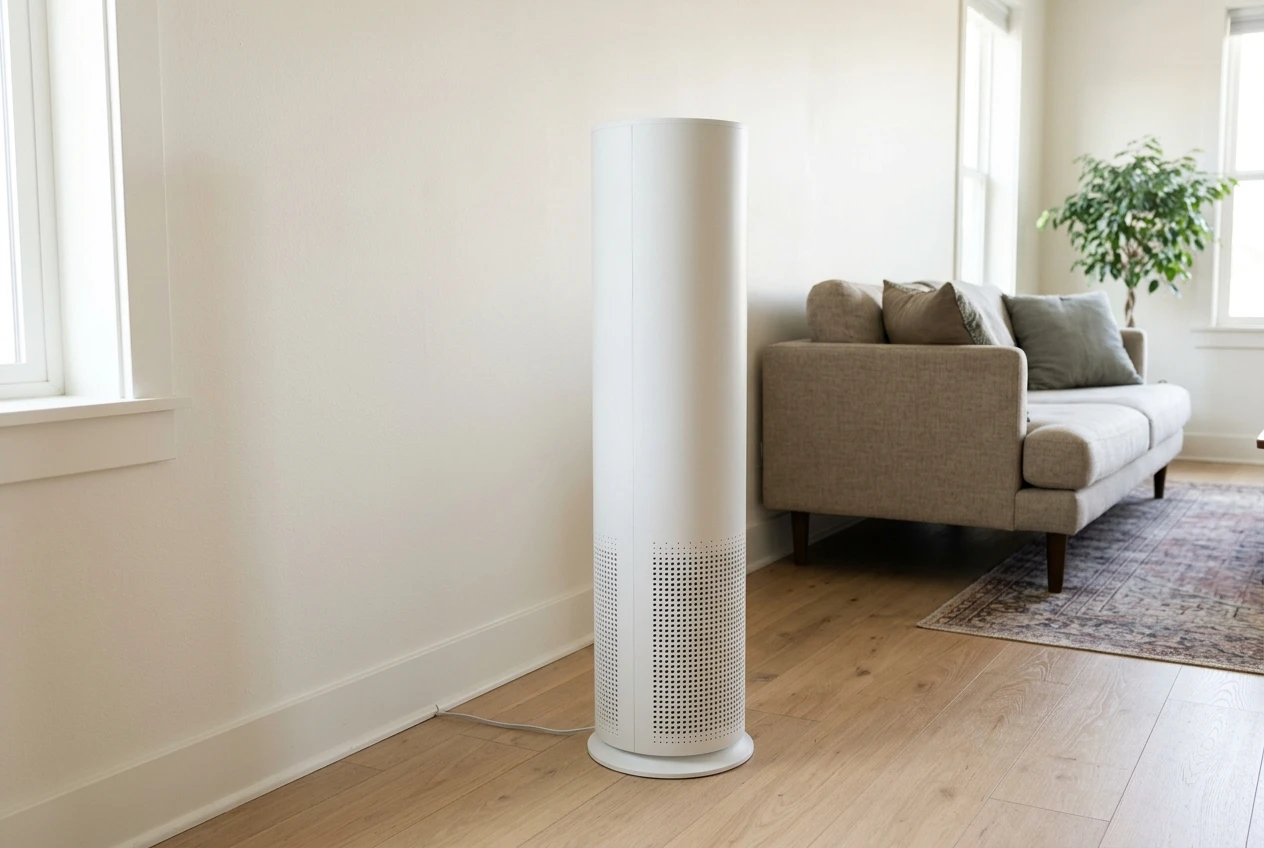
- Find the intake (usually a grille with the filter behind it).
- Find the outlet (usually a vent with louvers, or a mesh top).
- Make sure neither faces a wall, and that nothing sits within the gap in front of them.
A purifier pushed flat against the wall is the most common mistake. It also hides the problem, because the unit still runs, the fan still spins and the lights still glow. Only the airflow suffers.
Floor, table or shelf: does height matter?
For most households the answer is “less than you would think.” Fine particles such as smoke, dust and pollen stay suspended and get carried around the room by normal air movement, so a floor unit will still reach them. Heavier particles, like pet hair and larger dust, settle toward the floor, which is one reason floor placement works well for many tower models.
What matters more is where the outlet points and what stands in its way. Use these checks:
- Top outlet, tower style. The floor is fine. Keep the top clear of shelves, curtains and hanging items.
- Front outlet. Make sure the air can travel across the room rather than hit a couch or table a few feet away.
- Small tabletop models. These are built for a desk or nightstand. Putting one on the floor can leave it blowing at the underside of furniture.
- Units with the sensor on top or in the side. Keep that sensor area clear and open, which matters again in the sections below.
Check the manual’s diagram for the intended orientation. If the unit was designed for the floor, a shelf will not improve it, and a shelf can add vibration noise.
Bedroom placement: close enough to help, far enough not to blow on you
In a bedroom, you want the unit near where you breathe during sleep but not pointed at you. A steady stream of air across your face can dry your eyes and throat and may keep you awake.
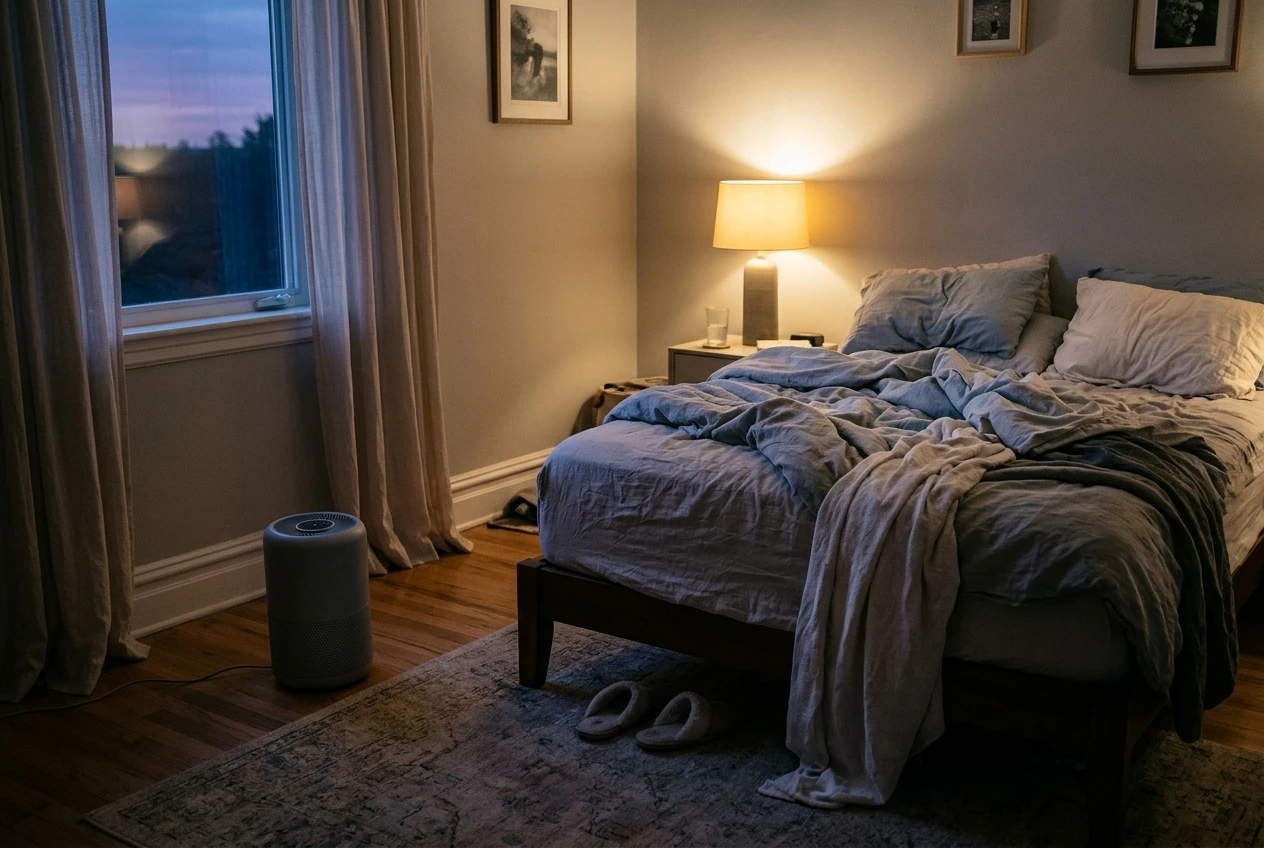
Good bedroom habits:
- Place it a few feet from the bed, ideally at the foot or on the side away from your pillow, with the outlet aimed across the room or upward.
- Leave the clearance gap even if the corner looks tidy. A unit tucked beside a dresser is often too close to the dresser.
- Keep it away from the headboard wall. Sound travels well through a bed frame, and fan noise is louder when the unit is near your head.
- Run it on a low or sleep setting at night once the room has had time to clean up before bedtime.
If noise is the reason you switch the unit off at night, placement helps but the unit itself matters too. Our guide to choosing a quiet air purifier for the bedroom covers what to look for. For the unit you already own, moving it a little farther from the bed and running it on a lower speed all night often works better than running it fast for an hour.
Living rooms and open plans: work with doorways, couches and the traffic path
Living rooms have bigger, more irregular airflow, and the main trouble is furniture. Couches, bookcases and TV stands create dead zones, and a purifier parked behind any of them cleans mostly its own corner.
Try these placements:
- Along the main traffic path, such as the line between the front door and the seating area. Particles carried in on clothing and air currents pass through the unit’s reach.
- At the edge of the seating area, with a clear gap in front of the intake and outlet, rather than behind the couch.
- Away from the TV and electronics area, where the narrow gaps of a media console limit airflow.
Open plans need a different approach. A single unit cannot clean a space that has no walls, and air flows freely between the kitchen, dining and living areas. Put the purifier where your longest sitting time is, and keep an eye on the airflow rating rather than the floor area printed on the box. Our piece on sizing a purifier for large living rooms by airflow explains why that rating matters more.
When a room has two zones, say a couch and a dining table, put the unit at the border between them and check your results in both spots, as described in the one-week test below.
Spots that make a purifier look broken
Some placements do not just waste airflow. They distort the unit’s readings, so the display suggests the purifier is failing when it is simply reading something nearby. Avoid these:
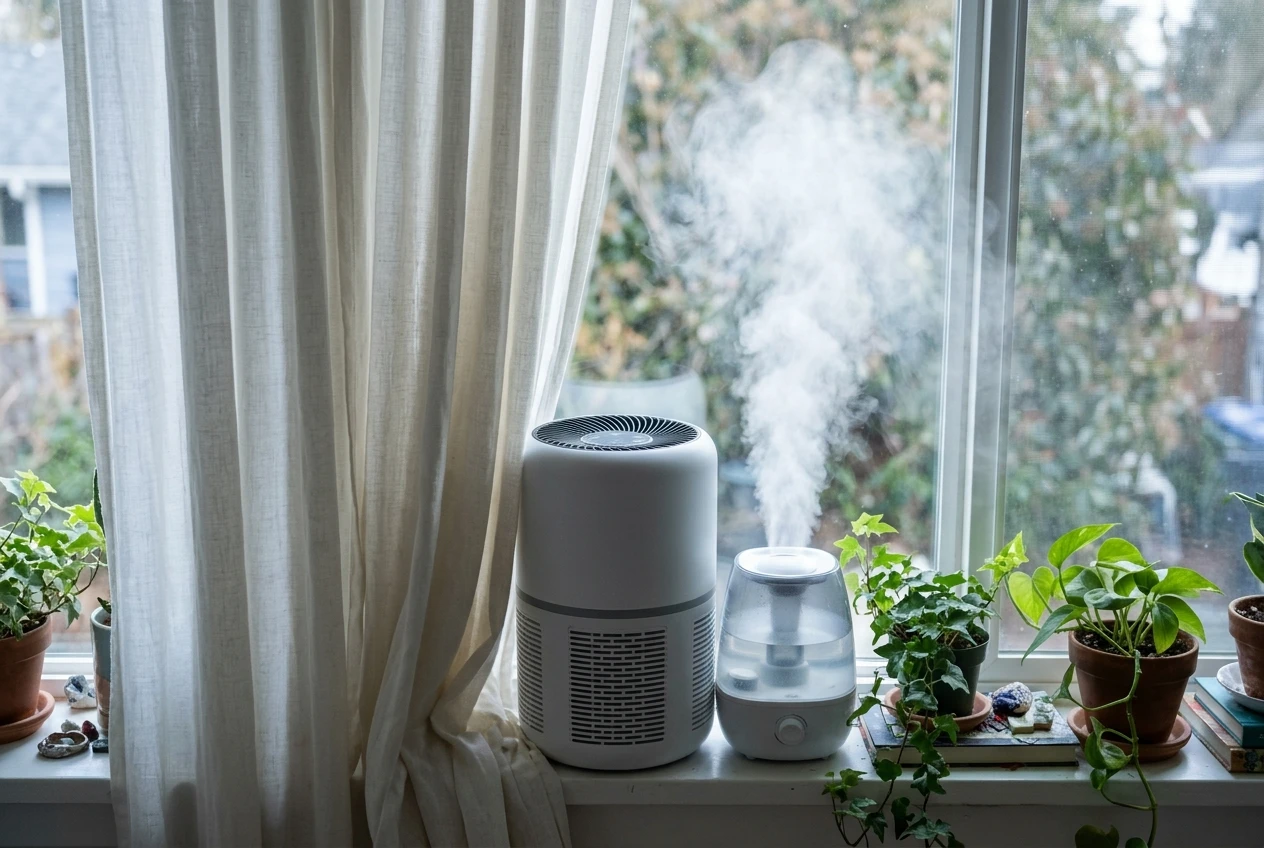
- Next to a humidifier. Mist and moisture can make the sensor read high and the display turn red even when the air is not dirty. If your reading jumps right after the humidifier starts, see our checklist for a humidifier turning a smart purifier red. Moving the two apart is usually the first fix.
- Right beside the kitchen. Cooking releases fine particles and vapor, and a unit close to the stove will spike during meals. That is a real reading, but it can look like a constant problem. Put the unit a reasonable distance away so it cleans the room rather than only chasing the stove.
- In front of a heating or cooling vent. The vent’s airflow competes with the purifier’s, and the sensor may sample air that is not typical of the room.
- Behind or touching curtains. Fabric covers intakes and shifts with the breeze, and it can be pulled against the grille.
- In direct sunlight or next to a hot appliance. Heat and bright light near the unit are not good for plastic housings or sensors.
If your unit reads high in a room that looks clean, you may also need to clean the sensor itself. We cover that in why your air purifier reads high when the room looks clean.
Renter-friendly fixes when outlets and furniture limit you
Renters often have an outlet in the worst spot and a landlord who will not let them move things. You can still improve a bad setup without drilling anything.
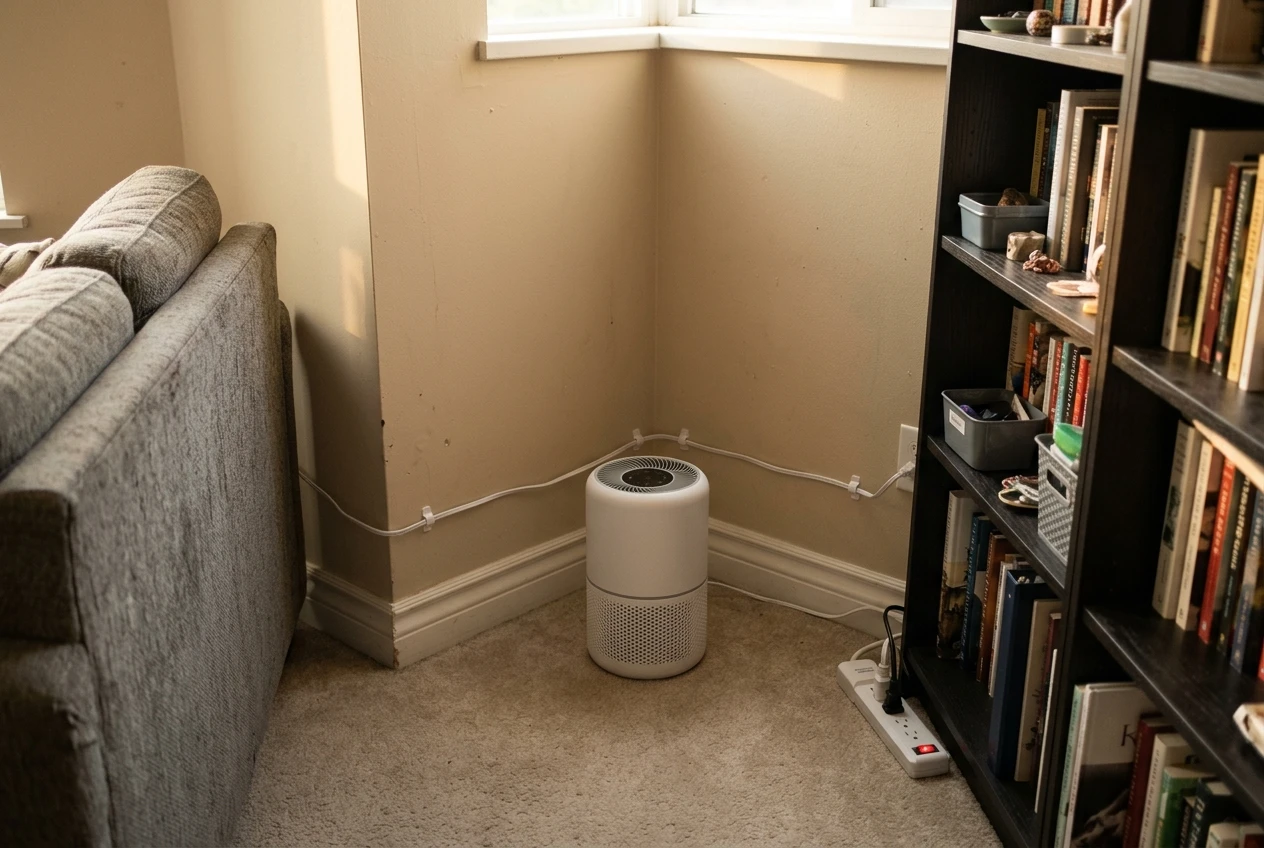
- Use a short extension cord or power strip with surge protection to move the unit away from the wall and furniture. Check your manual first, because some manufacturers want the unit plugged directly into the wall. Do not chain multiple strips together.
- Shift the furniture a few inches instead of rearranging the whole room. Pulling a couch forward or moving a side table can open the clearance gap you need.
- Run the cord along the baseboard with a cord cover or a few removable clips so nobody trips over it.
- Use a different room position for different times of day. A unit near the couch for the evening and by the bed at night will often do more than one that never moves. Smaller units are easy to carry.
- Choose the side of the room with the clearest line across the space, even if it is not the one with the nicest view.
If the only free outlet is behind a heavy bookcase, extend the cord rather than shoving the unit into the gap.
A one-week test: move it and see if it made a difference
You do not need to take placement on faith. A simple test shows whether the new spot is better.
- Days 1 to 3: baseline. Leave the unit in its current spot. Note the reading at the same two times each day, say morning and evening, along with the fan setting and whether windows were open. Your app’s history graph makes this easy.
- Day 4: move it. Apply the rules above. Change only the position, and leave the settings alone.
- Days 4 to 7: compare. Note the same readings at the same times, with the same fan setting and window habits.
- Look at more than numbers. Is the room less stuffy? Did dust settle more slowly on surfaces? Is the unit quieter where you sleep?
Keep in mind that the unit’s sensor only reads the air right next to it, and outdoor air quality changes from day to day. A single reading means little, but a pattern across several days says more. If the new spot shows no change, move it to the next-best spot and repeat, keeping the notes brief.
If you want everything in one place, join the email list for a free printable room-by-room placement checklist. It is a practical extra for your wall or fridge, and you can follow every rule here without it.