You fill your bedroom humidifier on a dry autumn evening, switch it on, and expect a quieter night’s sleep. Ten minutes later, your smart air purifier’s indicator ring flashes bright red, the PM2.5 display jumps past 200, and Auto Mode revs the fan to full speed—even though nobody is cooking, burning a candle, or opening a window.
If your humidifier is turning your smart air purifier red, your house hasn’t suddenly filled with smoke. Instead, your purifier’s optical particle sensor is reacting to microscopic water droplets and dissolved tap-water minerals floating in the mist. Left unchecked, that same mist can coat your HEPA pleats in a chalky white crust, waterlog your filter media, and make your activated carbon stage smell sour weeks ahead of schedule.
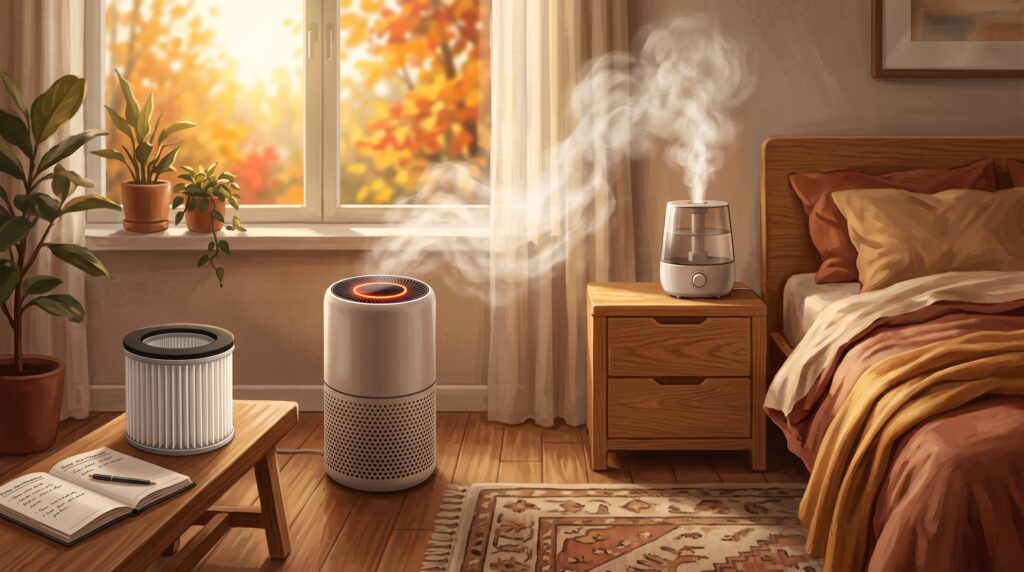
Why Does a Humidifier Turn a Smart Air Purifier Red?
Most smart air purifiers use an infrared laser sensor to count airborne particles (learn how smart sensors work). That laser cannot tell the difference between wildfire smoke, fine household dust, and the aerosolized mist or dissolved tap-water minerals (“white dust”) pushed into the air by an ultrasonic or impeller humidifier (U.S. EPA Use and Care of Home Humidifiers).
- Immediate fix: Move the humidifier at least 6 to 10 feet away from the purifier, aim the mist nozzle away from the intake, and keep room relative humidity between 30% and 50%.
- Sensor & filter fix: Switch from tap water to distilled water in ultrasonic units (or use an evaporative wick humidifier) so dissolved calcium and magnesium don’t turn into airborne mineral dust.
- Filter safety check: Inspect your HEPA and carbon filters now—if they feel damp, smell musty, or show a stiff white mineral crust, dry or replace them before airflow drops.
Why Your Smart Sensor Thinks Clean Mist Is Heavy Pollution
In our previous troubleshooting guide on why your air purifier may be measuring the cleanest spot in the room, we looked at how a sensor placed too close to the clean-air outlet can give you a false green reading. Pairing a portable humidifier in the same room creates the exact opposite problem: a relentless false red alarm.
Inside nearly every connected purifier is an optical nephelometer—a tiny chamber where an LED or laser beam shines across a stream of room air. Whenever particles pass through the beam, they scatter light onto a photodetector. As we cover in Smart Air Purifiers: Which Features Matter Most?, built-in PM2.5 sensors are helpful trend tools, not laboratory instruments. Two things inside humidifier mist trigger that laser immediately:
- Microscopic liquid water droplets: Ultrasonic nebulizers vibrate water into a cool fog of tiny droplets roughly 1 to 5 microns wide. When those droplets float into your purifier before evaporating, they scatter the laser beam just like dense smoke.
- Solid mineral particles (“white dust”): According to the U.S. Environmental Protection Agency (EPA), ultrasonic and impeller humidifiers aerosolize everything dissolved in their water tank. Even after the water droplet evaporates mid-air, solid specks of calcium and magnesium carbonate remain suspended as genuine fine particulate matter (PM2.5) that both your lungs and your HEPA filter have to catch.
Comparison: How Different Humidifiers Affect Smart Air Purifiers
Not every humidifier fights with your air purifier. Before you change how you run your purifier, check which humidifier technology is sitting on your nightstand or floor:
| Humidifier Type | How It Adds Moisture | PM2.5 Sensor Spike Risk | HEPA “White Dust” & Moisture Risk | Best Water & Setup Rule |
|---|---|---|---|---|
| Ultrasonic (Cool Mist) | High-frequency vibrations nebulize water into visible mist droplets | Very High (spikes with tap water or close placement) | High (disperses dissolved minerals as fine white dust) | Use distilled water only; place 6–10+ ft from purifier |
| Impeller (Cool Mist) | High-speed rotating disk flings fine water droplets into the room | High (droplets and tap minerals scatter sensor light) | Moderate to High (can release mineral dust and mist) | Use distilled or demineralized water; keep mist plume away |
| Evaporative (Wick Filter) | Fan blows air through a wet absorbent wick; minerals stay trapped in the wick | Very Low (releases invisible water vapor, not droplets) | Low (unless room humidity exceeds 50%–60%) | Tap water is fine; replace humidifier wick on schedule |
| Steam Vaporizer (Warm Mist) | Boils water electrically and releases cooled steam vapor | Low (only spikes if dense steam blows straight into sensor) | Low for minerals (scale stays in boiling chamber) | Keep out of children’s reach (EPA safety rule); 6+ ft clearance |
7 Checks Before Your Humidifier Ruins Your Air Purifier Filter
Walk through these seven checks in order. The first three take less than five minutes and will tell you immediately whether your sensor is reacting to tap-water minerals, raw water droplets, or an overloaded filter.
Check 1: Run the 15-Minute “Tap Water vs. Distilled” Sensor Test
If you use an ultrasonic humidifier filled from the kitchen faucet, dissolved calcium, magnesium, and iron are the prime suspects behind your purifier’s red ring. Turn the humidifier off and let the air purifier run until the PM2.5 reading drops back into the green zone. Then empty the humidifier tank, wipe it dry, and refill it with bottled distilled water (not spring, artesian, or mineral water, which the EPA notes still contain natural mineral loads).
If the PM2.5 reading stays calm with distilled water at a moderate mist setting, your purifier wasn’t malfunctioning—it was accurately catching a cloud of hard-water mineral dust before you inhaled it.
Check 2: Inspect the Pre-Filter and HEPA Pleats for Chalky “White Dust”
Unplug your air purifier, open the filter compartment, and look closely at the outer pre-filter mesh and the white HEPA pleats under a bright light. Household dust normally looks gray-brown and fibrous. Humidifier mineral dust looks like fine white talcum powder or baking flour.
Because mineral particles are ultra-fine and slightly damp when they enter the intake, they pack tightly into the microscopic pores of a HEPA-grade particle filter. Even a filter that is only three weeks old can suffer a severe airflow drop once calcium scale crusts over the pleats—causing the exact weak-airflow symptom we cover in our replacement filter guides.
What Happens When Tap-Water Ultrasonic Mist Reaches Your Smart Purifier
Ultrasonic disk vibrates tap water into 1–5 µm mist droplets carrying dissolved calcium & magnesium.
Water evaporates into room air, leaving behind solid sub-micron mineral specks (“white dust”) plus stray droplets.
Optical PM2.5 sensor spikes to Red (150–999 µg/m³), Auto Mode roars to Turbo, and mineral powder cakes the HEPA pleats.
Check 3: Measure Your Separation Distance and Mist Direction
Even if you use distilled water, placing an ultrasonic humidifier within two or three feet of your smart air purifier will still trigger false red alerts because unevaporated water droplets get pulled straight into the purifier’s intake.
Give the mist enough distance to evaporate completely into invisible water vapor before it reaches the purifier. Place the humidifier at least 6 to 10 feet away, elevate it on a water-resistant nightstand or table so mist doesn’t pool on the floor, and point the mist nozzle away from the purifier’s intake and sensor window.
Check 4: Cap Indoor Relative Humidity Between 30% and 50%
More humidity is not always better for your airways or your air purifier. The U.S. EPA recommends keeping indoor relative humidity below 50% (typically between 30% and 50%) because higher moisture levels encourage dust mites, mold growth, and biological activity.
When bedroom humidity climbs past 55% or 60%—especially overnight with the door closed—two things happen inside your air purifier:
- Hygroscopic particle swelling: Airborne dust particles absorb moisture, swell in size, and scatter more light inside the optical PM2.5 sensor chamber.
- Activated carbon saturation: As we explain in Smart Purifiers for Smokers: Eliminating Lingering Odors Fast, activated carbon relies on millions of microscopic pores to adsorb odor and gas molecules. At high relative humidity (above 60%), water molecules compete for those pores, reducing odor capture and sometimes causing trapped organic compounds to release a stale, sour, or wet-cardboard smell.
How to Position a Humidifier and Smart Air Purifier in the Same Bedroom
Nightstand near bed · Distilled water · Nozzle aimed toward open center of room
Target 30%–50% RH on Hygrometer
Opposite wall or foot of bed · Unobstructed 360° intake · Away from mist plume
Check 5: Clean the Optical Sensor Lens (Mineral Film Causes Permanent Red Readings)
What if you turn the humidifier completely off, air out the room, and your smart air purifier still stays stuck on yellow or red? Tap-water mineral mist can leave a thin, cloudy film of calcium residue directly on the optical sensor lens inside the purifier.
Unplug the machine, pop open the small vented sensor access door on the side or back of the housing, and gently wipe the lens and inlet with a barely damp (not dripping) cotton swab, followed immediately by a dry cotton swab. Never spray glass cleaner or compressed air into the sensor port.
Check 6: Switch From Auto Mode to a Fixed Manual Sleep or Medium Speed Overnight
As we emphasize in Smart Air Purifiers Guide: Automation, Sensors & Home Integration, Auto Mode is only as smart as the sensor feeding it data. If your bedroom layout is compact and occasional moisture fluctuations still nudge the PM2.5 reading upward at 2:00 a.m., don’t let Auto Mode rev the blower up and down all night.
Instead, use your purifier’s app schedule to lock in a steady, quiet manual fan speed (such as Low/Sleep or a quiet Medium setting) during the hours your humidifier runs. An ENERGY STAR certified room air cleaner with sufficient AHAM-verified CADR headroom will continue capturing actual dust, pet dander, and allergens quietly without overreacting to harmless water vapor.
Check 7: Test Whether Your Current Filter Can Be Saved—or Needs Immediate Replacement
Once a HEPA filter has been exposed to weeks of hard-water ultrasonic mist or excessive dampness, you need to know whether it is still safe and effective to run. According to the EPA Guide to Air Cleaners in the Home, dirty or overloaded filters restrict airflow and cannot clean the room properly—and damp organic dust trapped inside filter pleats can become a source of musty indoor odors.
| What You See, Feel, or Smell | What Happened Inside the Filter | Can You Rescue It? | Recommended Action |
|---|---|---|---|
| Light white powder on outer washable pre-filter only; strong airflow | Early tap-water mineral dust caught on outer screen | Yes | Vacuum or rinse/dry the removable pre-filter (if manufacturer-approved); switch humidifier to distilled water. |
| Slightly cool/humid filter after one night; no odor or stiffness | Brief surface moisture exposure from close mist plume | Usually | Remove filter and air-dry in a warm, dry room for 24 hours; relocate humidifier 6–10 ft away before reinstalling. |
| Chalky white crust deep in HEPA pleats; weak outlet airflow | Calcium/magnesium carbonate has cemented inside the micro-fibers | No (Do Not Wash HEPA) | Replace the filter. Vacuuming or washing a non-washable HEPA filter tears the fibers and ruins filtration. |
| Sour, musty, or wet-dog odor from exhaust; warped or discolored pleats | Moisture-saturated carbon and damp organic dust inside the pleat pack | No | Replace immediately. Never run a damp, musty filter—it blows odors right back into your breathing zone. |
Track Your Room Fit, Filter Code, and Seasonal Checks With the Free Planner
Winter heating season is when filter mistakes get expensive—especially if you manage purifiers across multiple bedrooms and living spaces. Use the Free 15-Page Smart Air Purifier Fit & Filter Planner on BestSmartPurifiers.com to log your exact purifier model number, replacement filter code, room square footage, CADR target, and first-year filter budget before you order replacements.
Where to Get Verified Replacement Filters (and High-Capacity Purifiers)
Affiliate notice: The partner links below are affiliate links. If you make a qualifying purchase, Best Smart Purifiers may earn a commission at no extra cost to you. Always confirm your purifier’s exact brand, model number, and filter dimensions before ordering.
If Check 2 or Check 7 showed that ultrasonic mineral dust or high humidity has already crusted your HEPA pleats or soured your carbon filter, running the machine on a clogged cartridge only wastes electricity and strains the fan motor. Here are two dependable resources we use and recommend across our allergy and maintenance guides:
1. Replace CloggedPurifier & Humidifier Filters on Schedule
FiltersFast stocks OEM and brand-compatible air purifier filters, HVAC MERV filters, and replacement evaporative humidifier wicks in one place. You can also use the FiltersFast Home Filter Club to schedule automatic deliveries before winter heating season peaks.
2. Upgrade to High-CADR, Multi-Stage Filtration
If your current unit is undersized or lacks a washable pre-filter screen and true H13 HEPA + carbon depth, explore Field Controls (Field Controls Homeowner Shop). The TRIO Plus S Portable Air Purifier delivers a verified 350 CFM CADR with CARB-certified zero-ozone operation.
Test Your Setup: 4 Quick Questions Before Tonight’s Run
Tap or click each question below to check your answer and make sure your humidifier and smart air purifier work together instead of fighting each other.
1. Why does an ultrasonic humidifier filled with tap water make a smart air purifier’s PM2.5 ring turn red?
Answer: Ultrasonic vibrations nebulize both water droplets and dissolved tap-water minerals (calcium and magnesium). As the mist travels across the room, both the fine droplets and the resulting solid mineral specks (“white dust”) scatter the infrared laser inside the purifier’s optical PM2.5 sensor, registering as heavy fine-particle pollution.
2. Does switching to bottled “spring” or “mineral” water stop white dust from clogging a HEPA filter?
Answer: No. As the U.S. EPA points out, bottled water labeled “spring,” “artesian,” or “mineral” has not been demineralized and can still release white dust. Look specifically for water labeled distilled (or use an evaporative wick humidifier that traps minerals in its wick).
3. What indoor relative humidity range protects both your respiratory comfort and your activated carbon filter?
Answer: Keep indoor relative humidity between 30% and 50% (never exceeding 50%, per EPA guidance). Above 50%–60% RH, dust mites and mold thrive, and water vapor saturates the microscopic pores in activated carbon filters, reducing odor control and triggering stale or sour smells.
4. If your HEPA filter pleats are stiff with chalky white mineral dust and smells sour, can you wash the HEPA filter in the sink?
Answer: No. Unless a filter is explicitly rated washable by the manufacturer (typically only the outer mesh pre-filter), rinsing a HEPA or carbon cartridge destroys its fiber structure and invites mold growth. A mineral-crusted or sour-smelling HEPA/carbon cartridge should be replaced with a verified match.
Frequently Asked Questions: Running a Humidifier and Smart Air Purifier Together
Can I run a humidifier and an air purifier in the same room at the same time?
Yes. An air purifier removes airborne particles (and some odors/gases if equipped with activated carbon), while a humidifier adds water vapor to dry indoor air. They do not cancel each other out—as long as you place them at least 6 to 10 feet apart, keep relative humidity below 50%, and avoid blowing tap-water ultrasonic mist into the purifier.
Is the “white dust” from my humidifier harmful to my air purifier?
Yes. White dust is solid mineral scale (mostly calcium and magnesium carbonate) left behind when tap-water mist evaporates. Your HEPA filter captures those fine mineral particles, which rapidly clogs the filter media, increases airflow resistance, makes the fan louder, and shortens filter life from months to weeks.
Why does my air purifier still show red after I switched to distilled water?
Two common causes remain: either the humidifier is sitting so close to the purifier that liquid water droplets are entering the optical sensor before they can evaporate, or old mineral residue has coated the inside of your humidifier tank or your purifier’s optical sensor lens. Scrub the humidifier tank free of scale every third day (per EPA humidifier care guidelines) and wipe the purifier’s sensor lens with a cotton swab.
Why does my air purifier smell sour or musty when the humidifier is on?
High humidity (or direct mist) can dampen the dust, pet dander, and skin cells already trapped on your HEPA filter and saturate the activated carbon layer. When carbon pores fill with water molecules, previously trapped odor compounds can release back into the air. If drying the filter for 24 hours does not eliminate the sour smell, replace the filter.
Which type of humidifier works best with a smart air purifier?
An evaporative (wick) humidifier is the easiest partner for a smart air purifier. Because it uses a fan to evaporate invisible moisture off a wet wick, dissolved tap-water minerals stay trapped inside the disposable wick rather than floating across the room into your purifier’s PM2.5 sensor and HEPA filter.
Continue Reading on BestSmartPurifiers.com
What Happened When You Ran Your Humidifier and Air Purifier Together?
Have you seen your smart air purifier jump to red when your winter humidifier kicks on—or found chalky white dust on your pre-filter? Drop a comment below with your purifier model, whether you use an ultrasonic or evaporative humidifier, and which of the 7 checks solved the spike in your room. I read and reply to reader comments to help troubleshoot tricky room setups!