Smart air purifier guidance · Room-first research
Choose for your room. Not the feature list.
The right air purifier starts with a few practical questions: What’s in the air? How big is the room? Can you live with the noise—and find the next filter?
Best Smart Purifiers helps you compare airflow, filtration, smart controls, and ownership costs without getting lost in the sales pitch.
Research-based education. No hands-on testing implied unless an article explicitly documents it.
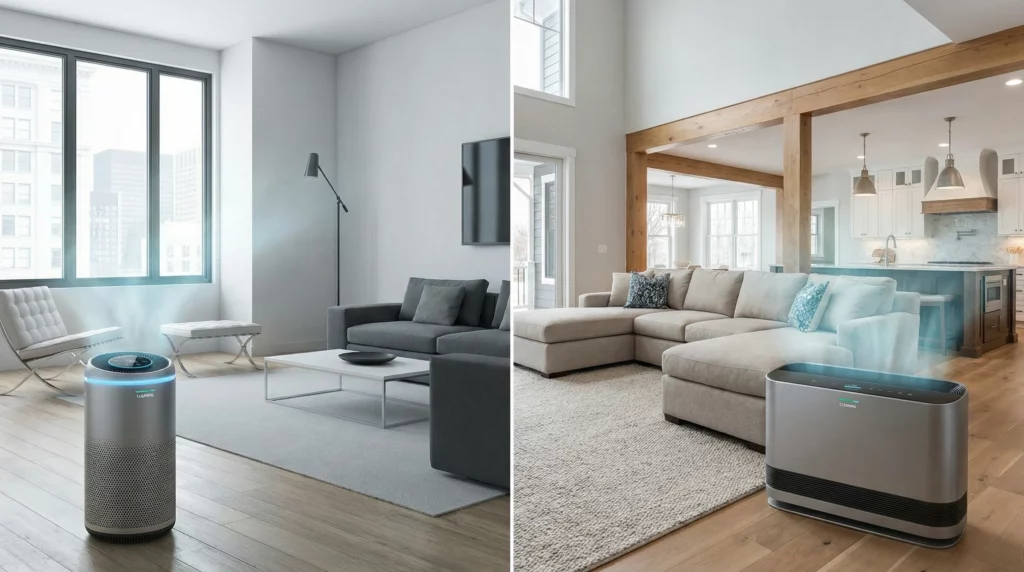
- 01 Enough clean-air delivery for the actual space
- 02 Filtration matched to the pollutant
- 03 Noise and maintenance you can live with
Independent research. Clear disclosure. Best Smart Purifiers is an education and research site—not a manufacturer, filter warehouse, medical provider, or HVAC contractor. Some links are affiliate links; we may earn a commission at no added cost to you. Read the disclosure.
Four checks. A more useful shortlist.
A good purifier has to fit
more than your budget.
A large coverage number and a clever app are not the whole story. Start with the space, then work toward the product.
-
Measure the space.
Note floor area, ceiling height, open doorways, and connected rooms. Leave the clearances the manufacturer requires around air intakes and outlets.
-
Name the concern.
Particle filtration and gas removal are different jobs. Carbon performance depends on the media type, quantity, design, and the gas involved.
-
Compare delivery.
CADR describes particle-cleaning delivery. Check units and test conditions; compare noise and airflow at the speed you will actually use.
-
Check the long game.
Find the replacement filter before buying the machine. Price filters, electricity, and maintenance; review warranty and return terms.
A useful starting estimate
Turn room size into
a smoke-CADR target.
For a typical enclosed room with a ceiling up to eight feet, AHAM’s rule of thumb is a smoke CADR of at least two-thirds of the floor area in square feet. For wildfire smoke particles, AHAM recommends a smoke CADR at least equal to the room’s square footage.
Example: a 150 sq ft room suggests at least 100 cfm smoke CADR for the general rule, or 150 cfm for the wildfire-smoke rule.
This is a sizing starting point—not a performance guarantee, health recommendation, or safety threshold. Higher ceilings and connected spaces need additional sizing. CADR does not rate gas removal, and smoke contains gases as well as particles.
Read AHAM’s sizing guidance ↗ (new tab)For a rectangular room: length in feet × width in feet. Enter 1–10,000 sq ft. These estimates use cfm, not m³/h.
Set your room area and sizing rule, then select Estimate Smoke CADR.
This tool runs in your browser. It does not submit or save your entries.
Quick-reference examples—no calculator needed
- 150 sq ft: general ≥100 cfm; wildfire smoke ≥150 cfm.
- 300 sq ft: general ≥200 cfm; wildfire smoke ≥300 cfm.
- 450 sq ft: general ≥300 cfm; wildfire smoke ≥450 cfm.
Smoke CADR; enclosed rooms with ceilings up to 8 ft. These are rule-of-thumb examples, not product ratings.
Already own a purifier?
Similar-looking filters
are not the same filter.
Start your search with the label on the machine—not a photo in a shopping result.
- 1. Find the exact purifier model. Check the label, manual, app, or filter compartment. Keep any letters, suffixes, and generation numbers.
- 2. Match the manufacturer’s filter code. Confirm every stage: prefilter, particle filter, and carbon may be combined or sold separately.
- 3. Read the listing beyond “compatible.” Compare supported models, dimensions, package quantity, seller identity, and return terms. Physical fit alone does not establish equivalent performance.
- 4. Follow the maintenance instructions. Inspect as directed, especially around smoke, pets, dust, or frequent cooking. Wash a filter only if the manufacturer explicitly permits it.
Different tools. Different jobs.
One room—or a bigger system?
A portable purifier and compatible HVAC filtration can work alongside each other. Choose based on the space, the system, and the maintenance involved.
Portable purifier
A targeted option for a bedroom, office, or other priority room. Size it for the area it actually serves.
- Compare smoke CADR and room fit.
- Check noise at useful fan speeds.
- Allow clear airflow and easy filter access.
HVAC filtration
A broader filtration approach in a compatible forced-air heating or cooling system.
- Match exact filter dimensions.
- Respect airflow and pressure-drop limits.
- Confirm suitable efficiency with system guidance.
Whole-home options
Centralized air-cleaning equipment may require professional evaluation, installation, and maintenance.
- Verify what the equipment actually treats.
- Review service and replacement costs.
- Use qualified HVAC advice before changes.
Read the purifier-versus-filter comparison. For installed equipment, verify system compatibility before purchasing.
Explore whole-home options ↗Whole-home shopping link: affiliate link; opens a retailer in a new tab. We may earn a commission at no added cost to you.
Filtration is one part of better indoor air. Reduce or remove pollutant sources and ventilate with clean outdoor air when appropriate. Purifiers cannot remove every pollutant or fix a continuing source problem. Read EPA’s air-cleaner guidance ↗ (new tab).
Make “smart” earn its place
A better app cannot fix
an undersized purifier.
Connected features are valuable when they help you run a well-matched machine consistently—not when they distract from the fundamentals.
- Look for everyday usefulness. Reliable schedules, sensible auto mode, clear readings, sleep controls, and helpful filter reminders.
- Check what happens offline. Are manual controls usable? Which features require an account, Wi-Fi, or a working app?
- Question the extra technology. Check vague “HEPA-type” claims, limited carbon layers, and optional features that may produce ozone. Avoid intentionally ozone-generating air cleaners in occupied spaces. See EPA’s consumer guidance ↗ (new tab).
The price tag is only the beginning
Buy for year one.
Think about year three.
A low purchase price can hide expensive filters, limited availability, or a machine too noisy to keep running.
First-year estimate = purchase + setup + energy + replacement supplies.
Free printable Fit & Filter Planner
Fewer open tabs.
A clearer buying decision.
Put the room, pollutant, filter system, and real ownership cost on the same page. The Smart Air Purifier Fit & Filter Planner is a decision workbook—not a list telling everyone to buy the same machine.
See what’s included and review the signup and download terms on the planner page.
- Define the actual air concern
- Record the room and ceiling height
- Build a practical CADR target
- Compare the filtration stages
- Verify replacement-filter compatibility
- Estimate costs and compare finalists
Read the part you need next.
Practical guides, without the product-ranking detour.
Know what’s behind the advice
Research first.
Claims kept in context.
Best Smart Purifiers compares manufacturer specifications, certification information, replacement-filter availability, seller details, and authoritative indoor-air guidance to help you make practical decisions.
We do not imply hands-on testing unless an article clearly states that a product was personally used or tested. Specifications, certifications, apps, prices, and availability can change; verify important details before buying.
Before you buy—or replace a filter
Good questions.
Plain answers.
A little clarity now can prevent a poor fit later.
What should I check first when buying a smart air purifier?
Start with the room’s floor area, ceiling height, and connected spaces. Identify the main air concern, compare CADR and filtration, check noise at a useful fan speed, and confirm replacement-filter cost and availability.
Do smart air purifiers clean better than regular models?
Not automatically. Smart controls can make a purifier easier to schedule, monitor, and run consistently. Particle-cleaning performance still depends on airflow, CADR, filter design, room fit, placement, and maintenance.
What does the room-sizing estimate actually tell me?
It applies AHAM’s smoke-CADR rule of thumb to an enclosed room with a ceiling up to eight feet: at least two-thirds of the room’s square footage for general sizing, or at least the room’s square footage for wildfire smoke. The result is in cubic feet per minute (cfm), rounded up. It is a starting point, not a guarantee. Higher ceilings and connected rooms need additional sizing, and CADR does not describe gas-removal performance.
Can I use any replacement filter that fits inside the machine?
No. Similar-looking filters can differ in seal, airflow resistance, filtration, carbon amount, and tested performance. Match the exact purifier model and filter code, then verify manufacturer and seller compatibility details. Physical fit alone does not establish equivalent performance.
Can an air purifier remove every indoor pollutant?
No. Source control and ventilation with clean outdoor air remain important. Portable purifiers and compatible HVAC filters can reduce some airborne pollutants, but they cannot remove every pollutant or solve a continuing source problem by themselves.
How often should I replace the filter?
Follow the manufacturer’s guidance. Smoke, pets, heavy dust, renovation work, cooking, and pollen can change maintenance needs. Inspect as directed; reduced airflow, visible loading, odor, or a filter alert can prompt a check. Wash a filter only if the manufacturer explicitly allows it.
Is the free Fit & Filter Planner a product-ranking guide?
No. It is a decision workbook for defining the air concern, measuring the room, building a CADR target, comparing filters, verifying replacement compatibility, estimating costs, and evaluating your final options. Check the planner page for current signup and download terms.
The best next step is a practical one
Size it. Run it. Maintain it.
Choose a purifier that fits the space, targets the right concern, and stays practical long after the box is opened.
Some links are affiliate links. Best Smart Purifiers may earn a commission from qualifying purchases at no added cost to you. Prices, partner status, specifications, availability, and compatibility can change. Verify before purchasing.