Air purifier reality check
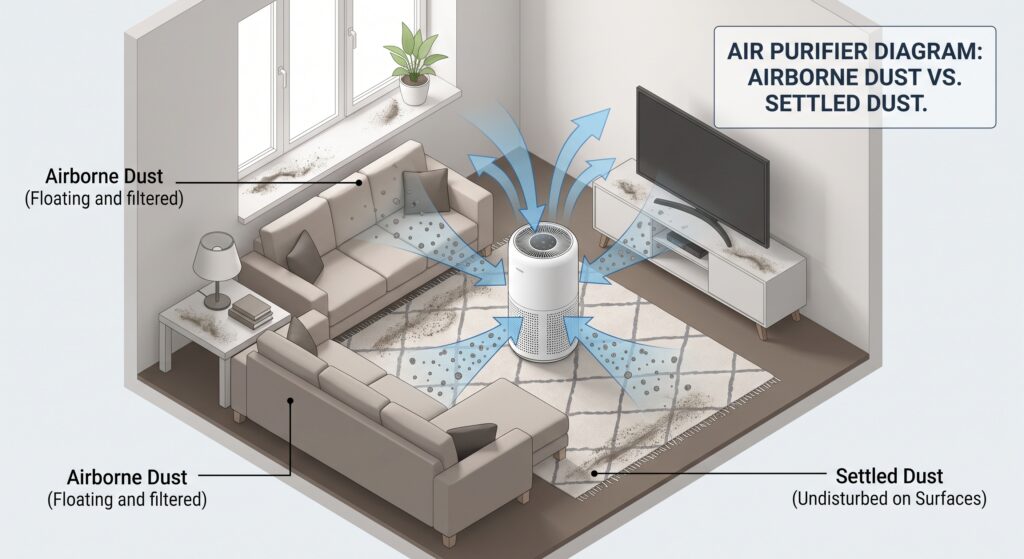
You can hear the purifier running. The filter is slowly turning gray. Yet the next shaft of afternoon sunlight still reveals dust in the air—and the shelf you wiped two days ago already looks coated again.
That does not automatically mean the purifier is defective. It may be doing one job while you are judging it by another. A portable purifier can capture particles that are airborne, reach its intake, and pass through the filter. It cannot wipe dust from a dresser, lift grit from carpet, remove lint from fabric, or stop every new particle at its source.
The practical fix is to connect filtration with surface cleaning, source control, and a repeatable room routine. Before you buy a larger machine, separate the dust that is moving through the air from the dust that has already landed.
Quick answer
Why Is the Room Still Dusty With an Air Purifier?
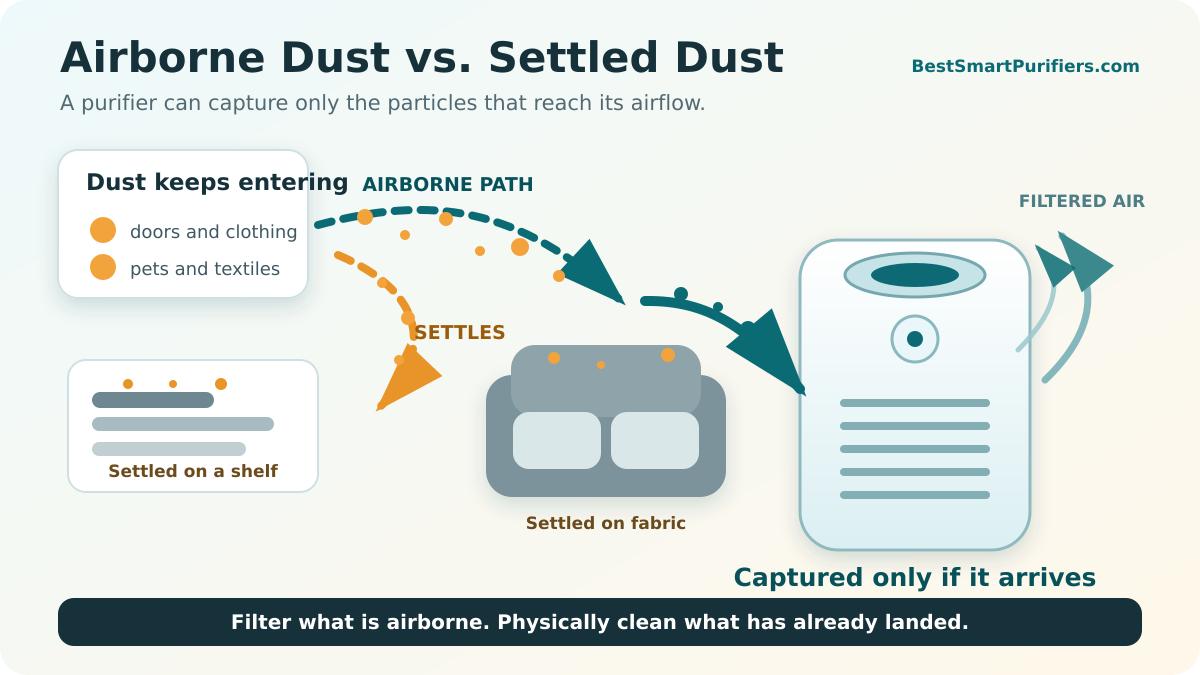
Your room can stay dusty because much household dust settles before it reaches the purifier, continues entering or being generated, hides in carpets and fabrics, or is stirred back into the air by walking, bedding, pets, dusting, and vacuuming. The purifier may also be undersized, obstructed, running too slowly, fitted with a poorly sealed replacement filter, or overdue for maintenance.
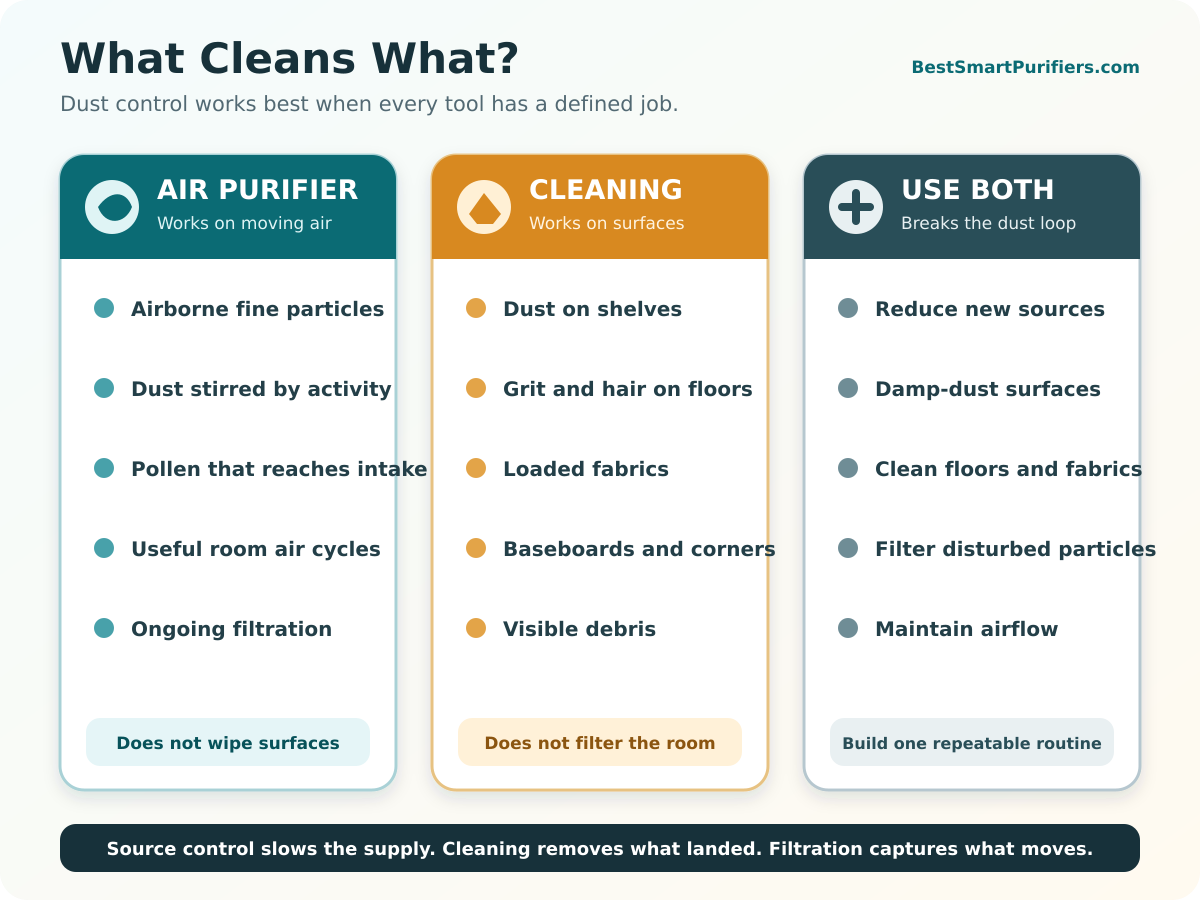
BestSmartPurifiers takeaway: Use the purifier to reduce airborne particles. Use damp dusting, effective vacuuming, laundering, entry control, and source reduction to remove settled material. One tool supports the other; neither replaces the other.
Airborne Dust and Settled Dust Need Different Tools
Dust is not one uniform substance floating at one height. The particles in a room vary in source, size, weight, shape, and how readily normal activity sends them back into the air. A purifier gets an opportunity to capture a particle only while that particle is suspended and travels into the machine’s airflow.
| What you notice | Best first tool | How the purifier helps | What it cannot do |
|---|---|---|---|
| Fine particles floating in sunlight | Correctly sized particle filtration | Captures a portion that reaches the intake | Guarantee that every visible particle crosses the filter |
| Dust coating shelves and hard furniture | Damp wiping plus source reduction | May reduce some particles before they land or after they are disturbed | Remove material already stuck to the surface |
| Lint, hair, crumbs, and grit on the floor | Vacuuming or other suitable floor cleaning | May capture smaller airborne material stirred up during activity | Replace direct floor cleaning |
| Dust returning after windows or doors stay open | Entry control based on outdoor conditions | Filters some incoming airborne particles | Make polluted outdoor air harmless or stop the entry path |
| Dust around a leaky return, renovation, or damaged material | Correct the source safely | Provides supplemental particle reduction | Repair the building, HVAC issue, or active source |
| Musty odor or visible moisture damage | Moisture correction and proper cleanup | May capture some airborne particles | Solve the water problem or remove established contamination |
The U.S. EPA’s Guide to Air Cleaners in the Home explains that portable air cleaners and HVAC filters can filter particles from the air, while also emphasizing source reduction and ventilation with clean outdoor air. That wording matters: from the air is not the same as from every surface in the room.
The Dust Loop Explains Why the Shelf Gets Dirty Again
A room is not a sealed test chamber. New particles enter on shoes, clothing, pets, packages, open doors, windows, outdoor-air leaks, and normal household airflow. Textiles shed. Bedding and upholstered furniture hold particles. Walking across carpet, making a bed, or brushing a pet can return some settled material to the air.
From there, a particle can follow one of several paths:
- It reaches the purifier and is captured by the installed filter.
- It settles before it reaches the intake.
- It leaves the room through an opening or ventilation path.
- It remains suspended and continues circulating.
- It lands, then becomes airborne again during later activity.
A gray filter can be evidence of capture—not proof of complete control
A loaded filter shows that material has moved through the purifier. It does not tell you how much dust settled elsewhere, how fast new dust is entering, or whether the machine delivers enough clean air at the fan speed you actually use. Judge the full room routine, not filter color alone.
Before You Blame the Purifier, Check Its Real Airflow
A good cleaning routine cannot rescue a purifier that is barely moving air. Check these performance basics before deciding the room simply makes “too much dust.”
Room fit
Compare the purifier’s CADR with the room’s actual square footage, ceiling height, open doors, and connected spaces. AHAM’s general rule of thumb is a smoke CADR of at least two-thirds of the room area for a standard room.
Useful fan speed
Published CADR is typically measured at the highest speed. A whisper setting may move far less air. Use the highest speed that remains practical for the room and routine.
Open intake and outlet
Move laundry, curtains, furniture, baskets, and walls away from the airflow paths according to the manufacturer’s clearance instructions.
Correct filter and seal
Confirm the exact purifier model, filter code, orientation, packaging removal, door closure, and seal. A similar-looking replacement may not fit or perform the same way.
Use the site’s guide to air purifier room-coverage claims before trusting the largest square-foot number on a product page. If the filter was recently changed, inspect the replacement-filter mistake that can make a good machine underperform.
AHAM’s air-filtration guidance gives the two-thirds rule as a practical comparison starting point and recommends more aggressive sizing for wildfire smoke. Ceilings above eight feet and connected spaces can require more capacity.
Build an Air-and-Surface Dust-Control Routine
The goal is not to make a normal home laboratory-clean. It is to interrupt the loop: reduce new dust, remove what settled, capture what becomes airborne, and keep the purifier’s airflow intact.
Reduce the easiest sources and entry paths
Use practical entry habits, manage shedding textiles, clean pet areas, and address unusual building or HVAC dust sources safely. Ventilate when it is useful and outdoor air is suitable; do not open windows by habit during smoke, high outdoor particle pollution, or heavy pollen.
Clean high surfaces before low surfaces
Use a damp cloth or method appropriate for the material so settled dust is collected instead of swept back into the room. Work down toward tables, furniture, baseboards, and floors. Follow product and surface-care directions.
Clean floors and fabrics with the right equipment
Vacuum carpets and upholstered furniture as appropriate. EPA guidance suggests considering a vacuum with a HEPA filter to reduce dust buildup and help keep some vacuumed material from escaping back into the air. People sensitive to stirred-up dust should avoid the area during vacuuming or follow guidance from a qualified healthcare professional.
Run the purifier as the airborne support layer
Increase airflow before a predictable dust-producing activity when practical, keep it running while the room is active, and continue afterward at a useful speed. Do not block the intake or use the purifier as permission to dry-sweep dust into the air.
Inspect the pre-filter, main filter, and sensor correctly
Unplug the unit before opening it when the manual instructs you to do so. Follow the manufacturer’s cleaning and replacement schedule. Do not wash a filter unless it is specifically identified as washable, and do not reset a filter reminder without checking the filter.
The EPA’s current page on sources of indoor particulate matter recommends frequent cleaning, damp dusting, and consideration of HEPA-filtered vacuuming as parts of dust reduction. The purifier belongs inside that larger routine—not at the expense of it.
Try This Seven-Day Test Before Buying a Bigger Purifier
A clean-looking room after one intense Saturday proves very little. A useful test holds the room setup steady long enough to see whether the combined routine changes how quickly dust returns.
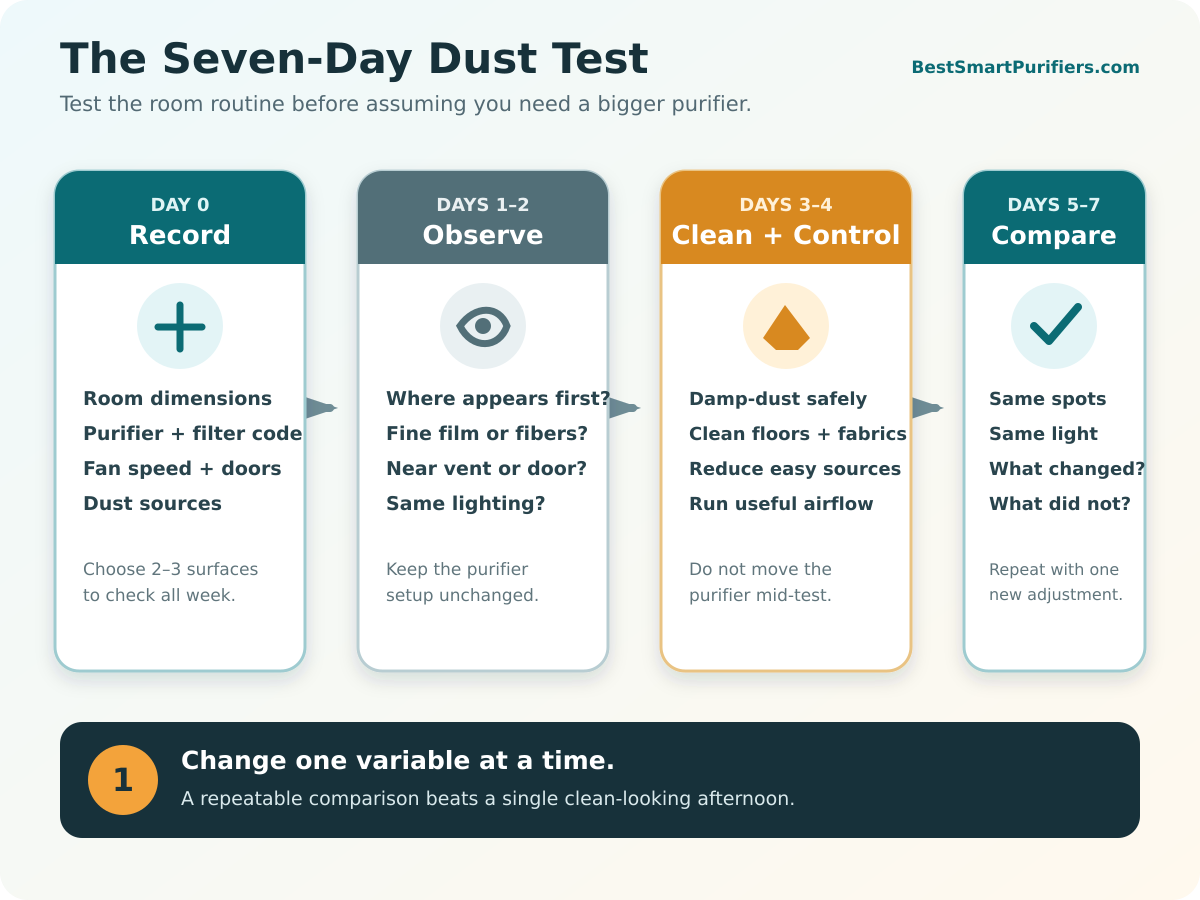
1Day 0: record the setup
Write down room dimensions, ceiling height, door and window position, purifier model, smoke CADR, filter code, fan speed, placement, filter condition, pets, and obvious dust sources.
2Days 1–2: observe the baseline
Choose two or three repeatable surfaces. Note where dust appears first and whether it is fine film, fibers, hair, grit, or material near a particular vent or doorway.
3Days 3–4: clean and control
Damp-dust suitable surfaces, clean floors and fabrics, manage the clearest sources, and keep the purifier on the planned useful speed. Avoid changing its location mid-test.
4Days 5–7: compare the return
Inspect the same surfaces under similar light. Record what improved, what did not, and where dust is concentrated. A localized pattern may point toward an entry path or source.
Change one variable at a time
If you move the purifier, change its speed, open a window, replace the filter, deep-clean the room, and change the HVAC fan on the same day, you will not know which change mattered. Repeat the test with one controlled adjustment when the first week reveals a clear question.
Put the Dust Routine Into the Fit & Filter Planner
The free 15-page Smart Air Purifier Fit & Filter Planner gives you a place to record the measured room, practical CADR target, exact filter code, first-year cost, and maintenance plan. Add the surfaces you are monitoring, the purifier’s normal and cleaning-day speeds, and the source-control tasks that need a schedule.
Open the Free Fit & Filter Planner
When the Filter or the Whole-Home System Needs Attention
If airflow has fallen, the filter no longer seals, or the correct replacement is hard to identify, begin with the label on the purifier. Verify the full model number and manufacturer filter code before comparing appearance or dimensions.
Need a replacement filter?
Check compatibility, filter stages, package quantity, seller details, and return terms. Do not assume that “fits” means identical construction or performance.
Investigating whole-home support?
A broader system may help when the problem spans multiple rooms, but filter resistance, blower operation, humidity, compatibility, and installation require qualified HVAC guidance.
Buying another purifier is not the automatic next step. First confirm room size, CADR, useful-speed airflow, placement, filter fit, maintenance, and the location of the dust. If those checks point to inadequate capacity, use the site’s complete air purifier guide to compare a better fit.
Four-question interactive knowledge check
Can You Break the Dust Loop?
Reader Check-In: Where Does the Dust Return First?
Does it show up first on a dark dresser, beside a supply vent, near the bedroom door, on electronics, or across the floor? Share the room dimensions, ceiling height, purifier model, filter code, normal fan speed, and the dust pattern in the comments. Avoid posting personal information. Your real-room observation may help another reader recognize the difference between weak airflow, a surface-cleaning gap, and a continuing source.
Frequently Asked Questions
Does an air purifier remove dust from furniture?
Should I run the air purifier while dusting or vacuuming?
Why does my room look dusty even though the purifier’s sensor says the air is good?
Why is the purifier filter still clean after weeks of use?
Will a larger air purifier stop dust from settling?
How often should I clean the pre-filter or replace the main filter?
Can an air purifier solve dust from a renovation, damaged material, or HVAC problem?
Authoritative Guidance Used for This Article
- U.S. EPA: Guide to Air Cleaners in the Home
- U.S. EPA: Sources of Indoor Particulate Matter
- U.S. EPA: Improving Indoor Air Quality
- AHAM Verifide: Air Filtration Standards and CADR Sizing
Editorial note: BestSmartPurifiers.com provides research-based consumer education. This article is not medical advice, an indoor-air assessment, a building inspection, or an HVAC design. Air cleaning can reduce some airborne particles, but it does not replace source control, appropriate cleaning, clean-air ventilation, moisture correction, certified alarms, or qualified professional service when those are needed.
Final takeaway
Let the Purifier Clean the Air—Then Clean What the Air Left Behind
If dust keeps coming back, do not judge the purifier by the shelf alone. Confirm that the machine fits the room, moves useful airflow, has the correct filter, and can breathe. Then remove settled dust, slow the clearest sources, and compare the same surfaces over a repeatable week.
The winning routine is layered: reduce the source, remove what settled, filter what becomes airborne, and maintain the system that connects it all.