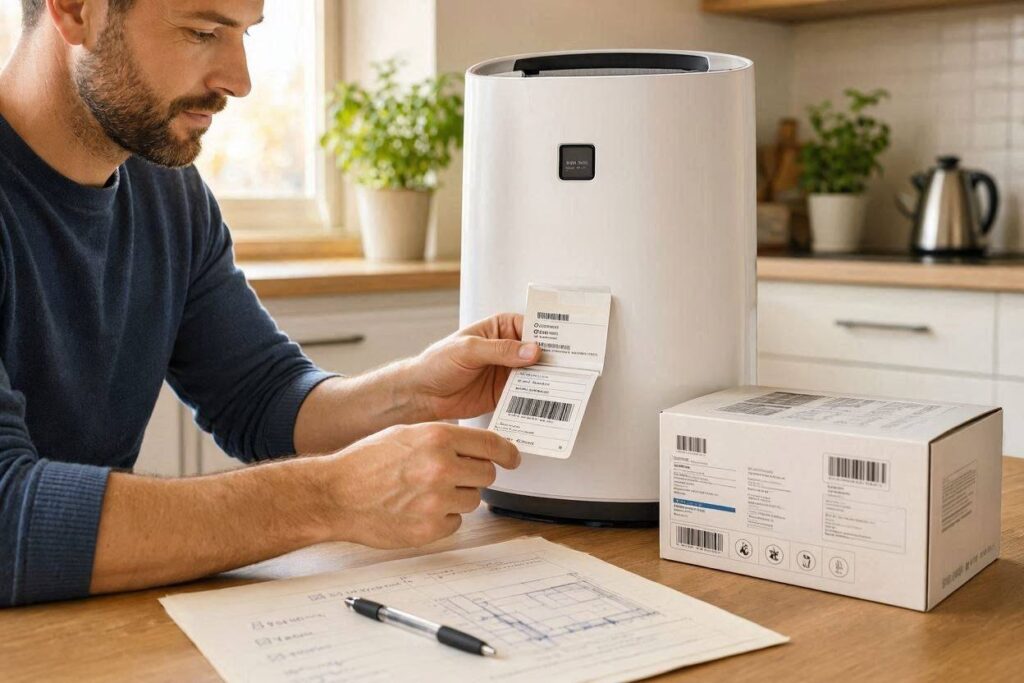
Replacement-filter buying guide
A Filter Can Look Right, Click In, and Still Be the Wrong Choice
Many air purifier problems begin after the first filter change. The machine still turns on, the app still looks normal, and the fan still moves air—but a poor-fit or incomplete replacement filter can leak around the edges, reduce airflow, skip a carbon stage, or cost more over time than expected.
Quick answer
What is the biggest air purifier replacement filter mistake?
The biggest mistake is ordering by appearance, brand name, or rough dimensions instead of matching the exact purifier model and filter code. A near-fit filter can leave small gaps, change airflow resistance, omit carbon media, use a different filter stack, or fail to match the purifier’s original design.
Before buying, check the purifier label, manual, app, filter compartment, and manufacturer guidance. Then compare the replacement listing for supported models, filter code, dimensions, included stages, package quantity, seller identity, and return terms.
If the filter is wrong, the purifier may still run—but the air may bypass the media, odors may return quickly, airflow may drop, and the “savings” can disappear.
Correct Filter vs. Near-Fit Filter
| Check | Correct replacement filter | Near-fit or risky replacement |
|---|---|---|
| Model match | Lists the exact purifier model or approved filter code | Mentions only the brand or a similar-looking model family |
| Seal and fit | Sits firmly with no obvious gaps, rattling, or loose edges | Slides in loosely, compresses poorly, or changes how the door closes |
| Filter stages | Matches the original pre-filter, particle filter, and carbon arrangement | Looks similar but removes or reduces the carbon or pre-filter stage |
| Airflow | Allows the purifier to move air as designed | May restrict airflow or allow bypass around the media |
| Odor support | Includes meaningful carbon when the original filter used it | Uses a thin carbon sheet or no carbon while claiming odor control |
| Seller clarity | Provides part numbers, package quantity, compatibility details, and return terms | Uses vague language such as “fits most” or “compatible with many models” |
Five Signs the Replacement Filter May Be Wrong
The door feels different
If the filter door is harder to close, closes too easily, bows outward, or rattles, the filter may not be seating correctly.
Airflow changed sharply
A noticeable drop in airflow after a fresh filter can suggest added resistance, blocked media, or a filter design mismatch.
Odors return quickly
The particle filter may be present, but the carbon stage may be thinner, missing, or already saturated.
Dust appears around gaps
Visible dust trails around the filter frame or compartment may indicate air is bypassing the filter media.
The listing keeps changing names
A replacement listing that mixes several model numbers without clear compatibility details deserves extra caution.
The price looks too good
A bargain may still be fine, but verify the part number, filter stages, package quantity, and seller reputation before trusting it.
A Seven-Step Filter Match Check
Find the purifier’s exact model number
Check the bottom, back, side label, manual, app, or filter compartment. Do not rely only on the brand name or the product’s appearance.
Record the filter code
Many brands sell multiple purifiers with similar shapes but different filter generations. A filter code or part number is usually more reliable than a broad shopping search.
Compare the full filter stack
Check whether the original design used a pre-filter, particle filter, activated carbon, specialty carbon, UV lamp, or separate gas-focused media. A cheaper replacement may leave out a stage that mattered for your air concern.
Check dimensions, but do not stop there
Length, width, depth, tabs, gaskets, frame design, and airflow direction can all matter. A filter can have similar dimensions and still fail to seal correctly.
Inspect the seller’s compatibility list
A good listing should clearly name the compatible purifier models or approved filter codes. Vague language, copied photos, or incomplete details are reasons to slow down.
Install and inspect before resetting the filter light
Make sure the packaging is removed, the airflow arrow is correct, the door closes properly, and there are no obvious gaps. Reset the filter indicator only after the new filter is installed correctly.
Track real-world performance
After the filter change, watch airflow, noise, odor, dust, app readings, and how quickly the pre-filter loads. A “fresh” filter should not make the purifier feel weaker.
Free 15-page workbook
Use the Planner Before You Order the Next Filter
The free Smart Air Purifier Fit & Filter Planner includes a filter-match checklist, room-fit worksheet, CADR target page, true-cost calculator, and 12-month maintenance plan. It gives you one place to record the exact purifier model, filter code, package quantity, and first-year cost.
Get the Smart Air Purifier Fit & Filter PlannerOEM vs. Compatible Replacement Filters
| Filter type | Potential advantage | What to verify |
|---|---|---|
| Manufacturer-original filter | Usually the safest match for fit, stages, airflow, and warranty expectations | Correct part number, package quantity, current design, and seller authenticity |
| Compatible third-party filter | May cost less or be easier to find | Exact supported model, dimensions, seal, carbon amount, reviews, and return policy |
| Generic “fits most” filter | Usually tempting because of price | Proceed carefully; vague compatibility is a major warning sign |
| Washable pre-filter | Can extend the life of the main filter when maintained correctly | Whether it is actually washable, how to clean it, and how long to dry it |
| Main HEPA-style filter | Targets fine airborne particles when matched to the purifier | Whether it is disposable, how it seals, and when the manufacturer recommends replacement |
Shop With the Filter Code Beside You
Before you shop, write down the purifier model number, filter code, package quantity, and the filter stages you need. This reduces the chance of buying a lookalike cartridge that skips carbon, fits loosely, or only supports a different generation of the same purifier family.
Readers who have already confirmed the correct replacement part can check replacement-filter availability through FiltersFast . Verify the model number, dimensions, manufacturer, seller, specifications, and return terms before ordering.
Homeowners comparing portable purifier filters with compatible central filtration can review Field Controls indoor-air solutions and discuss airflow, filter resistance, installation, and maintenance with a qualified HVAC professional.
Affiliate disclosure: These are affiliate links. BestSmartPurifiers.com may earn a commission at no additional cost to you. Their inclusion does not change the filter-compatibility, model-verification, or reader-first standards used in this guide.
Four-question knowledge check
Can You Spot a Risky Replacement Filter?
Choose one answer for each question, then check your score.
Reader Check-In
Have you ever bought a replacement filter that looked right but did not perform like the original? Share the purifier model, the filter code, what changed after installation, and how you solved it. Real examples can help another reader avoid wasting money.
Frequently Asked Questions
Can I use any replacement filter that fits inside my air purifier?
No. A filter that physically fits may still differ in seal quality, airflow resistance, carbon amount, filter stages, frame design, and manufacturer approval. Match the exact purifier model and filter code whenever possible.
Are third-party air purifier filters always bad?
No. Some compatible filters may work for certain users, but they require careful checking. Confirm the exact supported model, dimensions, filter stages, seller reputation, reviews, package quantity, and return policy before ordering.
Why did my purifier smell worse after changing the filter?
The replacement may be missing the right carbon stage, the packaging may not have been fully removed, the filter may be seated incorrectly, or the odor may be coming from a source the purifier cannot solve by filtration alone.
Can I vacuum or wash a HEPA-style filter?
Only follow the manufacturer’s instructions. Some pre-filters are washable, but many main particle filters are disposable. Washing or rough vacuuming a filter not designed for it may damage the media.
Does filter life percentage prove the filter is still good?
Not always. Some reminders are based on runtime or estimated conditions. Heavy smoke, pets, dust, renovation work, or frequent cooking may load a filter faster than the indicator suggests.
What should I write down before ordering filters?
Record the purifier brand, exact model number, filter code, filter stages, dimensions, package quantity, date ordered, seller, and expected replacement schedule. The free Fit & Filter Planner gives you a place to keep those details together.
Continue learning
Related Best Smart Purifiers Resources
Smart Air Purifier Fit & Filter Planner
Use the free workbook to measure the room, compare CADR, verify replacement filters, estimate first-year cost, and plan maintenance.
Get the free plannerComplete Air Purifier Guide
Review filtration, CADR, room sizing, smart controls, placement, maintenance, and realistic purifier limits.
Read the complete guideAir Purifiers vs. Air Filters
Understand the difference between the machine, the filter media, HVAC filters, and whole-home support.
Compare purifiers and filtersBest Time to Replace Filters
Learn the signs that a filter is loaded, overdue, odor-saturated, or restricting airflow.
Review filter timingThe True Cost of Ownership
Compare filter cost, electricity, maintenance, room-size mistakes, and long-term availability.
Calculate ownership costUnderstanding Filter Technology
Compare particle filters, activated carbon, UV, ionizers, ozone concerns, and smart sensor limitations.
Compare filter technologiesAuthoritative Guidance
Editorial note: BestSmartPurifiers.com reports on air-cleaning equipment from a consumer-research perspective. A replacement filter should be matched to the exact purifier model, filter code, fit, airflow, filter stages, and manufacturer guidance. Portable air purifiers can reduce certain airborne pollutants when properly sized, operated, and maintained, but they do not remove every pollutant or replace source control, safe ventilation when appropriate, certified alarms, medical care, or qualified HVAC guidance.