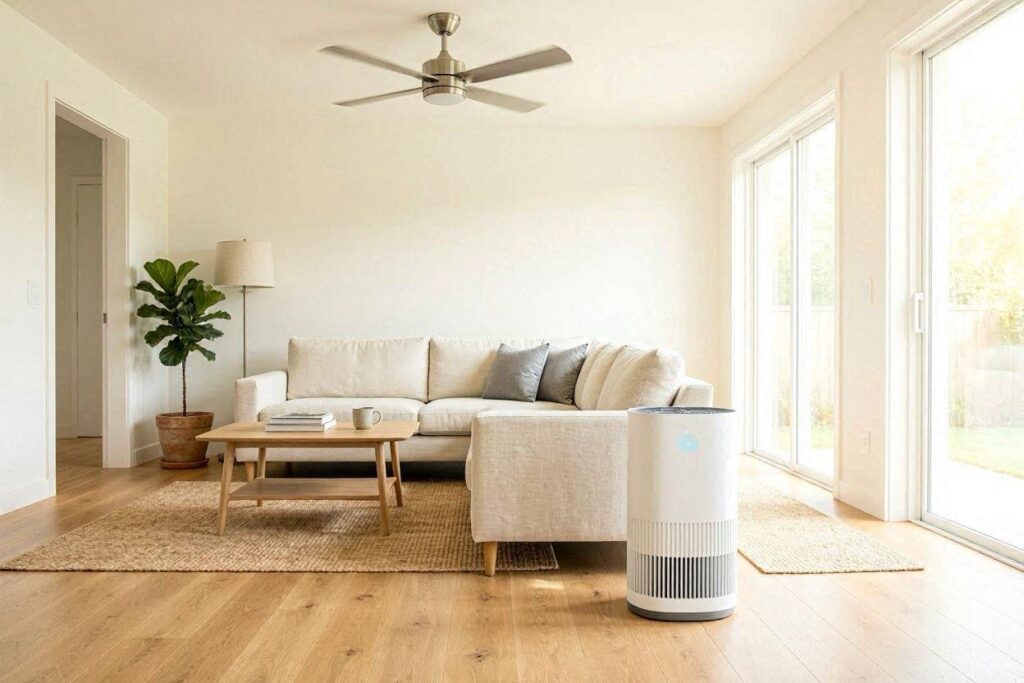
Summer airflow setup guide
A Fan Moves the Air—Your Purifier Still Has to Clean It
A ceiling fan can help mix room air so fewer pockets remain stagnant, but it cannot capture smoke, pollen, dust, or pet dander. The purifier still needs enough CADR, open intake space, a clean filter, and a fan speed that moves meaningful air through the machine.
Quick answer
Should you run a ceiling fan and air purifier together?
Yes, in many rooms you can run both. A ceiling fan or room fan may help distribute air through the space, while the purifier removes particles from the air that passes through its filter.
Use the circulation fan on a comfortable low or medium setting and keep the purifier’s intake and clean-air outlet unobstructed. Do not aim a powerful portable fan directly into either opening, because that can disrupt the purifier’s designed airflow or make the built-in sensor less representative of the room.
Remember that the extra fan does not increase the purifier’s rated CADR. If the purifier is undersized, running a ceiling fan cannot create the missing clean-air delivery.
Ceiling Fan vs. Air Purifier
| Device | What it does | What it does not do | Best role |
|---|---|---|---|
| Ceiling fan | Mixes room air and creates a cooling breeze | Does not filter particles or remove gases | Comfort and broad air circulation |
| Portable room fan | Moves air in a chosen direction | Does not create clean air by itself | Helping circulation in long or divided spaces |
| Air purifier | Pulls air through particle and, where included, gas-removal media | Does not cool the room like an air conditioner | Delivering filtered air to a defined room or zone |
| Purifier plus fan | Combines filtration with additional room-air mixing | Does not compensate for insufficient CADR or a clogged filter | Larger bedrooms, living rooms, offices, and long spaces |
When the Extra Fan May Help
A long living room
Gentle circulation may help reduce quiet corners where air moves less readily toward the purifier.
A room with high ceilings
A ceiling fan may improve mixing, but the purifier must still be sized for the room’s larger air volume.
A warm bedroom
The ceiling fan can improve comfort while the purifier runs at an effective, tolerable speed overnight.
An open sitting area
Additional circulation may help move air through an occupied zone when doors and furniture interrupt the path.
After dust is disturbed
Fan activity may temporarily increase airborne particles. Running the purifier can help capture particles that reach its intake.
Uneven sensor readings
Gentle mixing may reduce local pockets, although a separate monitor should still be kept away from the purifier outlet.
A Five-Step Purifier-and-Fan Setup
Size the purifier before adjusting circulation
Measure the floor area and account for ceiling height, open doors, adjoining rooms, and the fan speed you will actually use. A ceiling fan cannot turn a small purifier into a large-room purifier.
Clear every purifier vent
Check the front, back, sides, bottom, and top. Intake and outlet locations vary. Keep curtains, couches, bedding, laundry, plants, and walls from crowding the airflow path.
Use gentle room circulation
Start the ceiling fan on low or medium. The goal is broad circulation—not a forceful jet aimed directly into the purifier. For a pedestal or floor fan, angle it across the room rather than directly at the purifier’s intake or sensor.
Check the room—not only the purifier display
A built-in sensor mainly describes the air reaching that unit. When using a separate monitor, place it in the occupied area with free airflow and away from the purifier’s clean-air outlet.
Compare readings before and after changing the fan setup. Look for stable trends rather than reacting to one brief spike.
Inspect the filter after dusty periods
Fans can lift some settled dust and pet hair back into circulation. Check the purifier’s pre-filter and intake more often after cleaning, renovations, high pollen, open-window periods, or heavy pet activity.
Room-by-Room Settings
| Room | Fan approach | Purifier priority | Common mistake |
|---|---|---|---|
| Bedroom | Low ceiling-fan speed for comfort | Quiet but effective continuous operation | Using sleep mode so low that useful airflow collapses |
| Living room | Gentle circulation across the occupied area | Enough CADR for the open space | Hiding the purifier behind a couch |
| Home office | Low fan speed that does not disturb calls or papers | Steady filtration near the work zone | Placing the monitor beside the clean-air outlet |
| Pet room | Moderate circulation when comfortable for the pet | Accessible pre-filter and regular hair removal | Allowing fur to coat the intake |
| Open floor plan | Use existing ceiling fans to reduce stagnant zones | Size for the connected air volume or use multiple units | Expecting one compact purifier to clean the whole layout |
Free 15-page workbook
Plan the Room Before You Rearrange the Appliances
The free Smart Air Purifier Fit & Filter Planner helps you measure the room, adjust for ceiling height, estimate a CADR target, compare filter systems, verify replacement-filter compatibility, and calculate first-year ownership cost.
Use it to record where the purifier will sit, which doors remain open, and whether the room’s normal fan or cooling setup changes the space the purifier must serve.
Get the Smart Air Purifier Fit & Filter PlannerFive Setup Mistakes to Avoid
- Aiming a high-powered floor fan directly into the purifier sensor
- Blocking the purifier’s clean-air outlet with furniture or curtains
- Assuming more room-air movement means more verified CADR
- Leaving a separate air monitor beside the purifier outlet
- Using a small purifier in a connected open layout because the ceiling fan circulates well
Extra Air Movement Can Mean Extra Filter Loading
When a fan lifts settled dust, lint, or pet hair into the room, the purifier’s pre-filter may collect material faster. Check it according to the manufacturer’s directions and confirm the exact filter code before ordering replacements.
Readers who have already verified the correct replacement part can check replacement-filter availability through FiltersFast . Confirm the model number, filter code, package quantity, seller, and return terms before purchasing.
Homeowners considering compatible HVAC filtration or broader circulation support can review Field Controls indoor-air solutions and discuss system airflow, filter resistance, and installation with a qualified HVAC professional.
Affiliate disclosure: These are affiliate links. BestSmartPurifiers.com may earn a commission at no additional cost to you. Their inclusion does not change the room-sizing, placement, filter-verification, or reader-first standards used in this guide.
Four-question knowledge check
Can You Set Up the Fan and Purifier Correctly?
Choose one answer for each question, then check your score.
Reader Check-In
Do you run a ceiling fan, tower fan, or floor fan with your purifier? Share the room size, purifier location, fan setting, and whether the change affected comfort, sensor readings, dust collection, or noise. Real room setups can help another reader avoid trial and error.
Frequently Asked Questions
Does a ceiling fan make an air purifier work better?
It may improve room-air mixing in some spaces, helping more air move through the room. It does not increase the purifier’s tested CADR or replace correct sizing, filter maintenance, and open intake space.
Should the ceiling fan be on high?
Usually not. Start with a low or medium setting that provides comfortable circulation without creating excessive noise, drafts, or unnecessary dust movement.
Can I point a floor fan at the air purifier?
Avoid aiming a powerful fan directly into the purifier intake, outlet, or sensor. Angle it across the room to support broad circulation while allowing the purifier to manage its own designed airflow.
Will a fan spread dust around the room?
It can temporarily lift some settled dust, lint, or pet material into the air. Cleaning surfaces, maintaining the fan blades, and running a properly sized purifier can help manage particles that become airborne.
Should I use a ceiling fan during wildfire smoke?
An indoor ceiling fan may provide comfort and room mixing, but it does not remove smoke. Keep polluted outdoor air from entering when local guidance recommends it and run adequately sized particle filtration continuously.
Can a purifier cool a room like a fan?
No. A purifier may create a localized breeze, but it does not lower room temperature like an air conditioner. Its primary job is to move air through filtration media.
Continue learning
Related Best Smart Purifiers Resources
Smart Air Purifier Fit & Filter Planner
Measure the room, account for ceiling height, compare CADR, verify filters, and estimate first-year cost.
Get the free plannerComplete Air Purifier Guide
Review room sizing, airflow, filtration, noise, placement, runtime, and realistic purifier limitations.
Read the complete guideRoom Coverage Claims Explained
Learn why one purifier can have several advertised room sizes and how air-change assumptions affect the claim.
Understand coverage claimsAir Purifier Placement Guide
See where a purifier should sit in bedrooms, living rooms, offices, nurseries, and pet areas.
Improve purifier placementAir Purifiers vs. HVAC Filters
Compare room-focused portable filtration with central-system filters and layered whole-home approaches.
Compare filtration approachesSmart Purifier Sensors
Learn why a built-in reading may differ from conditions across the room and what the sensor may miss.
Interpret purifier readingsAuthoritative Guidance
Editorial note: BestSmartPurifiers.com reports on air-cleaning equipment from a consumer-research perspective. Room fans and ceiling fans move air but do not remove pollutants. Portable purifiers can reduce certain airborne particles when properly sized, placed, operated, and maintained, but they do not remove every gas or replace source control, safe ventilation when appropriate, certified alarms, medical care, emergency instructions, or qualified HVAC service.