College move-in air-quality guide
The Best Dorm Purifier Is Not Necessarily the Smallest One on the Shelf
Dorm rooms are compact, but they also contain two beds, clothing, rugs, laundry, open doors, cleaning sprays, shared ventilation, and very little free floor space. The right purifier must clean the actual room, remain quiet enough for sleep and study, fit without blocked vents, and use filters a student can afford to replace.
Quick answer
What should you look for in a dorm room air purifier?
Start with the dorm’s actual square footage and ceiling height. For an ordinary room with an eight-foot ceiling, a practical starting point is a smoke CADR equal to at least two-thirds of the floor area.
Then check noise at a useful fan speed, physical dimensions, intake and outlet locations, replacement-filter cost, manual controls, light-dimming options, and whether the residence hall permits the appliance.
A purifier should supplement source control and clean-air ventilation when appropriate. It cannot remove every pollutant, correct a mold or moisture problem, replace smoke or carbon-monoxide alarms, or overcome a filter that is blocked by bedding and furniture.
Compact Purifier vs. Properly Sized Purifier
| Buying factor | Smallest available purifier | Properly sized dorm purifier |
|---|---|---|
| Room fit | May fit easily on a crowded desk | Has enough clean-air delivery for the measured room |
| Cleaning speed | May process the room slowly | Uses smoke CADR matched to the room size |
| Noise | May need maximum speed to provide useful airflow | May deliver sufficient airflow at a more tolerable setting |
| Placement | Easy to hide behind books or a monitor | Selected with enough open intake and outlet space |
| Filter cost | Low upfront price may hide frequent filter replacement | Compared by first-year cost and filter availability |
| Roommate use | May be too noisy or bright to remain on | Includes practical fan, display, schedule, and manual controls |
What a Dorm Purifier May Help With
Dust and lint
Particle filtration may reduce airborne material from bedding, clothing, carpets, open windows, and regular room activity.
Outdoor smoke and pollen
A properly sized particle-filtering unit may reduce pollutants that enter through windows, doors, and building leakage.
Some odors
Activated carbon may help with certain odors, but thin carbon sheets have limited capacity and do not replace source removal.
Shared-room activity
Continuous filtration may help manage airborne particles created by frequent movement, visitors, and shared living.
Cleaning-day particles
Dusting, changing bedding, and vacuuming may temporarily raise airborne particle levels.
Sleep-time consistency
A quiet, properly sized purifier can provide steady room filtration without constant manual adjustments.
Seven Checks Before Move-In Day
Check the residence-hall rules
Review the current housing handbook or contact residence life before buying. Appliance, extension-cord, placement, noise, and electrical rules can differ by school and building.
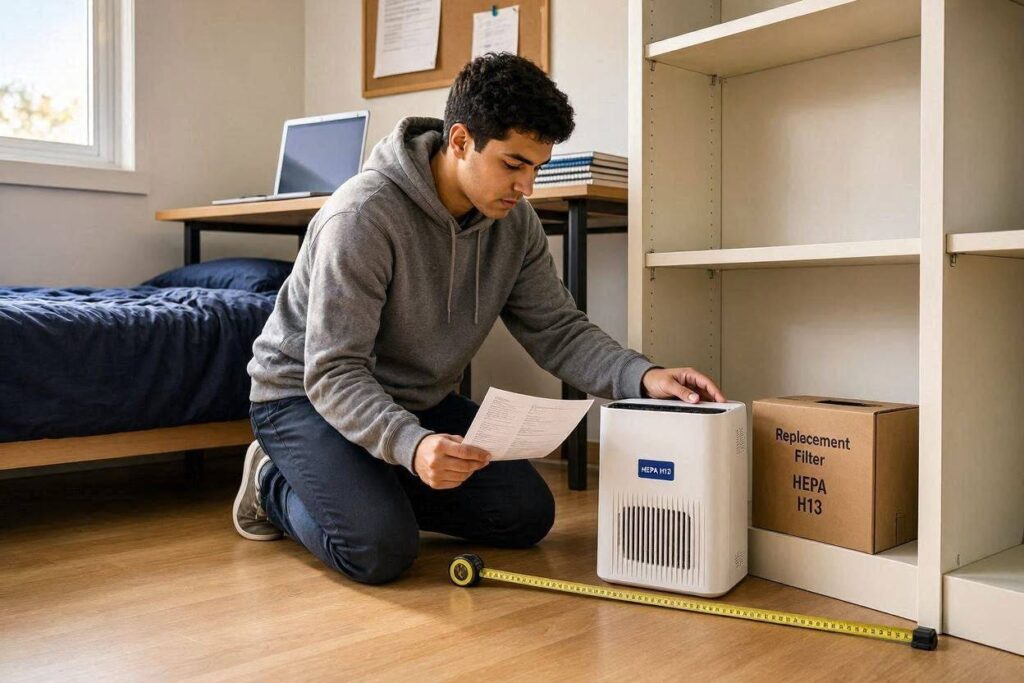
Measure the entire shared room
Use the full floor area—not just the half assigned to one student. Account for the ceiling height and any normally open doorway, connected sink area, or adjoining space.
Check noise at the speed that matters
Published CADR is commonly associated with a purifier’s highest setting. A tiny unit may sound acceptable on sleep mode but move too little air at that setting.
Look for clear noise information and consider whether both roommates can tolerate the machine during sleep, online classes, phone calls, and study time.
Plan the placement before buying
Check whether the unit pulls air from the back, front, sides, bottom, or all around. Confirm that its clean-air outlet will not be blocked by a lofted bed, curtain, desk shelf, clothing rack, or wall.
Compare the filter—not just the purifier
Record the exact replacement-filter code, current price, package quantity, expected replacement schedule, and seller availability. A student should know where the next filter will come from before the first one becomes loaded.
For odor concerns, confirm that the unit contains activated carbon or other gas-removal media rather than assuming every HEPA-style filter addresses odors.
Choose controls both roommates can use
App control can be convenient, but the purifier should also have understandable manual controls. Look for display dimming, child or control lock where useful, scheduling, filter reminders, and settings that do not require one roommate’s phone.
Avoid intentional ozone generation
Do not choose a device designed to generate ozone in an occupied dorm room. EPA identifies ozone as a lung irritant and advises against ozone generators in occupied spaces.
Dorm Room Sizing Examples
| Room size | Two-thirds smoke CADR starting point | When to size upward |
|---|---|---|
| 120 sq. ft. | About 80 smoke CADR or higher | Tall ceiling, wildfire smoke, frequent open door, or very low normal fan speed |
| 150 sq. ft. | About 100 smoke CADR or higher | Two occupants, heavy pollen, older leaky building, or lofted-bed placement limits |
| 180 sq. ft. | About 120 smoke CADR or higher | Connected sink or entry area, taller ceiling, or purifier used below maximum speed |
| 220 sq. ft. | About 147 smoke CADR or higher | Suite-style layout, open doorway, smoke preparation, or divided furniture arrangement |
Free 15-page workbook
Make the Dorm-Room Decision Before Shopping
The free Smart Air Purifier Fit & Filter Planner helps students and families measure the room, name the main air concern, estimate a CADR target, compare filter stages, verify replacement-filter compatibility, calculate first-year cost, and score final buying options.
Use it beside the housing handbook and purifier listings so room size, placement, noise, filter cost, and appliance rules stay in the same decision.
Get the Smart Air Purifier Fit & Filter PlannerThe Roommate Agreement Most Buyers Forget
A purifier affects both people sharing the room. Before move-in—or before the return period ends—agree on:
- Where the purifier will sit without blocking either person’s space
- Which fan speed will run during sleep and study
- Whether display lights should remain dimmed
- Who will clean the pre-filter and inspect the intake
- How replacement-filter costs will be handled
- Whether windows will stay open during high pollen or poor outdoor AQI
Put One Replacement Filter on the Move-In List
Before move-in, record the exact purifier model and filter code. Keeping one correct replacement available can be useful when smoke, heavy pollen, renovation dust, or supply shortages load the original filter faster than expected.
Readers who have already verified the correct replacement part can check replacement-filter availability through FiltersFast . Confirm the supported purifier model, filter code, package quantity, seller, specifications, and return terms before ordering.
Affiliate disclosure: This is an affiliate link. BestSmartPurifiers.com may earn a commission at no additional cost to you. Its inclusion does not change the room-sizing, filter-verification, residence-hall, or reader-first standards used in this guide.
Four-question knowledge check
Is Your Dorm Purifier Plan Ready?
Choose one answer for each question, then check your score.
Reader Check-In
Are you choosing a purifier for an incoming student or setting up your own residence-hall room? Share the room dimensions, ceiling height, purifier CADR, placement plan, and any appliance rule your school requires. Real dorm setups can help other families prepare more carefully.
Frequently Asked Questions
Are air purifiers allowed in college dorm rooms?
Rules vary by school, residence hall, electrical system, and appliance policy. Review the current housing handbook or contact residence life before purchasing or bringing a purifier.
What size air purifier is best for a dorm room?
Measure the entire room and check the ceiling height. For an ordinary room with an eight-foot ceiling, AHAM’s two-thirds guideline provides a practical starting point: choose smoke CADR equal to at least two-thirds of the floor area.
Where should an air purifier go in a dorm?
Place it on a stable, manufacturer-approved surface where every intake and outlet remains open. Keep it away from curtains, bedding, hanging clothing, water, heaters, clutter, and areas where it creates a tripping hazard.
Can a dorm purifier remove roommate odors?
Particle filtration alone does not remove most odor-causing gases. Activated carbon may help with some odors, but source removal, laundry, trash management, cleaning, and appropriate ventilation remain important.
Should the purifier run all night?
Longer runtime generally means more air passes through the filter. Choose a properly sized unit and a tolerable fan setting that both roommates can safely and consistently use.
Is a desktop purifier enough for a dorm room?
Only when its verified smoke CADR is sufficient for the room. A very small desktop unit may fit conveniently but provide too little clean-air delivery for the full shared space.
Continue learning
Related Best Smart Purifiers Resources
Smart Air Purifier Fit & Filter Planner
Measure the dorm, estimate CADR, compare filters, calculate first-year costs, and score final options.
Get the free plannerComplete Air Purifier Guide
Review room sizing, particle filtration, carbon, noise, smart controls, placement, and maintenance.
Read the complete guideRoom Coverage Claims Explained
Learn why one purifier may be advertised for several different room sizes.
Understand coverage claimsAir Purifier Placement Guide
See how furniture, walls, curtains, doors, and occupied zones affect purifier placement.
Plan the placementReplacement-Filter Mistakes
Learn how to match the exact purifier model, filter code, seal, stages, and seller details.
Avoid the wrong filterThe True Cost of Ownership
Compare purchase price, filters, electricity, maintenance, noise, and long-term availability.
Calculate the ownership costAuthoritative Guidance
Editorial note: BestSmartPurifiers.com reports on air-cleaning equipment from a consumer-research perspective. Residence-hall rules, purifier specifications, filter availability, prices, app features, and certifications can change. Verify the current school policy, purifier model, CADR, filter code, electrical requirements, seller information, and manufacturer instructions before purchasing. Portable purifiers can reduce certain airborne pollutants but cannot eliminate every pollutant or replace source control, clean-air ventilation when appropriate, building maintenance, certified alarms, emergency guidance, or medical care.