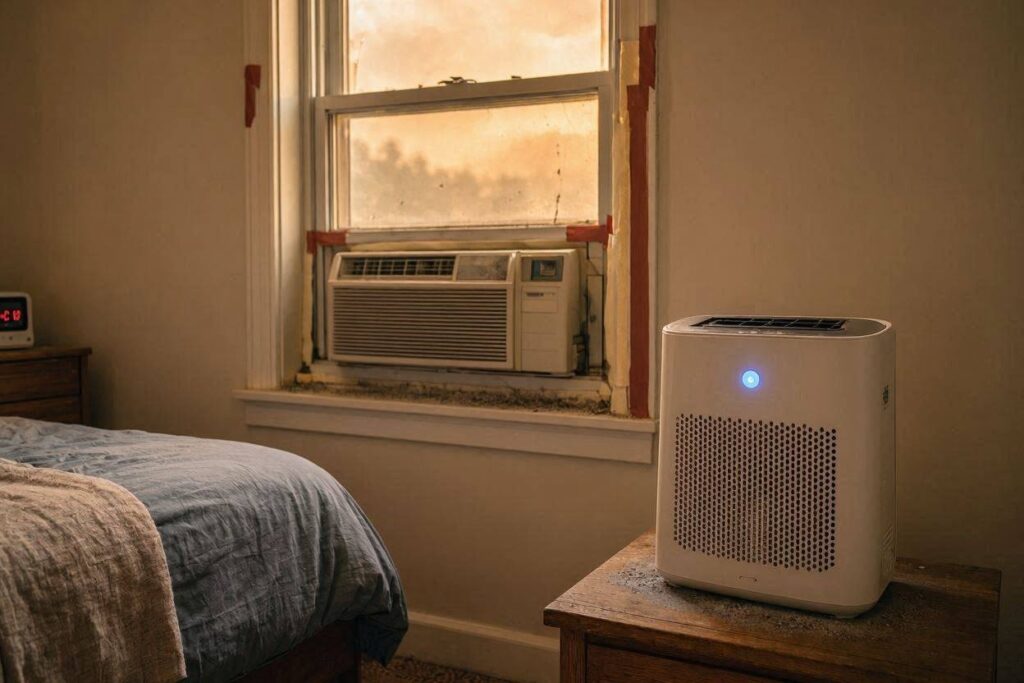
Summer smoke and cooling guide
Closing the Windows Is Only Half the Plan
When wildfire smoke and extreme heat arrive together, the goal is not simply to seal the room. You also need safe cooling, controlled outdoor-air entry, properly sized particle filtration, and filters that can handle longer runtime.
Quick answer
Can you run an air conditioner and air purifier during wildfire smoke?
Yes. In many homes, using cooling and portable filtration together is the more practical approach. Keep windows and exterior doors closed when outdoor air is smoky, set compatible systems to recirculate indoor air, and run a properly sized particle-filtering purifier continuously in the occupied room.
A central HVAC system, window unit, mini-split, or portable air conditioner does not automatically remove fine smoke particles. The purifier supplies focused particle filtration, while the air conditioner manages heat.
The correct setup depends on whether the cooling system recirculates indoor air, introduces outdoor air, or creates negative pressure that pulls smoky air through leaks.
How Different Cooling Systems Behave During Smoke
| Cooling system | Typical smoke concern | Practical setup |
|---|---|---|
| Central HVAC | Fresh-air intake or an inadequate system filter | Use recirculation where available and the highest-efficiency filter the system can safely handle |
| Window air conditioner | Gaps around the unit or an open outdoor-air vent | Seal the installation and close any fresh-air or ventilation control when appropriate |
| Mini-split | Indoor unit usually recirculates room air but may not capture fine smoke effectively | Use the mini-split for cooling and a portable purifier for particle filtration |
| Single-hose portable AC | May create negative pressure that draws outdoor air through leaks | Seal the window kit carefully and monitor indoor PM2.5 away from the purifier outlet |
| Dual-hose portable AC | Usually reduces room-pressure imbalance compared with a single-hose design | Seal both hose connections and continue using room filtration |
| Evaporative cooler | May depend on bringing outdoor air inside | Review local smoke guidance and the equipment design before operating |
A Six-Step Smoke-and-Heat Action Plan
Check the outdoor AQI and the heat forecast
Identify whether PM2.5 from wildfire smoke is driving the alert and whether indoor heat may become unsafe. Do not treat smoke protection and cooling as separate decisions.
Choose one priority room
Select a bedroom or living space where household members can spend several hours. Fewer exterior openings and a door that can close make the area easier to cool and filter.
Reduce direct smoke entry
Close windows and exterior doors when outdoor air is smoky. Inspect the window-unit panel, portable-AC hose plate, door sweeps, and visible gaps.
Do not permanently block required equipment ventilation or create an unsafe installation. Follow the appliance manufacturer’s directions.
Run the purifier continuously
Choose sufficient smoke CADR for the actual room and operate the purifier at the highest effective speed occupants can tolerate.
- Keep the purifier intake and outlet clear
- Use manual speed during a known smoke event
- Keep the priority-room door closed when practical
- Avoid candles, smoking, frying, and unnecessary aerosols
- Check PM2.5 away from the clean-air outlet when possible
Inspect both filter systems
Check the purifier pre-filter and main filter, along with the air conditioner or HVAC filter. Smoke and extended runtime may increase loading and reduce airflow.
Know when the home is no longer the safest place
A purifier cannot protect against nearby fire, structural danger, loss of power, carbon monoxide, or unsafe indoor temperatures. Follow evacuation notices and seek a public cleaner-air or cooling location when the home cannot remain safely cool and filtered.
Free 15-page workbook
Make Sure the Purifier Fits the Room Before Smoke Arrives
The free Smart Air Purifier Fit & Filter Planner helps you measure the priority room, estimate a CADR target, compare filter stages, verify replacement-filter compatibility, and calculate first-year ownership cost.
Get the Smart Air Purifier Fit & Filter PlannerFive Mistakes That Undercut the Setup
- Opening windows because the purifier display has turned green
- Assuming the air conditioner’s basic screen filter captures fine smoke
- Using a purifier sized for a bedroom in an open living area
- Ignoring gaps around a window unit or portable-AC hose panel
- Allowing indoor heat to become unsafe in the name of keeping smoke outside
Prepare Replacement Filters Before Demand Spikes
Record the exact purifier model, filter code, and HVAC filter size before a regional smoke event. Confirm fit, filter stages, package quantity, and return terms before ordering.
Readers who have verified the correct replacement part can check replacement-filter availability through FiltersFast .
Homeowners exploring compatible central filtration, controls, or whole-home indoor-air options can review Field Controls indoor-air solutions and discuss system airflow, filtration resistance, and installation with a qualified HVAC professional.
Affiliate disclosure: These are affiliate links. BestSmartPurifiers.com may earn a commission at no additional cost to you. Their inclusion does not change the room-sizing, filter-verification, safety, or reader-first standards used in this guide.
Four-question knowledge check
Is Your Smoke-and-Cooling Plan Ready?
Choose one answer for each question, then check your score.
Reader Check-In
Which cooling system do you use during smoke—central HVAC, a window unit, mini-split, or portable AC? Share the room size, purifier CADR, indoor PM2.5 pattern, and any sealing or filter change that improved the setup.
Frequently Asked Questions
Does an air conditioner remove wildfire smoke?
Not necessarily. Many cooling systems primarily control temperature. Fine-particle removal depends on the system’s filter efficiency, airflow, sealing, operating mode, and whether outdoor air is being introduced.
Can I use a window AC when it is smoky outside?
A conventional window unit may be usable when it is well sealed and any fresh-air vent is closed, but designs vary. Follow the current manufacturer instructions and local public-health guidance.
Should I run the purifier on auto mode?
Auto mode can be convenient, but a steady manual speed may provide more predictable filtration during a known wildfire-smoke event.
Can I open the windows after the purifier turns green?
Not based on the purifier light alone. Check the current outdoor AQI, pollutant, smoke forecast, temperature, and local guidance before bringing outdoor air inside.
Is a mini-split enough without an air purifier?
A mini-split can cool and recirculate room air, but its built-in filter may not provide sufficient fine-particle removal for wildfire smoke. Verify the system’s filtration specifications.
How often should filters be checked during smoke?
There is no universal schedule. Inspect filters more frequently during sustained smoke and extended runtime, and follow the equipment manufacturer’s replacement guidance.
Continue learning
Related Best Smart Purifiers Resources
Smart Air Purifier Fit & Filter Planner
Measure the room, estimate CADR, compare filters, and calculate first-year cost.
Get the free plannerCleaner-Air Room for Wildfire Smoke
Build one better-protected room before outdoor smoke reaches unhealthy levels.
Build a cleaner-air roomOutdoor AQI vs. Purifier Readings
Learn why outdoor air can remain unhealthy while a purifier displays green indoors.
Compare the readingsRoom Coverage Claims Explained
Understand how CADR, ceiling height, and air-change assumptions affect purifier sizing.
Check the room fitAir Purifiers vs. HVAC Filters
Compare room-level portable filtration with central-system and layered approaches.
Compare filtration optionsReplacement-Filter Mistakes
Match the exact filter code, fit, stages, airflow design, and seller information.
Avoid the wrong filterAuthoritative Guidance
Editorial note: BestSmartPurifiers.com reports on indoor-air equipment from a consumer-research perspective. Cooling-system designs, purifier specifications, filters, controls, and local smoke conditions vary. Verify current manufacturer instructions and public-health guidance. Air purifiers can reduce certain airborne particles but cannot eliminate every smoke component or replace safe cooling, evacuation instructions, certified alarms, medical care, source control, or qualified HVAC service.