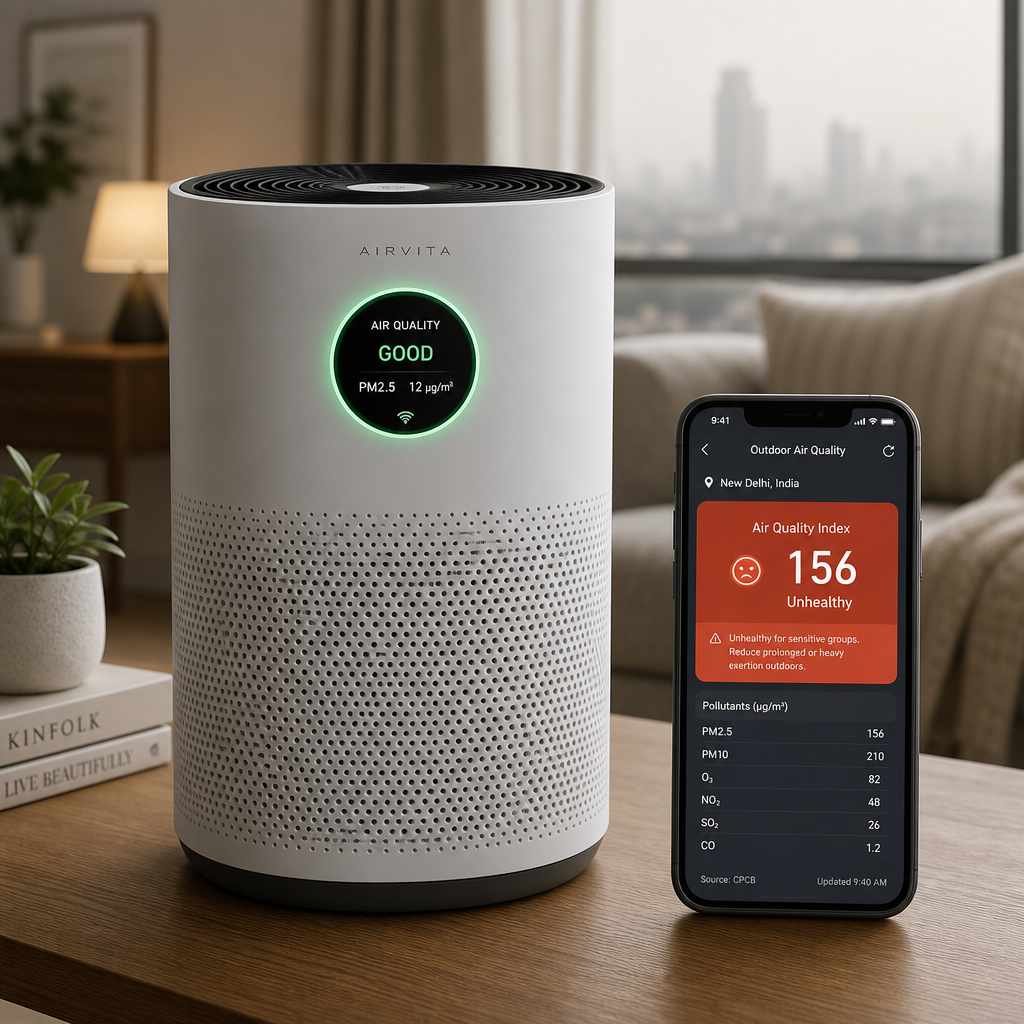
Outdoor versus indoor air quality
Both Readings Can Be Correct—and Still Tell You Different Things
AirNow may report unhealthy outdoor air while your purifier glows green inside. That does not automatically mean the purifier is wrong—or that it is safe to open the windows. The two readings come from different locations, may track different pollutants, and should be used for different decisions.
Quick answer
Which should you trust: the outdoor AQI or your purifier?
Use the outdoor AQI to decide whether outdoor air is suitable for opening windows, exercising outside, or bringing outside air into the home. Use the purifier reading as a limited estimate of the air near that purifier’s sensor.
An unhealthy outdoor AQI and a green purifier light can both be accurate. Closed windows and effective filtration may have reduced indoor particles even while outdoor pollution remains high.
However, a green indoor light does not prove that every room is clean, that ozone is absent, or that opening a window is safe. First identify which pollutant is driving the outdoor AQI and which pollutant the purifier actually measures.
Outdoor AQI vs. Purifier Reading
| Reading | Where it comes from | What it may represent | Best use |
|---|---|---|---|
| AirNow outdoor AQI | Regulatory monitors, supplemented by reporting and forecasting systems | The highest AQI among tracked outdoor pollutants for the location and period | Outdoor activity, window, ventilation, and exposure decisions |
| Purifier PM2.5 reading | A small particle sensor inside or near the purifier | Fine particles reaching that particular sensor | Watching indoor particle trends and purifier response |
| Purifier color indicator | The manufacturer’s software and thresholds | A simplified category based on supported sensors | Quick status checks after learning what the colors mean |
| Separate indoor monitor | A monitor positioned independently from the purifier | Pollution near its own location and supported sensors | Checking room patterns away from the clean-air outlet |
Free planning tool
Match the Room, CADR, and Filter Before the Next Alert
If outdoor AQI alerts keep sending you back to purifier specs, room measurements, filter codes, and ownership costs, use the free Smart Air Purifier Fit & Filter Planner. It helps you measure your room, compare CADR more carefully, record the correct replacement filter, and avoid buying from coverage claims alone.
This planner is especially helpful when you are trying to decide whether your current purifier is strong enough for a bedroom, home office, cleaner-air room, or open living area.
Get the Smart Air Purifier Fit & Filter PlannerThe Most Important Question: Is the Alert for Smoke or Ozone?
PM2.5 or wildfire smoke
Fine smoke particles can enter through windows, doors, gaps, and ventilation systems. A properly sized particle-filtering purifier can reduce indoor PM2.5 when it runs consistently.
Ground-level ozone
Typical particle filters do not remove ozone. Some substantial activated-carbon media may reduce certain gases, but ordinary purifier readings may not measure outdoor ozone at all.
Multiple pollutants
Hot, stagnant weather can involve ozone while transported wildfire smoke raises particles. One green PM2.5 light cannot summarize both problems.
A Five-Step Indoor-Air Action Plan
Check which pollutant is driving the outdoor AQI
Open AirNow or your local air-quality agency’s report and look beyond the overall color. Determine whether PM2.5, ozone, or another monitored pollutant is responsible for the alert.
Confirm what the purifier measures
Check the manual or manufacturer specifications for terms such as PM2.5, particulate matter, TVOC, humidity, or carbon dioxide. A label such as “smart sensor” or “air-quality detection” is not specific enough.
Reduce polluted outdoor-air entry
During wildfire smoke or an outdoor pollution alert, keep windows and exterior doors closed when it is safe to do so. Set compatible air-conditioning systems to recirculate rather than intentionally drawing in polluted outside air.
For a window air conditioner, follow current public-health and manufacturer guidance concerning the outdoor-air damper and window seal.
Run adequate filtration consistently
Use enough CADR for the actual room and operate the purifier continuously during a particle-pollution event. A steady manual speed may provide more predictable filtration than auto mode when you already know outdoor smoke is present.
- Keep the intake and outlet unobstructed
- Close the priority-room door when appropriate
- Inspect the pre-filter and main filter
- Avoid candles, smoking, frying, and unnecessary aerosols
- Check another part of the room when possible
Recheck before opening the windows
Do not open windows merely because the purifier has turned green. Recheck the outdoor AQI and the pollutant forecast. Ventilate when outdoor conditions improve and when doing so is appropriate for the home’s temperature, humidity, and indoor pollutant sources.
A Realistic Example
Suppose AirNow reports an AQI of 135 because wildfire smoke has raised outdoor PM2.5. Your bedroom purifier reports low indoor particles after running on high with the windows closed.
Those readings are not contradictory. The purifier may be successfully reducing indoor particles while outside air remains unhealthy for sensitive groups. Keep filtering, limit outdoor-air entry, and continue checking the outdoor report rather than opening the window because the purifier turned green.
Now suppose the AQI is driven mainly by ozone. Your purifier’s PM2.5 indicator may remain green because the device is not measuring ozone. In that case, the green light says little about the pollutant driving the outdoor alert.
Why Two Indoor Sensors May Disagree
| Reason | What may be happening | What to try |
|---|---|---|
| Different locations | One sensor is near the purifier while another is across the room | Compare readings side by side, then return the monitor to the occupied area |
| Clean-air outlet effect | The built-in sensor may sample filtered air sooner | Improve circulation and check the far side of the room |
| Different thresholds | Manufacturers may assign colors and categories differently | Compare numerical readings rather than colors alone |
| Humidity or aerosol interference | Steam, sprays, or high humidity may affect optical particle readings | Remove the interference and watch whether readings stabilize |
| Dirty sensor opening | Dust may affect airflow or sensor response | Clean only according to the manufacturer’s instructions |
Check Filter Readiness Before the Next Alert
Regional smoke events can increase demand for replacement filters. Record your purifier’s exact model and filter number before air quality deteriorates. Inspect the filter rather than relying only on an app countdown.
Readers who already know the correct replacement part can check replacement-filter availability through FiltersFast . Confirm the model number, dimensions, manufacturer, seller, specifications, and return terms before ordering.
Homeowners considering compatible central filtration or a layered whole-home approach can review Field Controls indoor-air solutions and discuss airflow, system compatibility, filter resistance, and installation with a qualified HVAC professional.
Affiliate disclosure: These are affiliate links. BestSmartPurifiers.com may earn a commission at no additional cost to you. Their inclusion does not change the AQI, room-sizing, source-control, filter-verification, or safety guidance used in this article.
Four-question knowledge check
Can You Read Outdoor and Indoor Air Quality Together?
Choose one answer for each question, then check your score.
Reader Check-In
Have you seen an unhealthy outdoor AQI while your purifier remained green? Share the outdoor pollutant, purifier model, indoor reading, room size, and fan setting. Real examples can help other readers understand when filtration is working—and when a green indicator is simply measuring the wrong concern.
Frequently Asked Questions
Why is AirNow unhealthy when my indoor monitor says good?
AirNow reports outdoor conditions, while the indoor monitor measures air near its own location. A closed home with effective filtration may have lower indoor particle levels even while the outdoor AQI remains unhealthy.
Should I open the windows when my purifier turns green?
Not without checking outdoor conditions. A green purifier light reflects its indoor sensor, not the safety of outdoor air. Check the current AQI, pollutant, forecast, temperature, and local guidance first.
Can a HEPA purifier remove ground-level ozone?
A particle filter such as HEPA is not designed to remove ozone. Gas-removal performance depends on the type and quantity of sorbent media, airflow, pollutant concentration, and other conditions.
Should I use auto mode during wildfire smoke?
Auto mode may be convenient, but a steady manual speed can provide more predictable filtration during a known smoke event. The best setting is one that supplies adequate airflow for the room and remains tolerable for occupants.
Does closing the windows keep all smoke outside?
No. Smoke can enter through gaps, doors, ventilation, and building leakage. Closing windows reduces direct entry, while properly sized portable or HVAC filtration can help lower particles that get indoors.
Can one purifier reading represent the entire house?
No. Pollution levels may differ by room, floor, open doorway, ventilation pattern, source, and distance from the purifier. A built-in sensor mainly describes conditions near that unit.
Continue learning
Related Best Smart Purifiers Resources
Smart Air Purifier Fit & Filter Planner
Use the free planner to measure your room, compare CADR, estimate ownership costs, and record the exact replacement-filter number.
Get the free plannerSmart Air Purifiers Guide
Learn how PM2.5 sensors, VOC readings, auto mode, apps, schedules, and smart-home routines work.
Understand smart purifier sensorsIndoor Air Quality Matters
Build a layered plan using source control, safe ventilation, filtration, moisture management, alarms, and professional help.
Build an indoor-air planTop Indoor Air Pollutants
Compare smoke, pollen, VOCs, mold, radon, carbon monoxide, cooking particles, and other concerns.
Identify the likely pollutantAir Purifiers vs. HVAC Filters
Compare room-level portable filtration with central-system filters and layered whole-home approaches.
Compare filtration strategiesUnderstanding Filter Technology
Learn the different jobs performed by particle filters, activated carbon, ionizers, UV, and other technologies.
Compare filter technologiesComplete Air Purifier Guide
Review room sizing, CADR, placement, runtime, noise, filter costs, and realistic purifier limits.
Read the complete purifier guideAuthoritative Guidance
Editorial note: BestSmartPurifiers.com reports on indoor-air equipment from a consumer-research perspective. Outdoor AQI, purifier sensors, and consumer monitors describe different environments and may track different pollutants. Portable air purifiers can reduce certain airborne particles when properly sized and operated, but they do not remove every gas or replace certified smoke and carbon-monoxide alarms, radon testing, emergency guidance, medical care, source control, safe ventilation, or qualified HVAC service. Verify current local conditions and manufacturer specifications before acting.