Smart Air Purifier Guide 2026
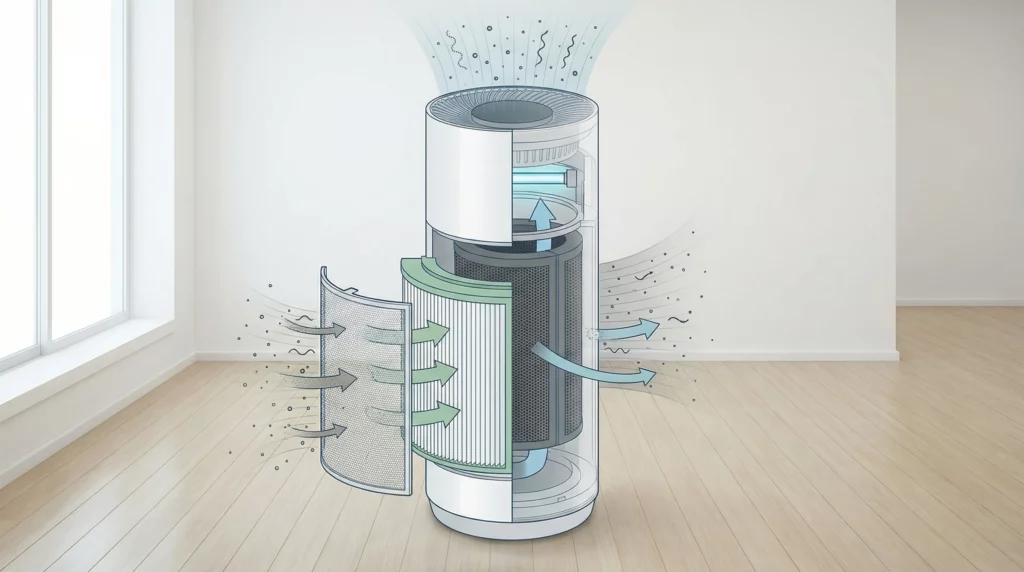
Air purifier technology has moved far beyond a basic fan and filter. Today’s best smart purifiers combine HEPA filtration, activated carbon, sensors, app controls, quiet fan design, and better energy efficiency to help you manage the air inside your home with more confidence.
Affiliate disclosure: This article may contain partner links. If you use one, BestSmartPurifiers.com may earn a commission at no extra cost to you. Our goal is to help you understand air purifier technology clearly so you can choose what fits your room, your budget, and your indoor air concerns.
Quick Answer: What Air Purifier Technology Matters Most?
If you want the simplest answer, look for a purifier with a strong particle filter, enough CADR for your room, and enough activated carbon for odors or VOC concerns. HEPA filtration is best for particles like dust, pollen, pet dander, mold spores, and fine smoke particles. Activated carbon is used for gases, odors, and many VOCs. Smart sensors and app controls are useful, but they should support the core job, not distract from it.
The safest default for most homes in 2026: a properly sized HEPA-style purifier with real activated carbon, no intentional ozone generation, clear replacement filter availability, and a CADR rating that matches the room where it will actually be used.
Clean indoor air matters because the air inside a home can carry a mix of particles and gases. Dust, pollen, pet dander, mold spores, fine particulate matter, cooking byproducts, smoke, cleaning-product chemicals, furniture emissions, and volatile organic compounds can all affect comfort and indoor air quality.
That is why air purifier technology is easier to understand when you break it into jobs. One technology handles particles. Another handles gases and odors. Another may help with microbes under the right conditions. Smart features help you see and manage what is happening. No single feature should be treated as magic.
A good purifier is not a replacement for source control, ventilation, or routine cleaning. It is a supplement. But when the purifier is sized correctly and uses the right filter stack, it can make a meaningful difference in the room where you spend the most time.
HEPA Filtration: The Particle-Capture Workhorse
HEPA stands for high-efficiency particulate air. In simple terms, a HEPA filter is designed to capture tiny airborne particles as air passes through a dense web of fibers. True HEPA filtration is commonly associated with removing at least 99.97% of airborne particles at 0.3 microns in laboratory testing conditions.
That makes HEPA-style filtration especially valuable for everyday particle problems, including dust, pollen, pet dander, mold spores, and many smoke-related particles. It is one of the most important technologies to understand when shopping for an air purifier because it handles the pollutants people usually picture when they think of “dirty air.”
What HEPA Is Best At
- Dust and household airborne particles
- Pollen and seasonal allergy triggers
- Pet dander and fine pet-related debris
- Mold spores floating in the air
- Many smoke and PM2.5 particles
How HEPA Filters Actually Trap Particles
HEPA filters do not work like a kitchen strainer where only large particles get caught. They use several capture methods at once. Larger particles can crash into fibers and stick. Medium particles may brush against fibers as they pass through. Very tiny particles move unpredictably in the airflow, which increases the chance that they will hit and attach to a filter fiber.
That is why the “0.3 micron” number can be confusing. It does not mean HEPA only captures particles at that size. It refers to a difficult particle size used in performance testing. In real home use, airflow, filter quality, seal design, fan speed, and room placement all matter too.
What HEPA Does Not Do Well
HEPA filtration is excellent for particles, but it is not the main technology for gases, chemical odors, VOCs, or smoke smell. If you are trying to reduce cooking odors, pet smells, cleaning-product fumes, wildfire smoke odor, or off-gassing from new furniture, you also want a purifier with a meaningful activated carbon stage.
Activated Carbon: The Odor, Gas, And VOC Layer
Activated carbon is the part of the filter stack that targets gases and odors. It works through adsorption, where gases and odor molecules attach to the surface of the carbon. This is different from HEPA filtration, which physically captures particles.
This matters because many indoor air complaints are not just particle problems. A room can look clean and still smell like cooking, pets, smoke, paint, cleaning products, or new furniture. In those cases, HEPA alone is not enough.
What Activated Carbon Helps With
- Cooking odors
- Pet smells
- Some smoke odors
- Many VOCs from household products
- Certain chemical fumes and off-gassing concerns
The biggest mistake shoppers make is assuming every “carbon filter” performs the same. A thin carbon sheet is not the same as a deep bed of pelletized or granular carbon. In general, more carbon gives gases and odors more surface area and contact time, which can improve performance.
Activated carbon also becomes saturated. Once it is loaded with gases and odor compounds, it cannot keep working forever. If odor control is your main reason for buying a purifier, check the replacement filter cost and schedule before choosing the model.
BestSmartPurifiers tip: If your purifier still moves air but odors return quickly, the particle filter may not be the problem. The carbon stage may be spent.
CADR: The Number That Matters More Than Big Room Claims
Clean Air Delivery Rate, or CADR, tells you how quickly an air purifier can deliver filtered air. It is one of the most useful numbers to compare because it connects filtration performance with airflow.
Many air purifier boxes advertise huge room sizes, but those claims can be based on very low air-change assumptions. For real-world shopping, CADR is usually more helpful than a bold “covers up to” number on a product page.
| Technology | Best For | Not Best For | What To Check |
|---|---|---|---|
| HEPA / Particle Filter | Dust, pollen, dander, mold spores, PM2.5, smoke particles | Odors, gases, VOCs | CADR, filter seal, replacement cost |
| Activated Carbon | Odors, VOCs, smoke smell, cooking smells | Dust, pollen, dander | Carbon amount, replacement schedule |
| UV-C | Microbial control under proper design conditions | Particles, odors, VOCs | Ozone-free design, exposure time, safety certification |
| Ionizer / Plasma | Supplemental particle charging in some designs | Primary filtration, ozone-sensitive homes | Whether it can be turned off, ozone testing |
| Smart Sensors | Auto mode, PM2.5 tracking, app alerts, routines | Replacing filtration power | Sensor type, display clarity, Matter/app support |
Simple CADR Sizing Rule
As a practical starting point, look for a smoke CADR that is at least two-thirds of the room’s square footage. For example, a 300-square-foot bedroom or office would need a smoke CADR of about 200 or higher. For smoke-heavy concerns, sizing up is often the smarter move.
Also remember ceiling height. Most simple room-size estimates assume an 8-foot ceiling. Tall ceilings, open floor plans, and rooms connected to hallways need more air-cleaning power.
UV-C Light: Useful In Some Designs, But Not A Standalone Solution
UV-C light is used in some air purifiers to help inactivate certain microorganisms. The concept is simple: expose microbes to enough UV-C energy for enough time, and the light can damage them so they cannot multiply normally.
The important phrase is “enough time.” In a small consumer purifier, air may pass through the unit quickly. If the UV-C chamber is weak, poorly placed, or mostly included for marketing, the benefit may be limited.
UV-C also does not remove dust, pollen, pet dander, VOCs, or odors by itself. It is best viewed as a possible supporting feature, not the main reason to buy a purifier.
Safety Note On UV-C And Ozone
Some air-cleaning technologies can produce ozone, either intentionally or as a byproduct. For home use, avoid devices that intentionally generate ozone. Ozone can irritate the lungs and is not a safe shortcut for cleaner indoor air.
Ionizers, Electrostatic Systems, And Ozone Generators
Ionizers and electrostatic systems use electrical charges to affect airborne particles. Some designs charge particles so they attach to collection plates or nearby surfaces. Others are added as optional “boost” modes inside filter-based purifiers.
The concern is not that every ionizer is automatically the same. The concern is that some electronic air-cleaning technologies can produce ozone, and some simply cause particles to settle onto surfaces rather than fully removing them from the home.
Ozone generators are different and should be treated with much more caution. These devices intentionally release ozone into indoor air. For occupied homes, that is not the technology to chase. The safer path is filtration, source control, ventilation when outdoor air is clean, and properly sized equipment.
Shopping rule: If a purifier promotes “activated oxygen,” “super oxygen,” or ozone-based odor removal for normal home use, keep looking.
Smart Air Purifiers: Sensors, Apps, Auto Mode, And Matter
The smart-home side of air purification has improved quickly. A smart purifier can show PM2.5 levels, adjust fan speed automatically, send filter alerts, track air quality patterns, and connect with routines in a larger smart-home setup.
That does not mean every smart purifier is automatically better. Sensors vary. Some detect particles well but do not measure VOCs. Some display a simple color ring without showing useful numbers. Others provide detailed readings, history, and automation support.
Smart Features Worth Paying For
- PM2.5 display: Helps you see fine-particle changes from cooking, smoke, dust, and outdoor pollution.
- Auto mode: Adjusts fan speed when the sensor detects worsening air.
- Filter-life tracking: Helps you avoid running an overloaded filter too long.
- Quiet scheduling: Useful for bedrooms and nurseries.
- Matter or broad smart-home compatibility: Helpful if you use Apple Home, Google Home, Amazon Alexa, or other connected systems.
Matter support is especially important to watch because smart-home buyers increasingly want devices that do not lock them into one app or ecosystem. Matter has added support for air purifiers and air quality sensors, which may make future smart purifier setups cleaner and easier to manage across platforms.
Still, the same rule applies: smart features should not compensate for weak filtration. A beautiful app cannot fix an undersized purifier.
Energy Efficiency: The Overlooked Air Purifier Feature
Air purifiers are often meant to run for long stretches of time. That makes energy efficiency more important than many shoppers realize. A purifier that performs well but uses too much electricity can become expensive if it runs day and night.
Look for ENERGY STAR certification, CADR-per-watt efficiency, and a good balance between airflow and noise. The best purifier is not always the one with the highest top speed. It is often the one you can afford to run consistently at a livable noise level.
Bedroom Buyer Tip
For bedrooms, consider sizing up slightly and running the purifier on a lower speed. A larger unit at a quiet setting may be more comfortable than a smaller unit running loudly all night.
What Technology Should You Choose?
The right air purifier technology depends on the problem you are trying to solve. Here is the cleanest way to think through it.
For Allergies
Prioritize HEPA-style particle filtration, strong CADR, and a sealed filter design. Carbon is still useful, but particles are the main target.
For Pets
Look for a washable pre-filter, HEPA filtration, and a carbon layer for odor. Filter replacement cost matters in pet homes.
For Smoke
Choose high smoke CADR and more activated carbon. Smoke is both a particle and odor problem, so weak carbon may disappoint.
For VOCs
Activated carbon or another gas-focused sorbent is essential. HEPA alone is not built for VOC removal.
If you are dealing with mold, remember that a purifier may capture airborne spores, but it will not fix the moisture problem causing mold growth. The same goes for strong chemical sources. Removing or reducing the source is still the first step.
Replacement Filters: The Part People Forget
A purifier is only as good as the filters inside it. Dirty, overloaded filters reduce airflow and performance. Carbon filters can become saturated. Pre-filters can clog with hair and dust. Before buying any purifier, check how easy it is to find replacement filters and how much they cost over a full year.
If you already own a purifier, keeping the correct filter on hand can make maintenance easier. For replacement filter shopping, you can compare options through FiltersFast. For readers looking beyond portable units and into broader whole-home air quality equipment, Field Controls is also worth reviewing.
BestSmartPurifiers Takeaway
A modern air purifier should not be judged by one buzzword. HEPA handles particles. Activated carbon helps with gases and odors. CADR tells you how much clean air the unit can deliver. Smart sensors help you manage changes. Energy efficiency affects long-term cost. Ozone-free design protects safety.
The best choice is not the purifier with the longest feature list. It is the one with the right technology stack for your room and your real air-quality problem.
Frequently Asked Questions
Is HEPA better than activated carbon?
HEPA and activated carbon do different jobs. HEPA is better for particles like dust, pollen, pet dander, and smoke particles. Activated carbon is better for gases, odors, and many VOCs. The best purifiers often use both.
Can an air purifier remove VOCs?
Some air purifiers can reduce certain VOCs if they include a substantial activated carbon or gas-phase filtration stage. A basic HEPA-only purifier is not designed for VOC removal.
Are ionizers safe?
Some ionizers are designed to meet low-ozone limits, but shoppers should be cautious. Choose models with clear ozone testing, avoid ozone generators, and look for units where ionizer features can be turned off.
What is CADR?
CADR stands for Clean Air Delivery Rate. It measures how quickly an air purifier delivers filtered air. Higher CADR usually means faster particle removal for a larger room.
Do smart air purifiers clean better?
Not automatically. Smart features can make a purifier easier to manage, but filtration power still comes from the fan, filter quality, airflow design, and room sizing. Smart controls are helpful when they support a strong purifier.
Should I leave my air purifier on all day?
Many air purifiers are designed for extended use, especially during allergy season, smoke events, or high-pollution days. For long run times, energy efficiency, noise level, and filter cost become important buying factors.
Final Word: Cleaner Air Starts With Matching The Technology To The Problem
Air purifier technology can sound complicated, but the buying decision becomes easier once you know what each layer does. HEPA captures particles. Activated carbon targets gases and odors. CADR helps you size the unit correctly. Smart sensors make the system easier to manage. Ozone-generating devices are not the shortcut they are often marketed to be.
Start with the room, identify the pollutant, check the CADR, confirm the filter stack, and make sure replacement filters are easy to find. That is how you choose an air purifier that works in real life, not just on a product box.
Helpful authority sources: EPA Guide to Air Cleaners in the Home, EPA HEPA filter guidance, AHAM CADR guidance, CARB ozone air cleaner warnings, ENERGY STAR air cleaner guidance, and Connectivity Standards Alliance Matter updates.