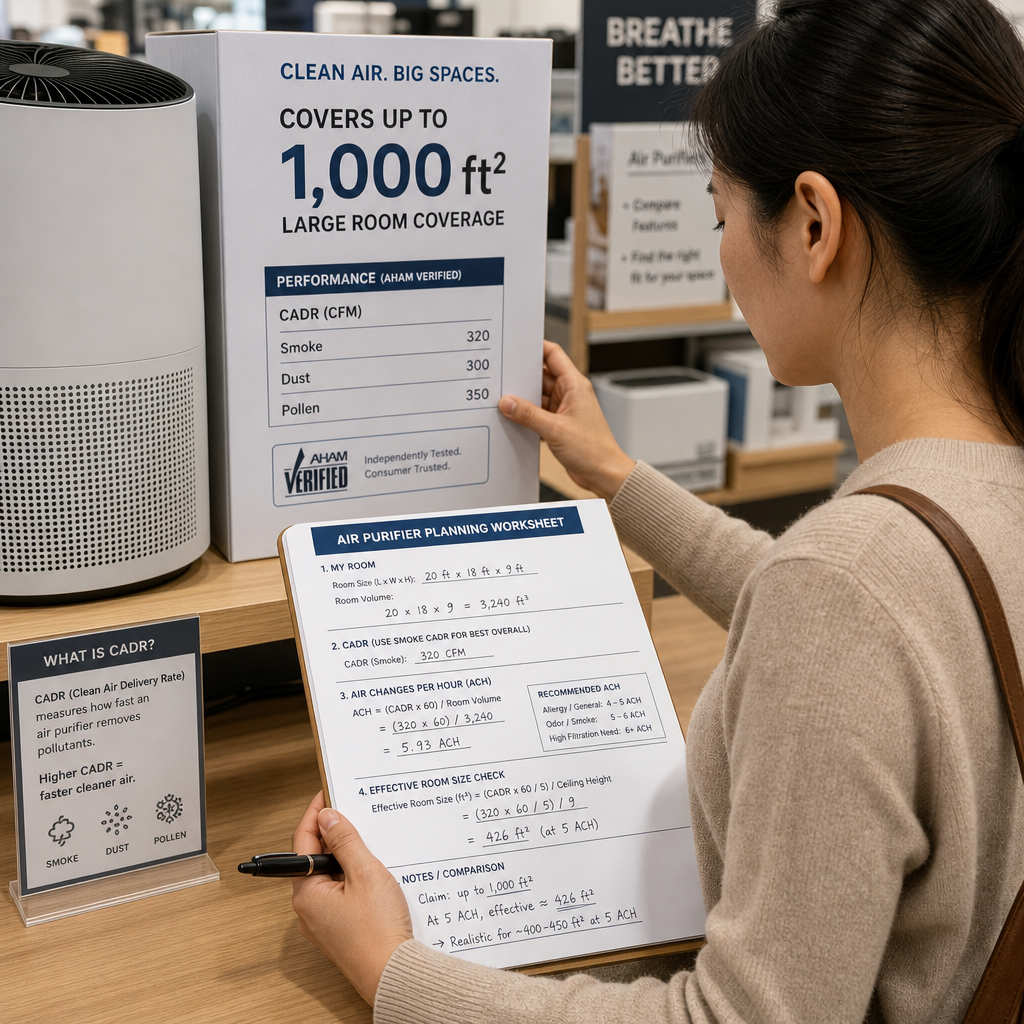
Air purifier buying reality check
The Biggest Number on the Box May Be the Least Useful One
A purifier advertised for 1,500 square feet may clean that space only once per hour. Put the same machine in a much smaller room, and it may clean the air four or five times per hour. The product has not changed—the marketing assumption has.
Quick answer
Can you trust an air purifier’s room-coverage claim?
You can use it only after checking the assumed air changes per hour. A large coverage claim may describe one complete air cleaning per hour, while a smaller suggested room size may be based on approximately 4.8 air changes per hour.
For a more consistent comparison, look for the purifier’s smoke CADR. For a standard room with an eight-foot ceiling, AHAM’s practical rule is to choose a smoke CADR of at least two-thirds of the room’s floor area.
A 300-square-foot room therefore calls for a smoke CADR near 200 or higher under that rule. For wildfire smoke, AHAM recommends a smoke CADR approximately equal to the room’s square footage.
Same Purifier, Very Different Coverage Claims
| Claim or metric | What it may mean | How useful it is |
|---|---|---|
| “Covers up to 1,500 sq. ft.” | The purifier may clean that large area only about once per hour | Limited unless the air-change assumption is disclosed |
| “Recommended for 300 sq. ft.” | May reflect a faster air-change rate intended for regular room cleaning | More useful when tied to a recognized test method |
| Smoke CADR: 200 | About 200 cubic feet of smoke-particle-cleaned air delivered per minute | Useful for comparing particle-cleaning performance |
| 4.8 ACH | The room’s air volume is theoretically processed about 4.8 times per hour | Useful for comparing rooms of the same ceiling height |
| HEPA filter | Describes filter efficiency—not how quickly enough room air reaches it | Important, but incomplete without airflow or CADR |
Three Reasons the Advertised Number May Not Fit Your Room
Your ceiling is higher
Coverage claims commonly assume an eight-foot ceiling. A 300-square-foot room with a 12-foot ceiling contains 50% more air than the same room with an eight-foot ceiling.
The room is open to other spaces
An open kitchen, hallway, stairwell, or adjoining living room increases the air volume the purifier is effectively serving.
You cannot tolerate high speed
CADR is generally associated with the purifier’s highest tested setting. If that speed is too loud, real-world cleaning may be slower.
A Four-Step Sizing Check Before You Buy
Measure the actual space
Multiply room length by width to find the floor area. Then note the ceiling height and whether doors normally remain open.
Find the smoke CADR
Look for a verified smoke CADR rather than relying on airflow, filter efficiency, or a broad coverage statement. CADR combines particle-removal performance with airflow.
Adjust for real-world conditions
Size upward for high ceilings, open layouts, wildfire smoke, frequent cooking particles, heavy pet activity, or a purifier that will usually operate below maximum speed.
Check whether you can afford to keep it running
Confirm the replacement-filter number, annual filter cost, energy use, noise level, and filter availability. An adequately sized purifier is not useful if its filters become unaffordable or unavailable.
Free 15-page workbook
Work Through the Numbers Before Spending Your Money
The free Smart Air Purifier Fit & Filter Planner helps you record room dimensions, identify the air problem, compare CADR, check replacement-filter compatibility, estimate first-year ownership cost, and score your final options.
Get the Smart Air Purifier Fit & Filter PlannerOne Larger Purifier or Two Smaller Units?
| Setup | Better fit | Main limitation |
|---|---|---|
| One larger purifier | One open room or defined living area with good circulation | May not clean around corners or through closed doors effectively |
| Two smaller purifiers | Separate bedrooms, divided spaces, or opposite ends of a long room | Requires two filters, two outlets, and more maintenance tracking |
| Portable plus HVAC filtration | Whole-home background support with stronger cleaning in a priority room | HVAC compatibility and filter resistance must be evaluated |
Check the Filter Before Committing to the Purifier
A low purchase price can become expensive when the correct filter is difficult to identify or costs more than expected. Record the exact model and filter code before buying.
Readers who have already confirmed the correct replacement part can check replacement-filter availability through FiltersFast . Verify the model, dimensions, manufacturer, seller, specifications, and return terms before ordering.
Homeowners comparing portable units with compatible central filtration can review Field Controls indoor-air solutions and discuss filter resistance, airflow, and installation with a qualified HVAC professional.
Affiliate disclosure: These are affiliate links. BestSmartPurifiers.com may earn a commission at no additional cost to you. Their inclusion does not change the sizing, CADR, filter-verification, or ownership-cost standards used in this guide.
Four-question knowledge check
Can You See Through a Room-Coverage Claim?
Choose one answer for each question, then check your score.
Reader Check-In
Have you found two different room-size claims for the same purifier? Share the model, stated coverage, smoke CADR, room dimensions, and the fan speed you normally use. Real examples can help other readers spot misleading comparisons.
Frequently Asked Questions
Is a purifier advertised for 1,500 square feet powerful enough for that room?
Possibly, but the claim may assume only one air change per hour. Check the smoke CADR and calculate how often the purifier can process the room’s actual air volume.
What is the easiest way to size an air purifier?
For a standard eight-foot ceiling, AHAM’s two-thirds rule provides a practical starting point: choose a smoke CADR at least two-thirds of the room’s square footage. Adjust upward for high ceilings, open layouts, smoke, or lower fan speeds.
Is HEPA more important than CADR?
Both matter. Filter efficiency describes how well the filter captures certain particles, while CADR reflects how much particle-cleaned air the complete purifier delivers. A highly efficient filter with weak airflow may clean a room slowly.
Does CADR apply to odors and VOCs?
Traditional smoke, dust, and pollen CADR ratings describe particle removal. They do not show how much activated carbon is present or how effectively a purifier handles specific gases or odors.
Can one purifier clean two bedrooms?
Not reliably when the doors are closed. Portable purifiers work best in defined rooms or zones. Separate occupied rooms commonly benefit from separate properly sized units.
Should I size an air purifier using its quiet setting?
Consider the speed you will actually tolerate. If published CADR applies only to maximum speed but you plan to use medium or sleep mode, choosing additional capacity may provide better real-world performance.
Continue learning
Related Best Smart Purifiers Resources
Smart Air Purifier Fit & Filter Planner
Measure the room, compare CADR, estimate ownership cost, and record the correct replacement filter.
Get the free plannerComplete Air Purifier Guide
Review filtration, room sizing, noise, placement, runtime, and realistic purifier limitations.
Read the complete guideSmall Apartments vs. Large Homes
See how layout, multiple rooms, noise, and maintenance change the buying decision.
Compare home sizesAir Purifiers vs. HVAC Filters
Compare room-focused portable filtration with central-system and layered approaches.
Compare the approachesTrue Cost of Ownership
Calculate replacement filters, electricity, maintenance, and long-term availability.
Review long-term costsSmart Air Purifiers Guide
Learn how sensors, auto mode, schedules, apps, and smart-home controls fit into the decision.
Understand smart featuresAuthoritative Guidance
Editorial note: BestSmartPurifiers.com evaluates air-cleaning equipment from a consumer-research perspective. CADR and suggested room size describe particle-cleaning performance under specific test conditions. They do not measure every gas, odor, building condition, or real-world airflow pattern. Verify current manufacturer specifications, filter compatibility, certification information, and operating instructions before purchasing.