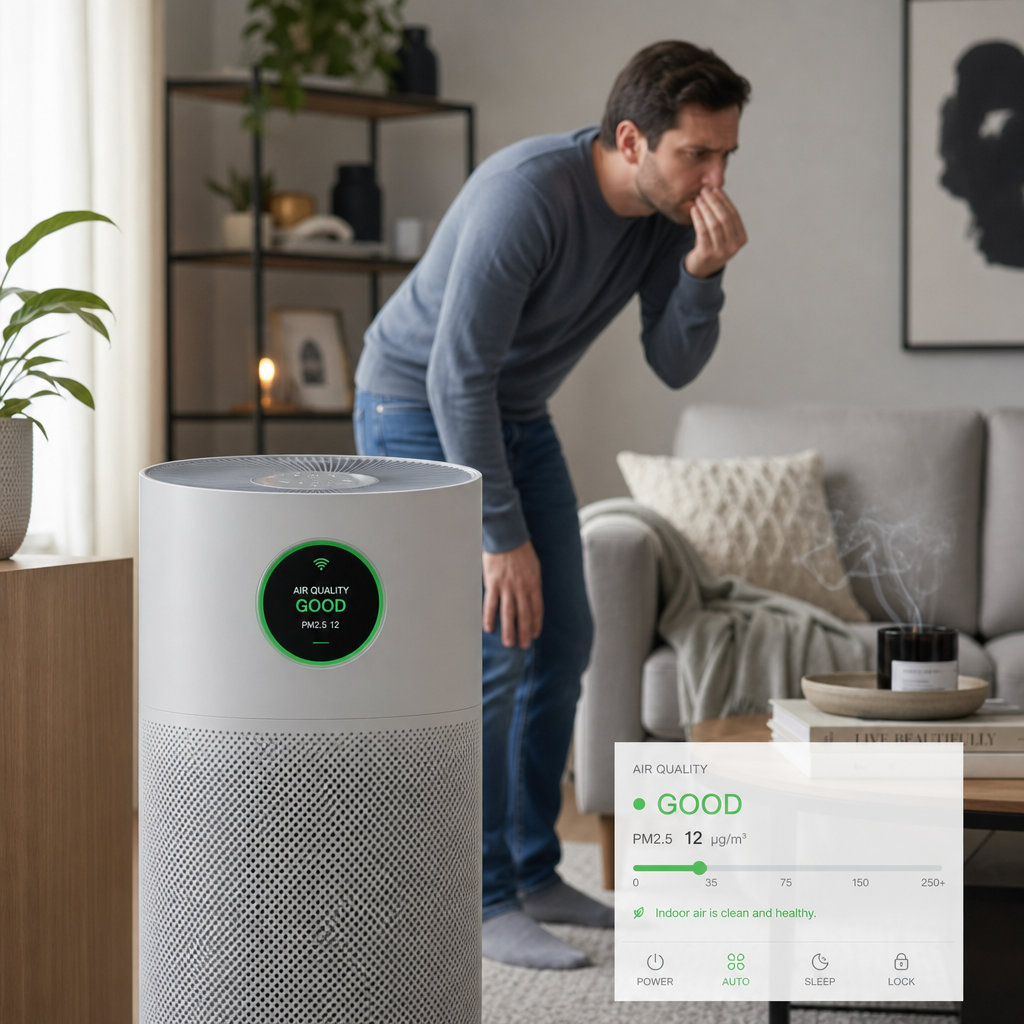
Smart purifier reality check
A Green Light Does Not Mean Every Indoor-Air Problem Is Gone
Your purifier may be accurately reporting low particle levels while completely missing the odor, gas, moisture, ventilation, or source problem you can still smell. The answer is not always a larger purifier. Start by identifying what the built-in sensor actually measures.
Quick answer
Why does the purifier say the air is good when the room still smells bad?
Most smart air purifiers measure only one or two air-quality signals. A model with a particle sensor may respond well to smoke, dust, or cooking particles but remain green when the problem is a gas, odor, excess humidity, stale ventilation, or a hidden moisture source.
Even purifiers marketed with a VOC sensor generally report a broad estimate rather than identifying a specific chemical. The sensor may also be positioned too close to the purifier’s clean-air outlet, affected by humidity, or unable to detect the pollutant causing the odor.
Treat the indicator as one piece of information—not a complete indoor-air diagnosis. Check the sensor type, switch temporarily to a higher manual fan speed, inspect the filter, improve source control, and ventilate safely when outdoor conditions allow.
What the Sensor May Detect—and What It May Miss
| Sensor or reading | What it can indicate | What it cannot prove | Useful response |
|---|---|---|---|
| PM2.5 or particle sensor | Fine-particle changes from smoke, cooking, dust, or aerosols | That gases, odors, carbon monoxide, radon, or mold are absent | Use particle filtration and investigate non-particle concerns separately |
| VOC or gas sensor | A broad change in certain airborne chemicals | The identity, toxicity, or exact concentration of one specific chemical | Remove the source and ventilate safely rather than relying only on carbon |
| Humidity sensor | Whether the surrounding air is relatively dry or humid | Where moisture is entering or whether hidden mold exists | Inspect for leaks, condensation, drainage, or damp materials |
| CO2 reading | A useful clue about occupancy and ventilation in some rooms | Overall air purity or the absence of dangerous combustion gases | Improve ventilation when appropriate and investigate recurring patterns |
| Color score or air-quality index | The manufacturer’s summary of supported sensor readings | That every important pollutant has been measured | Review the manual to learn what the score actually includes |
| Filter-life percentage | An estimate based on time, speed, or an internal algorithm | The filter’s exact physical condition or remaining odor capacity | Inspect the filter and track airflow, odor, and actual use conditions |
Three Common Reasons the Light Stays Green
The problem is not a particle
A PM2.5 sensor may not respond strongly to humidity, carbon dioxide, many gases, a plumbing odor, damp materials, or a small chemical source.
The sensor is sampling cleaner air
A sensor close to the clean-air outlet may see filtered air sooner than the occupied side of the room, especially when circulation is weak.
The threshold is designed for convenience
Auto mode may wait for a larger sensor change before increasing fan speed to reduce noise, energy use, or frequent fan cycling.
A Five-Step Check Before You Blame the Purifier
Confirm what the purifier measures
Read the product manual or specification page. Look for precise terms such as PM2.5, particulate matter, TVOC, temperature, humidity, or carbon dioxide. A general phrase such as “air-quality sensor” does not tell you enough.
Move from auto mode to manual high speed
Run the purifier at a higher manual speed for a defined period. If particle levels, visible haze, or airborne dust improve but the odor remains, the source may be gaseous, damp, embedded in materials, or outside the purifier’s capability.
Inspect the purifier and its placement
Check whether the intake or outlet is blocked, the pre-filter is loaded, the main filter is installed correctly, or the purifier is hidden behind furniture. Confirm that protective filter packaging was removed during setup.
A dirty sensor opening can also affect readings. Follow the manufacturer’s cleaning instructions and never spray cleaner directly into the sensor or purifier.
Find the source instead of chasing the number
Look for cooking residue, trash, litter boxes, cleaning products, stored chemicals, damp carpet, plumbing issues, dirty HVAC components, smoke entry, or new furniture and building materials.
- Cooking odor: use an outdoor-venting range hood when available
- Musty odor: measure humidity and inspect for moisture
- Chemical odor: remove or seal the source and ventilate safely
- Smoke: stop the source and use adequate particle filtration
- Stale occupied room: investigate ventilation and carbon dioxide
Use the right safety device for serious hazards
A purifier display is not a certified carbon-monoxide alarm, smoke alarm, radon test, gas-leak detector, or professional mold assessment. Use dedicated certified devices and qualified help for those concerns.
When Auto Mode Helps—and When Manual Mode Is Better
| Situation | Auto mode | Manual mode |
|---|---|---|
| Everyday dust and occasional cooking particles | Convenient when the particle sensor responds reliably | Useful when you want faster cleanup before or during cooking |
| Wildfire smoke | May lower the fan earlier than you prefer | A steady higher speed can provide more predictable filtration |
| Persistent odor | May not respond when the unit lacks an appropriate gas sensor | Moves more air, but carbon capacity and source control still matter |
| Sleep | Convenient when sensor changes are reliable and fan shifts are not disruptive | A steady low or medium speed may be quieter and more predictable |
| Testing purifier performance | Introduces changing fan speeds that make comparison harder | Provides a consistent operating condition for a simple room test |
Do Not Let a Filter-Life Percentage Replace Inspection
Many smart purifiers estimate filter life using runtime and fan speed. Heavy smoke, pet hair, construction dust, cooking residue, or persistent odors may change real-world filter performance faster than a simple countdown predicts.
Record the exact purifier model and replacement-filter number before ordering. Readers who already know the correct part can check replacement-filter availability through FiltersFast . Verify the part number, dimensions, seller, specifications, and return terms before purchasing.
Homes with recurring HVAC odors, ventilation concerns, or whole-home filtration needs may also review Field Controls indoor-air solutions and discuss system compatibility, airflow, and installation with a qualified HVAC professional.
Affiliate disclosure: These are affiliate links. BestSmartPurifiers.com may earn a commission at no additional cost to you. Their inclusion does not change the sensor-limit, filter-verification, or source-control standards used in this guide.
Four-question knowledge check
Can You Interpret Your Purifier’s Air-Quality Reading?
Choose one answer for each question, then check your score.
Reader Check-In
Has your purifier ever displayed good air quality while you could still smell smoke, cooking, chemicals, pets, or dampness? Share the purifier model, sensor type, room, and what finally solved the problem. Real observations can help other readers interpret their own displays more carefully.
Frequently Asked Questions
Are built-in air purifier sensors accurate?
They can be useful for showing trends and responding to certain pollution events, but accuracy and sensitivity vary by sensor type, calibration, placement, humidity, maintenance, and manufacturer thresholds. Treat the reading as an estimate rather than a laboratory measurement.
Why does my purifier turn blue or green so quickly?
The sensor may be close to the purifier’s clean-air outlet, the pollutant may have moved away from the sensor, or the manufacturer’s threshold may change color before the entire room has been thoroughly filtered.
Can a PM2.5 sensor detect odors?
Not reliably. A PM2.5 sensor detects fine particles. Some odor-producing events also create particles, but many gases and smells do not create a particle signal that the sensor can meaningfully report.
Does a VOC sensor identify dangerous chemicals?
Most consumer VOC sensors provide a broad response or estimated total VOC trend. They generally do not identify one specific chemical or prove whether its concentration is safe.
Should I leave the purifier on auto mode all day?
Auto mode can be convenient when the sensor responds appropriately to the main pollutant. A steady manual speed may be more reliable during wildfire smoke, cleaning, cooking, allergy periods, or other predictable high-pollution events.
Can an air purifier detect mold?
No typical purifier sensor can confirm that mold is present or identify where it is growing. A particle sensor may react to airborne material, but the reading cannot diagnose mold or locate a moisture source.
Continue learning
Related Best Smart Purifiers Guides
Smart Air Purifiers Guide
Learn how PM2.5 sensors, VOC readings, schedules, auto mode, apps, and smart-home routines work together.
Understand smart purifier featuresAI Purifiers Explained
See how newer models detect patterns, interpret readings, change fan speeds, and make automated recommendations.
Examine AI purifier claimsUnderstanding Filter Technology
Compare particle filtration, activated carbon, ionization, UV, and the limits of each technology.
Compare filter technologiesIndoor Air Quality Matters
Learn when source control, ventilation, moisture correction, filtration, alarms, or professional help should come first.
Build a broader air-quality planThe True Cost of Ownership
Review filter pricing, replacement intervals, electricity use, maintenance, and filter availability before buying.
Calculate long-term costsSmart vs. Traditional Purifiers
Decide whether sensors, apps, automation, and remote controls justify the added complexity and price.
Compare smart and manual modelsAuthoritative Guidance
Editorial note: BestSmartPurifiers.com reports on air-cleaning equipment from a consumer-research perspective. Built-in sensors can help identify trends, but they do not measure every pollutant or replace certified smoke and carbon-monoxide alarms, radon testing, gas-leak detection, mold assessment, medical advice, emergency guidance, source control, ventilation, or qualified HVAC service. Product sensors, thresholds, apps, specifications, and filter availability can change, so verify current manufacturer information before purchasing.