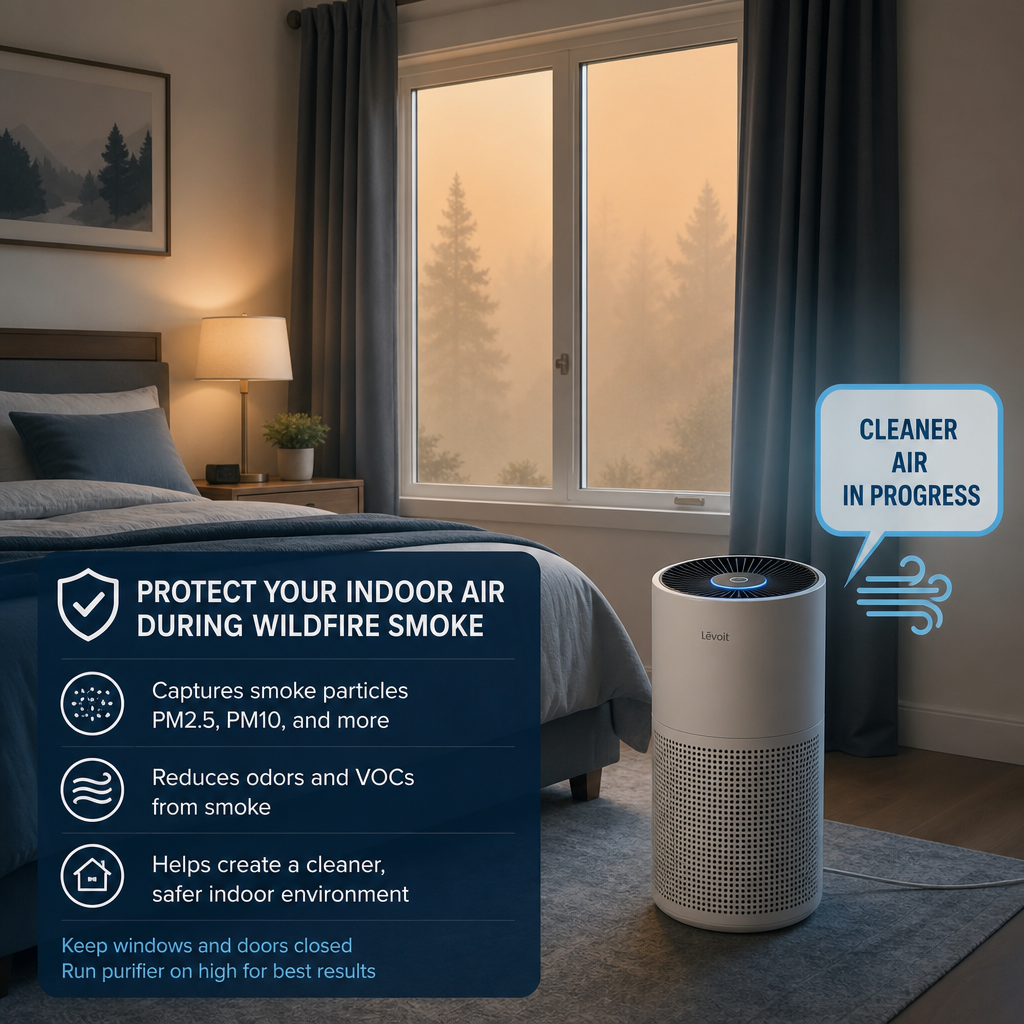
Wildfire smoke preparation
You May Not Be Able to Protect Every Room—Start With One
A cleaner-air room gives your household one better-protected place to sleep, rest, work, or spend time when wildfire smoke moves indoors. The plan does not require the most expensive purifier. It requires the right room, enough smoke CADR, controlled airflow, consistent operation, and filters that are ready before the smoke arrives.
Quick answer
How do you create a cleaner-air room for wildfire smoke?
Choose a room where household members can comfortably spend several hours, preferably one with few windows and doors and no fireplace. Close exterior openings when outdoor air is smoky, run a properly sized portable air purifier continuously, and avoid activities that create additional indoor particles.
For wildfire smoke, look for a purifier whose smoke CADR is approximately equal to the room’s square footage. A 200-square-foot room, for example, should generally use a purifier with a smoke CADR near 200 or higher. Choose more capacity for ceilings above eight feet or unusually leaky rooms.
Keep the room cool without drawing smoky outdoor air inside, inspect filters frequently, and follow official evacuation or health instructions. A cleaner-air room reduces exposure; it does not make an unsafe home or evacuation area safe.
Cleaner-Air Room vs. Trying to Filter the Whole House
| Approach | Best fit | Main advantage | Main limitation |
|---|---|---|---|
| One cleaner-air room | Bedrooms, apartments, renters, limited budgets | Concentrates available filtration where people spend time | Does not protect every area of the home equally |
| Several portable purifiers | Homes with multiple occupied rooms | Provides room-by-room control and flexibility | Requires several filters and more maintenance |
| HVAC filtration | Compatible forced-air heating and cooling systems | Can provide broader background particle filtration | Filter efficiency and continuous-fan use must suit the system |
| Portable plus HVAC | Households wanting layered protection | Combines whole-home support with stronger priority-room cleaning | Higher equipment, energy, and maintenance costs |
A Six-Step Cleaner-Air Room Plan
Choose the room before choosing the purifier
A bedroom is often practical because people can sleep and rest there for several hours. Select a room with as few exterior windows and doors as reasonably possible, enough space for the household members who will use it, and a safe way to stay cool.
Use smoke CADR—not the largest marketing number
CADR measures how much filtered air a purifier delivers for particular particle categories. During wildfire conditions, AHAM recommends a smoke CADR that matches the room’s square footage.
- 150-square-foot room: target smoke CADR near 150 or higher
- 250-square-foot room: target smoke CADR near 250 or higher
- Higher ceiling: choose more capacity
- Open doorway: the purifier may effectively be serving a larger area
Place the purifier where it can move air freely
Keep the intake and clean-air outlet away from curtains, bedding, furniture, clothing, and walls when the manufacturer requires clearance. The purifier should serve the occupied part of the room without creating a tripping hazard or blowing uncomfortably toward a sleeper.
Reduce smoke entry and indoor particle sources
Keep windows and exterior doors closed while outdoor air is smoky, provided it remains safe to stay indoors. Set compatible air-conditioning systems to recirculate rather than drawing in smoky outside air.
Avoid smoking, candles, incense, aerosol sprays, frying, wood fires, and unnecessary vacuuming during a smoke event. These activities can add particles to the same room you are trying to clean.
Run the purifier continuously at the highest tolerable speed
A purifier only filters air while its fan is moving air through the filter. Run it continuously during a smoke event, using the highest speed that the room’s occupants can comfortably tolerate.
Auto mode may reduce the fan too quickly if the built-in sensor is positioned poorly or responds differently from an independent monitor. During substantial smoke, a steady manual fan speed may provide more predictable filtration.
Inspect the filter before, during, and after the event
Smoke can load filters faster than ordinary household dust. Check the pre-filter and main filter according to the manufacturer’s instructions and replace them when they are heavily soiled, damaged, producing persistent odor, or restricting airflow.
What Type of Filtration Matters for Wildfire Smoke?
Particle filtration
Wildfire smoke contains fine particles, including PM2.5. A high-efficiency particle filter paired with sufficient airflow is the primary portable-purifier feature to prioritize.
Activated carbon
Carbon may help with some smoke odors and gases, but thin carbon sheets have limited capacity. CADR measures particle removal and does not reveal how much gas-removing media is present.
Ozone avoidance
Avoid devices designed to intentionally generate ozone. Ozone is a lung irritant and should not be added to an occupied cleaner-air room.
Prepare the Filters Before Smoke Arrives
Before ordering, confirm the exact purifier model, filter number, dimensions, and whether the replacement is manufacturer-original or third-party. A filter that merely looks similar may not seal correctly or provide the expected airflow.
Check replacement-filter availability at FiltersFast if you already know the correct filter number. Compare the final price, seller, specifications, and return terms before purchasing.
Homeowners considering compatible HVAC filtration or a broader indoor-air strategy can also review whole-home air-quality options from Field Controls . Consult a qualified HVAC professional before installing a higher-resistance filter or changing system airflow.
Affiliate disclosure: These are affiliate links. BestSmartPurifiers.com may earn a commission at no additional cost to you. Their inclusion does not change the room-sizing, filter-verification, or safety standards used in this guide.
Four-question knowledge check
Is Your Cleaner-Air Room Ready?
Reader Check-In
Have you prepared one room for smoke, or did you have to build a cleaner-air space during an actual event? Share the room size, purifier smoke CADR, fan setting, and anything you would change next time. Practical household experiences can help another reader prepare before filters and purifiers become difficult to find.
Frequently Asked Questions
Is a HEPA purifier enough for wildfire smoke?
High-efficiency particle filtration can reduce airborne smoke particles when the purifier has enough CADR for the room and runs consistently. It may not remove all smoke gases or odors, especially when the purifier contains only a small amount of activated carbon.
Should I use auto mode during wildfire smoke?
Auto mode can be useful, but a steady manual fan setting may provide more predictable filtration during a substantial smoke event. Built-in sensors differ in sensitivity and may reduce the fan before the room has received enough continuous filtration.
Should the cleaner-air-room door stay closed?
Closing the door can help the purifier serve a defined area, provided household safety, temperature, ventilation needs, and access are addressed. Frequently opening the door may allow more polluted air to enter.
Can I make a DIY box-fan air cleaner?
EPA research indicates that well-built DIY air cleaners can reduce smoke particles. EPA generally prefers commercial units with known CADR when they are available and affordable. Use a newer certified box fan, follow current EPA safety instructions, add a proper filter and shroud, and never block the fan.
How often should I replace the filter during wildfire smoke?
There is no universal schedule because smoke concentration, runtime, filter size, airflow, and room conditions vary. Inspect the filter more frequently than normal and follow the manufacturer’s replacement guidance. Replace a heavily loaded, damaged, odorous, or airflow-restricting filter.
Can an air purifier make it safe to ignore an evacuation order?
No. A purifier cannot protect against fire, structural danger, extreme heat, carbon monoxide, loss of power, or changing emergency conditions. Follow instructions from local emergency and public-health authorities.
Continue learning
Related Best Smart Purifiers Guides
Complete Air Purifier Guide
Review CADR, room sizing, filter types, noise, placement, and realistic purifier limits.
Read the complete guideSmart Purifiers and Automation
Learn when schedules, sensors, auto mode, and app alerts improve consistency—and when they do not.
Explore smart purifier featuresAir Purifiers vs. HVAC Filters
Compare room-level portable filtration with forced-air HVAC filtration and layered strategies.
Compare the two approachesUnderstanding Filter Technology
See what particle filters, activated carbon, ionizers, UV, and other technologies actually do.
Understand the filter stagesIndoor Air Pollutants
Identify particle, gas, moisture, smoke, radon, and carbon-monoxide concerns that need different responses.
Review common indoor pollutantsIndoor Air Quality Matters
Build a wider plan using source control, safer ventilation, monitoring, filtration, and professional help where needed.
Build an indoor-air planAuthoritative Sources
Editorial note: BestSmartPurifiers.com reports on air-cleaning equipment from a consumer-research perspective. Product claims, filter availability, prices, certifications, and specifications can change. Verify current manufacturer information before buying. Air purifiers can reduce certain airborne pollutants but cannot eliminate every smoke component or replace emergency instructions, certified alarms, medical care, evacuation, source control, or qualified HVAC guidance.