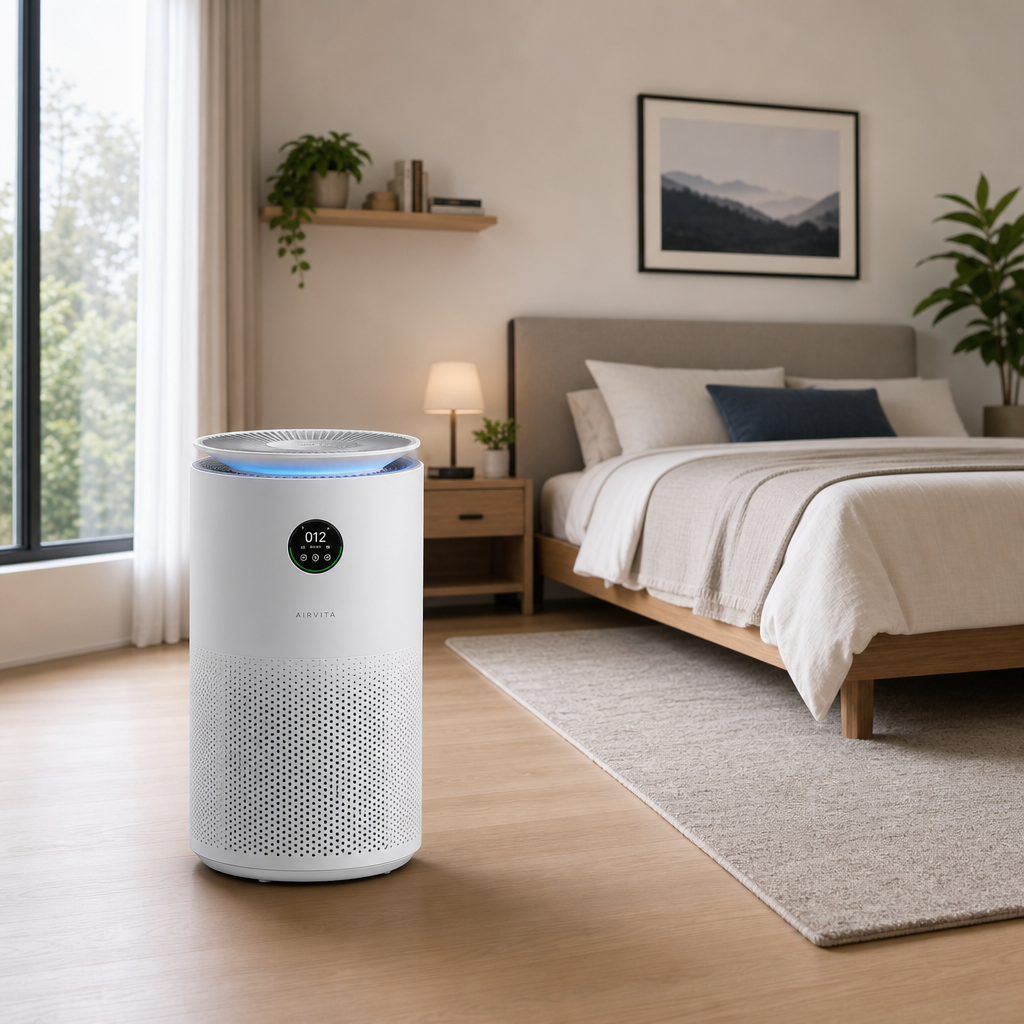
Practical air purifier setup
Your Purifier May Be Powerful Enough—But Sitting in the Wrong Spot
A smart air purifier can have the right filter, useful sensors, and enough cleaning power on paper, yet still disappoint when its intake is blocked, its outlet faces a curtain, or it sits in a room where nobody spends much time.
Quick answer
Where should you place an air purifier?
Place a portable air purifier in the room where people spend the most time or where the air concern occurs most often. Keep its air intake and clean-air outlet unobstructed, follow the manufacturer’s clearance instructions, and make sure the purifier is properly sized for that room.
For many homes, the bedroom is the best first location because people spend several continuous hours there. A living room, nursery, home office, or pet-heavy room may be the better priority when that is where exposure and activity are concentrated.
Do not hide the purifier behind a couch, curtain, cabinet, plant, laundry pile, or other obstruction. Placement cannot rescue an undersized machine, so also compare the room size with the purifier’s CADR.
The Five-Minute Placement Check
Choose the priority room
Start where people sleep, work, recover, relax, or spend the longest uninterrupted time.
Clear the airflow
Make sure furniture, curtains, walls, bedding, and household clutter are not blocking the intake or outlet.
Confirm the room fit
Compare CADR with the room’s square footage and account for high ceilings, open doors, and connected spaces.
Best Air Purifier Placement by Room
The exact setup depends on the purifier’s intake design, outlet direction, power cord, stability, and manufacturer instructions. This comparison gives you a practical starting point.
| Room | Practical placement | Common mistake |
|---|---|---|
| Bedroom | Place it in an open part of the room where it can circulate air around the sleeping area without blowing directly into your face. | Hiding it behind a nightstand or relying only on an extremely low sleep setting before the room has been cleaned. |
| Living room | Position it near the main seating area with clear intake and outlet space. | Pushing it behind a sofa, entertainment center, curtain, or decorative plant. |
| Home office | Keep it close enough to serve the work area while balancing fan noise during calls and focused work. | Using a tiny desktop purifier for a full-sized office without checking CADR. |
| Nursery or child’s room | Use a stable location with safe cord management, open airflow, and controls out of reach. | Placing the unit where it can tip, where a child can access the cord, or where bedding blocks the vents. |
| Pet area | Place it in the room where pets sleep or spend the most time, while keeping it away from direct contact with fur and water bowls. | Allowing pet hair to overload the pre-filter until airflow noticeably drops. |
| Kitchen-adjacent area | Use it in the nearby living space while continuing to use kitchen exhaust and source control. | Placing the purifier where grease or steam can enter it, or expecting it to replace a range hood. |
| Open floor plan | Place it near the occupied zone and choose enough CADR for the connected area rather than one small corner. | Using a bedroom-sized purifier for a large connected kitchen, dining room, and living room. |
A Five-Step Air Purifier Placement Plan
Start with the room, not the appliance
Portable air purifiers are designed primarily for individual rooms or defined areas. Pick the room where cleaner air would provide the greatest practical value instead of placing the purifier in a hallway simply because the location looks central.
Give the purifier breathing room
A purifier must draw room air into its intake and return filtered air through its outlet. Furniture, curtains, walls, blankets, and household clutter can interfere with that circulation.
Match CADR to the actual space
Clean Air Delivery Rate measures particle-cleaning delivery. A higher CADR generally means the purifier can clean room air more quickly or serve a larger area.
Room-size marketing can be based on different assumptions, so compare CADR instead of relying only on the largest coverage number printed on the box.
Run it consistently at a useful speed
Higher fan speeds and longer runtime generally move more room air through the filter. A well-placed purifier that runs only occasionally may provide less filtration than a consistently operated unit.
Smart schedules and auto mode can improve consistency, but they should support—not replace—appropriate sizing and manual control when pollution rises.
Recheck the filter after improving placement
A better location may pull more dust, lint, hair, and particles into the pre-filter. That can be a sign that the purifier is intercepting more airborne material, but it also makes maintenance more important.
Five Places That Commonly Reduce Performance
- Behind a sofa, chair, curtain, or entertainment center
- Inside a closet, cabinet, shelf cubby, or enclosed alcove
- Pressed tightly against a wall despite rear or side air intakes
- Beside piles of laundry, bedding, boxes, or other clutter
- In a hallway while the doors to priority rooms remain closed
What Better Placement Can—and Cannot—Fix
| Situation | Can placement help? | What else matters? |
|---|---|---|
| Blocked intake or outlet | Yes. Clearing the airflow path can improve circulation. | Manufacturer clearance instructions and filter condition |
| Purifier is in an unused room | Yes. Moving it to a priority room can better target exposure. | Room size, occupancy, and the pollutant source |
| Purifier is undersized | Only partly. Placement cannot create more CADR. | A stronger unit, smaller target area, or additional filtration |
| Odors persist | Sometimes. Moving closer to the affected area may help. | Source control and meaningful activated-carbon media |
| Active mold or moisture problem | No. A purifier does not repair the cause. | Moisture correction, cleanup, and qualified help when needed |
| Carbon monoxide or gas emergency | No. Do not rely on an air purifier. | Leave when appropriate, use certified alarms, and contact emergency or qualified services |
Interactive knowledge check
Is Your Air Purifier in the Right Place?
Choose one answer for each question, then check your score.
Reader check-in
Did Moving Your Purifier Make a Difference?
Share your experience in the comments. Real placement examples can help another reader avoid replacing a purifier that only needed better airflow, more runtime, or a more useful room.
- Which room is the purifier serving?
- Was furniture or a curtain blocking it?
- Did you change the fan speed or schedule?
- Did the pre-filter collect more debris after the move?
Frequently Asked Questions
Can I put an air purifier in a corner?
Only when the purifier’s intake and outlet remain clear and the location follows the manufacturer’s clearance instructions. A tight corner may restrict rear or side intakes and interfere with room circulation.
Should an air purifier sit on the floor or a table?
Follow the product manual. Many tower and console purifiers are designed for floor placement, while smaller units may be approved for a stable table or shelf. Prevent tipping, keep cords safe, and never block the vents.
Is the bedroom the best place for an air purifier?
The bedroom is often a practical first choice because people spend several continuous hours there. The purifier still needs enough CADR for the room, tolerable noise, open airflow, and consistent runtime.
Can one portable air purifier clean multiple rooms?
It may help in a small, connected open area, but walls and closed doors restrict circulation. Portable purifiers generally work best as room-level tools. Larger or divided homes may need additional units or compatible HVAC filtration.
Can I place an air purifier beside an open window?
It depends on outdoor conditions. An open window may bring in pollen, smoke, or other outdoor pollution and increase the purifier’s workload. Ventilate when outdoor air is clean and appropriate, but keep windows closed when outside conditions are poor.
Should an air purifier be placed near the source of a problem?
Placing it closer to an identifiable particle or odor source may help intercept pollution sooner, provided the location is safe and airflow remains open. Source control should still come first whenever the source can be reduced or removed.
Continue learning
Related Best Smart Purifiers Guides
Use these supporting articles to improve room sizing, filtration, smart controls, maintenance, and long-term buying decisions.
Complete Air Purifier Guide
Learn how room size, CADR, particle filtration, activated carbon, noise, placement, and maintenance work together.
Read the complete guideAir Purifiers vs. Air Filters
Compare portable room purifiers, HVAC filters, HEPA filtration, MERV ratings, CADR, and whole-home support.
Compare purifiers and filtersSmart Air Purifiers Guide
See how sensors, schedules, auto mode, apps, and smart-home routines can support consistent filtration.
Explore smart purifier featuresUnderstanding Filter Technology
Learn the different jobs performed by particle filters, activated carbon, UV, ionization, and other technologies.
Compare air-cleaning technologiesThe True Cost of Ownership
Review replacement-filter costs, electricity use, maintenance, room-sizing mistakes, and long-term value.
Review ownership costsIndoor Air Quality Matters
Identify pollutant sources and understand which problems require more than portable filtration.
Build a broader clean-air planAuthoritative Guidance
For additional consumer guidance on portable air cleaners, room sizing, filtration limits, and CADR, review:
Editorial note: BestSmartPurifiers.com provides research-based consumer education. Portable air purifiers can reduce certain airborne pollutants when properly sized, placed, maintained, and operated, but they cannot remove every pollutant or replace source control, safe ventilation when appropriate, certified smoke and carbon-monoxide alarms, moisture correction, medical care, or qualified professional services. Product specifications and filter availability can change, so verify current manufacturer information before purchasing.