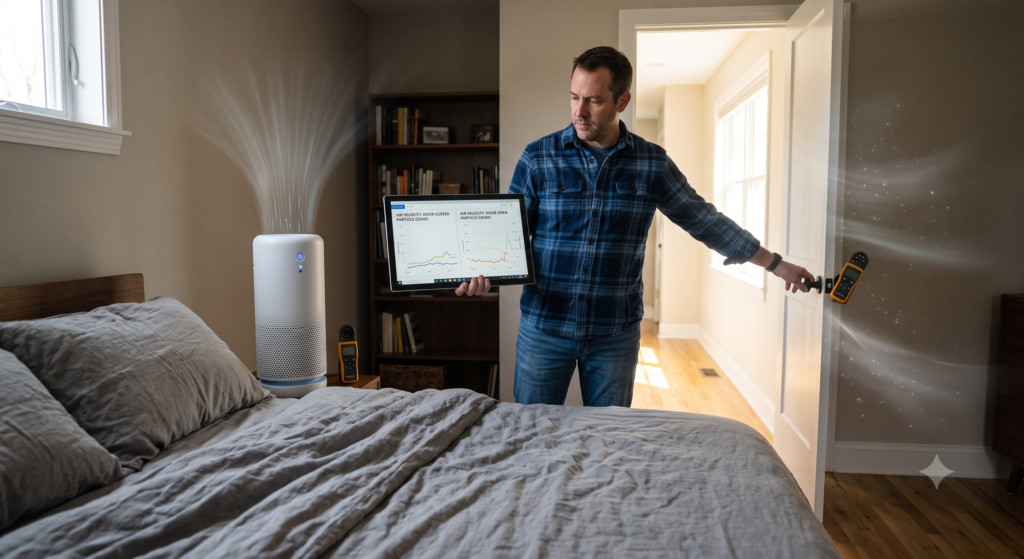
You measured the bedroom, bought a purifier with enough clean-air delivery, and gave every intake room to breathe. Then one small choice changed the job: the door stayed open all night.
An open bedroom door does not make the purifier stop working. It changes the air the machine is being asked to clean. Instead of repeatedly filtering one defined room, the purifier may begin exchanging air with a hallway, stairwell, living area, or much larger part of the home.
That distinction matters because portable air cleaners are room-level tools. They work best when the purifier, its fan speed, and the air volume all match the same clearly defined zone.
Should the bedroom door be open or closed with an air purifier?
Close the bedroom door when your goal is to clean that one room as efficiently and predictably as possible—provided it is safe and the room has suitable ventilation and HVAC return airflow. The purifier can repeatedly filter a smaller, defined volume instead of drawing in air from connected spaces.
Leave the door open when you intentionally want air exchange with adjoining areas, need a return-air path, or are following a ventilation, temperature, caregiving, or safety plan. Just recognize that the purifier is now serving a larger and less controlled zone. Cleaning will usually be slower, and a bedroom-sized unit may no longer have enough CADR for the connected space.
Important limit: A particle-filtering purifier does not add outdoor air, remove occupant-generated carbon dioxide, correct an HVAC pressure imbalance, or make an unsafe room safe.
Door Closed vs. Door Open: What Actually Changes?
| Setup | What the purifier is serving | Likely advantage | Main limitation to check |
|---|---|---|---|
| Door closed | One defined bedroom | Faster, more repeatable particle reduction from the same CADR | Ventilation, temperature, and HVAC return-air pathway still matter |
| Door partly open | Bedroom plus an uncontrolled amount of adjoining air | Some connection for comfort, supervision, or airflow | A cracked door is not a precise room-size setting |
| Door fully open | Bedroom, hallway, and whatever spaces exchange air with them | Broader mixing across connected areas | The effective volume may exceed the purifier’s useful capacity |
| Separate purifier in each closed room | Two defined zones | Independent sizing, schedules, noise settings, and sensor feedback | Higher purchase, filter, energy, and maintenance cost |
Why a Closed Door Usually Helps One Bedroom Clean Faster
A purifier lowers particle concentration by pulling room air through a filter and returning cleaned air. It must repeat that cycle while new particles enter from people, pets, bedding, leaks, windows, HVAC airflow, and adjoining rooms.
Closing the bedroom door reduces one major connection to the rest of the home. The purifier is still dealing with infiltration and indoor sources, but the operating zone is more stable. That makes its CADR easier to match to the actual space and its performance easier to compare from one night to the next.
The U.S. Environmental Protection Agency’s current wildfire-filtration guidance says a portable air cleaner is most effective in a room with doors and windows closed when it is safe to do so. That advice is especially important when outdoor smoke is the source, but the room-boundary principle also explains why a bedroom purifier becomes less predictable when the door opens into a much larger area.
The air volume stays defined
The purifier repeatedly treats the bedroom rather than continually mixing with an unknown connected volume.
The CADR calculation still fits
A room-size target based on bedroom dimensions remains relevant only when the normal room boundary resembles the one you measured.
New particles may enter more slowly
A closed door can reduce direct exchange with a dusty hall, pet area, kitchen, or other source elsewhere in the home.
Your test becomes easier to repeat
Keeping the door, fan speed, window position, and runtime consistent makes sensor trends more meaningful.
The Bedroom Math Changes as Soon as the Door Opens
For general particle filtration in a room with a standard eight-foot ceiling, AHAM recommends a smoke CADR of at least two-thirds of the room’s square footage. It recommends sizing more aggressively for wildfire smoke and accounting for ceilings above eight feet.
If that 168-square-foot bedroom opens to a 70-square-foot hall and a 220-square-foot sitting area, the theoretical connected floor area becomes 458 square feet. The airflow will not divide neatly, and walls, doorways, stairs, supply vents, return grilles, furniture, and temperature differences make the pattern uneven. But the key decision is obvious: a purifier selected for 168 square feet should not be judged as though the open layout were still 168 square feet.
Before accepting a large number printed on a box, see why one “1,500-square-foot” claim may describe only one air cleaning per hour. Compare CADR and the air-change assumption, not the largest coverage number alone.
When “Keep the Door Closed” Is Not the Whole Answer
A closed door can help portable filtration, but cleaner indoor air is not produced by filtration alone. The right setup also protects ventilation, HVAC operation, thermal comfort, and household safety.
1. The purifier does not provide ventilation
People generate carbon dioxide, heat, moisture, and odors while occupying a bedroom. A normal particle purifier recirculates indoor air; it does not bring in outdoor air or directly remove carbon dioxide. If the room feels stuffy or ventilation is inadequate, the solution is not simply a bigger HEPA filter.
Use the home’s designed ventilation system, safe window-opening periods, or qualified HVAC guidance as appropriate. When outdoor smoke, pollen, extreme heat, or pollution makes natural ventilation unsuitable, follow current local guidance and use the cleanest safe ventilation strategy available.
2. A central HVAC system still needs a return path
Some bedrooms have a dedicated return grille. Others depend on a door undercut, transfer grille, jump duct, or another pathway back to a central return. Closing a bedroom door without an adequate return path can create pressure and comfort problems while the air handler runs.
Do not block supply or return grilles. If the closed door pulls shut, whistles, changes the room temperature sharply, or produces a strong draft at the gap, ask a qualified HVAC professional to evaluate the return-air pathway. A portable purifier cannot correct the duct design.
3. Safety and caregiving needs come first
Do not obstruct a door, defeat a latch, block an exit, or arrange cords where they create a trip hazard. Families may also need an open door for supervision, accessibility, hearing alarms, or another caregiving reason. In that case, treat the connected area as the purifier’s real job and adjust the filtration plan—not the household’s safety plan.
4. A particle reading is not a complete air-quality verdict
A purifier display may show low PM2.5 while the room still has excess moisture, carbon dioxide, carbon monoxide, radon, or a gas or odor the onboard sensor does not measure. Use certified smoke and carbon-monoxide alarms, radon testing, moisture correction, source control, and professional evaluation where appropriate.
Try This Three-Night Bedroom Door Test
This is a practical comparison—not a laboratory test and not proof that a room is safe. Its purpose is to show whether the door position changes particle trends, comfort, noise, and purifier behavior in your actual bedroom.
- Set one repeatable routine. Use the same purifier location, manual fan speed, bedtime, window position, ceiling-fan setting, and approximate runtime each night. Avoid deliberately creating smoke or aerosols for a test.
- Record the real room. Write down bedroom length, width, ceiling height, purifier model, smoke CADR, filter code, normal occupancy, and whether the HVAC supply and return grilles are inside the room.
- Night one: use your normal door position. Record the starting particle reading, the trend after one hour, the morning reading, noise comfort, temperature, and whether auto mode changed speed.
- Night two: close the door when safe. Keep everything else as consistent as practical. Note whether the particle trend falls faster or stays lower—and whether comfort or HVAC airflow changes.
- Night three: open the door. Repeat the same observations. Watch for slower cleaning, more frequent sensor spikes, or a lower fan response near the purifier while a separate occupied-area monitor remains higher.
- Compare patterns, not one number. Consumer sensors can differ. The useful question is whether readings repeatedly move in the same direction under similar conditions.
Place a separate monitor in the occupied area, away from the purifier’s clean-air outlet and away from direct steam, sprays, or a strong draft. The purifier’s built-in sensor mainly describes the air reaching the machine. Use the three-point sensor placement check if the display and the room seem to tell different stories.
Use the Result to Choose the Next Move
| What you observe | Likely first check | Practical next move |
|---|---|---|
| Closed-door particle levels fall faster and comfort stays normal | The purifier likely fits the defined bedroom better than the connected area | Use the closed-room routine when it is safe and appropriate |
| Opening the door causes repeated spikes or slower recovery | Pollution may be entering from the hall, kitchen, pet area, or outdoors | Find the source before assuming the purifier is defective |
| The built-in sensor is low but the bedside monitor stays higher | Placement, blocked airflow, short-circuiting, or weak room mixing | Reposition the purifier and retest under the same conditions |
| Both readings remain high with either door position | Continuing source, overloaded filter, insufficient CADR, or ineffective fan speed | Control the source, inspect the filter, and recalculate the room |
| Closing the door creates whistling, drafts, or temperature changes | Possible return-air or pressure issue while the HVAC system operates | Keep vents clear and request qualified HVAC evaluation |
| The room smells stale even though particle readings are low | The concern may involve ventilation, moisture, or gases rather than particles | Identify the source; do not treat a low PM reading as a complete answer |
Six Bedroom Setup Mistakes That Blur the Result
Hiding the purifier beside furniture
A closed door cannot help a machine whose intake or clean-air outlet is blocked by a dresser, curtain, laundry, or bedding.
Testing on sleep mode only
The quietest setting may move too little air for the room. Compare the fan speed you can actually tolerate for a full night.
Trusting the color ring alone
A local green reading does not prove that the bedside, doorway, or opposite corner has the same particle level.
Changing everything at once
Moving the purifier, opening a window, changing fan speed, and closing the door together makes the result hard to interpret.
Ignoring the filter
A loaded pre-filter, incorrect replacement, poor seal, or overdue main filter can reduce useful airflow even in a closed room.
Expecting one unit to clean through walls
A purifier cannot reliably pull air around corners, through several doorways, and across multiple closed bedrooms as if the home were one simple box.
For comfortable room mixing, read how a ceiling fan can help a purifier—unless it is aimed the wrong way. The extra fan may improve mixing, but it does not add to the purifier’s tested CADR.
Put the Door Position Into the Fit & Filter Planner
The Smart Air Purifier Fit & Filter Planner helps you measure the room, estimate a CADR target, compare filter stages, verify the replacement-filter code, and calculate first-year ownership cost.
Add four notes for this bedroom: the normal door position, connected areas, ceiling height, and the fan speed quiet enough for overnight use. Those details turn a generic coverage claim into a real operating plan.
Get the Free Fit & Filter Planner Read the Complete Air Purifier GuideCheck the Filter Before You Buy a Second Purifier
If the closed-door test still shows weak airflow or slow particle reduction, inspect the pre-filter, main filter, intake, outlet, and sensor opening according to the manufacturer’s instructions. Confirm that the replacement filter matches the exact purifier model and filter code—not only the brand name or physical appearance.
See the replacement-filter mistake that can make a good purifier underperform before blaming the room or adding another machine.
After confirming the purifier model and filter code, readers can check replacement-filter availability through FiltersFast. Verify compatibility, filter stages, package quantity, seller information, specifications, shipping, and return terms before ordering.
Can You Define the Purifier’s Real Room?
Choose one answer for each question, then check your score.
Reader Check-In
Does your purifier behave differently with the bedroom door closed? Share the room dimensions, ceiling height, purifier model, smoke CADR, normal fan speed, door position, and what changed. A specific real-room example can help another reader recognize when the purifier is serving more space than the label suggests.
Frequently Asked Questions
Should I close my bedroom door when the air purifier runs at night?
Usually, yes, if the goal is focused particle filtration in one bedroom and closing the door is safe and compatible with the room’s ventilation and HVAC return-air design. A closed door gives the purifier a smaller, more defined zone. Keep supply and return grilles clear and do not ignore comfort or pressure problems.
Is leaving the bedroom door cracked open a good compromise?
It may meet a household need for supervision, comfort, or airflow, but it is not a precise filtration setting. Even a partly open door connects the room to changing air from the hall. Test the actual setup and size the purifier for more than the bedroom alone when the connected area is substantial.
Can one bedroom purifier clean the hallway too?
It may reduce some particles in air that reaches it, but a bedroom purifier should not be assumed to clean a hall, stairs, and other rooms evenly. Doorways, corners, walls, HVAC airflow, and distance make distribution unpredictable. Use a larger correctly sized unit for the connected zone or separate purifiers for priority rooms.
Will a closed door make the bedroom stale?
A purifier recirculates and filters indoor air; it does not supply outdoor air or directly remove carbon dioxide. A closed occupied room still needs suitable ventilation. If the room feels stuffy or develops excess moisture, evaluate ventilation and the HVAC return path rather than expecting the purifier to solve it.
Should the windows be closed too?
Close windows when outdoor smoke, pollen, or pollution is the problem and current guidance recommends keeping that air out. When outdoor air is clean and conditions are safe, ventilation may help with indoor-generated pollutants that a purifier does not address. Check the current outdoor AQI and identify the pollutant before choosing.
Does auto mode change the door-open answer?
No. Auto mode responds to the sensor built into the purifier. It cannot measure every part of the connected space, and it may slow the fan when the air near the unit is cleaner than the air across the room or in the hall. Room sizing and sensor location still matter.
Is a closed door better during wildfire smoke?
When it is safe to do so, official EPA and AirNow guidance recommends operating a properly sized portable air cleaner in a room with doors and windows closed to reduce smoke intrusion. Follow current local air-quality, heat, evacuation, and emergency instructions.
Authoritative Guidance Used for This Guide
- U.S. EPA: Guide to Air Cleaners in the Home
- U.S. EPA: Indoor Air Filtration During Wildfire Smoke
- AHAM: Air Filtration Standards and the Two-Thirds CADR Rule
- AirNow: When Smoke Is in the Air
- U.S. Department of Energy: HVAC Ducted Returns
Editorial note: BestSmartPurifiers.com provides research-based consumer education. This article is not a medical assessment, ventilation design, HVAC inspection, or guarantee of indoor-air safety. Room layouts, HVAC systems, outdoor air, occupant needs, purifier specifications, filters, and sensor behavior vary.
Final Takeaway: The Door Is Part of the Purifier Setup
For focused bedroom filtration, a closed door usually gives a properly sized purifier the clearest job: clean one defined room repeatedly. An open door turns that bedroom into part of a larger, shifting air zone and may expose the limits of a small unit.
Measure the space as you actually use it. Check CADR, fan speed, placement, filter condition, ventilation, and the HVAC return path. Then run a consistent door test before spending money on a larger purifier.
Build My Room Plan