Smart purifier reality check
The Display May Be Right—and Still Not Describe the Room
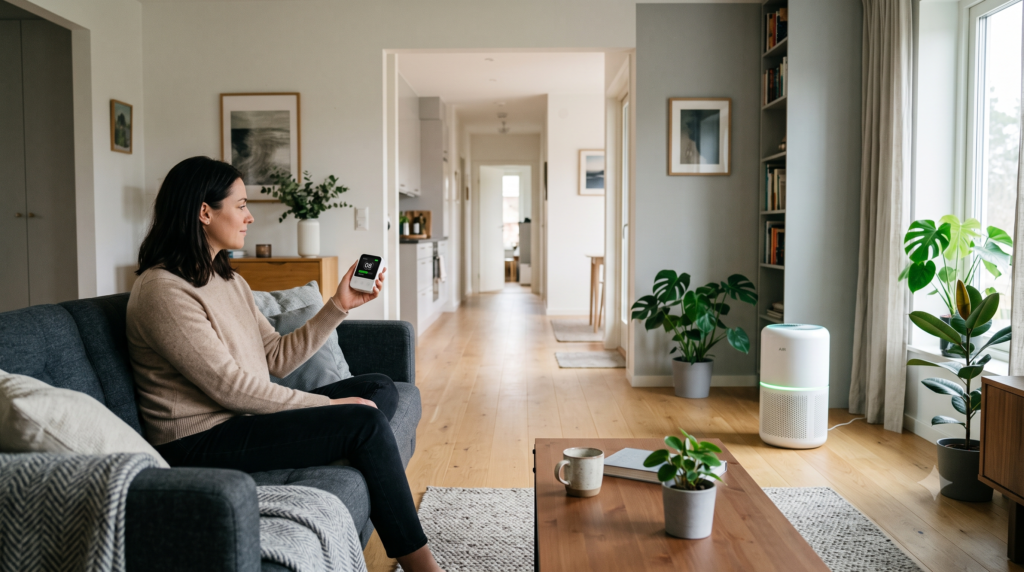
A smart air purifier can show an excellent particle reading while the chair, bed, doorway, or opposite side of the room tells a different story. That does not automatically mean the sensor is defective. It may simply be describing the small pocket of air reaching the machine.
Quick answer
Can your purifier’s sensor represent the entire room?
Not reliably by itself. A built-in sensor mainly reports the air reaching its own sampling location. If the sensor sits near the clean-air outlet, in an easy-to-clean corner, or far from the pollution source, its reading may improve before conditions do across the occupied area.
Use the purifier display to watch trends, not as proof that every part of the room is equally clean. When possible, compare it with a separate indoor monitor positioned away from the outlet and near the part of the room people actually use.
The problem is easy to miss because the purifier appears to be doing exactly what it should. The indicator changes from red to yellow and then green. The app graph slopes downward. Auto mode lowers the fan.
But where was the measurement taken?
A sensor attached to the purifier samples the air that reaches the machine. It does not walk across the room, sit on the sofa, check the hallway, inspect the air beside your pillow, or measure every pollutant that might matter.
One Room Can Produce Three Different Air-Quality Stories
| Measurement location | What it may show | What it may miss | Best use |
|---|---|---|---|
| Purifier’s built-in sensor | Particle or air-quality trends immediately around the purifier | Conditions across the room, behind obstacles, or near another source | Watching purifier response and local trends |
| Occupied-area monitor | Conditions near a desk, chair, bed, play area, or other regularly used location | Short-lived spikes elsewhere in the room | Checking whether cleaner air is reaching the people in the room |
| Source-side monitor | Changes near a doorway, kitchen edge, window, pet area, printer, or other likely source | Average conditions across the occupied zone | Finding where pollution enters or builds |
This is why two devices can disagree without either one necessarily being broken. They may be using different sensors, thresholds, calibration methods, display categories, or sampling locations.
A separate consumer monitor is not a regulatory instrument, either. Its greatest value is often comparison: Does the reading rise after cooking? Does it fall when the purifier runs faster? Is the far side of the room improving more slowly than the air beside the machine?
The BestSmartPurifiers Three-Point Room Check
This is not a laboratory performance test, and it cannot certify that the room is safe. It is a practical diagnostic check designed to reveal whether placement, circulation, sensor location, or a continuing source deserves a closer look.
Check the Devices Together
Place the separate monitor near the purifier without blocking its intake, outlet, or sensor opening. Let both devices settle under the same room conditions.
Do not expect identical numbers. Note whether they generally rise and fall together and whether one consistently reads much higher or lower.
Move to the Occupied Area
Place the monitor on a stable surface near the chair, desk, bed, or section of the room people use most. Keep it out of the purifier’s direct clean-air stream.
The goal is to learn whether cleaner air is reaching the occupied area—not to aim the purifier directly at someone’s face.
Check the Source Side
Move the monitor near the likely entry point or pollution source, while avoiding direct steam, sprays, smoke plumes, or unsafe conditions that could distort or damage the sensor.
Useful locations may include the room side of a doorway, a kitchen boundary, a leaky window, or the edge of a pet area.
Keep the Test Conditions Consistent
A room check becomes confusing when everything changes at once. Try to hold the main conditions steady while watching the trend.
- Use one consistent manual fan speed
- Keep the same doors and windows open or closed
- Avoid candles, sprays, smoking, and aerosol cleaners
- Pause avoidable frying or high-particle cooking
- Keep ceiling and portable fans on the same setting
- Do not place the monitor in the purifier’s exhaust stream
- Record the time and each measurement location
- Look for direction and pattern, not instant perfection
Give the purifier enough time to create a visible trend, but do not treat one fixed number of minutes as a universal room-clearance promise. Cleaning time changes with CADR, fan speed, ceiling height, room volume, air mixing, incoming pollution, filter condition, and the starting particle level.
EPA guidance notes that higher fan speeds and longer operating times generally increase the amount of air filtered. A lower, quieter setting may be comfortable, but it also moves less air through the filter.
How to Interpret What You Find
The purifier is low, but the occupied area stays higher
Cleaner air may not be mixing evenly through the room. The purifier could be blocked, poorly placed, operating too slowly, or undersized for the actual space.
Check furniture, curtains, walls, open doorways, ceiling height, fan direction, and whether the advertised coverage assumes a very low air-change rate.
Both readings stay high
A continuing source may be adding particles faster than the purifier removes them. The unit may also lack sufficient CADR, have a loaded filter, or be running at an ineffective speed.
Reduce the source first, inspect the filter and airflow, and then reconsider room sizing.
Particles read low, but the room still smells bad
The problem may involve gases, odors, moisture, plumbing, damp material, or another source that a PM2.5 sensor does not measure.
Do not interpret a low particle reading as proof that every indoor-air concern has been removed.
The source side spikes, then the room gradually follows
You may have identified the entry point or activity driving the pattern. Source control, safe ventilation when outdoor air permits, or moving the purifier closer to the source may help.
Keep enough clearance for unrestricted intake and outlet airflow.
The devices disagree even when side by side
They may use different sensor technologies, averaging periods, calibration, size ranges, or display thresholds. Humidity and aerosols can also affect some optical particle sensors.
Use repeated trends rather than assuming one device must be universally correct.
The purifier improves only on high speed
The unit may technically fit the room only at a fan speed that is too loud for normal use. Real-world performance depends on the speed people will actually tolerate.
A larger, quieter unit or two-room strategy may be more practical than relying on an undersized purifier in sleep mode.
Five Placement Problems That Can Fool the Display
1. The purifier is breathing its own clean air
Some layouts allow filtered air to return quickly toward the machine while the far side of the room changes more slowly. This is sometimes called short-circuiting airflow. The exact pattern depends on intake and outlet design, nearby walls, furniture, fans, and room circulation.
2. A sofa, curtain, or desk blocks the intake
A purifier needs room to draw polluted air in and release filtered air. Hiding it behind furniture may make the machine less intrusive visually, but it can also restrict the airflow that creates clean-air delivery.
3. The doorway keeps feeding the room
An open doorway can connect the purifier to a hallway, stairwell, kitchen, or larger living area. The effective space may be much larger than the bedroom or office measurements used during shopping.
4. Auto mode responds only to the onboard sensor
Auto mode cannot react to a particle spike it does not detect. If cooking particles enter from the opposite side of the room and disperse slowly, the occupied area may change before the purifier’s local sensor triggers a higher speed.
5. The room problem is not a particle problem
A particle sensor may remain low during a gas, odor, humidity, carbon dioxide, radon, or carbon-monoxide concern. The correct response depends on the pollutant and may involve source correction, ventilation, moisture control, dedicated testing, a certified alarm, or qualified professional help.
Should You Move the Purifier or Add a Second One?
| Room pattern | Likely first move | When another purifier may make sense |
|---|---|---|
| One defined room with blocked airflow | Improve clearance and reposition the existing unit | When adequate CADR still cannot be delivered quietly and evenly |
| Long room with occupied areas at both ends | Test a more central position and improve circulation | When two smaller units provide better distribution than one distant unit |
| Two bedrooms separated by a hallway | Treat each closed room as its own zone | When both rooms need filtration at the same time |
| Open kitchen connected to living space | Use source control and position filtration near the transition area | When the full connected volume exceeds one unit’s practical capacity |
| Bedroom purifier works only on an intolerably loud speed | Confirm the room-size and CADR calculation | When a larger or additional unit can provide adequate cleaning at quieter speeds |
A portable purifier is generally intended to clean one room or defined area. It should not be expected to pull air predictably around corners, through closed doors, up stairways, and across an entire home simply because the largest number on the box appears big enough.
For a deeper room-size check, read why a “1,500-square-foot” purifier may be cleaning that space only once per hour.
Put the Room on Paper Before Buying Another Purifier
The free 15-page Smart Air Purifier Fit & Filter Planner helps you measure the real room, estimate a practical CADR target, compare filter stages, record replacement-filter codes, and calculate first-year ownership cost.
Use what you learn from the three-point check to identify whether the problem is placement, room size, filtration, noise, maintenance, or a continuing source.
Get the Free Fit & Filter PlannerCheck the Filter Before Blaming the Sensor
A purifier with a blocked pre-filter, poorly seated replacement filter, missing gasket, incorrect cartridge, or heavily loaded main filter may move less clean air than expected. The sensor can still light up and the app can still connect while airflow performance declines.
Record the exact purifier model and replacement-filter code before ordering. Similar-looking filters may differ in dimensions, seal, airflow resistance, carbon quantity, or included stages.
Readers who have confirmed the correct model and filter code can check replacement-filter availability through FiltersFast. Verify the model, dimensions, manufacturer information, package contents, seller, and return terms before ordering.
Homeowners exploring compatible HVAC filtration or a layered whole-home approach can review Field Controls indoor-air solutions and discuss airflow, filter resistance, installation, and system compatibility with a qualified HVAC professional.
Four-question knowledge check
Can You Read the Room Instead of Just the Display?
Choose one answer for each question, then check your score.
Reader Check-In
Does your purifier show a better reading than a monitor across the room? Share the purifier model, room dimensions, ceiling height, fan setting, monitor location, and the activity that caused the change. Real room patterns can help other readers distinguish a faulty sensor from a placement or circulation problem.
Frequently Asked Questions
Where should I place a separate PM2.5 monitor?
Use a stable location near the part of the room people regularly occupy, but keep the monitor away from the purifier’s direct outlet, cooking steam, open windows, candles, sprays, and other concentrated plumes. Follow the monitor manufacturer’s placement instructions.
Why does my purifier show a lower PM2.5 number than my separate monitor?
The devices may be in different locations or use different sensors, calibration methods, averaging periods, thresholds, or particle-size assumptions. Place them near each other temporarily to compare their trends before evaluating opposite sides of the room.
Is the purifier’s built-in sensor useless?
No. It can be useful for watching local particle trends, triggering auto mode, and identifying changes over time. Its limitation is location and sensor scope: it should not be treated as a complete measurement of every room or pollutant.
Should I place the purifier beside the pollution source?
Moving the purifier closer to a recurring particle source may help capture pollution before it spreads, provided the unit remains on a stable surface with the manufacturer’s required clearance. Source control should still come first whenever possible.
Should an air purifier be placed in the center of the room?
A more central position can improve access to room air, but it is not always practical or required. EPA guidance says free airflow is the essential consideration. Keep the intake and outlet clear and follow the manufacturer’s placement requirements.
Can auto mode clean the room evenly?
Auto mode responds to the sensor and thresholds built into that purifier. It may work well when the sensed air represents the room, but it can respond slowly when pollution begins far from the machine or the sensor does not measure the relevant pollutant.
How long should I run the purifier before comparing readings?
There is no universal time. Watch for a meaningful trend under stable conditions. The rate of improvement depends on CADR, room volume, ceiling height, fan speed, filter condition, air mixing, incoming pollution, and the starting concentration.
Can a purifier sensor detect carbon monoxide or radon?
Do not assume it can. Most purifier particle sensors do not detect carbon monoxide or radon. Use certified carbon-monoxide alarms and appropriate radon testing rather than relying on a general purifier display.