Best Smart Purifiers 2026 Pet-Odor Buying Guide
You clean the litter box, wash the pet bed, and open the room—yet the smell returns by dinner. That is exactly where purifier marketing becomes confusing.
Many product pages blend three different jobs into one promise: catching pet hair, filtering airborne dander, and reducing odor-causing gases. This guide separates those jobs so you can buy the filtration you need instead of paying for a brighter app or a vague “pet mode.”
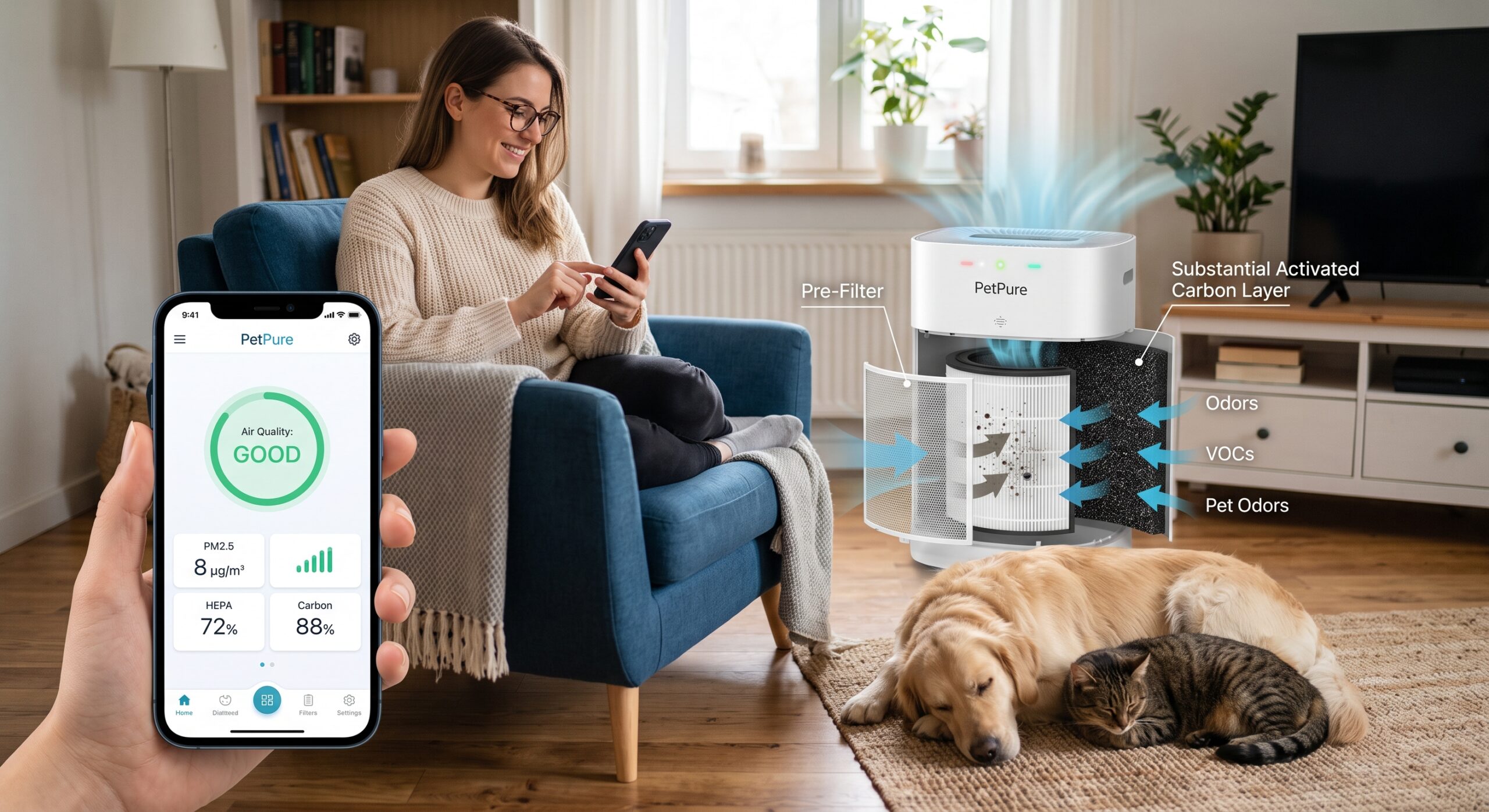
Quick Answer: Can a Smart Air Purifier Eliminate Pet Odors?
No air purifier should be expected to eliminate pet odors by itself. A well-sized purifier with a substantial activated-carbon filter can reduce some airborne odor compounds, while a particle filter can capture airborne dander and fine particles. The odor source still needs to be cleaned or removed.
That distinction matters. A HEPA filter is useful for particles, but pet odors are largely a gas-phase problem. The U.S. Environmental Protection Agency recommends source control first and identifies activated carbon or another sorbent filter as the relevant technology for some gases.
The most reliable approach is a three-part plan: clean the source, ventilate with clean outdoor air when conditions allow, and use a properly sized purifier as a supplement. The EPA Guide to Air Cleaners in the Home explains why filtration works best alongside source control and clean-air ventilation.
The smell-comes-back test: If the room improves immediately after cleaning but the odor returns while the purifier runs, the remaining problem is usually continuing source emissions, insufficient carbon capacity, or too little airflow—not a missing smart feature.
What a Pet Air Purifier Can and Cannot Do
Before comparing products, separate the odor problem from the particle problem. That one step prevents many disappointing purchases.
Hair and debris
First tool: Vacuuming, washable prefilters, and surface cleaning. A purifier only catches material that reaches its intake.
Airborne dander
First tool: A properly sized particle filter with verified airflow performance.
Gas-phase odor
First tool: Source cleanup, followed by enough appropriate activated carbon to provide useful adsorption capacity.
A particle filter handles airborne dander
A high-efficiency particle filter captures particles that pass through the purifier, including airborne pet dander, dust, and some fine debris. It does not remove hair already caught in carpet, on upholstery, or under furniture.
It also does not remove gas molecules simply because the product uses the word “HEPA.” If pet allergies are part of your concern, particle performance still matters, but it is a separate buying criterion from odor control. Read which smart-purifier features actually help with pet dander before combining the two buying decisions.
Activated carbon addresses some airborne odors
Activated carbon is a sorbent. It can adsorb certain gases onto its large internal surface area as contaminated air passes through the filter.
However, carbon filters are not interchangeable. Performance depends on factors such as the amount and type of sorbent, the target gas, airflow, contact time, and how much capacity remains. The EPA notes that gas filtration can be effective when a large amount of material is used.
Source cleanup removes what keeps producing the smell
A purifier cannot clean a litter box, wash dog bedding, dry damp carpet, or remove urine residue from flooring. If the source keeps emitting odor, the carbon filter must keep adsorbing it and will eventually lose useful capacity.
This is why a purifier often seems to work after a deep cleaning but disappoints when it is expected to replace one. Air cleaning supports odor control; it does not erase the need for it.
Why the Word “Smart” Does Not Guarantee Better Odor Removal
Smart controls can make a capable purifier easier to run. They cannot compensate for a shallow carbon layer, an undersized fan, or an expensive filter that is difficult to replace.
A useful smart purifier may offer:
- Schedules that increase fan speed before guests arrive
- Remote control for a litter-box room or pet area
- Filter-life reminders based on time, use, or measured resistance
- Energy-use tracking or an operating history
- A child or control lock that also helps prevent accidental setting changes
Now look at what the sensor actually measures. A model that reports only particle levels may show “clean” air while a gas-phase odor remains. Our guide to why a purifier can report good air while the room still smells bad explains that sensor mismatch in more detail. Even a model with a gas or volatile-organic-compound sensor does not prove that its carbon filter has enough capacity to control the source.
Buy the filtration system first. Treat the app and automation as operating tools, not as evidence of odor-removal performance.
Pet-Odor Air Purifier Comparison: What Each Option Really Solves
The comparison below focuses on the filter configuration rather than marketing labels. It shows why two purifiers with similar apps can perform very differently in a pet home.
| Purifier type | Airborne dander | Pet-odor potential | Main limitation | Best use |
|---|---|---|---|---|
| Particle filter only | Good when properly sized | Low | Does not target gas-phase odor | Particle and allergy support |
| Particle filter plus thin carbon sheet | Good when properly sized | Limited to moderate | Small sorbent capacity may become exhausted quickly | Light, occasional odor |
| Particle filter plus substantial carbon bed | Good when properly sized | Best of these mechanical options | Higher filter cost and no universal residential gas-performance rating | Persistent pet odor after source cleanup |
| Ionizer or ozone-producing device | Varies | Not a recommended odor shortcut | May emit ozone, a lung irritant | Avoid devices designed to generate ozone in occupied spaces |
One important warning belongs beside this table: Clean Air Delivery Rate, or CADR, measures particle-cleaning performance. The EPA states that there is no widely used residential performance rating for gas removal, so a strong smoke CADR does not prove strong pet-odor control.
For a deeper filter comparison, see HEPA vs. Activated Carbon: Which Filter Wins? You can also review the AHAM Verifide air-filtration standards for an independent explanation of CADR and room sizing.
The 2026 Pet-Odor Air Purifier Buying Checklist
Once you know which problem each filter solves, you can compare models without being distracted by feature count. Use the S.M.E.L.L. Buyer Check to keep the decision focused on the room and the odor problem.
Source
Find what keeps producing the odor.
Media
Check the carbon type and amount.
Enough airflow
Match verified CADR to the room.
Long-term cost
Price replacement filters first.
Livability
Check noise, controls, and energy use.
1. Identify the odor source before choosing a purifier
- Litter box: Focus first on frequent waste removal, suitable litter depth, and box cleaning.
- Pet bedding: Check whether washable fabric, foam, carpet, or upholstery is holding the odor.
- Accident area: Clean the affected material with a product and method appropriate for that surface.
- Damp-pet smell: Dry wet fabrics and address moisture instead of trying to filter around it.
- Sudden or unusual body odor: Consider whether the pet needs grooming or veterinary attention.
If you cannot control the source, treat a purifier as partial support. Do not promise yourself complete odor removal.
2. Look for disclosed carbon details
Search the product page and replacement-filter listing for the carbon type, carbon weight, filter construction, and replacement schedule. A manufacturer that says only “odor filter” has not told you enough to compare capacity.
A pelletized or deep carbon bed generally offers more sorbent material than a lightly coated sheet, but construction alone still does not guarantee performance against every gas. If carbon weight is not disclosed, ask the manufacturer.
3. Size the particle-cleaning side correctly
Measure the room’s length and width, then multiply them to get square footage. Compare that area with the purifier’s independently verified smoke, dust, and pollen CADR values.
As a general AHAM rule of thumb, the smoke CADR should be at least two-thirds of the room area when ceilings are about eight feet high. A 180-square-foot room would therefore call for a smoke CADR of roughly 120 or higher. Higher ceilings and open floor plans require more capacity.
4. Check the sensor, not just the app
- Does the model measure particles, gases, or both?
- Can you see a trend history instead of only a colored light?
- Can you create a schedule if automatic mode does not respond to the odor?
- Will the purifier continue its schedule if the internet connection drops?
- Can essential controls still be used on the machine?
A reliable manual schedule may be more useful than an automatic mode driven only by a particle sensor.
5. Price the replacement filters before the machine
Compare the purchase price of the purifier with the annual cost and availability of its particle and carbon filters. In a multi-pet home, hair, dust, and persistent odors can increase the filter load, so inspect filters regularly and follow the manufacturer’s replacement guidance.
Affiliate disclosure: BestSmartPurifiers.com may earn a commission from qualifying purchases made through the FiltersFast and Field Controls links, at no additional cost to you. These relationships do not change the room-fit, filter-capacity, or source-control standards used in this guide.
If you already know the exact purifier model and filter number, you can check replacement-filter availability through FiltersFast. Verify the model number, package contents, compatibility details, and return terms before ordering.
Do not stretch a carbon filter solely because an app reports remaining life. If odor reduction has clearly declined after source cleanup, the sorbent may no longer have useful capacity for that application.
6. Consider noise and energy at the speed you will use
Particle CADR is normally measured at the highest speed. Lower or sleep speeds move less air and therefore provide less filtration, even when the purifier’s published room-size claim stays the same on the box.
For a purifier that will run for long periods, compare wattage by speed and look for an ENERGY STAR-certified model. ENERGY STAR’s current room-air-cleaner criteria emphasize energy efficiency, but the label does not certify odor-removal effectiveness. Compare the program’s current guidance on the ENERGY STAR air-cleaners page.
7. Avoid ozone as an odor-control strategy
Do not choose an ozone generator for use around people or pets. The EPA identifies ozone as a lung irritant and advises against air cleaners that intentionally produce it in occupied spaces.
Some ionizers, electrostatic devices, plasma systems, and certain UV configurations may also emit ozone. Check the technology, the manual, and any independent emissions certification instead of relying on the phrase “fresh air.” The EPA’s ozone-generator guidance explains why ozone should not be treated as an occupied-room air-cleaning shortcut.
Which Pet-Odor Purifier Setup Fits Your Room?
The best configuration depends on where the odor begins and how far it travels. Use these room-based starting points before comparing individual models.
Best setup for a litter-box room
Choose a stable purifier with clear intake space, a washable prefilter, a correctly sized particle CADR, and as much replaceable carbon as the budget allows. Place it where air can circulate past the litter area without letting the cat block, climb on, or knock over the unit.
A schedule that increases fan speed after typical litter-box use may be more dependable than a particle-only auto mode. Compare carbon construction, filter cost, noise, and verified particle airflow before choosing a model.
Best setup for a dog bed or crate area
Start with washable bedding and a dry floor. Then position the purifier nearby without pointing a strong draft directly at the pet or trapping the intake against a wall.
Prioritize easy prefilter cleaning because fur can reduce airflow if it builds up. Confirm that the correct particle and carbon filters remain identifiable and affordable before buying the purifier.
Best setup for an open living area with multiple pets
One small purifier beside a sofa may not circulate enough air through a large connected space. Measure the full area, account for higher ceilings, and compare the cost of one high-capacity unit with two well-placed units.
A larger total carbon supply and higher particle CADR may matter more than extra app features. Readers comparing installed or higher-capacity approaches can review Field Controls indoor-air solutions, then discuss filtration, airflow, system compatibility, and installation with a qualified HVAC professional.
Best setup for a bedroom shared with a pet
Balance overnight noise with enough airflow to clean the room. An oversized purifier can sometimes deliver useful airflow at a lower speed, but compare published noise and power data rather than assuming every sleep mode is effective.
Use the app to dim displays and set a schedule, then judge the result by room comfort, odor control, and filter condition. Do not let a quiet setting hide the fact that the purifier may be moving too little air for the room.
The Seven-Day Pet-Odor Purifier Test
A quick smell test immediately after unboxing is not enough. Use a controlled seven-day check to separate source-cleaning results from purifier performance.
- Day 1: Map the source. Note where the odor is strongest, when it appears, room size, ceiling height, and whether the door is normally open or closed.
- Day 2: Clean before filtering. Empty and clean the litter area, wash appropriate bedding, vacuum pet hair, and treat known accident areas according to the surface and cleaner instructions.
- Day 3: Establish a baseline. With the room used normally, record odor intensity at the same three times of day before changing purifier settings.
- Day 4: Run a medium-speed test. Operate the purifier with clear airflow and record noise, odor, and particle-sensor readings if available.
- Day 5: Test automatic mode. Watch whether the fan actually responds when the odor becomes noticeable. Record which sensor reading changed.
- Day 6: Test the livable schedule. Use the highest speed you can comfortably maintain, then schedule a quieter setting when the room needs it.
- Day 7: Make the keep-or-return decision. Keep the purifier only if the combined cleaning and filtration plan produces a worthwhile improvement at an acceptable noise and replacement-filter cost.
Planner checkpoint: If the odor returns quickly while the source remains dirty, improve source control. If the odor remains after cleaning but the purifier has little carbon, reconsider the filter design. If the room improves only on high speed, the unit may be undersized for your real operating conditions.
Use the free Smart Air Purifier Fit & Filter Planner to record the room size, CADR target, carbon stage, replacement-filter details, and first-year ownership cost before ordering.
Pet-Odor Purifier Claims That Deserve a Closer Look
Product language is often more confident than the available test data. Slow down when you see any of these claims without supporting detail.
- “Eliminates all pet odors.” No residential purifier should be treated as a substitute for removing the source.
- “HEPA removes smells.” HEPA describes particle filtration, not gas adsorption.
- “Real-time odor detection.” Confirm what the sensor measures and whether the app identifies particles or gases.
- “Lifetime odor filter.” Sorbent capacity is finite; ask how the filter is maintained or replaced.
- “Covers 1,500 square feet.” Check the stated air-change basis and verified CADR, especially if the claim assumes only one air cleaning per hour.
- “No filter replacement needed.” Determine what captures particles and gases, how collected material is removed, and whether the technology may produce ozone.
The strongest product page will disclose verified particle CADR, recommended room size, filter construction, replacement-filter price, power use, noise information, sensor type, and emissions information. Missing data is not proof of poor performance, but it makes a confident comparison harder.
Knowledge Check: Are You Ready to Buy for Pet Odors?
Choose your answer before opening each explanation. The goal is to test whether you are buying for the actual problem rather than the most attractive feature list.
1. Which filter is primarily responsible for capturing airborne pet dander?
- A. Activated carbon
- B. A high-efficiency particle filter
- C. A Wi-Fi antenna
Show the answer
Answer: B. A high-efficiency particle filter captures airborne dander and other particles that pass through it. Activated carbon serves a different gas-adsorption role.
2. Does a high smoke CADR prove that a purifier will remove pet odors well?
- A. Yes
- B. No
Show the answer
Answer: B. CADR is a particle-performance measure. It does not provide a standardized residential rating for gas or odor removal.
3. What should you do first when a litter-box odor persists?
- A. Turn on an ozone generator
- B. Clean and control the source
- C. Buy the purifier with the brightest air-quality light
Show the answer
Answer: B. Source control is the first step. Filtration is a supplement, and ozone generators should not be used as an odor shortcut in occupied spaces.
4. Which smart feature is most useful if auto mode responds only to particles?
- A. A controllable schedule
- B. A decorative color ring
- C. A larger product box
Show the answer
Answer: A. A schedule lets you increase airflow around predictable odor events even when the particle sensor does not react.
Frequently Asked Questions About Air Purifiers and Pet Odors
Will a HEPA air purifier remove dog smell?
A HEPA or other high-efficiency particle filter can capture airborne dander and fine particles, but it does not target gas-phase odor by itself. For dog odor, clean bedding, upholstery, carpet, and damp areas first, then use a purifier with meaningful activated-carbon filtration as support.
Can an air purifier remove cat litter-box odor?
It may reduce some airborne odor compounds if it has enough appropriate sorbent material and airflow. It cannot replace frequent waste removal, box cleaning, suitable litter management, or attention to a persistent unusual odor.
How do I know when the carbon filter is exhausted?
There is no universal consumer indicator that directly measures remaining capacity for every odor compound. Follow the manufacturer’s guidance, but also watch for a clear decline in odor reduction after the source has been cleaned and normal operating conditions have remained similar.
Should I leave a pet air purifier running all day?
Longer runtime filters more air, provided the unit is safely operated according to its manual and the filter still has capacity. Use the highest sustainable fan speed for the room, keep the airflow unobstructed, inspect the prefilter for fur, and consider an ENERGY STAR-certified model if it will run for long periods.
Final Verdict: Buy Carbon Capacity, Airflow, and Honest Expectations
A smart air purifier can be a useful part of a pet-odor plan, but it is not an odor eraser. The best choice combines verified particle performance for dander, a meaningful amount of replaceable activated carbon for some gases, affordable filters, suitable room sizing, and controls you will actually use.
Start with the room and the odor source, not the newest gadget. When the source is controlled, the purifier is sized correctly, and the carbon filter has real capacity, smart scheduling can help maintain a fresher room with less guesswork.
What pet odor are you trying to control, and what has or has not worked in your home? Share the room size, pet type, odor source, and purifier or filter you tried in the comments. Your details may help another pet owner avoid the wrong purchase.