A nursery is usually the smallest room in the house, and it tends to get the newest things at the same time: fresh paint, a crib, a dresser, maybe new flooring or a rug. If you are looking for the best air purifier for a baby nursery, those details matter more than a long spec sheet. The room’s size, how loud the unit is at its lowest setting, and what you expect it to do are the three things worth checking.
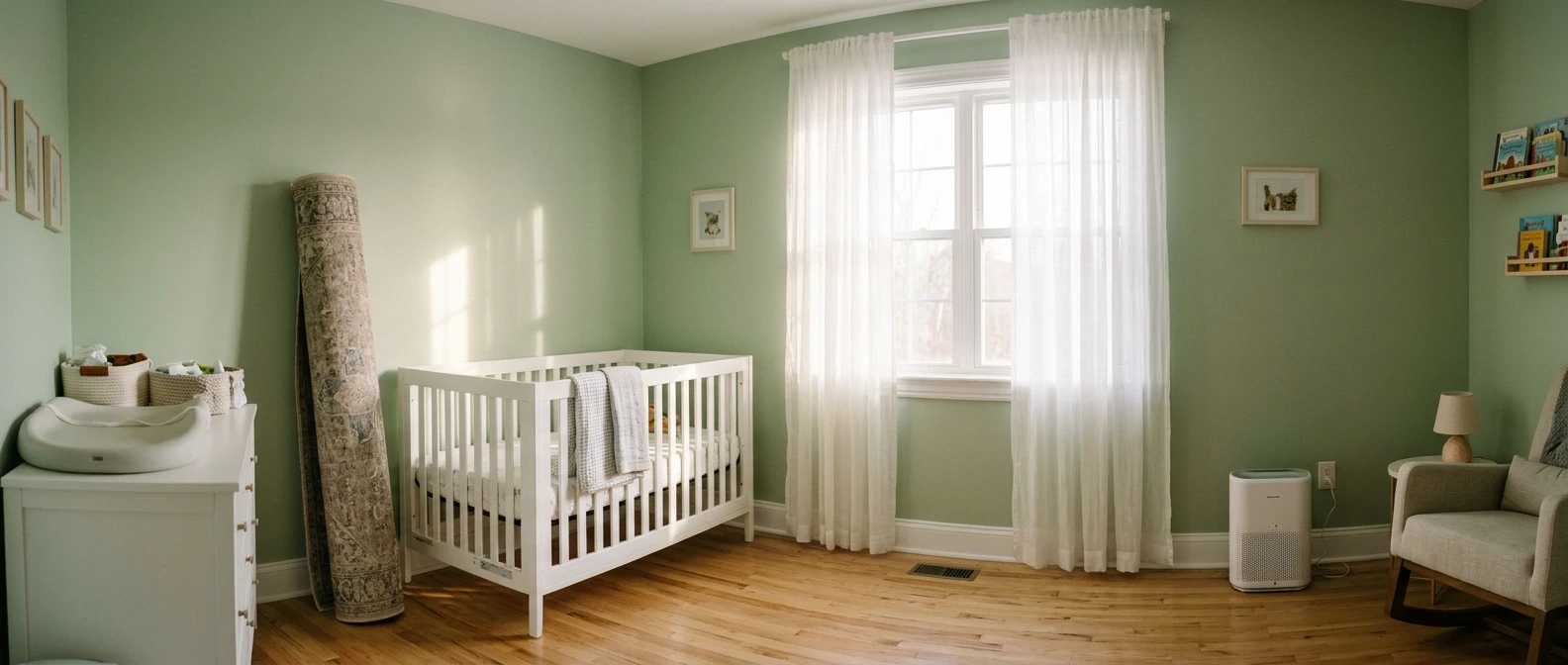
This guide goes through them in order of how much they affect your nights. It also covers what a purifier cannot do, because that part is easy to get wrong when you are buying for a baby.
Start with the nursery: room size, new furniture and what you want to fix
Before you compare models, measure the room and note the ceiling height. A purifier is rated by how much clean air it delivers per hour (the CADR number on the box), and the right rating depends on the room’s volume. Nurseries are often small, so you do not need a large unit. A smaller purifier running on a low, quiet setting usually suits the room better than a big one that has to be turned down.
Next, decide what you want to fix. Most nursery situations fall into one of these:
- Dust and general airborne particles: a true HEPA filter handles this, and any decent purifier does it.
- Smells and gases from new paint, furniture, mattress or flooring: this needs a substantial activated carbon filter, and even then it is only part of the answer (more on that below).
- Pollen, pet dander or smoke coming in from outside or from elsewhere in the house: HEPA again, plus good placement and keeping windows closed on bad days.
Write down which of these apply. A room with new paint and a new crib has a different problem from a room in an older house with dusty carpet. If you are weighing a general-purpose purifier against a nursery-specific one, the broader smart air purifier buying guide walks through matching a unit to a room, and this article builds on it for infant rooms.
Quiet that holds up at 3 a.m.
Noise is the first thing to check, and the number on the box needs some interpretation. Manufacturers usually quote decibels at the lowest fan speed, measured under lab conditions. In a quiet nursery at night, you will hear more than the lab figure suggests, because there is nothing else making noise.
Check these things before you buy:
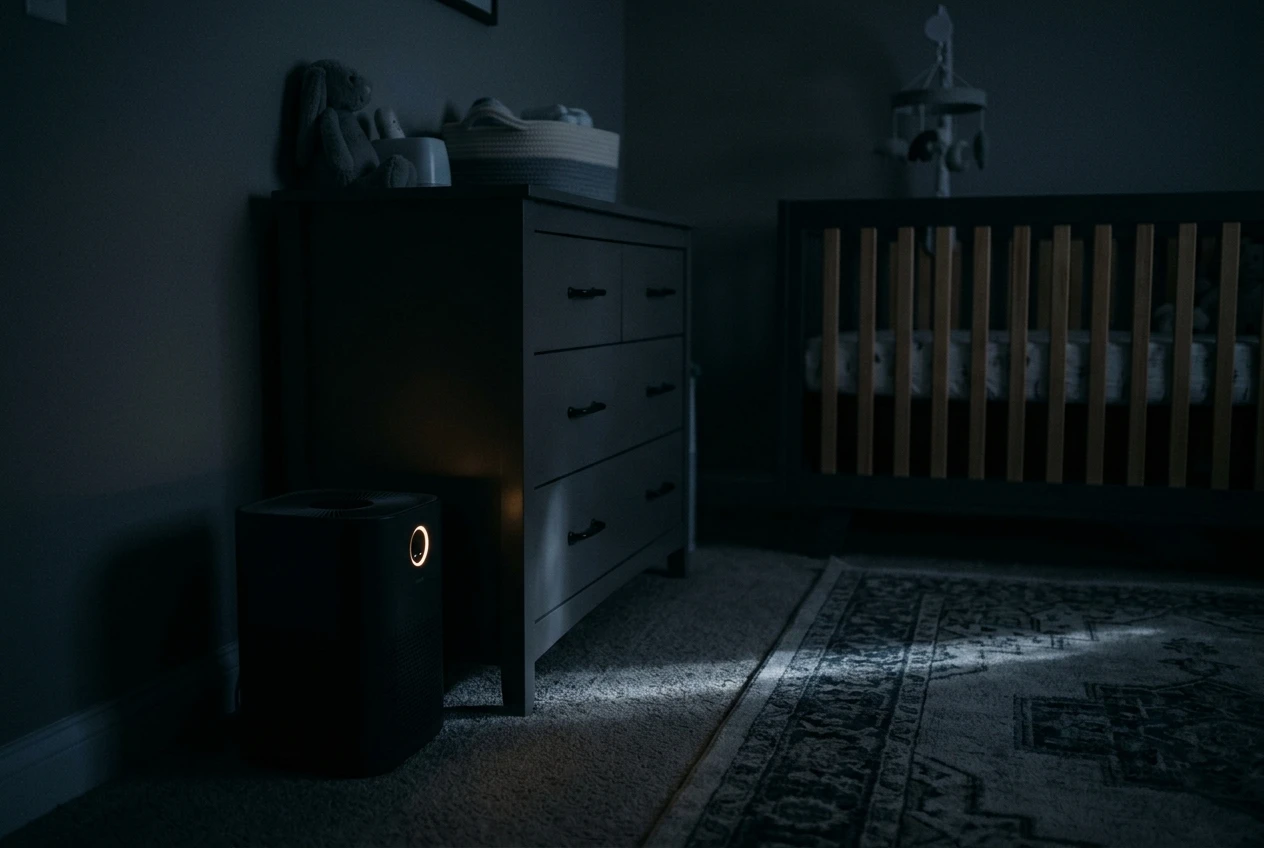
- The lowest speed, not the highest. You will run the purifier at its lowest or second-lowest setting overnight. Look for the decibel rating at that setting, and read reviews that describe the sound in a bedroom rather than quoting the maximum.
- The type of sound. A steady, low whoosh is easy to sleep through. A whine, rattle or periodic click is harder to ignore, even when it is quieter on paper.
- Whether the lowest speed still moves enough air. A unit that is quiet only because it barely moves air is not doing much. Compare the CADR at the low setting to your room size if the manufacturer publishes it.
- Display lights. A bright panel or status ring is a nuisance in a dark room. Look for a night mode that dims or turns off the lights, and confirm the unit does not beep when you press a button or change a setting.
- Sleep or night mode behavior. Some units drop to a very low speed in night mode and stay there regardless of what the sensor reads. That is fine for a quiet night, but know what the mode does so it does not surprise you.
If you want a deeper look at sleeping-room noise in general, the bedroom purifier guide covers the same ground for adult rooms.
What the app should do for you (and what you can ignore)
A smart purifier is useful in a nursery when the app removes work. It is a bother when the app adds notifications. Judge it on a short list.
Worth having:
- A clear current reading of particles (usually PM2.5), so you can see the effect of cooking smoke, a window left open or a dusty afternoon.
- A filter life indicator, so you know when to order a replacement before the old one is spent.
- A schedule and a night mode you can set once, so the unit changes speed on its own.
- Control of the display lights from the app, so you do not have to walk into the nursery to dim them.
- Alerts that you can switch off or limit to things that matter, such as a filter change.
Safe to ignore:
- Push notifications every time the reading moves. At 3 a.m. a notification that says air quality has changed does not help you.
- Scores, streaks and “air quality grades” that compress the readings into a single number without telling you what moved it.
- Extras you will not use, such as voice assistant integration, if you do not already use one.
One practical point: the reading comes from a small sensor in the unit, and it can drift or get dusty. If the app shows high numbers in a room that looks clean, the dust sensor guide explains how to check it. Treat the readings as a general indication of how the room is doing, not as a precise medical measurement.
Also decide how much of the unit’s behavior you want automatic. If you wonder whether to leave it running continuously, the article on running your purifier all day or using auto mode covers that choice.
VOCs from new paint, cribs and flooring: what carbon filters can and can’t do
New paint, composite wood furniture, mattresses, rugs and flooring can release volatile organic compounds, or VOCs, which are gases rather than particles. This is where purifier marketing gets vague, so it helps to know the basics.
A HEPA filter captures particles. It does not capture gases. For gases you need activated carbon, which adsorbs some gas molecules as air passes through it. Three points decide whether that is meaningful in a nursery:
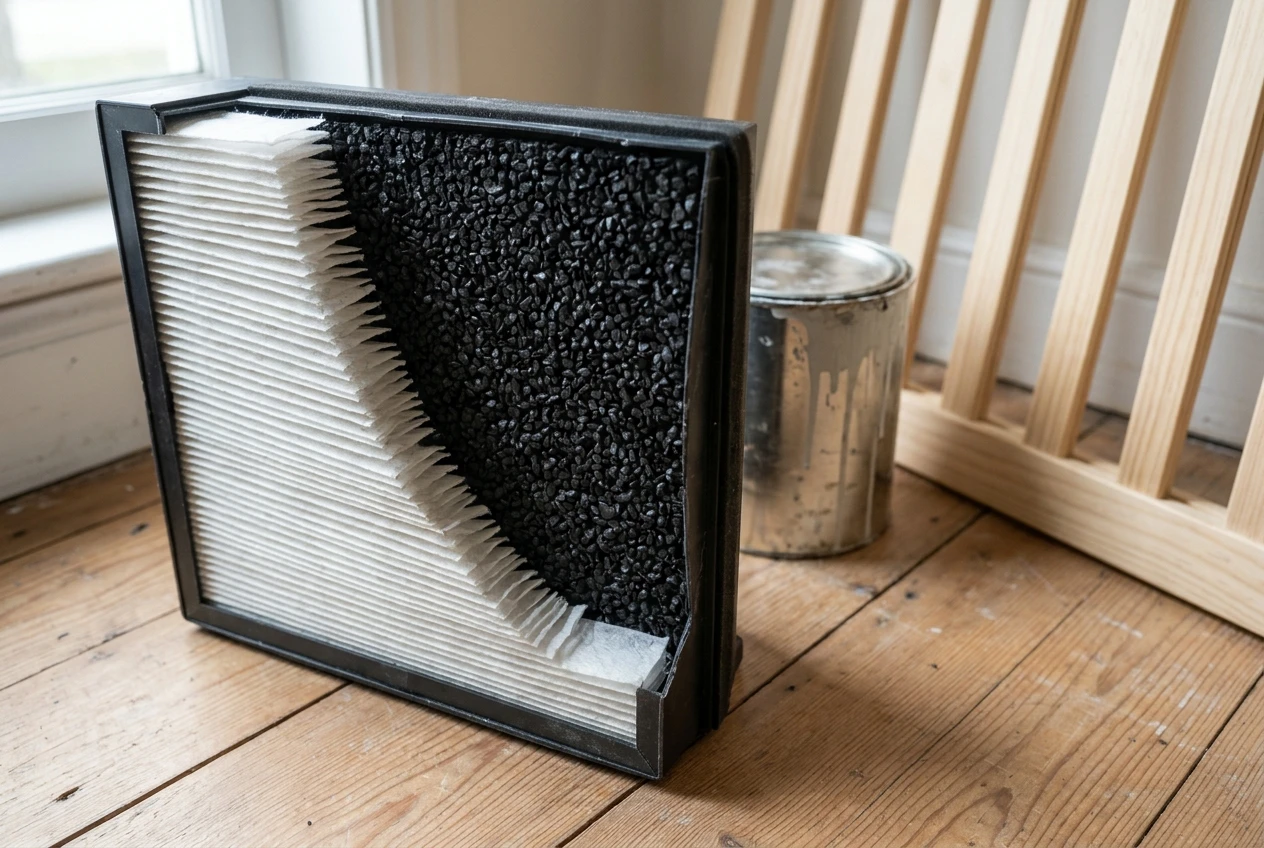
- How much carbon there is. A thin carbon-coated mesh or a light dusting on a pre-filter has little capacity. A filter with a real bed of granular carbon, which you can often tell by its weight and thickness, has far more. If the manufacturer does not say how much carbon the filter has, assume it is modest.
- Carbon fills up. Once its surface is saturated it stops adsorbing, and the filter will need replacing sooner in a room with a heavy gas load. A new nursery is exactly that kind of room.
- It reduces gases but does not remove the source. The paint, crib or flooring keeps releasing gas while the purifier works on what has already entered the air.
Be wary of any product that promises to “eliminate” fumes or claims it will make the room safe. A purifier can help reduce some odors and gases, and that is a reasonable thing to expect. It cannot guarantee a particular result, and it should not be your only step. If you or your doctor have specific concerns about a baby’s health or sensitivities, ask your pediatrician rather than relying on a product description.
Avoid units that produce ozone on purpose, such as some “ionizer” or “ozone” features. A nursery is a poor place for them.
What helps more than any filter is dealing with the source:
- Choose low-VOC paint if you are painting, and check the can for how long it needs to cure.
- Unbox and air out new furniture, mattresses and rugs before they go into the room, if you have a garage, porch or spare room.
- Give the room time with windows open before the baby sleeps there.
For smoke and similar situations, the carbon filter article on wildfire smoke explains in more detail why carbon matters alongside HEPA.
Placement and safety: cords, airflow and keeping it out of reach
Placement matters for safety first and performance second.
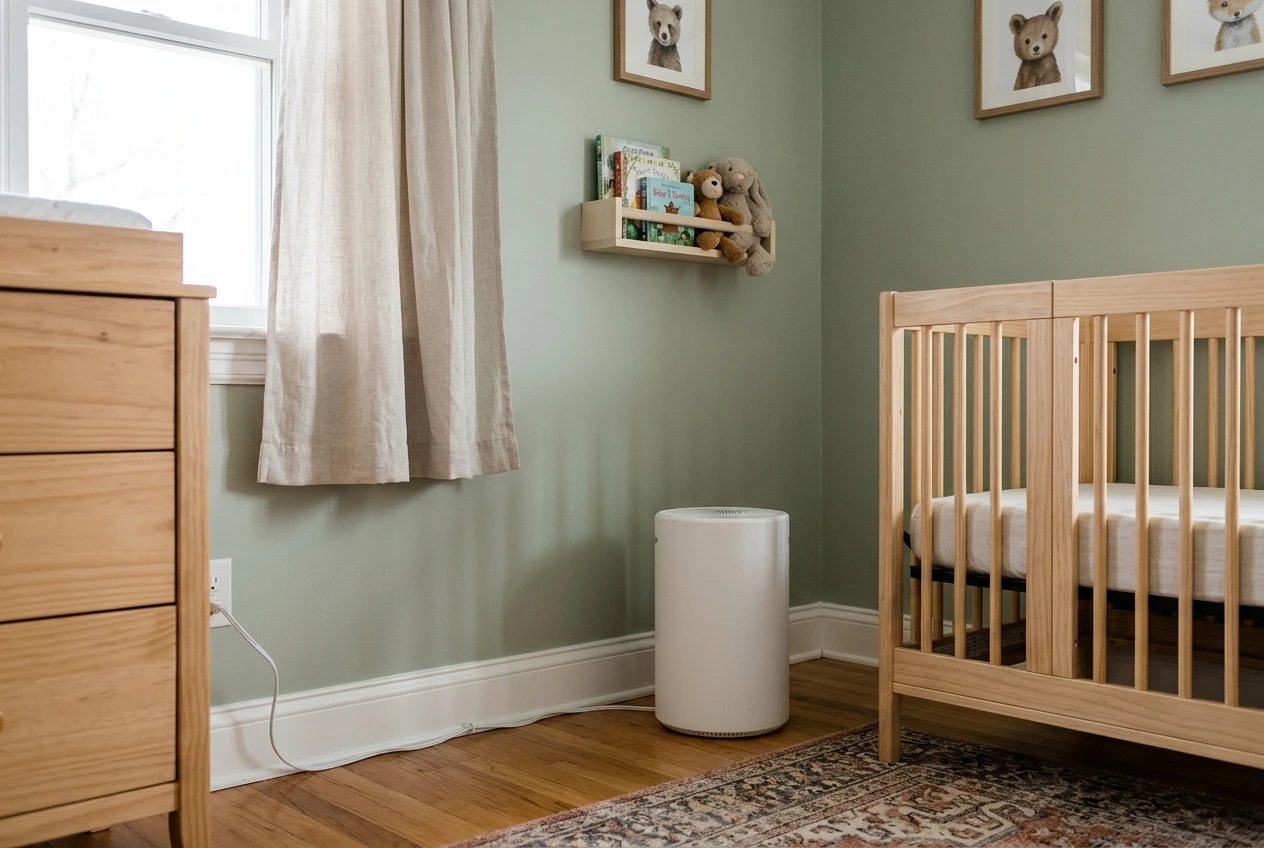
Safety:
- Keep the unit and its power cord well out of the baby’s reach, now and as the baby grows. A crawling infant or a toddler can pull on a cord or touch the unit in a few weeks, so plan for the room you will have in six months, not only on day one.
- Choose an outlet that allows a short, tidy cord run along a wall, behind furniture or otherwise out of reach. Avoid a cord stretched across the floor.
- Do not put the purifier inside or next to the crib. Keep it a sensible distance from the crib, changing table and anything the baby can touch.
- Choose a stable, floor-standing unit with a low center of gravity rather than a tall, narrow one that could tip. If a unit has a child lock for its controls, that is a useful extra.
- Follow the manufacturer’s instructions for clearance, and check them again if you move the unit.
Airflow:
- Leave space around the intake and outlet so the unit is not blocked by curtains, furniture or a wall. Most manufacturers state the minimum gap.
- Avoid pointing the outlet directly at the crib. A steady stream of air near a sleeping baby is unnecessary, and a purifier works by circulating the whole room’s air.
For the specifics by room, see the placement guide.
Setting up before the baby arrives
Set the purifier up early, ideally while the room is still being finished. That gives you time to learn how it behaves and fix problems before they happen at night.
- Run it empty first. New units can have a slight smell from the filter or packaging. Running it in the room for a few days beforehand lets that pass and lets you check the noise at each speed.
- Open the windows. Ventilate when the paint is drying and when new furniture arrives. A purifier recirculates the air in the room and does not bring in fresh air, so it is no substitute for ventilation.
- Test the app and Wi-Fi. Set up the schedule, the night mode and the display lights, and make sure the connection holds. If it drops, the Wi-Fi troubleshooting guide goes through the fixes in order.
- Plan a simple filter schedule. Put the filter’s expected life on your calendar from the day you open it, and add a reminder for the pre-filter check. The pre-filter cleaning guide explains how often a room like this tends to need it. A new nursery may use up its carbon filter faster than the manufacturer’s estimate, so watch for a return of smells and replace the filter when it happens.
- Know how to reset the filter light. After you swap a filter, you will need to reset the counter. The filter light reset guide covers the common brands.
A short checklist for comparing nursery purifiers without overspending
Use this list when you compare models. If a unit fails the first three, the rest does not matter.
- Room fit: the CADR suits your room’s volume, and the unit is not oversized for a small space.
- Low-speed noise: the decibel rating at the lowest setting is quiet, reviews describe it as steady, and the low setting still moves a useful amount of air.
- Lights and sounds: the display can be dimmed or switched off, and there are no beeps.
- True HEPA filter: the manufacturer says so plainly.
- Carbon filter: there is a real carbon layer, with the amount stated, if fumes are a concern. No ozone-producing features.
- App: a clear PM2.5 reading, filter life, schedules and controllable alerts.
- Safety: a stable body, a cord that can be kept out of reach, and a child lock if possible.
- Running cost: replacement filters are available, affordable and compatible, because a cheap purifier with expensive filters costs more over time.
Spend your money on quiet low speeds, a good filter and easy upkeep, and skip premium features you will not use.
If you are ready to look at placement or the long-term filter bill, start with the placement rules for each room and the breakdown of what a smart air purifier really costs over three years.