Say you have picked a purifier for your living room or bedroom. The app looks good, the reviews are fine, and the price on the box seems fair. Then you open the replacement filter listing and find that one filter costs a large share of what the unit did.
That filter is a recurring bill, and it often decides which purifier is the cheaper one to own. This article shows how to work out the three-year cost of any smart air purifier, so you can compare models on what you will actually spend.
Why the price on the box is only the first bill
A purifier does one job: it pushes room air through filters that trap particles. Those filters fill up, and once they do, the unit moves less clean air and eventually needs new ones. The purifier is built around a part you will keep buying.
This is why two models with the same sticker price can end up far apart after a few years. One may use a single filter that you replace on a long interval. Another may use two or three filters on shorter intervals, with a smart timer that counts down faster than you expected.
Three years is a useful window for comparing. It is long enough for every filter in the unit to be replaced at least once, and short enough that you can still reasonably predict how you will use the machine. The comparison works the same whether you own your home or rent it, although renters who may move should think about whether the unit and its filters will come along.
The three-year cost formula: unit, filters, and the extras people forget
The formula is short:
Three-year cost = unit price + (filter sets needed over three years × price per filter set) + extras
Take each part in turn.
- Unit price. What you actually pay, including shipping and tax if they apply.
- Filter sets needed. Three years in months, divided by the replacement interval in months, rounded down to whole sets. If a filter lasts twelve months, you will usually buy two or three sets over three years, depending on whether the unit shipped with a first set and when you count the first replacement.
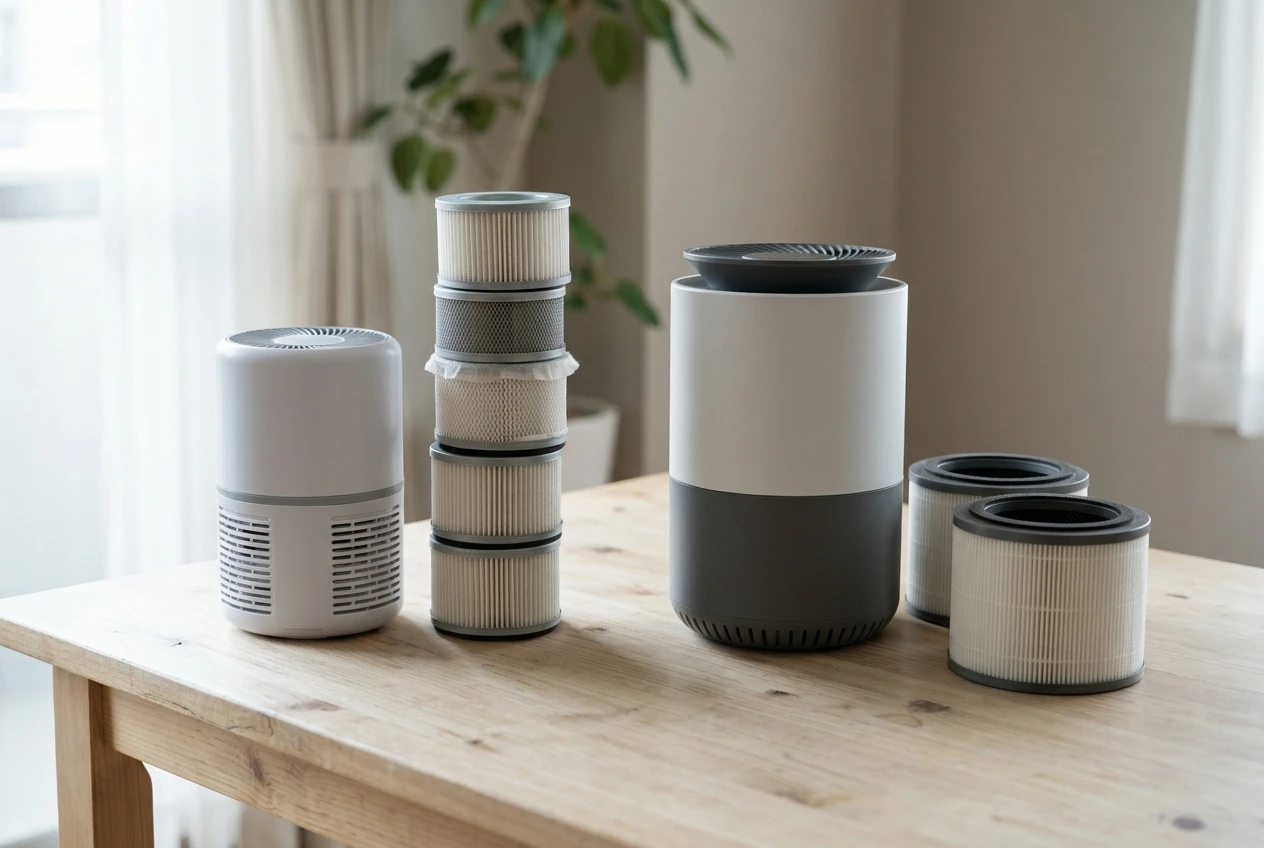
- Price per filter set. The total for every filter the unit needs at one replacement, not the price of the one filter in the product photo.
- Extras. The costs people leave out, covered below.
As an arithmetic illustration only, with round numbers that are not real prices: a $100 unit that needs one $30 filter set per year costs $100 + (2 × $30) = $160 over three years, if the first set comes in the box. A $70 unit that needs a $50 set every six months costs $70 + (5 × $50) = $320 over the same period. The cheaper box ends up costing twice as much.
The extras people forget
- Shipping on filters. Heavy or bulky filters can add a meaningful amount per order.
- Separate pre-filters or carbon layers. Some units sell these apart from the main filter.
- Electricity. A purifier running around the clock uses power. The unit’s rated wattage is in the specs, and your utility bill shows what a kilowatt hour costs you.
- Subscription features. Some apps lock certain features, or automatic filter reordering, behind paid tiers. If an app asks for a fee, add it.
- Cleaning supplies. If a part is washable or vacuumable, count the minor cost of keeping it clean, or ignore it if you already own a vacuum.
Read the filter spec before you buy: how many, how often, how many stages
Every manufacturer lists what filters the unit uses, usually on the product page under specifications or accessories. Three details matter for the formula.
How many filters. Some purifiers use one combined filter that includes the particle layer and a carbon layer. Others use separate filters for each stage. Separate filters can be cheaper to replace individually, since you might swap the carbon layer without touching the particle filter, but they can also mean more parts to buy and track.
How often. Look for the manufacturer’s stated replacement interval. It may be given in months, hours of running time, or both. Note whether the figure is a maximum under light use or a general recommendation, because the wording tells you how much to trust it.
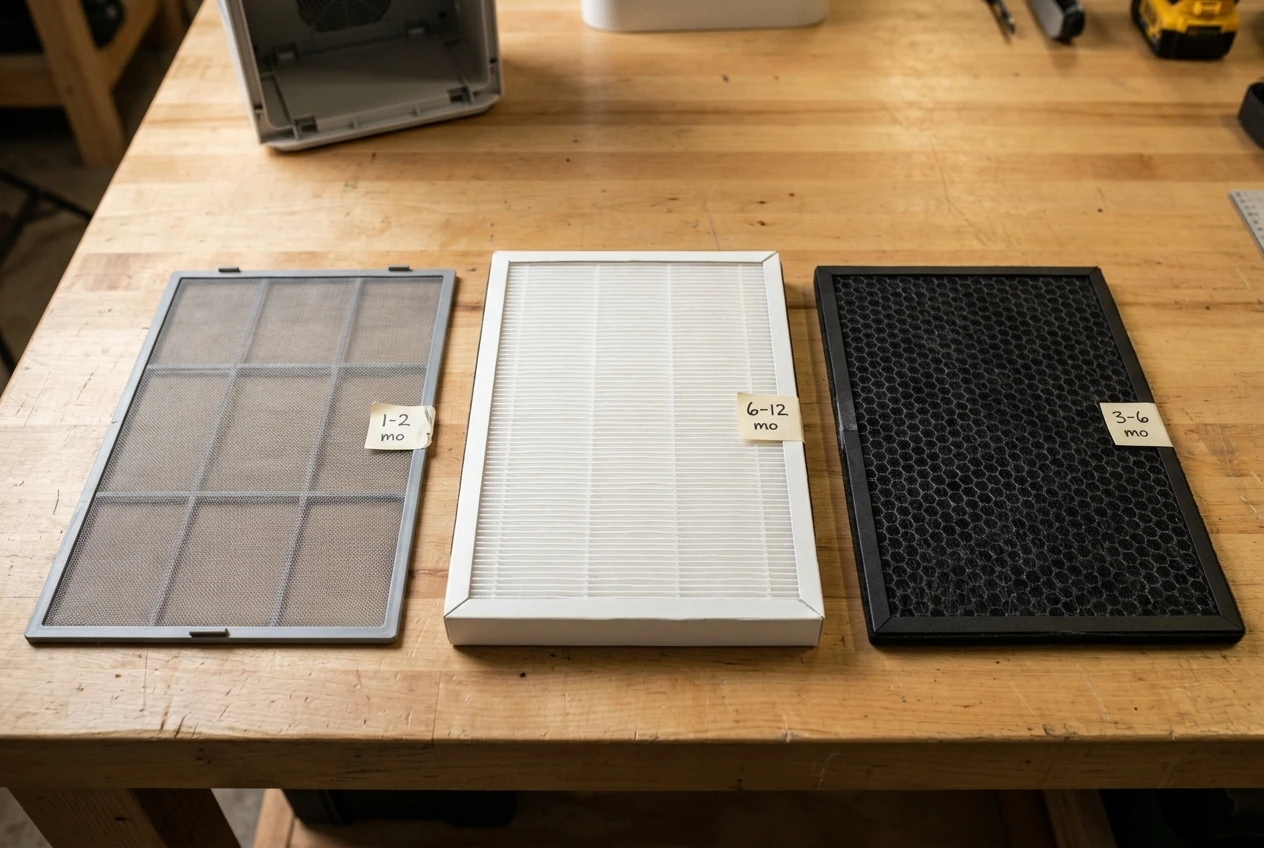
How many stages. Each extra stage is one more thing that wears out. A unit with a pre-filter, a particle filter and a carbon filter has three different replacement schedules. Write each one down.
If the filter’s name or part number is not on the product page, that is information too. A model whose replacements are hard to find may leave you stuck later. Our post on what to do when you can’t find your air purifier filter covers that problem in detail, and it is easier to avoid before you buy than to solve after.
Smart filter timers: when the app is right and when it’s just nudging you to buy
The app’s filter indicator is a convenience, and it can also be a sales prompt. It helps to know how your unit decides that a filter is finished.
Some timers count calendar days or fan hours. Those are simple clocks. They do not know whether your room is dusty, whether you have pets or whether the unit mostly ran on low. A clock-based alert is a reasonable reminder, but it can ask for a new filter before the old one is spent.
Other units use a sensor or measure airflow and pressure. These respond more closely to real conditions, though no timer sees the filter itself.

The practical check is the filter. Pull it out and look. Heavy gray or dark buildup, reduced airflow from the unit, or a rising odor are signs it needs replacing, whatever the app says. If the app says replace and the filter looks and performs fine, you can reasonably wait a bit, especially if the manufacturer’s manual gives an interval longer than the app’s alert. A clean-looking filter does not prove it still works, though, because fine particles and odor absorption are not always visible. If you want to think this through, your air purifier filter still looks clean walks through the checks.
The reverse case also happens: you replace a filter and the light stays on. That usually means the counter needs a manual reset, and our post on a warning light that stays on after you replace the filter lists the usual causes. Before ordering anything else, confirm you reset it.
Which kinds of purifiers tend to keep filter costs low
No brand is cheap across the board, and models change, so check each one against the formula. These design traits tend to lower the filter bill:
- A single combined filter on a long interval. Fewer parts and fewer reorders mean less to track, and the price per set may be the lowest total for the unit.
- A washable or vacuumable pre-filter. A pre-filter catches larger particles like hair and lint. If you can clean it instead of replacing it, the main filter is protected and may last longer. Check that the manual permits cleaning.
- Filters sold by several sellers. A filter you can buy in more than one place is less likely to be overpriced or out of stock. Look at how many listings exist and whether the price moves between them.
- A unit that fits the room. A purifier sized to the space can often run at lower fan speeds and still clean the air, which means less wear per month. Our guide on sizing a purifier for a large living room by airflow explains how to read clean air delivery ratings instead of the square footage on the box.
- Honest timers. A unit that shows its filter life from actual use, and lets you read and reset it, gives you control over when you buy.
Traits that tend to raise the bill: several proprietary filters with different schedules, filters sold only by the manufacturer, and a timer you cannot adjust or reset. None of these means a model is bad. They mean you should enter the numbers carefully.
If you are still choosing a model from scratch, our smart air purifier buying guide starts with your room and your problem and works from there. Then use the formula here to settle between the finalists.
When a cheaper compatible filter makes sense, and when to stay with the original
Third-party filters are priced lower and sold in many shops. They can bring the three-year cost down a lot, so they belong in the formula as a second scenario.
A compatible filter makes sense when:
- It matches the original’s dimensions and shape exactly, so the seal against the housing is the same.
- The seller lists the filter’s media, stages and any carbon content, so you can compare it with the original.
- Your unit’s warranty does not require original parts. Read the warranty wording before you decide.
- The reviews describe the same model as yours, not a similar one.
Staying with the original makes more sense when:
- The unit has sensor or chip features that only recognize the maker’s filters.
- You need the filter for a specific health reason and want the manufacturer’s stated performance.
- The price gap is small once you count shipping and the lower confidence.
A filter that does not seal properly lets air go around it instead of through it, which defeats the purpose. A poor fit can also cause the cover not to close. If you are weighing both sides, our full comparison, original vs. compatible air purifier filters, covers the trade-offs, and what to do when a filter won’t fit helps if you have already bought one that does not.
In your worksheet, run both scenarios as two rows. The difference shows how much the choice is worth to you over three years.
A simple worksheet to compare any two models in ten minutes
Open two product pages and a note, and fill in these lines for each model.
- Unit price you would pay, with shipping and tax.
- Filters in one replacement set, listed by name.
- Price of each filter, added into one set price.
- Replacement interval in months, from the manual or the product page.
- Sets needed in 36 months, using the interval, and whether a first set is included.
- Filter total = sets × set price.
- Extras: filter shipping, subscription fees, estimated electricity.
- Three-year total = line 1 + line 6 + line 7.
- Compatible scenario: repeat lines 3 to 8 with a compatible filter price, if a trustworthy one exists.
- Per-month cost = three-year total ÷ 36.
Then check the result against your room. A model that costs less to own but is too small for your space will run on high all day and may wear its filters faster than the manufacturer’s interval. Total cost only helps if the unit can do the job in the first place.
If you do buy more than one set at once, think through whether it saves money or just ties up cash; our look at buying air purifier filters in bulk lists what to check first.
Keeping filters lasting longer without cutting corners on air quality
Once you own the unit, a few habits can stretch filter life while keeping the air clean:
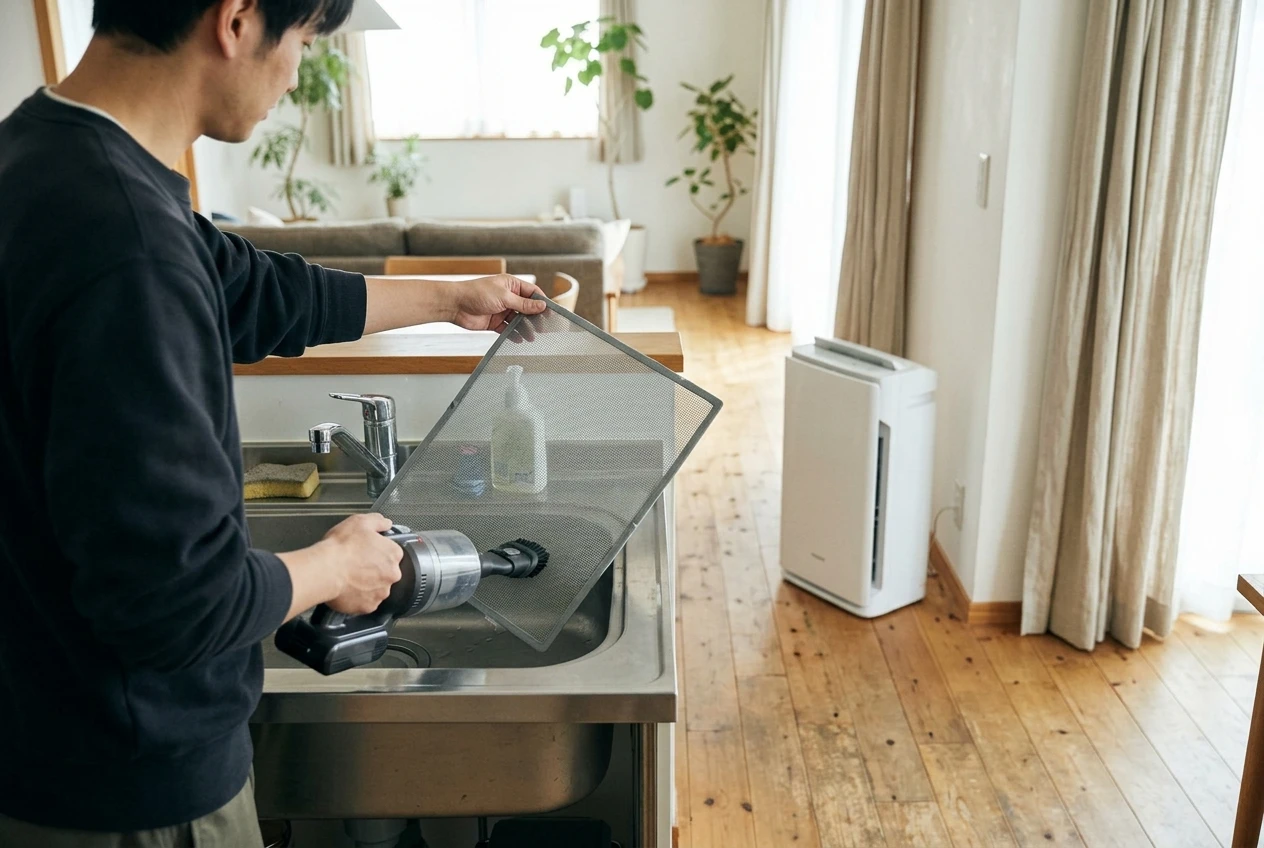
- Clean the pre-filter on the schedule in the manual. It collects the bulk of hair and lint, which protects the main filter.
- Give the intake space. Keep the unit away from walls, curtains and furniture as the manual directs, since blocked intake reduces airflow and can make the filter work harder. Placing the purifier on carpet can also be a problem, and our post on carpet and blocked intakes explains why.
- Reduce the dust source. Regular vacuuming, washing bedding and closing windows during high-pollen or smoky days leave less for the filter to catch.
- Run it where you spend time. A purifier in the room you use most does more for you than one running in an empty room.
- Do not wash filters that are not made to be washed. Water ruins most paper-style filters. If it has happened, read this before turning the unit back on.
- Do not stretch a filter past its useful life to save money. If airflow drops, odor returns or the filter is clearly loaded, replace it. Saving a few dollars is not worth running a filter that no longer works.
Running the formula on two or three models before you commit takes under an hour, and it shows which purifier will cost you least to keep running.
Join the email list for a free filter cost worksheet you can fill in for any purifier you’re considering.