FILTER CARE • ONE MISTAKE, THREE DIFFERENT NEXT STEPS
The dust washed away. Then you saw the label: “Do not wash.”
Before you order a replacement purifier—or convince yourself the filter will be fine by morning—answer one question: what, exactly, got wet? A separate washable screen, a disposable cartridge, and water inside the machine are three different problems.
This guide helps you choose the next step without turning a cleaning mistake into another experiment.
Disclosure: This research-based guide contains a FiltersFast affiliate link. We may earn a commission from qualifying purchases without adding a separate charge to your purchase. No hands-on filter recovery testing is claimed. Read our affiliate disclosure .
Quick answer: Can you use an air purifier filter after washing it?
Only reuse a washed component when its exact care instructions permit washing and you have completed the specified cleaning and drying process. If you washed a non-washable main filter or carbon cartridge, keep it out of service and follow replacement guidance or contact the manufacturer.
If water entered the purifier body or electrical connections, do not test-run it. That requires separate safety guidance. A dry-looking filter does not resolve water exposure inside the appliance.
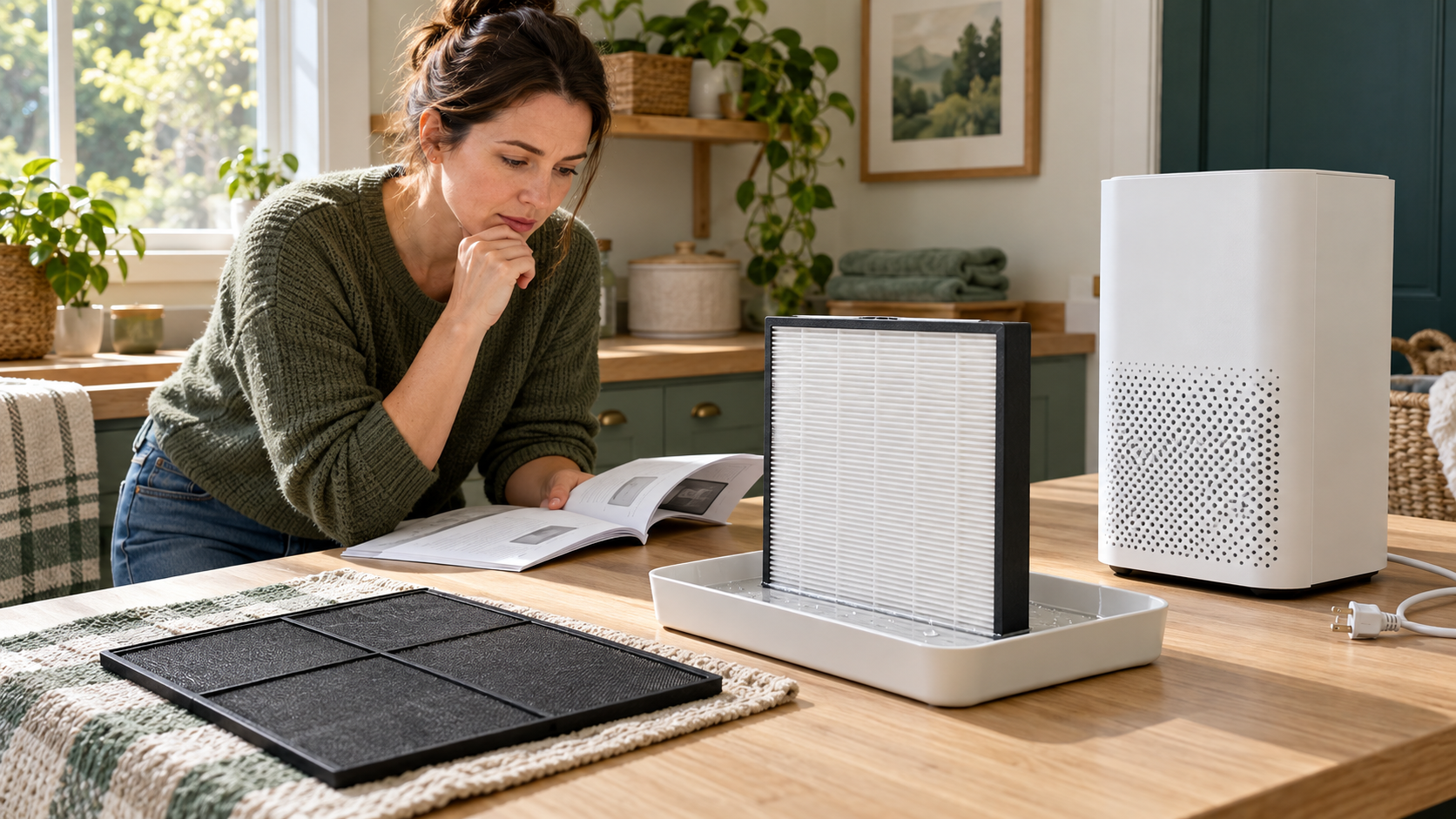
First, separate the wet filter from the wet-appliance problem
If the purifier, plug, outlet, and surrounding area are dry, switch it off and unplug it before opening the filter compartment. Keep the wet removable component outside the machine.
If the appliance or electrical connection is wet and still connected to power, do not touch it. Keep people away and get qualified help to make it safe. Do not reach through water for the plug or try the power button to see whether the purifier survived.
The CPSC’s wet-appliance guidance warns of shock and fire hazards after water exposure. Its storm guidance concerns wet appliances; it does not mean that rinsing an approved removable pre-filter ruins an otherwise dry purifier.
What got wet? Find your starting point.
Confirm washing is permitted. Follow the full cleaning and drying instructions.
Keep it out. Follow replacement guidance or ask official support about the incident.
Do not test-run it. Seek appropriate service or electrical guidance.
“Washable filter” may describe only one layer
A product description can emphasize a washable pre-filter while the main cartridge remains replacement-only. Look for the instruction attached to the exact component, not the most reassuring word on the box.
| Component | What to establish | What follows |
|---|---|---|
| Separate mesh pre-filter | Does the manual explicitly allow washing? | If yes, follow its cleaning method and complete drying requirements. |
| Main particle or HEPA filter | Is this exact part washable or replacement-only? | A washed, non-washable filter needs replacement guidance—not a guessed drying time. |
| Carbon stage or bonded cartridge | Is the whole assembly approved for washing? | Do not assume a mesh exterior makes the inner layers washable. Do not peel them apart. |
| Unidentified “permanent” filter | What cleaning method does the manufacturer specify? | “Permanent” is not permission to rinse it. |
For example, Coway’s AP-1512HH instructions allow washing the pre-filter and require complete drying before installation. That is permission for a specified part, not for every filter in the machine.
Need help distinguishing routine cleaning methods? Read Can You Vacuum an Air Purifier Filter? before using a vacuum as the next rescue attempt.
Choose the next step from the instructions—not the appearance
If you washed an approved washable pre-filter
Read the entire care instruction, including water temperature, cleaning agents, handling, and drying conditions. Follow any stated minimum drying time and the requirement for complete dryness. Check the frame and corners as well as the center of the screen.
Leave it outside the purifier while it dries. Do not use the purifier’s fan, a hair dryer, an oven, or another improvised heat treatment to speed things up. If you used a cleaner the manual prohibits, or the frame or mesh is damaged, ask support before reusing it.
If you washed a non-washable main filter
The relevant question is whether the manufacturer allows that filter to be washed—not whether you can remove all the water. Levoit’s maintenance guide , for example, identifies its main and activated-carbon filters as non-washable replacement items.
Do not treat normal airflow, an unchanged smell, or a green air-quality light as proof that the washed cartridge still performs to specification. Those observations cannot establish filter integrity. Follow the replacement instructions or obtain incident-specific advice from official support.
If you cannot tell what got wet
Find the purifier model and filter code. Photograph the affected part and explain whether it was briefly rinsed, soaked, washed with detergent, or reinstalled while wet. Send this through the manufacturer’s official support channel:
My purifier model is ____, and the filter code is ____. I washed ____ using ____. Water did / did not / may have reached the purifier body. Is this component approved for washing, and what replacement or service action do you recommend?
If you already ran the machine with a wet filter, include that detail. Do not keep running it to “finish drying.” If water may have entered electrical areas, follow the wet-appliance precautions above.
The useful distinction: dry is a condition, not a performance test
An approved washable part must be completely dry before reinstallation. A non-washable cartridge does not become approved for reuse simply because it dries. There is no universal 24- or 48-hour rule that settles both situations.
Before spending money, identify what actually needs replacing
If the appliance stayed dry and only a removable non-washable filter was washed, start with the correct replacement filter. A filter mistake does not automatically justify a whole new purifier.
- Match: the full purifier model, including its version or suffix.
- Confirm: the manufacturer’s filter code and every required stage.
- Check: pack quantity, seller identity, delivery availability, and return terms.
- Avoid: trimming, crushing, or removing layers to make a similar cartridge fit.
Begin with the manufacturer’s compatibility information. Once you know the code, you can check FiltersFast for a replacement (affiliate link; opens a new tab) . This goes to the retailer, not to a preselected filter for your machine. Confirm the live listing before buying.
If the right part appears unavailable, use our five checks before replacing a purifier whose filter is hard to find .
The restart gate: resolve all four checks
- Appliance: no water exposure to the body or electrical parts and no unresolved fault.
- Filter: correct, serviceable replacement or an approved washable part cleaned as directed.
- Dryness: approved washed components are completely dry.
- Assembly: packaging removed, orientation correct, filter seated, cover closed normally.
Stop if startup produces a burning smell, overheating, unusual mechanical noise, or an unresolved error. Do not bypass an interlock or run the purifier without required filters to diagnose or dry it.
Make a three-line record so this happens only once
The free Smart Air Purifier Fit & Filter Planner includes filter matching and a maintenance plan. Its signup page offers the 15-page workbook by email. Add this short record to the maintenance notes or a companion sheet:
IDENTIFY: Purifier model ____ / Filter code ____ / Affected layer ____.
DECIDE: Manual page or support response ____ / Approved care method ____ / Action taken ____.
REMEMBER: Incident date ____ / Replacement cost ____ / Installation date ____ / Next manual-directed check ____.
Keep the care instruction with the filter code: “This part: wash / vacuum / replace.” That small note is more useful than relying on memory the next time the cartridge looks dusty.
What to do while the purifier is out of service
Do not reinstall a questionable filter just to keep the fan moving. If available, use another suitable, undamaged purifier according to its manual in the room you most need to cover.
Reduce avoidable indoor particle sources, such as candles, incense, and smoking. Ventilate with clean outdoor air when conditions allow; avoid bringing outdoor smoke or pollution inside. The EPA’s home air-cleaner guide explains that filtration supplements source control and ventilation.
Four quick decisions: What would you do?
Select an answer to reveal feedback. You can change your choice. This check sends no answers and does not certify an appliance as safe.
Frequently asked questions
I only rinsed it for a few seconds. Does that change the advice?
Describe the brief rinse to support, but do not assume short exposure makes a non-washable cartridge reusable. The filter’s instructions and the affected components still determine the next step.
Can I leave it in the sun or on a heater?
Use only the drying conditions specified for an approved washable component. Do not improvise heat treatment. Drying a non-washable cartridge does not establish restored performance.
Can I wash the black carbon layer separately?
Only if the manufacturer explicitly permits it for that exact part. Do not pull bonded layers apart. A black screen may also be a different component entirely; color does not identify its care method.
What if the purifier seems to work normally?
Normal fan operation does not verify filter capture performance or resolve possible internal water exposure. Base reuse on the exact care instructions and any necessary service guidance.
Do I reset the filter light after this?
Reset it only after completing the maintenance action specified by the manual. Resetting a reminder does not repair a washed cartridge or make a wet appliance ready to run.
Does washing a filter void the warranty?
That depends on the product’s terms and the incident. Do not assume coverage or exclusion. Explain what happened to official support and ask what options apply.
Which instruction would have prevented your mistake?
Was “do not wash” hidden in the manual? Did “washable pre-filter” sound as though it described the entire cartridge?
Tell us in the comments: your purifier model, which part you washed, and the care instruction you found afterward. Leave out serial numbers, order details, and personal information. Your example may help another reader spot the distinction before heading to the sink.
Fact-checked October 24, 2026: This guide draws on the official Coway, Levoit, CPSC, and EPA guidance linked above. Manufacturer examples are model-specific. The decision aids are editorial summaries, not diagnostic tests; your exact manual and official support instructions take priority.