Reader-First Affiliate Disclosure: This article contains affiliate links. If you make a qualifying purchase through one of these links, Best Smart Purifiers may earn a commission at no extra cost to you. Best Smart Purifiers is an independent research and education site—always verify your exact purifier model number, filter code, and seller return policy before ordering.
You bought an air purifier to make your room feel fresher—so when a damp, sour, or stale smell starts drifting out of the top vent, it feels like the machine has turned against you. Many homeowners immediately assume the motor is burning out or throw away an expensive filter cartridge months ahead of schedule.
In most homes, a smelly air purifier is not a broken machine. Instead, it is a specific physical signal from one of your filtration stages: either trapped organic dust on the pleated HEPA media has absorbed room moisture, the activated carbon layer has reached saturation and begun releasing stored odor molecules, or a simple setup oversight is blocking clean airflow.
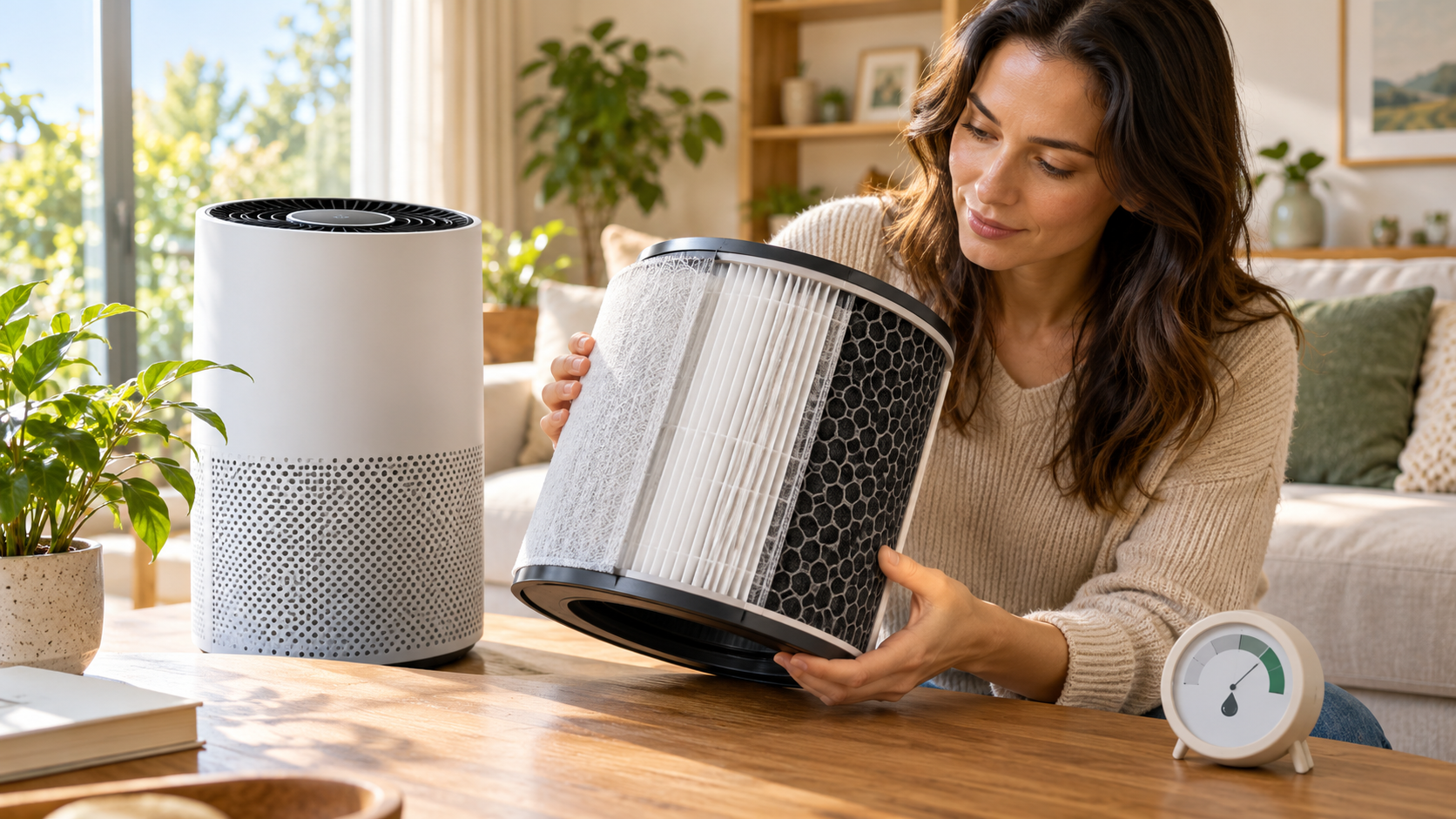
A musty or sour smell coming from an air purifier is almost always caused by moisture interacting with organic dust trapped in the pre-filter or HEPA layer, or by an activated carbon filter that is fully saturated and can no longer hold cooking, pet, or household gases.
- Smells like a damp towel or sour vinegar? Indoor relative humidity above 55%–60% has dampened pet dander, skin cells, or pollen sitting on the filter pleats.
- Smells like yesterday’s dinner or pet litter? Your activated carbon stage is full. According to the U.S. EPA Guide to Air Cleaners in the Home, particle filters and gas filters perform completely different jobs.
- Smells like sweet plastic or chemicals on a brand-new filter? Normal initial off-gassing—or a forgotten inner plastic wrapper still sealed around the carbon stage.
- Smells sharp, metallic, or like ozone/burnt dust? Turn off optional ionizer/plasma switches immediately and vacuum dust from the intake grille and sensor port.
Quick Comparison: Match the Smell to the Real Cause
Before pulling out your credit card for a replacement filter or a new purifier, match what you smell at the outlet grille against this diagnostic table.
| Odor Type | Most Likely Culprit | Can You Save the Filter? | Best Immediate Action |
|---|---|---|---|
| Musty, Sour, or “Wet Dog” | High room humidity (above 55%) dampening organic dander/dust trapped in the HEPA pleats | Sometimes (if mild & recent; No if mold or mildew is present) | Wash & bone-dry the pre-filter, lower room humidity to 30%–50%, or replace the cartridge if the sour odor persists after 24 hours. |
| Stale Cooking Oil, Garlic, or Pet Litter | Saturated activated carbon pores (desorption of trapped VOCs when temperature shifts) | No (HEPA cannot trap gases; washed carbon loses capacity) | Replace the carbon stage or combo filter using your exact model code via FiltersFast. |
| Chemical or Plastic Smell (New Filter) | Fresh adhesive/packaging off-gassing OR inner plastic bag left on a secondary stage | Yes | Open the housing to verify all plastic wrap is removed, then run on High in a ventilated room for 2–4 hours. |
| Sharp “bleach/rain” or Hot Electrical Smell | Active ionizer/UV-C ozone byproduct OR heavy dust buildup straining the fan motor | Yes (if filter is clean; inspect motor if burning smell continues) | Disable any “Ion / Plasma / Anion” toggle in your app; unplug immediately if the motor housing feels hot. |
Visual Breakdown • Infographic #1
BestSmartPurifiers.com Filtration Reference
Why Your Smart Sensor Says “Green” While Your Nose Says “Sour”
STAGE 1
Pre-Filter Mesh
• Traps pet hair, lint & coarse dust
• Odors happen if rinsed & reinstalled
while still slightly damp
FIX: Vacuum every 2–4 weeks;
air-dry 24 hrs after washing
STAGE 2
True HEPA (Particles)
• Captures ≥99.97% at 0.3 microns
• Tracked by PM2.5 laser sensors
• Does NOT block gas/odor molecules
WARNING: Never wash HEPA;
moisture breeds sour bacteria
STAGE 3
Activated Carbon
• Adsorbs VOCs, smoke & odors
• Fills up faster than HEPA media
• Releases odors when saturated
FIX: Replace carbon on time;
choose pellet beds over thin foam
7 Checks Before You Toss the Filter (or Blame the Purifier)
Work through these seven checks in order—starting with the fastest, zero-cost inspections—before ordering a replacement cartridge.
Check 1: Did a Washed Pre-Filter Go Back In Before It Was 100% Bone-Dry?
Washable mesh pre-filters are great for extending filter life, but they are also the single most common source of a sudden “wet laundry” or sour smell. Even a few drops of residual moisture trapped in the nylon mesh get pulled directly into the dry dust cake sitting on your HEPA pleats.
What to do: Open the housing and touch the pre-filter and the outer face of the HEPA pleat pack. If you recently rinsed the pre-filter, remove it, wipe the interior housing with a dry microfiber cloth, and let the pre-filter air-dry for a full 24 hours before reinstalling. Never rinse or wet a paper/fiberglass HEPA filter unless the manufacturer explicitly rates it as washable.
Check 2: Has Indoor Relative Humidity Climbed Above 55%–60%?
Think about what a HEPA filter actually holds after three months of operation: microscopic skin flakes, pet dander, pollen grains, and organic household dust. When indoor humidity stays between 30% and 50%, that trapped layer stays dry and odorless. However, if a rainy week, an unvented bathroom shower, or an ultrasonic humidifier pushes room humidity above 60%, bacteria and mold spores sitting on that organic dust can become active and release volatile microbial compounds.
What to do: Check a simple tabletop hygrometer or your smart purifier’s humidity readout. As the EPA’s consumer guidance on home air cleaners notes, portable air purifiers cannot fix an underlying moisture problem. Move any humidifier at least 6 to 10 feet away from your air purifier, keep indoor humidity between 30% and 50%, and replace the HEPA filter immediately if it smells strongly of mildew.
Check 3: Is Your Activated Carbon Stage Saturated (Desorption)?
Unlike a HEPA filter—which physically snares particles in a web of fibers—activated carbon traps odors and gases through adsorption, binding gas molecules inside millions of microscopic pores. Once every pore on the carbon surface is full, the carbon stops absorbing smells. Worse, when room temperature rises or humidity spikes, water vapor molecules can knock previously trapped cooking, pet, or smoke molecules loose—a process called desorption—turning the filter itself into an odor source.
What to do: Compare how long the carbon layer has been in service against your home’s odor load. Thin carbon-coated foam sheets can saturate in 60 to 90 days in kitchens or pet rooms, even if the HEPA stage is rated for 6 to 12 months. For a deeper look at how pet dander and odors differ, see our Air Purifier Buying Guides.
Check 4: Is a Secondary Filter Stage Still Wrapped in Plastic (or Outgassing)?
If the smell started the exact day you installed a brand-new filter, check two possibilities. First, new pleated filters and adhesives can emit a mild, slightly sweet “new plastic” or cardboard scent for the first few hours of airflow. Second, multi-piece filter kits (especially tower and box purifiers with separate pre-filter, HEPA, and carbon frames) sometimes wrap each frame individually. Leaving the clear shrink-wrap on an inner frame chokes airflow and heats up the fan motor.
What to do: Open the filter compartment and confirm every single stage is unwrapped and seated with the airflow arrows pointing in the proper direction. If the smell is mild new-filter outgassing, run the unit on High for 2 to 4 hours with a window cracked.
Check 5: Is an Optional Ionizer, Plasma, or UV Feature Switched On?
Some smart air purifiers include an optional toggle labeled “Ionizer,” “Anion,” “PlasmaWave,” or “UV-C.” If you notice a sharp, metallic, chlorine-like, or “after-a-thunderstorm” scent near the outlet grille, you may be smelling trace ozone or ionized air byproducts interacting with household VOCs.
What to do: Open your purifier’s control panel or companion app and turn off the ionizer or plasma setting. As both the U.S. EPA and AHAM Verifide® filtration standards emphasize, mechanical filtration (True HEPA + activated carbon) cleans the air without relying on ozone-generating components.
Check 6: Is the Purifier Pulling Air From a Hidden Odor Micro-Zone?
Air purifiers draw room air from 360 degrees or through side/rear intakes. If your unit sits tucked beside a litter box, a diaper pail, a damp laundry hamper, a kitchen trash can, or a musty baseboard, it continuously pulls concentrated odor plumes into the filter media—saturating the carbon bed in weeks and blowing the excess straight upward into your breathing zone.
What to do: Remove the odor source first, then give the purifier at least 12 to 18 inches of open clearance on all intake sides so it circulates room air evenly instead of vacuuming a smelly corner.
Check 7: Did an Unverified Third-Party Filter Cut Corners on Carbon Weight or Gasket Seals?
Two replacement filters can look identical in an online listing photo while performing completely differently inside your machine. Budget look-alike filters frequently replace heavy granular activated carbon pellets with a thin, sprayed-on black mesh—or use a stiff foam gasket that leaves a 2-millimeter gap around the frame. Unfiltered room air takes the path of least resistance right around the gasket, depositing dust onto the internal fan blades and motor housing.
What to do: Weigh the replacement filter in your hand and inspect the perimeter gasket seal. Always match your exact purifier model number and filter part code before ordering replacements from a verified supplier like FiltersFast.
Decision Flowchart • Infographic #2
Save vs. Replace Diagnostic
The 5-Minute “Keep, Clean, or Replace” Filter Decision Tree
STEP 1: THE NOSE TEST
Remove Filter & Run Fan
Run the empty purifier for
2 minutes. Does the air
still smell without the filter?
YES → Clean housing & vents
STEP 2: CHECK AGE & RH%
Under 3 Months & Dry?
If filter is <3 mos old and
never got wet, vacuum pre-filter
& air out in dry sun/breeze 4 hrs.
FIXED → Keep & lower RH <50%
STEP 3: REPLACE SAFELY
Saturated or Musty HEPA
If sour smell returns or filter
is 6+ mos old, carbon is full
or HEPA holds damp microbes.
ACTION → Replace exact filter code
Stop Guessing Which Filter Stage Failed—Track It With the Fit & Filter Planner
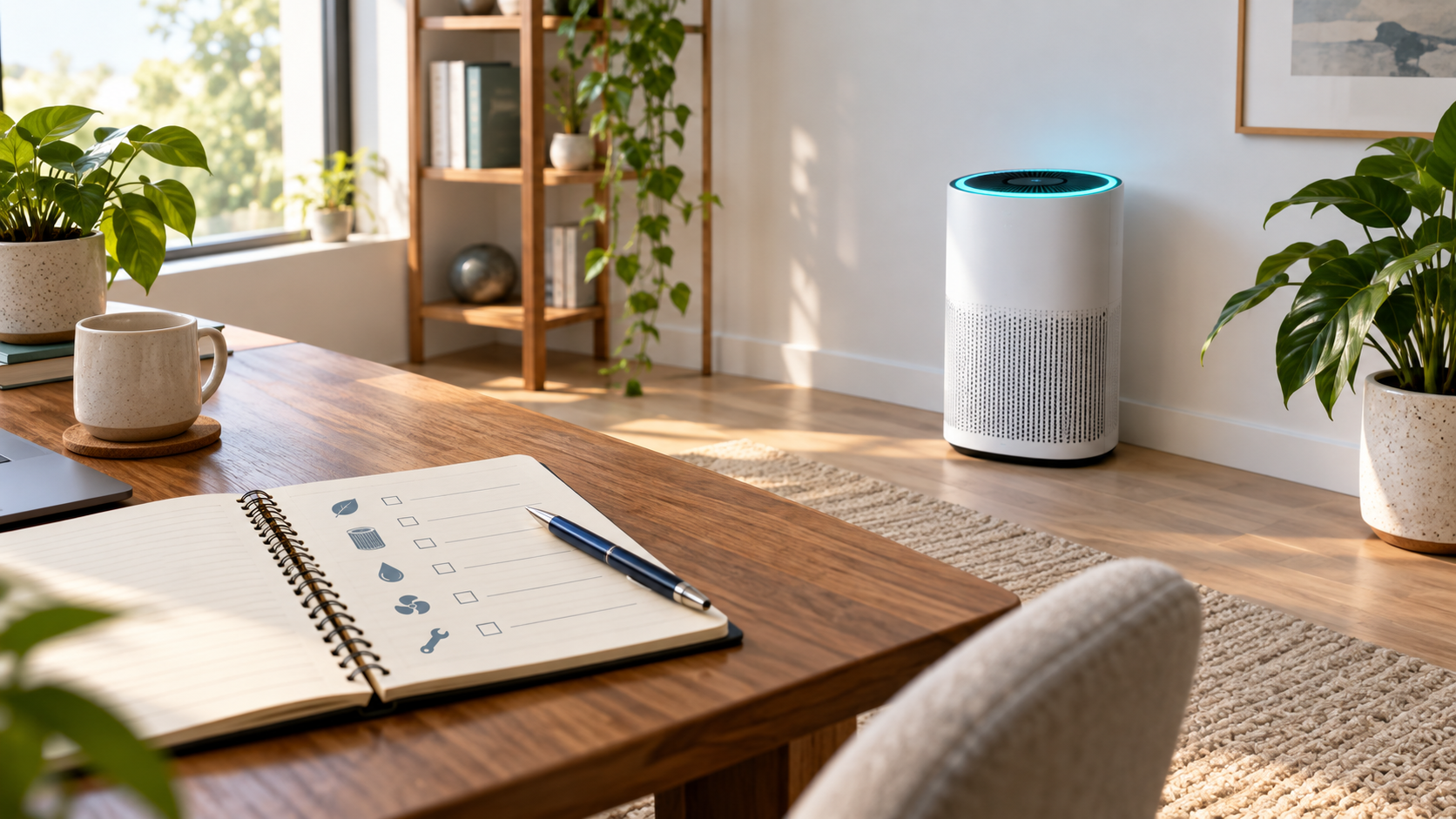
Most filter headaches happen because homeowners buy a machine for particles when their real problem is odors, or they lose track of their exact replacement filter code and install date. Use the free Smart Air Purifier Fit & Filter Planner on BestSmartPurifiers.com to log your exact purifier model number, filter code, room square footage, CADR target, and first-year replacement schedule on one printable worksheet.
Get the Free Smart Air Purifier Fit & Filter Planner →
Includes the Room Sizing Sheet, Filter Compatibility Checklist & First-Year Cost Calculator.
When to Replace the Filter vs. Upgrade Your Odor Control
Once you run the two-minute “empty fan test” (running the purifier with the filter removed) and confirm the odor lives inside the filter cartridge itself, resist the urge to spray air fresheners, essential oils, or disinfectant sprays onto the filter. Perfumes and oils coat HEPA fibers, permanently block microscopic pores in activated carbon, and void manufacturer warranties.
- When you just need a verified replacement filter: Write down the exact model number from the back or bottom label of your purifier and match the filter code on FiltersFast. Setting up scheduled deliveries through the FiltersFast Home Filter Club ensures you swap carbon and HEPA stages before desorption starts—especially if you run ENERGY STAR® certified room air cleaners 24/7.
- When a single portable unit isn’t enough for whole-home odors: If cooking fumes, pet odors, or seasonal dampness affect multiple rooms connected to forced-air ductwork, a small portable filter with a thin carbon sheet will saturate repeatedly. Explore commercial-grade portable and whole-home in-duct IAQ solutions from Field Controls—which pair high-capacity filtration with dedicated VOC and odor reduction—or review our foundational guide, Is Your Home’s Air Toxic? Indoor Air Quality Matters.
Interactive Reader Check • 4 Questions
Score: 0 / 4 Answered
Quick Knowledge Check: Can You Diagnose the Smell Before Buying a Filter?
Tap an answer for each question below to test your troubleshooting instincts and see the instant explanation.
1. Your smart air purifier’s PM2.5 light is glowing green (“Good”), yet the air coming from the top vent smells like stale garlic and cooking oil. Why didn’t Auto Mode speed up?
2. Two days after you rinsed your washable mesh pre-filter and popped it right back in, the purifier smells like a damp gym towel. What happened?
3. Can you fix a smelly HEPA and activated carbon combo cartridge by misting it with essential oils or fabric refresher spray?
4. What is the fastest way to tell whether a bad smell is coming from the filter cartridge versus the purifier’s internal fan housing?
Answer all 4 questions to see your troubleshooting rating!
Frequently Asked Questions (FAQs)
1. Why does my air purifier smell like sour vinegar or dirty socks?
A sour, vinegar-like, or “dirty sock” smell usually happens when organic debris trapped on the pre-filter or HEPA pleats (such as pet dander, skin cells, and pollen) absorbs moisture from humid indoor air (above 55%–60% RH) or an ultrasonic humidifier placed too close to the intake. Microbes feeding on that damp organic layer release acidic volatile compounds. Keeping room humidity between 30% and 50% and replacing damp HEPA cartridges solves the issue.
2. Can I vacuum or wash a smelly HEPA or activated carbon filter to make the odor go away?
You can gently vacuum or rinse a removable pre-filter (provided you let it dry completely for 24 hours before reinstalling), but you should never wash a standard True HEPA filter or an activated carbon filter unless the manufacturer explicitly labels it washable. Water ruins the electrostatic and mechanical web of HEPA fibers, and water cannot flush trapped volatile organic compounds out of saturated carbon pores.
3. Why does my brand-new replacement air purifier filter smell like plastic or chemicals?
A brand-new filter sealed in airtight shrink-wrap can hold a mild manufacturing scent from potting adhesives, frame gaskets, or virgin carbon dust. First, open the housing to verify that no secondary plastic wrapper was left inside. Then run the purifier on High for 2 to 4 hours in a ventilated room; genuine new-filter outgassing fades quickly, whereas a harsh chemical odor that persists after 48 hours warrants contacting the seller for a replacement.
4. Why did my filter start smelling after only two months when the box says it lasts 12 months?
Filter lifespan claims (such as “up to 12 months”) typically apply to the HEPA particle stage under moderate dust conditions. The activated carbon stage inside a combo cartridge has a finite pore capacity and can saturate in 60 to 90 days in homes with frequent high-heat cooking, multiple pets, wildfire smoke, or new paint and furniture off-gassing.
5. When should I unplug an air purifier immediately because of a smell?
Unplug the unit right away if you smell acrid burning plastic, hot electrical insulation, or see smoke, or if the top housing feels hot to the touch. Those are signs of motor bearing friction or an electrical fault rather than a dirty filter.
Join the Conversation in the Comments Below
Have you run into a sudden musty, sour, or plastic smell from your smart air purifier? Tell me in the comments below:
- Which purifier model are you running, and how long was the current filter installed before the odor started?
- What did the smell remind you of (damp towel, yesterday’s cooking, sweet plastic, or sharp ozone)?
- Which of the 7 checks solved it for you—or are you still troubleshooting?
I read every comment and use your real-world filter experiences to shape upcoming troubleshooting guides here on BestSmartPurifiers.com!