Best Smart Purifiers · Replacement-filter buying check
You found the right model number. One replacement filter carries the purifier maker’s name; another promises to fit for less. The photos look almost identical. Is the cheaper one a sensible purchase?
The answer depends on the exact purifier, filter construction, evidence of performance, and total cost. A compatible cartridge may be a reasonable option when its fit and performance are documented. A low price and a familiar shape alone do not establish that.
Affiliate disclosure: This article includes a FiltersFast affiliate link. Best Smart Purifiers may earn a commission from a qualifying purchase at no extra cost to you. Check the exact model and filter code before ordering through any seller.
Quick answer: Original or compatible?
Start with the manufacturer’s specified replacement code. An original filter gives you the clearest match to that specification. Consider a compatible filter only if its listing names your exact purifier model and filter code, its stages and seal match what your machine requires, the seller explains its performance evidence, and the return terms make sense. Independently verified replacements deserve a closer look; an unverified “fits most” claim deserves more questions.
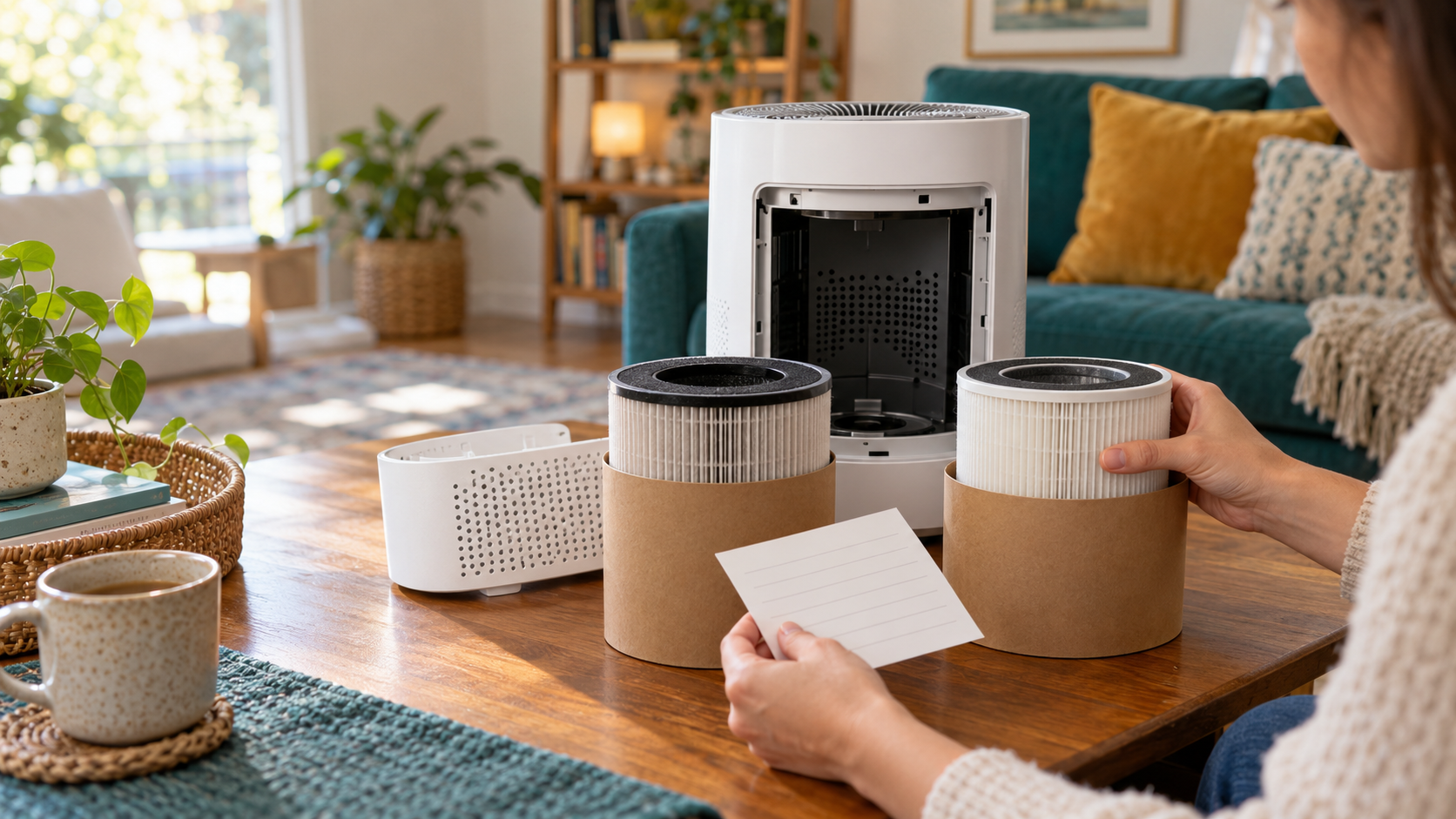
Why this decision comes after the fit check
A purifier’s published clean air delivery rate, or CADR, describes particle cleaning by the unit. It does not establish the performance of every future replacement cartridge. Filter media, airflow resistance, and the way a cartridge seals inside the housing can affect what happens when you change it. AHAM notes that some off-brand or unverified filters may perform differently from the original and has introduced independent testing for replacement filters. Review AHAM’s filter and CADR guidance.
If your new cartridge physically will not seat, stop at the site’s seven checks for a filter that will not fit. Do not force a cover closed or trim the filter to make it fit.
Original vs. compatible: What actually changes?
| Buying question | Original manufacturer filter | Compatible replacement |
|---|---|---|
| Identity | Sold as the purifier maker’s specified filter part. | Made by another company for named purifier models; the listing needs exact, current compatibility details. |
| Fit and seal | Designed for the specified model when the correct version is selected. | May fit well, but check dimensions, gasket or edge seal, seating, and door closure. |
| Filter stages | Check which particle, pre-filter, and carbon components the maker includes. | Confirm the same required stages and quantities; “three-stage” wording can hide different construction. |
| Performance evidence | Use the manufacturer’s documentation for the exact purifier and original filter. | Seek model-specific independent verification or clear test details. Fit alone is not proof of equal CADR or gas removal. |
| Real cost | Compare delivered price per complete change and expected schedule. | Calculate the same cost; a cheap pack can omit a stage, contain fewer filters, or have unclear return terms. |
“Original” describes who made the filter, not where you buy it. A third-party retailer can sell a genuine manufacturer filter. A compatible filter is manufactured by a different company.
Five checks before you put either filter in the cart
- Record the full purifier model. Read the unit’s label, manual, or manufacturer support page. Check suffixes, generations, and region-specific versions; a shortened product family name is insufficient.
- Match the approved filter code and every stage. Note whether the machine uses one combined cartridge or separate pre-filter, particle, and carbon pieces. Carbon is relevant to certain gases and odors; CADR ratings describe particles, according to the EPA’s home air-cleaner guide.
- Look for credible evidence. AHAM says its Verifide replacement-filter program independently tests enrolled filters against original-filter performance. Check the AHAM directory for the actual filter, model, and scope of any claim. A logo in a marketplace photo is not enough.
- Read the maker’s instructions and warranty terms. Some brands explicitly call for genuine filters for particular models. For example, Blueair describes model-specific genuine replacements. Check the instructions and support terms for your machine before assuming another brand’s policy applies.
- Compare a complete year, not one sticker price. Record delivered price, filters per pack, all required stages, expected replacement schedule from your manual, and return policy. An illustrative $25 filter used twice a year costs $50 in filters; a $38 filter used once costs $38. Those numbers illustrate the calculation, not a verified lifespan or current offer.
The 3-gate replacement filter check
When a compatible filter may be worth considering
The listing identifies the exact purifier model and original filter code, specifies all required layers, and gives enough dimensions and construction detail to check the seal. Better still, there is relevant independent testing for that replacement in that purifier, or other credible model-specific performance information you can inspect.
That does not make every aftermarket filter equal. It gives you a basis for comparing a particular one. AHAM’s replacement-filter verification is useful precisely because visual similarity cannot establish equal performance.
Pause the purchase when: the model list is vague; the listing confuses a particle filter with an odor filter; photos show a different gasket or shape; a required stage is missing; the seller makes broad “HEPA” or odor claims without model-specific evidence; or the return policy would leave you with an unusable cartridge.
What if the filter fits and the purifier still disappoints?
Check the airflow at the same manual speed you normally use, with intakes and outlet clear. If the machine suddenly moves less air, see the weak-airflow troubleshooting guide. A glowing “replace filter” light may track time or use rather than measure filter loading directly; read the filter-light guide before resetting it.
A new filter will not resolve every air concern. The EPA emphasizes source control and ventilation with clean outdoor air alongside filtration. Particle CADR also does not rate gas or odor removal. If your concern is moisture, a continuing indoor source, or a gas, diagnose that problem separately.
Put the comparison in your Fit & Filter Planner
The free 15-page Get the Fit & Filter Planner has room-fit, filter-match, first-year-cost, and maintenance worksheets. Add a line for each candidate:
- Exact purifier model and original filter code
- Original or compatible; maker and seller
- Particle and carbon stages, fit evidence, and certification if applicable
- Price per complete change, estimated annual cost, and return terms
Then compare the filter decision with your room’s CADR need and the fan speed you will actually use.
Ready to compare listings?
Keep the label or manual open as you shop. If you find an original filter through a third-party seller, verify the part number and authenticity. If you choose a compatible one, verify the exact model, stages, documented performance, and return policy.
Compare replacement filters at FiltersFast
Affiliate link to a retailer. Inventory, prices, and compatibility can change; check the listing against your purifier before purchasing.
Four-question knowledge check
Choose an answer in your head, then open each item to check it.
1. A cartridge has the same shape. Does that prove the same particle-cleaning performance?
No. Shape and fit are necessary checks, but media, seal, and airflow can differ. Look for model-specific documentation or independent verification.
2. Does a purifier’s particle CADR prove that a replacement removes cooking odors equally well?
No. CADR is a particle-cleaning measure. For odors and gases, inspect the relevant gas-removal media and evidence separately.
3. Can a retailer sell a genuine original filter?
Yes. The filter’s manufacturer and exact part identity determine whether it is original. Verify the seller and listing details.
4. Which costs should you compare: price per pack or cost per complete year?
Both, with the annual cost guiding the decision. Include every required stage, pack quantity, delivery, and the manufacturer’s replacement schedule as a starting point.
Frequently asked questions
Are all compatible air purifier filters bad?
No. Quality and evidence vary by the specific filter. AHAM now describes an independent verification program for enrolled replacement filters. Confirm the exact product and purifier model in the directory; do not treat a generic compatibility claim as proof.
Will an aftermarket filter void my purifier warranty?
Do not assume one answer across brands or models. Read your purifier’s actual warranty and filter instructions, and ask the manufacturer how a specific replacement would be treated. Document any claim in writing before ordering if warranty coverage is central to your decision.
Is an original filter always the cheapest in the long run?
No. Compare the delivered cost per complete change and a realistic replacement schedule. A cheaper compatible pack can save money, but only when it supplies the required stages and acceptable documented performance.
Should I replace a filter just because it looks gray?
Follow the model’s maintenance instructions and check age, use, airflow, and any filter warning together. Appearance alone does not show how much useful life remains or how a carbon stage is performing.
Your next filter decision
Write down your purifier’s complete model and specified filter code. Compare one original and one compatible listing through the three gates above. If the cheaper choice cannot clear the fit and evidence checks, the savings are not yet established.
What filter model are you comparing, and which detail is hardest to verify? Share the purifier model and filter code in the comments, without personal information, and tell us where the listing leaves you uncertain.