Best Smart Purifiers · The dinner-time air check
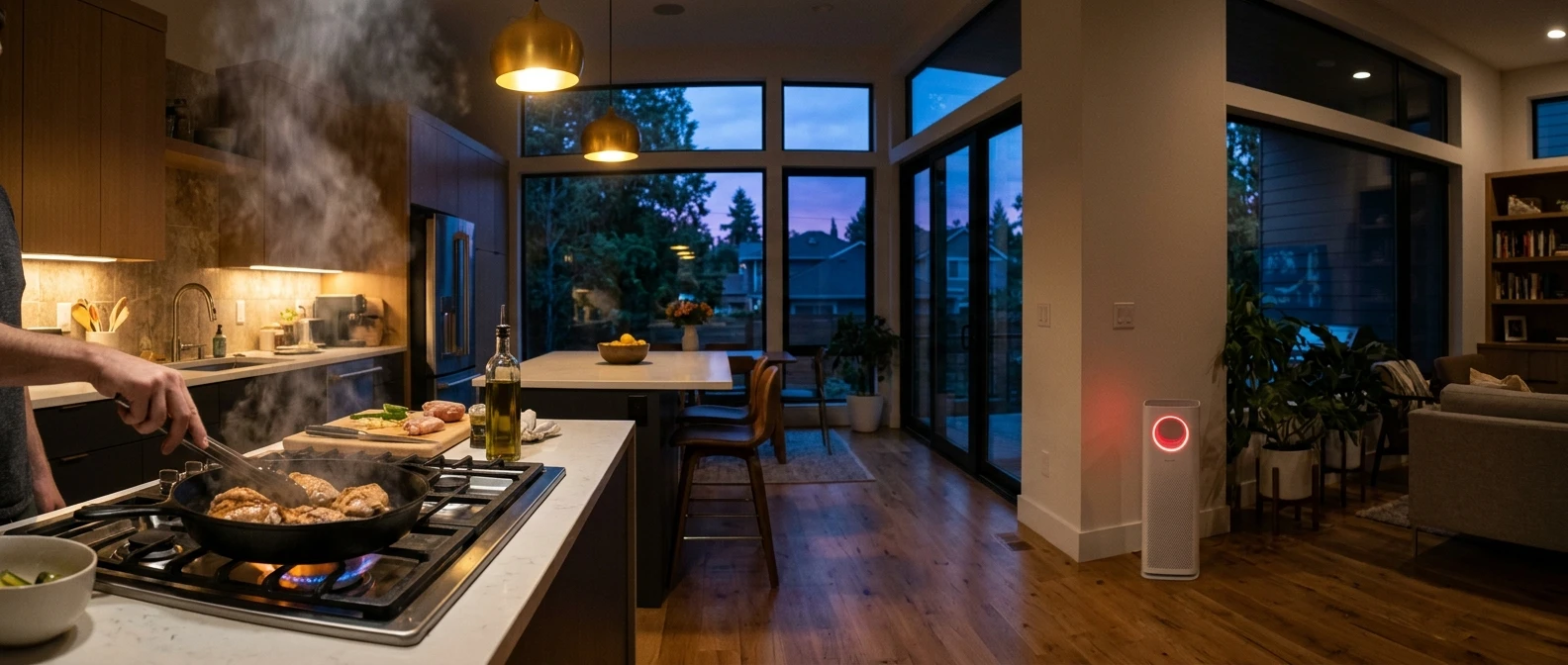
The first piece of chicken hits the skillet. A minute later, the purifier across the room lights up red. You haven’t even flipped the chicken, and you’re already thinking about buying another filter.
Look at the display once while you cook and again after you turn off the burner. A light that follows the meal tells a different story from a filter icon that’s still there at breakfast. Here’s how to follow both clues.
Affiliate disclosure: This article includes a FiltersFast affiliate link. If you purchase through it, BestSmartPurifiers.com may earn a commission at no added cost to you. A red air-quality light alone is not a reason to buy a filter. This is research-based guidance, not a hands-on purifier test.
Why does my air purifier turn red when I cook?
A red air-quality light during cooking can mean the sensor is picking up airborne cooking particles. The light alone tells you little about whether the filter needs replacing. Check your manual to tell the air-quality indicator apart from a filter reminder or fault code.
If the air-quality light rose with the sizzle, check the pan and run your outdoor-venting hood if you have one. EPA recommends keeping that hood on for 10–20 minutes after cooking. Your purifier can help with particles that reach it. A green particle display can return while cooking odors still linger.
Sources: EPA cooking guidance and Blueair’s model-specific particle-indicator explanation.
1. Read the icon before you read the color
The air-quality ring changed as the pan heated. Check what the sensor measures. Blueair’s DustMagnet, for example, uses fine particle levels to change the color of its air-quality indicator. Your model may use a different display or scale.
A separate filter icon stayed on before and after dinner. Look up the service procedure for your exact model. If you recently changed the filter, check whether the manual calls for a reset after installation. If the light is a fault code, follow the model’s troubleshooting instructions.
Take a photo of the display the next time it happens. The icon and the timing are more useful to manufacturer support than “the purifier went red.”
One dinner. Three different jobs.
2. Find out where the air goes when you flip the hood switch
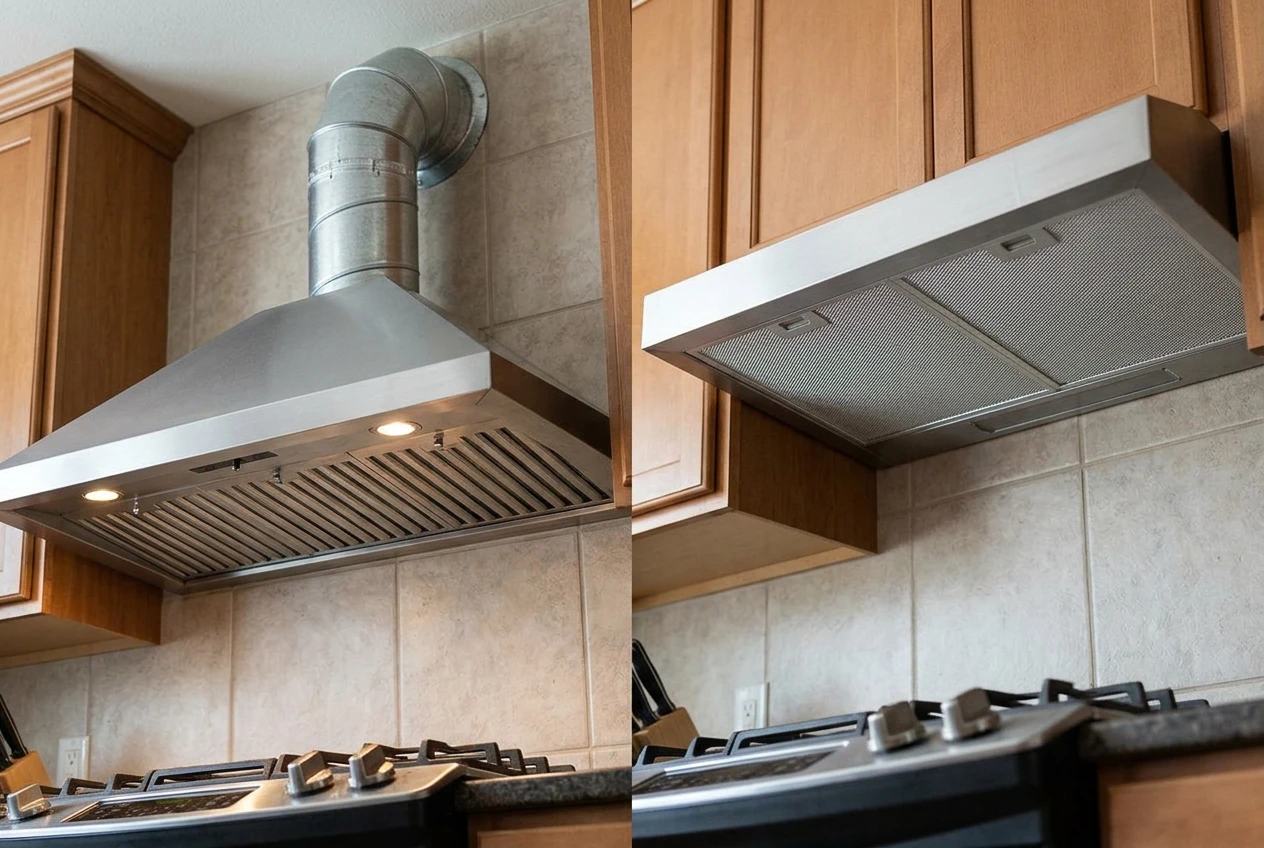
The sound of a fan does not tell you where the air goes. Check your hood’s documentation or ask building maintenance whether it exhausts outdoors or returns air to the kitchen. Do not infer outdoor ventilation simply because there is a metal canopy over the stove.
| Tool | Useful role | Key limit |
|---|---|---|
| Outdoor-venting hood | Captures and exhausts some emissions near the stove. | Performance depends on the installation, operation, and capture of the cooking plume. |
| Recirculating hood | Passes air through its installed filters and returns it indoors. | Does not provide outdoor exhaust; generally less effective at removing cooking pollution. |
| HEPA / particle purifier | Filters airborne particles from the room air passing through it. | Particle filtration does not remove cooking gases. |
| Activated-carbon stage | Can reduce certain gases and odors, depending on the media and design. | A thin sheet is not equivalent to a substantial amount of carbon; particle CADR does not rate odor removal. |
| Open window | May provide useful outdoor-air exchange. | Outdoor pollution, weather, and safety can make it unsuitable. |
Sources: Washington State Department of Health: ventilation while cooking and EPA: Guide to Air Cleaners in the Home.
Gas, electric, and induction cooking can all generate particles from cooking food. Gas combustion adds other concerns, including nitrogen dioxide. Changing the stove type does not eliminate the need to manage cooking emissions.
Safety boundary: A purifier is not a carbon-monoxide alarm or gas-leak detector. If a CO alarm sounds or you suspect a gas leak, leave the area and follow emergency-service or utility instructions. Do not troubleshoot the purifier first.
3. Try the dinner-to-breakfast check
Try this during a meal you already planned. Keep the purifier in the same spot and note any changes to its fan speed. There’s no need to recreate a smoky dinner.
- Before the first sizzle. Note the usual color or particle reading. Turn on your outdoor-venting hood if you have one. A back burner can help it catch more of the cooking plume when the recipe allows.
- When the light changes. Note what was happening. Frying, toasting, and food starting to burn can all raise particle levels. Check the heat and exhaust first. Keep the purifier clear of steam, grease, and splashes, with the clearance in its manual. See the room-by-room placement guide.
- After the stove goes off. Keep the outdoor-venting hood on for the EPA’s recommended 10–20 minutes and watch whether the reading trends back toward where it started. That interval applies to the hood. Purifier runtime depends on the space and conditions.
- The next quiet morning. Check the same display before making toast or switching on the stove. If the air-quality reading is back near its usual level, the timing points toward a cooking-related spike. If it’s still elevated, check for other sources, room fit, or sensor maintenance. If a separate filter icon remains on, use your model’s service instructions.
If you’re considering opening a window, weigh outdoor smoke, pollution, weather, and safety first. See the window-opening guide.
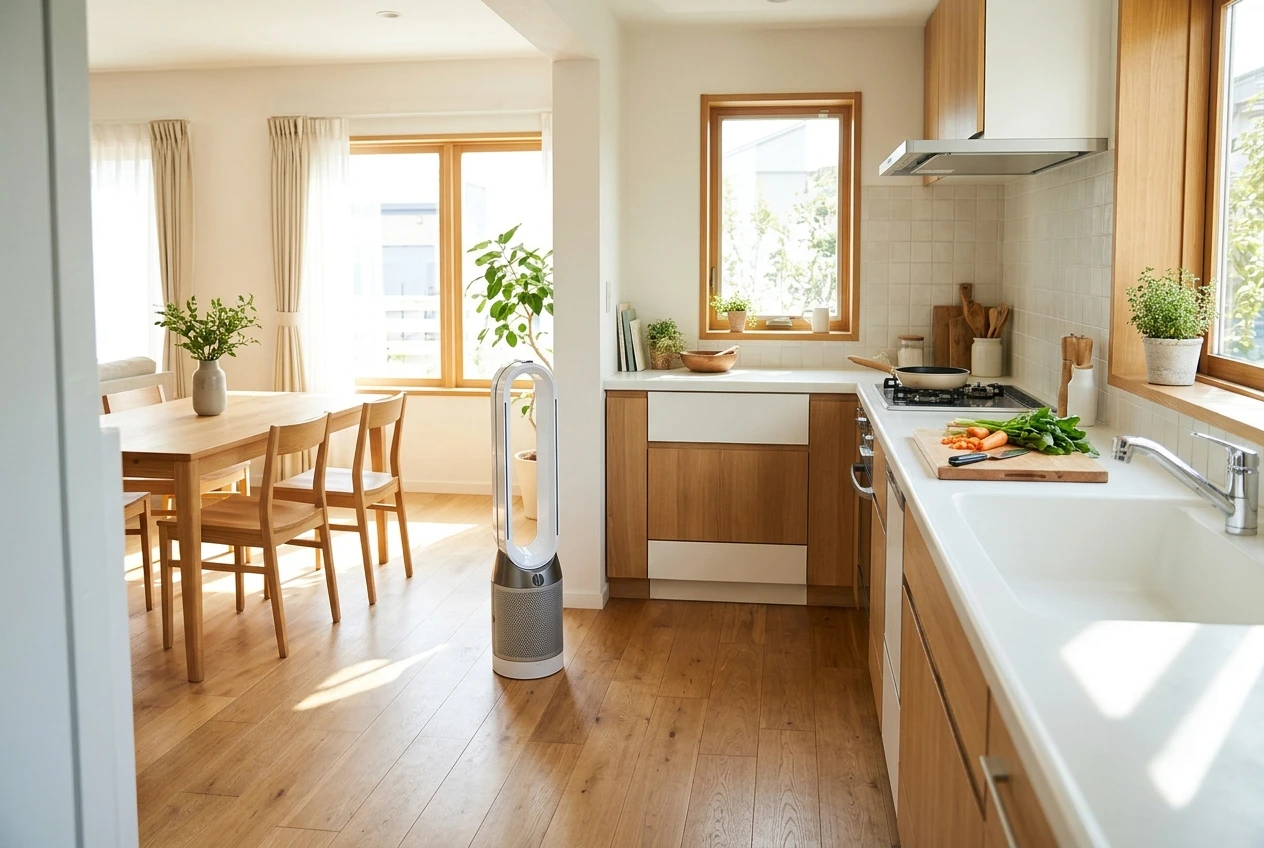
Cooking-source guidance: EPA: Sources of Indoor Particulate Matter.
Read the pattern—not just the peak
4. Follow the smell separately
Particle readings and odor removal answer different questions. A particle-focused display cannot verify that every gas has been removed. Some models also report a combined VOC reading, but that does not necessarily identify individual gases; Blueair explains this distinction for its Classic sensors.
For persistent ordinary cooking smells, revisit exhaust, cleanup, and the actual carbon stage. Do not buy a new particle filter solely because yesterday’s dinner is still noticeable.
What if the purifier keeps running hard?
Write down the situation before changing several things at once: cooking finished, hood setting, other active sources, open doors, purifier speed, and the exact reading. Then check the manual’s maintenance and troubleshooting steps.
A purifier chosen for a bedroom may be serving a much larger connected kitchen, dining area, and lounge. Compare its clean-air delivery rate with that actual space. If readings remain unexplained, contact the manufacturer with the model and observations; do not hide the sensor or reset maintenance history to quiet the machine.
Give the kitchen a page in your purifier plan
Use the free Smart Air Purifier Fit & Filter Planner to record the connected room size, purifier model, useful fan setting, exact replacement code, and ownership costs. The download page offers the workbook by email.
Add a simple dinner log beside your worksheet: meal and cooking method → hood type and setting → purifier setting → reading before and after cooking. Keep placement consistent and record ordinary meals. Never burn food or disable ventilation to test the purifier.
Example entry: “Stir-fry; outdoor-venting hood on; purifier manual medium; display rose during cooking and declined afterward.” This is an illustrative note, not a measured result or recommended universal setting.
Get the free Fit & Filter Planner5. Check airflow on a quiet morning
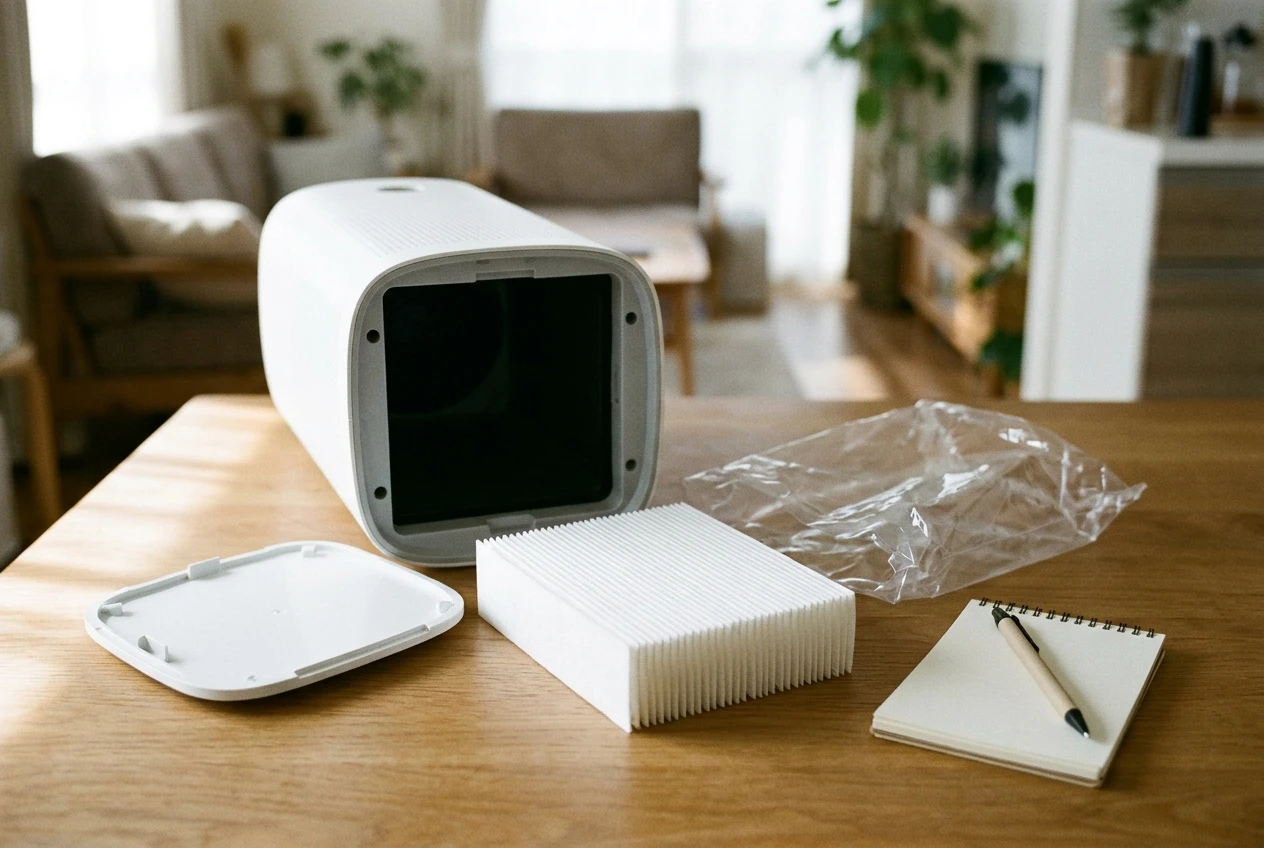
If the same spike happens during frying and settles afterward, start with the cooking setup. If airflow is weak even on a quiet morning, check the intake and the filter installation. Follow the manual for powering down and opening the unit. Look for blocked vents, packaging left on a new cartridge, or a filter that hasn’t seated correctly.
Buy a replacement when your model’s care instructions and the filter’s condition point to one. Before ordering, record the full purifier model, approved filter code, and required stages. Check the listing and return terms against that information. Use the filter-fit checklist if two cartridges look almost identical.
A washable hood grease screen and a disposable purifier cartridge have separate care instructions. Follow the manual for the exact part before cleaning it.
Check your filter code at FiltersFast
Affiliate link. Verify that the listing explicitly supports your model; availability and compatibility are not guaranteed.
Four-question knowledge check: What would you do?
Select your answer, then open the explanation. No score tracking or personal information is required.
Frequently asked questions
Is a red light during cooking proof my purifier is broken?
No. An air-quality indicator may be responding to cooking particles. Identify the symbol first and investigate persistent or unexplained readings using the exact model’s support guidance.
Can I use a purifier instead of my range hood?
Use it as supplemental room filtration. It does not provide the source exhaust of a properly installed outdoor-venting hood.
Should I use Auto mode or a manual setting during dinner?
Either may be useful, depending on the model and setup. A planned manual speed avoids waiting for Auto mode to react, but no universal speed fits all rooms. Choose a tolerable setting that provides useful airflow.
What if I rent and the hood only recirculates?
Maintain the hood’s filters as instructed, reduce avoidable cooking smoke, and use suitable ventilation when outdoor conditions permit. Ask the property manager about exhaust options. A room purifier can support particle control while those limitations remain.
Should I replace the filter after a smoky meal?
Not automatically because of the display color. Follow the manufacturer’s guidance after unusual smoke exposure and inspect as directed. Damage, persistent abnormal odor, or a maintenance problem deserves attention.
What did your purifier say at breakfast?
Tell us what you cooked, which light changed, where your hood vents, and what the display showed the next morning. If you tried one change for the next meal, tell us what you changed and what you noticed.
Copy this into your comment
Purifier model: ___ · Meal: ___ · Light or reading: ___ · Hood type: ___ · Next morning: ___
Editorial approach: Sources were reviewed November 8, 2026. This article combines public-agency guidance, manufacturer sensor explanations, and practical planning suggestions. Illustrations do not represent product testing. Follow the current instructions for your appliances.