The purifier is running, the display looks normal, and nothing appears to be blocking it. But the machine is sitting on a deep rug—and its lowest intake slots are disappearing into the fibers.
That does not mean every air purifier belongs on bare flooring. It means the surface has become part of the airflow test. Some floor-standing units can sit safely on low, firm carpet when their manual permits it and every intake remains clear. Others draw air from underneath, wobble on plush pile, collect lint faster, or simply were designed for a hard, level surface.
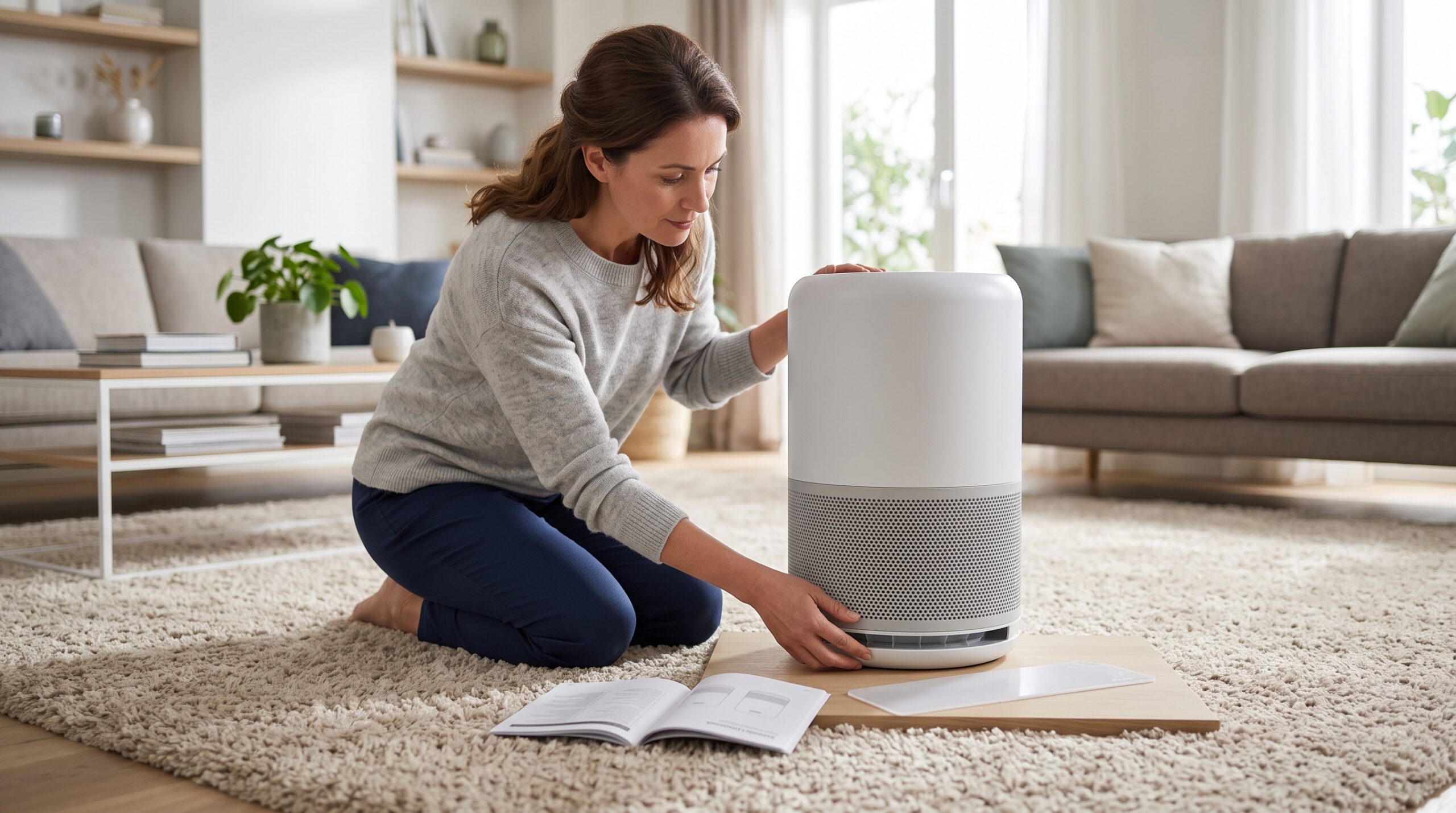
Can You Put an Air Purifier on Carpet?
Sometimes. Use the location only when the purifier’s instructions allow floor placement, the base is stable, the power cord is safe, and carpet cannot cover or crowd any intake, outlet, sensor, wheel, or cooling opening.
If the purifier draws air from the bottom, sinks into thick pile, tilts, vibrates, or gathers carpet lint around a low intake, move it to a hard, level location approved by the manufacturer. Do not improvise a soft mat, upside-down basket, narrow stool, or stand that makes the unit unstable.
Start Under the Purifier—not at the Room Diagram
Portable purifiers do not all breathe the same way. A cylindrical model may draw air around its lower sides. A tower may use front and rear grilles. A console may pull from the sides and discharge upward. Another design may depend on a gap beneath the cabinet.
That is why a generic rule such as “all purifiers should sit on the floor” or “every purifier works better on a table” is unreliable. The correct first move is to identify every opening on the actual machine and compare the placement section of its current manual.
Find the intake
Look around the sides, back, front, and underside. Carpet matters most when fibers can reach an opening.
Find the outlet
Filtered air still needs an open path into the room. A shelf, curtain, chair, or wall can create a second restriction.
Read the placement line
“Flat,” “level,” “floor,” “table,” and listed clearance distances are model-specific instructions—not suggestions to average together.
The U.S. Environmental Protection Agency recommends keeping airflow to and from an air cleaner free of obstructions. EPA also notes that portable units are room-level tools, so the purifier still needs enough clean-air delivery for the space. A perfect surface cannot rescue a machine that is too small or kept on an ineffective setting.
Hard Floor, Low-Pile Carpet, Plush Rug, or Stand?
| Surface | Possible advantage | What can go wrong | Best first decision |
|---|---|---|---|
| Hard, level floor | Usually provides a firm base and keeps the machine at its designed floor height. | Dust, pet hair, water, or a nearby curtain can still reach the intake. | Use when the manual permits it and required clearance is open. |
| Firm, low-pile carpet | May be acceptable for some units with side intakes and a broad stable base. | Fibers may crowd low openings; the unit may vibrate or collect lint faster. | Inspect the underside and manual before assuming the carpet is harmless. |
| Deep carpet or plush rug | May soften ordinary case vibration. | The base can sink, tilt, trap heat around openings, or lose its designed intake gap. | Choose an approved hard, level location when any opening or stability is affected. |
| Table or shelf | Can lift a small unit above floor dust when the manufacturer allows elevated use. | A narrow, weak, vibrating, or crowded surface can create a fall risk and block airflow. | Use only for a model approved for that placement and only on a stable surface. |
| Purpose-built base or platform | Can create a firm surface without moving the purifier to another room. | The wrong size can obstruct a bottom intake, change stability, or invite improvised stacking. | Confirm base dimensions, feet, vents, cord path, and manufacturer guidance first. |
Blueair’s current care guidance illustrates why model instructions matter: some products are explicitly directed to a flat floor surface rather than a table or tilted position. Another purifier may have different feet, intake geometry, and placement instructions. Treat a manufacturer’s example as evidence to check your manual—not as permission for every model.
The Seven-Check Carpet Test
Record the current setup
Write down the purifier model, filter code, fan speed, room, floor surface, and what prompted the question. Is airflow weaker, noise different, the case tilted, or lint gathering around the base? A clear “before” observation prevents the move itself from becoming guesswork.
Power down before inspecting
Turn off and unplug the purifier as directed before moving it or examining the filter compartment. Keep fingers, tools, and cleaning products out of grilles and internal fan areas. If the cord, plug, outlet, or housing is damaged or unusually hot, stop the placement test and use manufacturer or qualified electrical support.
Map every opening and foot
Use the manual and a careful exterior inspection to locate bottom, side, rear, and front intakes; the clean-air outlet; sensors; cooling openings; feet; casters; and the cord exit. If carpet rises into a designed gap, the purifier is no longer sitting as the manufacturer intended.
Check stability without rocking the machine while it runs
With the purifier unplugged, confirm that the base rests evenly and does not lean, sink, or wobble. Thick padding can make a tall purifier easier to tip. Homes with children or pets need a cord and location that do not invite pulling, climbing, collision, or blocked exits.
Look for a carpet-lint pattern
Hair and lint around a low intake may show that the purifier is drawing from a debris-heavy zone. Inspect only the owner-serviceable pre-filter and other components named in the manual. Clean or replace each layer only by its approved method; permission to vacuum one pre-filter is not permission to vacuum a disposable main filter.
Compare one approved hard-surface location
Move the complete purifier to a hard, level, open spot that meets its clearances. Keep the same manual fan speed, room boundary, and approximate test period. Compare sound, stability, and outlet airflow. This is a practical observation—not a home measurement of CADR.
Decide from the evidence
If the hard surface restores a visible intake gap, stops wobble, reduces new vibration, or corresponds with stronger output at the same setting, keep the safer approved setup. If nothing changes and the purifier still has weak airflow, continue with the site’s dedicated seven-check airflow guide rather than blaming the carpet alone.
Should You Buy an Air Purifier Stand?
A stand is not an automatic upgrade. It can be useful only when the purifier is approved for elevated placement and the stand keeps the entire base supported, level, and stable without covering a bottom opening. The combined setup must also remain safe around children, pets, cords, doors, curtains, and daily foot traffic.
A platform may make sense when…
The manual permits the location, the full base is supported, all airflow openings stay clear, the cord remains safe, and the setup cannot easily tip or slide.
Move the purifier instead when…
The manual specifies floor placement, the unit is tall or heavy, the intake is underneath, the platform changes the feet or clearances, or the setup would sit in a walkway.
Do not buy a stand to compensate for a purifier hidden behind furniture or assigned to the wrong room. The site’s room-by-room placement guide can help you find an open location first. If the new spot sends a draft toward a chair or bed, use the guide to redirect purifier airflow without blocking it.
Carpet Dust Does Not Automatically Mean the Filter Failed
Carpet, rugs, textiles, pets, shoes, and normal activity can all contribute fibers or return settled particles to the air. A purifier can capture only the share that becomes airborne, reaches its intake, and passes through the filter. It cannot clean the carpet itself.
Use direct cleaning for the floor and filtration for airborne particles. If dust returns quickly across the room, the site’s guide to airborne dust versus settled dust explains why placement, cleaning, source control, filter fit, CADR, and fan speed must work together.
If inspection confirms that a filter is due, begin with the complete purifier model and manufacturer filter code. Then compare replacement-filter availability through FiltersFast. Verify supported models, filter stages, package quantity, dimensions, seller information, shipping, and return terms before ordering.
Add the Surface Check to Your Fit & Filter Planner
The free 15-page Smart Air Purifier Fit & Filter Planner already helps you record the room, CADR target, filter system, exact replacement code, true cost, and maintenance plan. Add a small placement note so the floor does not disappear from the decision:
- Purifier make, model, and filter code
- Intake and outlet locations
- Manual’s approved surface and clearance wording
- Hard floor, low-pile carpet, deep carpet, or rug
- Stability, cord route, and nearby obstructions
- Normal fan speed, sound, and airflow observation
- Pre-filter inspection date and approved maintenance
Make the room decision before buying another accessory
Use the planner to connect surface, placement, room size, realistic fan speed, filter availability, and first-year cost.
Open the Free Fit & Filter Planner Review the Complete Purifier GuideFour-Question Interactive Knowledge Check
Can you choose a purifier surface without guessing?
1. What decides whether carpet is an acceptable surface?
2. What should you do if plush carpet rises into a bottom intake?
3. What makes a table or stand a reasonable option?
4. What does a stronger breeze after moving the purifier prove?
Frequently Asked Questions
Is it better to put an air purifier on the floor or a table?
Follow the exact model’s instructions. Many tower and console purifiers are designed for floor placement; some compact units may be approved for a stable table or shelf. Whichever location is allowed must support the full base, keep every intake and outlet clear, and avoid tipping and cord hazards.
Can carpet block a 360-degree air purifier?
It can when the intake extends very low on the cabinet or depends on an open gap beneath the base. “360-degree” describes the intake pattern around some units; it does not prove that deep carpet cannot crowd the lowest openings. Inspect the underside and use the stated clearance instructions.
Will raising an air purifier make it work better?
Not automatically. Elevation may keep a permitted small unit away from some floor debris, but it can also create instability or move the purifier away from the source and occupied zone. Airflow, CADR, room fit, filter condition, and safe placement matter more than height alone.
Can I put a board under an air purifier on carpet?
Only when the purifier’s instructions permit the resulting setup and the board creates a hard, level, stable surface larger than the complete base without covering feet, vents, sensors, wheels, or the cord path. A purpose-built, correctly sized base is preferable to improvised stacking. If the setup can slide, tip, flex, or obstruct an opening, relocate the purifier.
Why is my air purifier louder on carpet?
A soft or uneven surface can change case vibration, tilt the unit, or allow nearby fibers to crowd a low intake. Noise can also come from a filter, loose cover, internal fan, or nearby object. Compare the same speed on an approved hard, level surface. Stop using the purifier if the sound includes grinding, electrical crackling, unusual heat, smoke, or a burning odor.
How often should I check the pre-filter in a carpeted room?
Use the model-specific inspection and maintenance schedule. Pets, visible lint, heavy foot traffic, smoke, renovation dust, and longer runtime can change how quickly material accumulates. Clean only the layers and by the methods the manufacturer approves.
Does an air purifier remove dust from carpet?
No. It may capture some particles after activity lifts them into the air and they reach the intake, but it does not extract material embedded in carpet. Use appropriate floor cleaning and source control alongside room-sized particle filtration.
Final Takeaway: Let the Intake Decide
Do not move an air purifier merely because “carpet is bad,” and do not leave it in place merely because the fan still runs. Turn it off, inspect the design, read the manual, check stability, and see whether the carpet changes any opening or intended gap.
If the surface is firm, permitted, stable, and clear of every intake and outlet, it may be a workable location. If the unit sinks, leans, vibrates, or pulls fibers against a low opening, move it to an approved hard, level spot. The best placement is the one that lets the purifier breathe, serve the occupied room, and stay safe enough to run consistently.
What does your setup look like? In the comments, share the purifier model, intake location, floor type, normal fan speed, and what changed when you tested a hard surface. Keep serial numbers and personal details private. A clear real-room observation may help another reader avoid an unnecessary filter, stand, or purifier purchase.
Authoritative Guidance and Editorial Approach
- U.S. EPA: Guide to Air Cleaners in the Home
- U.S. EPA: Air-Cleaner Placement and Unobstructed Airflow
- AHAM Verifide: CADR and Room-Sizing Guidance
- Blueair: Model-Specific Air-Care and Placement Guidance
Editorial note: BestSmartPurifiers.com provides research-based consumer education. This is not a hands-on test of every purifier or carpet type. Product feet, intakes, clearances, filters, manuals, and safety instructions vary by model and can change. Follow the current instructions for the exact purifier. Air cleaning can reduce some airborne pollutants, but it does not replace source control, appropriate cleaning, clean-air ventilation, moisture correction, certified alarms, or qualified professional help when those are needed.