If your air purifier makes the room feel cold, the machine is probably changing the airflow you feel—not refrigerating the room. A clean-air outlet aimed at a chair, desk, couch, or bed can create a surprisingly chilly draft even when the thermostat barely moves.
The wrong response is to shove the purifier against a wall, cover the outlet, or switch it off whenever the room is occupied. Those shortcuts can reduce airflow, undermine particle cleaning, and hide a placement problem that may take only a few minutes to correct.
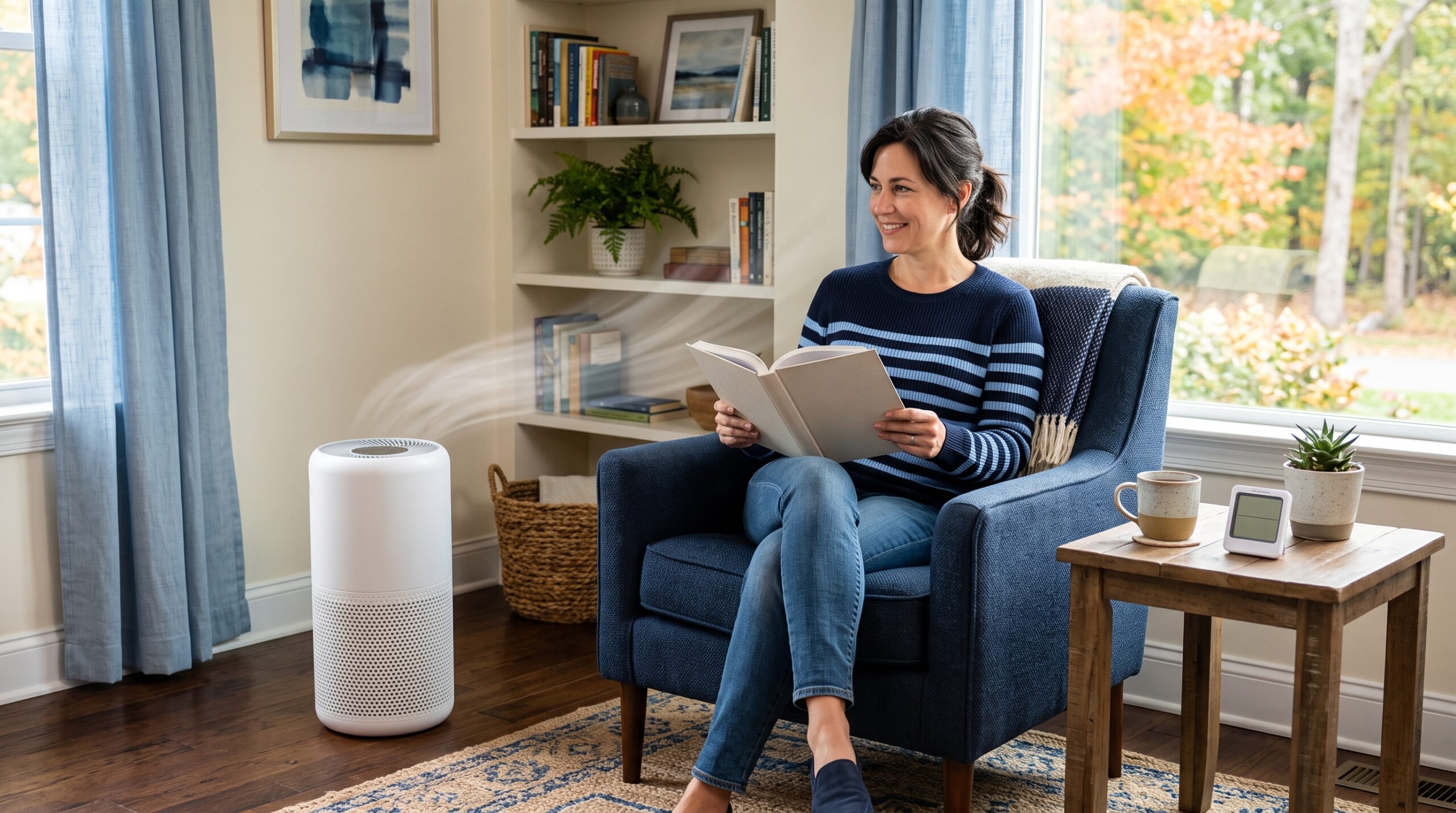
Does an Air Purifier Actually Make a Room Colder?
A typical portable air purifier does not contain a refrigeration system, so it does not cool the room like an air conditioner. Its fan moves existing room air. That moving air can increase heat loss from exposed skin and make you feel cooler, especially when the outlet is close or aimed directly at you.
First, compare the actual room temperature with how the air feels. Then redirect the airflow path by relocating the purifier to an open, stable spot that does not blow continuously across your body. Keep the manufacturer’s required clearance around every intake and outlet. If comfort requires the lowest setting, confirm that the purifier still supplies enough clean-air delivery for the room.
BestSmartPurifiers takeaway: Solve the draft at the chair, couch, desk, or bed. Do not solve it by starving the purifier of air.
Why Moving Air Feels Colder Even When the Temperature Is Stable
A purifier pulls room air through one or more filters and sends that air back through an outlet. The outlet stream may be narrow and fast, broad and upward, or angled across the room. If it repeatedly crosses your skin, it can make the same room temperature feel less comfortable.
The U.S. Department of Energy makes the same distinction when explaining ordinary fans: fans move existing air and cool people through air movement; they do not generate cold air. A purifier is built for filtration rather than personal cooling, but its fan can create a similar local comfort effect.
Temperature and Comfort Are Not the Same Reading
Run a thermometer check before changing the room
Place a reliable room thermometer near the occupied area, but not directly in the purifier outlet, beside a heating or cooling register, against an exterior wall, or in direct sunlight. Record the reading with the purifier off, then repeat under similar HVAC and door conditions with the purifier at your normal speed.
The goal is not laboratory testing. It is to separate a localized draft from a real change in room temperature. If the thermometer stays nearly steady but your hands, face, or shoulders feel chilly only in one seat, airflow direction is the stronger clue.
Cold-Feeling Air Purifier Problems Compared
| What you notice | Likely first explanation | Best first move | Do not do this |
|---|---|---|---|
| One chair or side of the bed feels chilly | The clean-air stream crosses the occupied spot | Move the purifier or the seat so the outlet does not blow continuously across the person | Cover the outlet or press it against furniture |
| The draft appears only on high speed | Higher outlet velocity creates a stronger local cooling sensation | Use a tolerable steady speed while occupied and a higher event speed when appropriate | Assume sleep mode provides the published maximum CADR |
| The purifier is beside a cold window or exterior door | It may be mixing and redistributing already-cool air from that area | Test a more central, open location while preserving required clearances | Block the window, exit, intake, or HVAC register with the purifier |
| Auto mode suddenly creates a blast | The sensor detected a supported particle change and raised the fan | Check what the sensor measures; compare a stable manual setting during occupied hours | Assume every fan increase proves a dangerous condition |
| The draft becomes uncomfortable when a ceiling fan or HVAC blower starts | Several airflow paths are combining at the occupied area | Test one device or setting at a time and redirect the room circulation | Block supply or return grilles |
| The whole room is measurably colder | An open window, HVAC setting, weather change, or building issue may be responsible | Check the thermostat, openings, registers, and HVAC operation separately | Use the purifier as the diagnosis |
The Seven-Step Draft Fix That Preserves Filtration
- Find every intake and outlet. Read the manual and inspect the case. Many cylindrical purifiers pull air around the lower body and exhaust upward; other units draw from the front or rear and discharge from the top or side. Do not guess from appearance.
- Mark the uncomfortable zone. Sit or lie where the draft bothers you. Note whether it reaches your face, hands, shoulders, feet, or only one side of the furniture. This turns “the room feels cold” into a location problem you can test.
- Move the purifier—not just the problem. Place the unit on a stable surface in an open area permitted by its instructions. Keep it out of walkways and away from curtains, bedding, papers, and furniture that can obstruct airflow or touch the case.
- Preserve the clean-air path. Do not aim a fixed outlet into a nearby wall or drape a cover over it. If the model has an adjustable outlet, use only the approved adjustment range. Otherwise, rotate or relocate the complete unit while maintaining every listed clearance.
- Choose a speed you can keep using. A steady medium speed may be more useful than high speed for ten minutes followed by hours with the purifier off. Use higher airflow around known particle events when it remains safe and practical, then return to a comfortable baseline.
- Change one variable and retest. Keep the door position, HVAC setting, thermometer location, and fan speed consistent while testing the new purifier position. If you change everything together, you will not know which adjustment solved the draft.
- Recheck room fit. If the purifier must stay on an extremely low setting to remain tolerable, the room may need a quieter airflow plan or a different capacity strategy. Compare the smoke CADR, actual room size, ceiling height, normal door position, and the speed you will realistically use.
For a general starting point, AHAM recommends a smoke CADR of at least two-thirds of the room’s square footage for a standard eight-foot ceiling. Higher ceilings and demanding particle conditions can require more capacity. Remember that a published CADR commonly represents a defined test setting; do not assume the quietest mode delivers the same result.
The Comfortable-Filtration Triangle
Open airflow path
Every intake and outlet has the clearance specified for the model.
No direct body draft
The clean-air stream mixes into the room instead of crossing one occupied spot.
Useful fan speed
The speed is comfortable enough to run and strong enough for the real room.
If one side fails: blocking airflow reduces performance, direct airflow reduces comfort, and an undersized or barely running purifier reduces useful cleaning.
Need a room-size reality check?
Compare the purifier’s smoke CADR with the room it is actually cleaning—not only the largest coverage number printed on the box.
Check Room-Coverage Claims Build a Daily Fan-Speed PlanHow to Stop an Air Purifier Draft in a Bedroom
Bedrooms expose placement mistakes because one person stays in nearly the same spot for hours. A purifier that feels fine while you walk around may send a persistent stream across the bed after the room becomes quiet.
Better bedroom checks
- Keep the outlet from blowing directly across the pillow or exposed skin.
- Leave the manufacturer’s required space around intakes and outlets.
- Keep cords out of walkways and away from bedding.
- Compare the normal door position with the room size used for CADR.
- Test the quietest useful setting before bedtime.
Bedroom shortcuts to avoid
- Hiding the purifier behind a nightstand or curtain.
- Placing it on unstable furniture to change outlet height.
- Aiming it into a wall without the required clearance.
- Blocking a supply or return grille.
- Assuming a green particle light measures temperature, humidity, or fresh air.
An open bedroom door also changes the air volume and circulation path the purifier serves. Review how the bedroom door changes purifier performance before treating “door open” or “door closed” as a universal rule.
What if moving air makes your eyes or skin feel dry?
A standard particle purifier does not meaningfully remove water vapor like a dehumidifier. However, a direct stream of moving air can make exposed eyes, skin, or nasal passages feel less comfortable. Redirect the local draft and measure relative humidity with a suitable hygrometer rather than assuming the purifier changed the room’s moisture level.
If indoor humidity is actually outside the range appropriate for the home, address the moisture source or humidity-control need separately. Do not place a mist-producing humidifier where moisture can enter the purifier or wet a non-washable filter.
When the Filter Deserves a Check
A draft usually begins with outlet direction and fan speed, not a shopping trip. Still, a wrong, damaged, poorly seated, or heavily loaded filter can change airflow and sound. If the comfort problem appeared immediately after maintenance, turn off and unplug the purifier as directed, then verify:
- the exact purifier model and manufacturer filter code;
- that all shipping plastic and temporary packaging were removed;
- the correct filter direction, seating, seal, cover, and latch position;
- which pre-filter surfaces the manufacturer permits you to clean;
- whether the main filter is washable, vacuumable, or replace-only.
If the purifier is suddenly louder as well as draftier, use the sound-by-sound air purifier troubleshooting guide. Grinding, electrical crackling, smoke, unusual heat, a burning odor, or a damaged cord belongs in the stop-and-unplug category—not the placement experiment.
Only shop after the filter check points there
Keep the complete purifier model number and manufacturer filter code beside you. Confirm supported models, filter stages, package quantity, seller, and return terms before ordering.
Compare Replacement FiltersAffiliate link. Compatibility, price, and availability can change. Match by exact model and filter code—not appearance alone.
Put Comfort Into the Fit & Filter Planner
The free 15-page Smart Air Purifier Fit & Filter Planner already helps you record the room, CADR target, filter stages, replacement code, and first-year cost. Add a comfort-and-placement note before you settle on a permanent location:
Map the room
Chair, couch, bed, desk, doors, windows, HVAC registers, and walking paths.
Record operation
Normal fan speed, auto-mode changes, runtime, door position, and actual room temperature.
Retest one move
New purifier location, required clearances, comfort result, noise, and particle trend.
That note matters because the technically strongest setting is useless if the draft makes you turn the purifier off. The practical goal is a repeatable setup: enough clean-air delivery, no blocked flow, and a location the household can live with.
Turn the draft test into a room plan
Open the Free Fit & Filter Planner Review the Complete Purifier GuideFour-Question Interactive Knowledge Check
Can you fix the cold-feeling draft without weakening filtration?
Frequently Asked Questions
Does an air purifier lower room temperature?
A typical portable purifier recirculates and filters room air; it does not refrigerate it. The fan can make people in its airflow path feel cooler. Confirm with a room thermometer, then check outlet direction, placement, fan speed, HVAC operation, and open windows or doors.
Why is my air purifier blowing cold air?
The purifier is usually blowing existing room air. It may feel cold because that moving air crosses your skin, or because the unit is redistributing cooler air from near a window, door, floor, or HVAC supply. A true temperature drop needs a separate building or HVAC check.
Can I point the air purifier toward a wall to stop the draft?
Only if the manufacturer’s placement and clearance instructions allow that position. A nearby wall can restrict the outlet or send air back toward an intake. Relocating the complete purifier away from the occupied spot is usually a better starting test than crowding the airflow path.
Can I put an air purifier behind a couch or nightstand?
Not when the furniture blocks an intake or outlet or violates the model’s required clearance. Hidden placement can reduce air movement, create noise, concentrate a draft, and make maintenance harder. Use an open, stable location outside walking paths.
Will lowering the fan speed make the purifier less effective?
Lower fan speed generally moves less air through the filter, so particle cleaning may be slower. Balance comfort with the room’s clean-air need. A correctly sized unit at a tolerable steady speed may be more useful than a powerful but uncomfortable setting that makes you shut the purifier off.
Does an air purifier dry out the room?
A standard particle purifier does not meaningfully remove water vapor. Direct air movement may make exposed skin or eyes feel drier. Measure relative humidity rather than judging it from the draft, and address any verified humidity problem with the appropriate source or humidity-control strategy.
Where should an air purifier go in a bedroom?
Use a stable, open location that meets the manual’s clearances, avoids blocked intakes and outlets, keeps cords out of walkways, and does not blow continuously across the bed. Include the normal door position and ceiling height when deciding what room size the purifier actually serves.
Authoritative Guidance Used for This Article
- U.S. EPA: Air Cleaners and Air Filters in the Home — portable air cleaners are room-level filtration tools and supplements to source control and clean-air ventilation.
- U.S. Department of Energy: Energy-Saving Hacks to Beat the Summer Heat — fans move existing air and make people feel cooler through air movement.
- AHAM Verifide: Air Filtration Standards — CADR comparison and the two-thirds room-sizing rule.
Editorial note: BestSmartPurifiers.com provides research-based consumer education. Purifier outlets, required clearances, sensor behavior, fan-speed performance, filter instructions, apps, and safety procedures vary by model and can change. Follow the current manual and manufacturer guidance for your exact purifier. Air cleaning does not replace source control, appropriate ventilation, humidity correction, HVAC repair, required safety alarms, emergency guidance, or qualified professional help.
Final Takeaway: Move the Draft, Not the Airflow Problem
When an air purifier makes the room feel cold, start with the person and the airflow path. Confirm whether the temperature actually changed. Find the outlet stream. Move the purifier to an open, stable location where clean air can mix without blowing across one seat or bed.
Then check the practical tradeoff: Is the comfortable speed still useful for the room? A good setup is not the highest fan setting at any cost. It is the combination you can keep running—correct room fit, open airflow, verified filter compatibility, and no persistent draft.
What part of the room feels cold first? In the comments, share the purifier model, room dimensions, normal fan speed, outlet direction, and whether the thermometer changes. Do not post personal information. Your real-room pattern may help another reader solve the same comfort problem without blocking the purifier.