If you share your home with a cat or a dog, you already know what ends up in the air and on every surface: loose hair, skin flakes, litter or yard dust, and the fine particles that come off a pet’s coat when it shakes or settles onto a cushion. Picking among the best smart air purifiers for pet owners means judging each unit on those specific problems, not on the longest feature list.
This comparison does that with five purifier designs, judged on four things: how the prefilter handles hair, what the specs say about fine particles, how the smart modes behave around animals, and what filters cost over a year. It relies on what manufacturers publish on their spec sheets and makes no health promises.
Start with your pet and your room
Before you compare any purifier, write down four facts about your home. They decide more than any brand does.
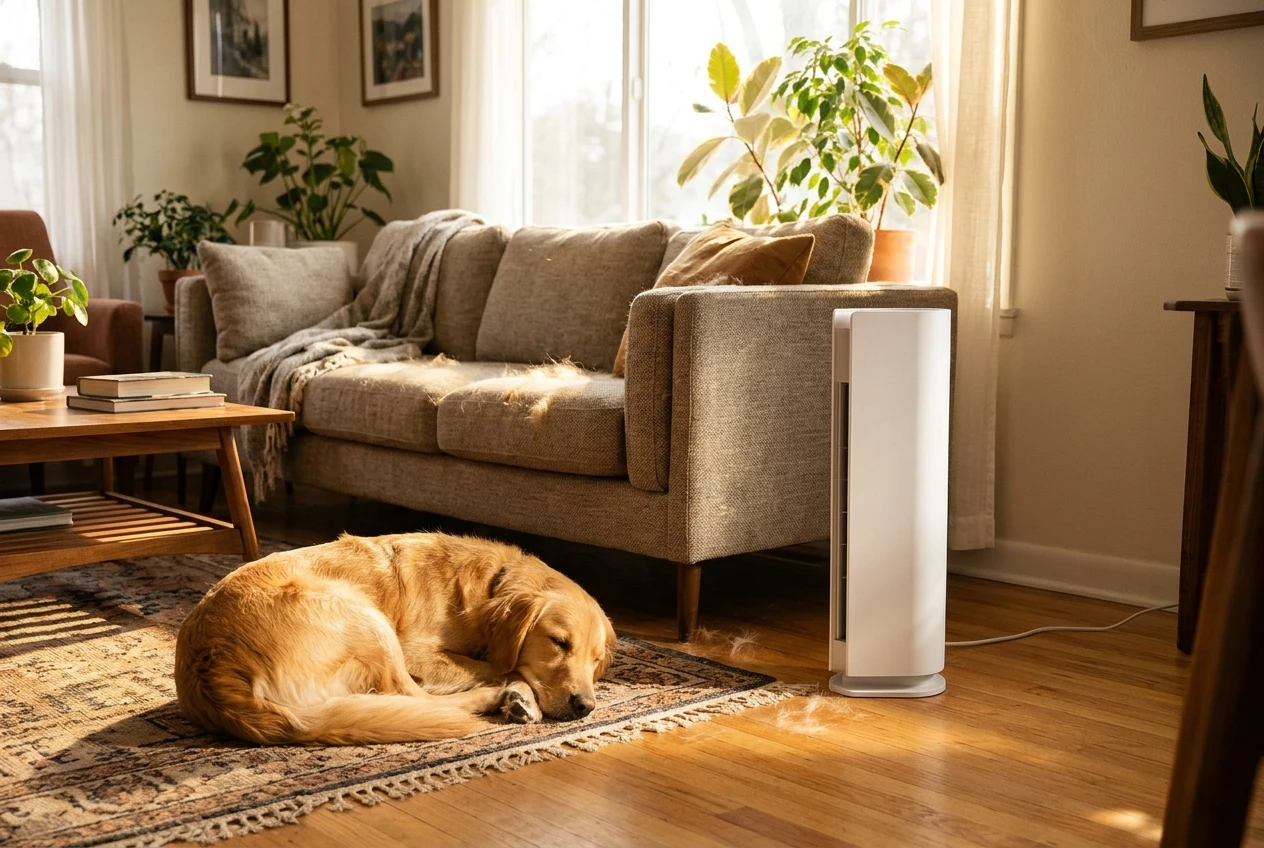
- The animal and the coat. A double-coated dog in seasonal shed puts far more hair into the air and onto the floor than a short-haired cat. Long-haired breeds and several animals multiply that.
- The room. Measure length and width, and note the ceiling height. A purifier rated for a bedroom will struggle in an open living area, however good its filter is.
- Where the unit will sit. Pets tend to lie in the same few spots. A purifier needs open space around its intake, so a spot a dog will curl up against, or a cat will climb on, is a poor choice.
- Who is sensitive. If someone in the house reacts to pets, you may want to run the unit more often. That is a reason to care about noise levels and filter cost, because a unit you run all day uses its filters faster.
Your answers point to a size of purifier and a type of prefilter. The rest of the comparison is about matching them.
How the five were compared
Brand names and model numbers change often, and a spec sheet from one season can be out of date by the next. So this article sorts five common designs and tells you what to look for in each one’s published specifications. When you narrow to a specific model, read its manufacturer page for the exact figures.
Each design is judged on five points:
- Hair handling. Can you reach the prefilter without tools, and can you vacuum it?
- Particle filtration. What filter grade is stated, and how is the airflow rating given?
- Smart modes. Does auto mode respond sensibly to pet activity, and are there quiet and schedule options?
- Noise. What decibel figures does the manufacturer list at low and high speeds?
- Filter cost. What does a replacement cost, how often does the maker say to change it, and are compatible filters sold?
I left out features that rarely matter in a pet home, such as voice assistant integrations or color-changing displays. If you like them, fine, but they should not add to the price you pay.
The five purifier designs at a glance
Design Best for Filter setup Prefilter access App features to expect 1. Compact tabletop unit Small bedroom, studio, a pet’s sleeping area One combined filter cartridge Often part of the cartridge Basic: on/off, speed, filter reminder 2. Mid-size tower with a separate mesh prefilter Typical living room or large bedroom Washable or vacuumable outer prefilter plus a main filter Outer panel comes off, prefilter lifts out Auto mode, schedules, air quality display 3. Cylinder with 360 degree intake Open spaces where pets move around Fabric or mesh wrap around a main filter Wrap slides off the outside Auto mode, schedules, sleep mode 4. Large-room console Big living rooms, open plans, multi-pet homes Multi-stage: prefilter, main filter, sometimes a carbon layer Front or rear panel, usually a large prefilter Full app control, sensor readouts, filter life tracking 5. Entry-level smart unit One room, one pet, tight budget Single filter, basic prefilter screen Varies, check before buying Simple app, timer, sometimes no auto mode
These are design categories, not rankings. A unit in the fifth row can be right for a one-cat apartment, and a unit in the fourth row is wasted on a small bedroom.
Pet hair: which prefilters are easy to service
Hair is the first thing a purifier meets, and what happens next depends on the prefilter. A prefilter is the outer layer that catches large debris before it reaches the main filter. When it is easy to reach and clean, the main filter lasts longer. When it is awkward, hair builds up on the intake and airflow drops.
Separate mesh prefilters (design 2 and often design 4). These are the easiest in a pet home. The panel comes off, the mesh lifts out, and you can run a vacuum brush over it in under a minute. Hair sits on the surface of mesh and does not work into it.
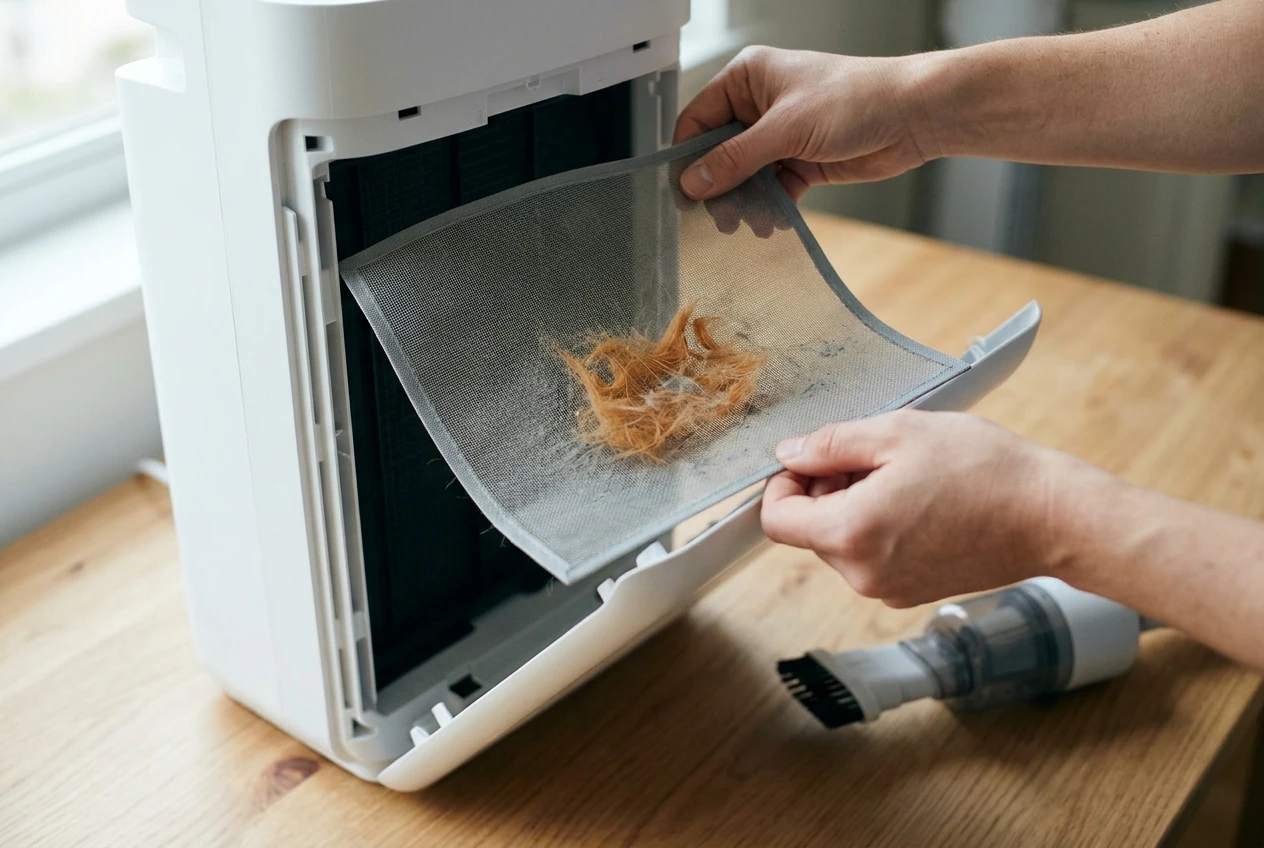
Wrap-style prefilters (design 3). Hair clings to fabric or knit wraps and needs a lint roller or a brush attachment. Check that the wrap slides off without tools, and whether the maker says it can be washed. Do not wash anything the manual does not tell you to wash, because a damp filter can cause problems. If you do get one wet by accident, read our piece on what to do if you washed your air purifier filter before you plug the unit in.
Combined cartridges (design 1 and many design 5 units). When the prefilter is part of the main filter, hair collects on the same surface that traps fine particles. You can vacuum the outside gently, but heavy shedding may mean replacing the whole cartridge sooner than the maker’s interval. That raises your yearly cost, which matters later in this article.
Questions to answer on the product page:
- Does the manual describe the prefilter as vacuumable or washable?
- Is it a separate piece you can buy on its own?
- Can you reach it without moving the unit or unscrewing anything?
If the page does not say, the answer is likely no.
Dander and fine particles: reading the specs without the marketing
Pet dander is made of skin flakes that range from large visible pieces down to very fine particles. The prefilter catches the large pieces. The main filter is responsible for the fine ones, so the specs that matter are the filter grade and the airflow rating.
Filter grade. Look for a stated HEPA grade. In the US, “True HEPA” refers to a filter standard tested on 0.3 micron particles. In Europe, grades such as H13 and H14 are used. Wording like “HEPA-type” or “HEPA-style” does not describe the same standard, so read it as a signal to check what the maker actually claims. If a spec sheet gives a test standard and a capture percentage, that is more reliable than a general statement.
Airflow rating. The figure to find is CADR, the clean air delivery rate, which tells you how much filtered air the unit produces per minute. A common guideline from the Association of Home Appliance Manufacturers is that a purifier’s CADR should be at least two thirds of your room’s floor area in square feet, for a standard ceiling height. A high-grade filter in a unit with a low CADR cleans a small volume of air slowly. For big rooms, our guide on sizing a smart purifier by airflow instead of the square footage on the box walks through the math.
Boxed room size. Be careful with the “covers up to” number on the packaging. Makers use different test conditions and often state a number of air changes per hour you may not need. Use the CADR line and your own room measurements.
Activated carbon. Carbon layers help with some odors. They do not catch dander, and a thin carbon layer will not handle a litter box. If odor is a concern, check how much carbon the maker lists and how often it says to replace it.
None of these specs predict how you or anyone else will feel. They describe what the machine does to the air passing through it. That is all a spec sheet can honestly say, so that is all this article claims.
Smart modes that help in a pet home
Smart features earn their price only if they reduce what you have to do by hand. In a house with animals, a few matter.
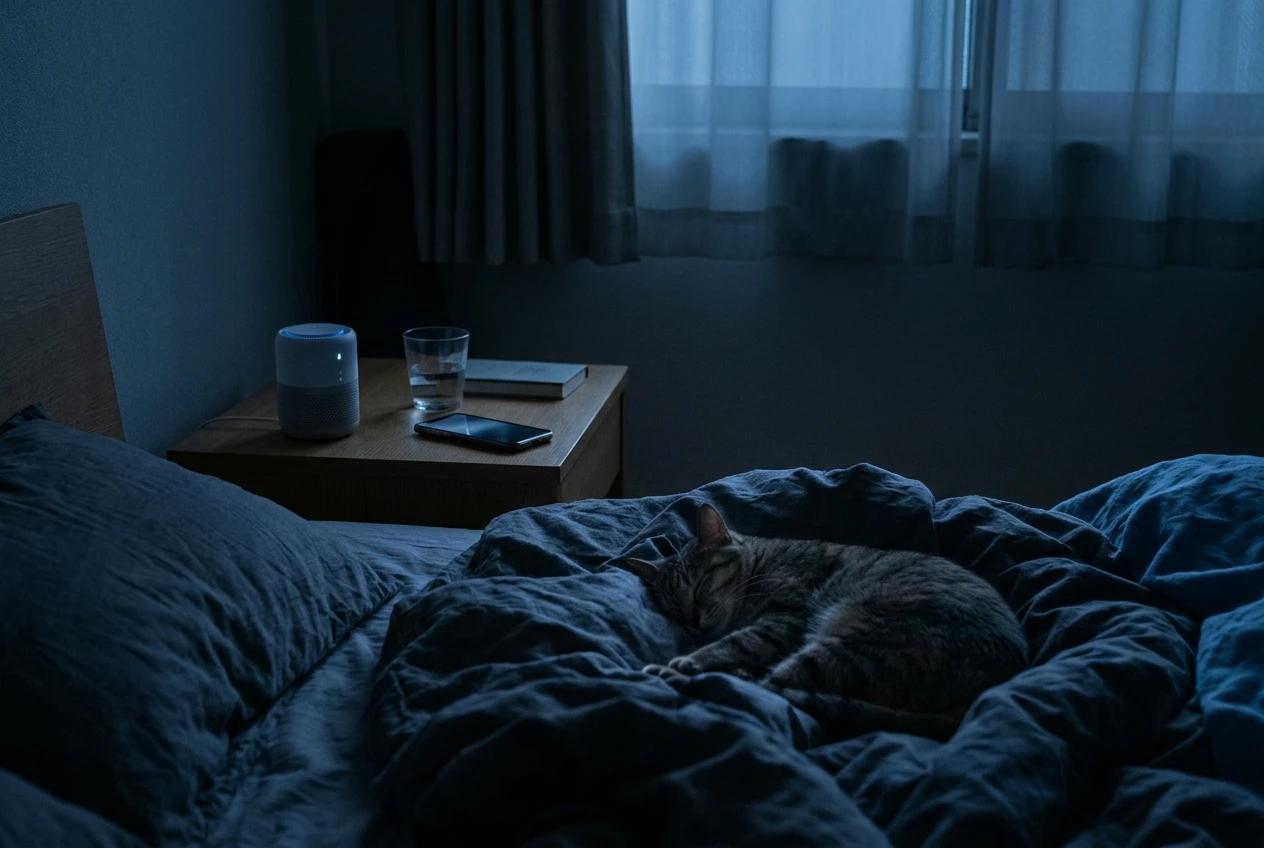
Auto mode with a particle sensor. The unit measures airborne particles and adjusts its fan speed. This can help in a pet home because activity changes through the day, with fur flying after brushing or dust rising after a dog runs through. The weak point is the sensor. It sits near the intake, and hair or dust over it can distort readings. Check whether the manual describes how to clean the sensor, and wipe it as the maker directs.
Quiet or night mode. If the purifier sits in a bedroom, you want a low-speed setting and a display that dims. Compare the stated decibel levels at the lowest speed. A quiet setting also matters for pets, since some animals are bothered by constant fan noise and may avoid the room.
Schedules. Setting a higher speed for the time of day when the pet is most active, and a lower one overnight, is a useful way to balance cleaning and noise. This works even on entry-level units that lack auto mode.
Filter alerts. Most smart units count hours of use and tell you when to change the filter. In a pet home, treat the alert as the latest date, not the earliest. If you see hair packed on the prefilter or airflow dropping, service the unit sooner. If a replacement does not clear the warning, these checks for a filter light that stays on can help.
Features worth skipping. Voice control, extra display modes, and detailed charts add cost without changing how clean the air is. Choose them only if you will use them.
What a year of filter upkeep looks like with a shedding pet
Filters are the main running cost, and a shedding pet pushes you toward the shorter end of the maker’s interval. To compare units, do this arithmetic for each one you are considering:
- Find the price of the main filter and any separate prefilter or carbon filter.
- Find the replacement interval the maker states, in months.
- Divide twelve by that interval to get replacements per year, and round up.
- Multiply that number by the filter set price.
As an illustration with round numbers only, a filter set priced at 40 and replaced every 6 months would cost 80 a year. A set at 25 replaced every 3 months would cost 100. The cheaper filter is the more expensive habit. Your own figures will differ, so use the prices on the product page when you check.
Then adjust for your home. A heavy-shedding dog, several cats, or a unit that runs around the clock can shorten the real interval. A combined cartridge that collects hair directly will likely need changing earlier than one with a separate prefilter you can vacuum weekly.
Original or compatible filters. Many popular units have third-party filters at lower prices. Savings can be real, but check that the dimensions match, that the filter grade is stated clearly, and that the unit’s filter counter will accept it. Our comparison of original and compatible air purifier filters covers what to check before you buy. If the model you want has no compatible option and the original is hard to find, that is a reason to consider a different unit before you commit.
Buying ahead. Stocking a year of filters can save on shipping, but filters age in storage and models get replaced. Consider whether buying in bulk makes sense before you do.
Which one fits which household
Small apartment, one cat or small dog. A compact tabletop unit (design 1) or an entry-level smart unit (design 5) can work if its CADR suits the room. Look for a vacuumable prefilter or an inexpensive replacement cartridge. A simple schedule and a quiet mode matter more than a long app feature list.
Mid-size living room, one or two pets. A tower with a separate mesh prefilter (design 2) is a sound fit. You can keep the prefilter clean weekly, and the main filter should hold up longer. Auto mode is helpful here.
Open floor plan or a room where pets roam. A cylinder with 360 degree intake (design 3) can draw air from all sides, which suits a unit placed in the middle of a space. Make sure the wrap is easy to remove and clean.
Large living room or a multi-pet home. A large-room console (design 4) is where the airflow figures justify the cost. Several animals produce more hair and dander, and a bigger prefilter with higher CADR keeps up. Expect the filter set to cost more, and do the yearly math before you decide.
Rental with limited space. Pick a unit with a footprint you can place clear of walls and furniture, because a purifier tucked into a tight corner will not draw air well. A moderately priced unit with easy filter access beats a more powerful one you can’t reach to service.
If you are still unsure where to begin, our smart air purifier buying guide starts with your room and your problem, then works toward a short list.
Placement and care so your pick keeps working
A well-chosen purifier still underperforms when it is placed badly or neglected.
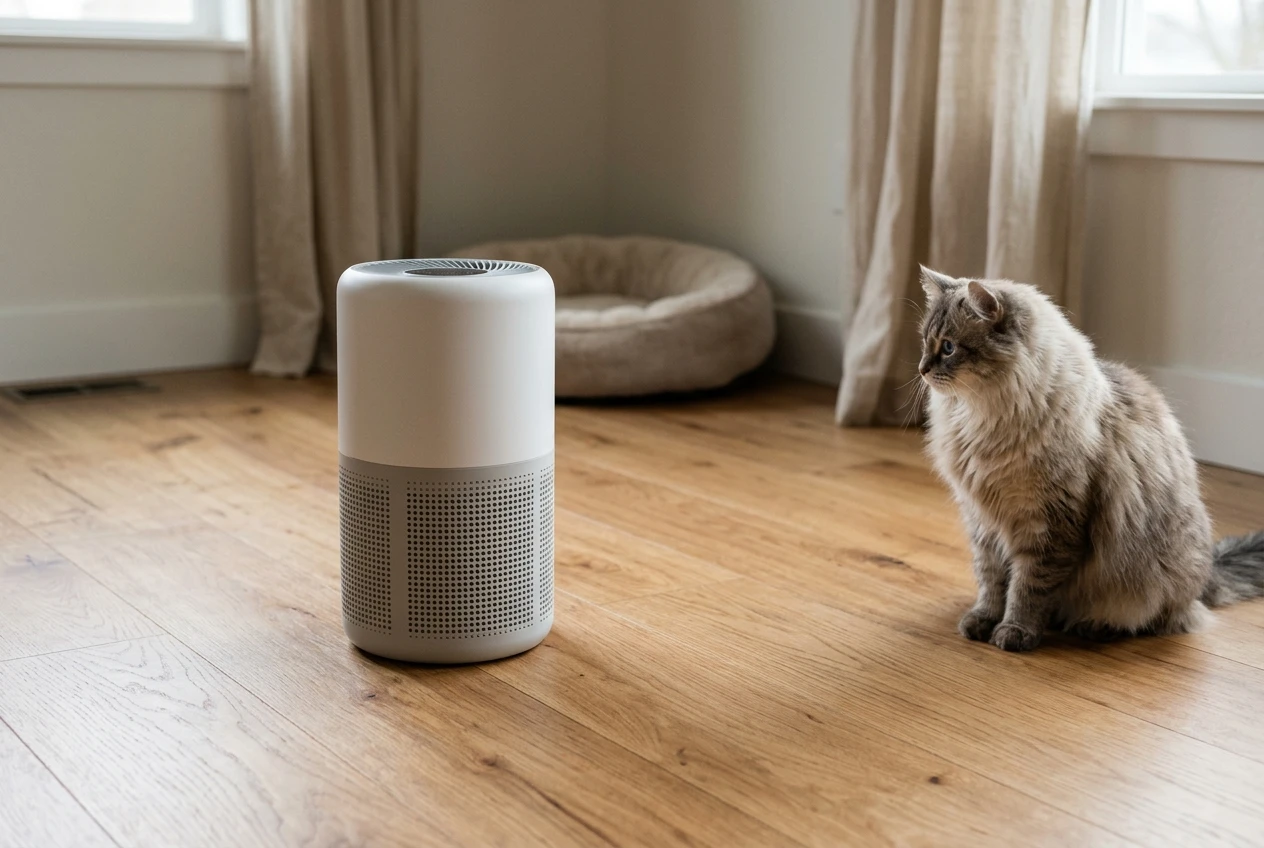
- Leave space around the intake. Manuals commonly call for clearance on all sides. Pet beds, couches, and curtains close to the unit restrict airflow.
- Mind the floor. Soft surfaces can partly block bottom intakes and collect hair around the base. Read what to do with an air purifier on carpet to check whether yours is affected.
- Keep it out of the pet’s reach. Cords, dangling parts, and open panels can tempt cats and puppies. Place the unit where it cannot be tipped or chewed.
- Vacuum the prefilter on a schedule. Once a week during heavy shedding and every two weeks otherwise is a reasonable starting rhythm. Adjust by looking at it.
- Wipe the sensor and the grille. Follow the manual. Hair across the sensor can distort auto mode.
- Read the filter’s color with context. A filter that darkens quickly in a pet home is not automatically faulty. Dust, smoke, cooking, and hair all contribute. If you want to know what the color might mean, see why a filter turns black so fast.
- Check airflow when it seems weak. If the fan sounds normal but little air comes out, look first at a hair-clogged prefilter before assuming the unit is failing.
Your next step
The right purifier for a pet home is the one sized to your room, with a prefilter you can reach, a filter set whose yearly cost you have worked out, and smart modes you will use. Join the email list for a simple filter-check reminder routine for pet homes, so servicing the prefilter does not slip by. When you have matched a design to your room, use the links in the comparison to check current pricing on the purifier that fits.