You pull the filter out expecting a little gray dust. Instead, part of it looks charcoal-colored—or nearly black.
That can be unsettling, especially when the filter was installed only a few weeks or months ago. But a dark filter does not automatically mean the purifier is defective, the air is dangerous, or the cartridge must be thrown away immediately.
Treat the color as a clue. Then identify which filter layer changed, how quickly it happened, and what was happening in the room while the purifier collected those particles.
Reader-first affiliate disclosure: This guide contains a FiltersFast affiliate link for readers whose inspection and manufacturer instructions confirm that a replacement is needed. BestSmartPurifiers.com may earn a commission from a qualifying purchase at no added cost to you. Filter color alone is not being used here as a reason to buy a new cartridge.
Why Is My Air Purifier Filter Turning Black?
An air purifier filter can become gray, brown, or black as it captures airborne particles from normal household dust, outdoor pollution, cooking, smoke, candles, fireplaces, wildfire events, and other combustion sources.
But first make sure you are looking at the particle-catching surface. Activated-carbon media is commonly dark or black when new, so a black carbon layer may be completely normal.
Do not judge replacement by color alone. Check the exact filter instructions, installation date, airflow, odor, filter reminder, recent pollution events, and any manufacturer-specified replacement interval. A rapid or unusual color change is more useful when you can connect it to what changed in the room.
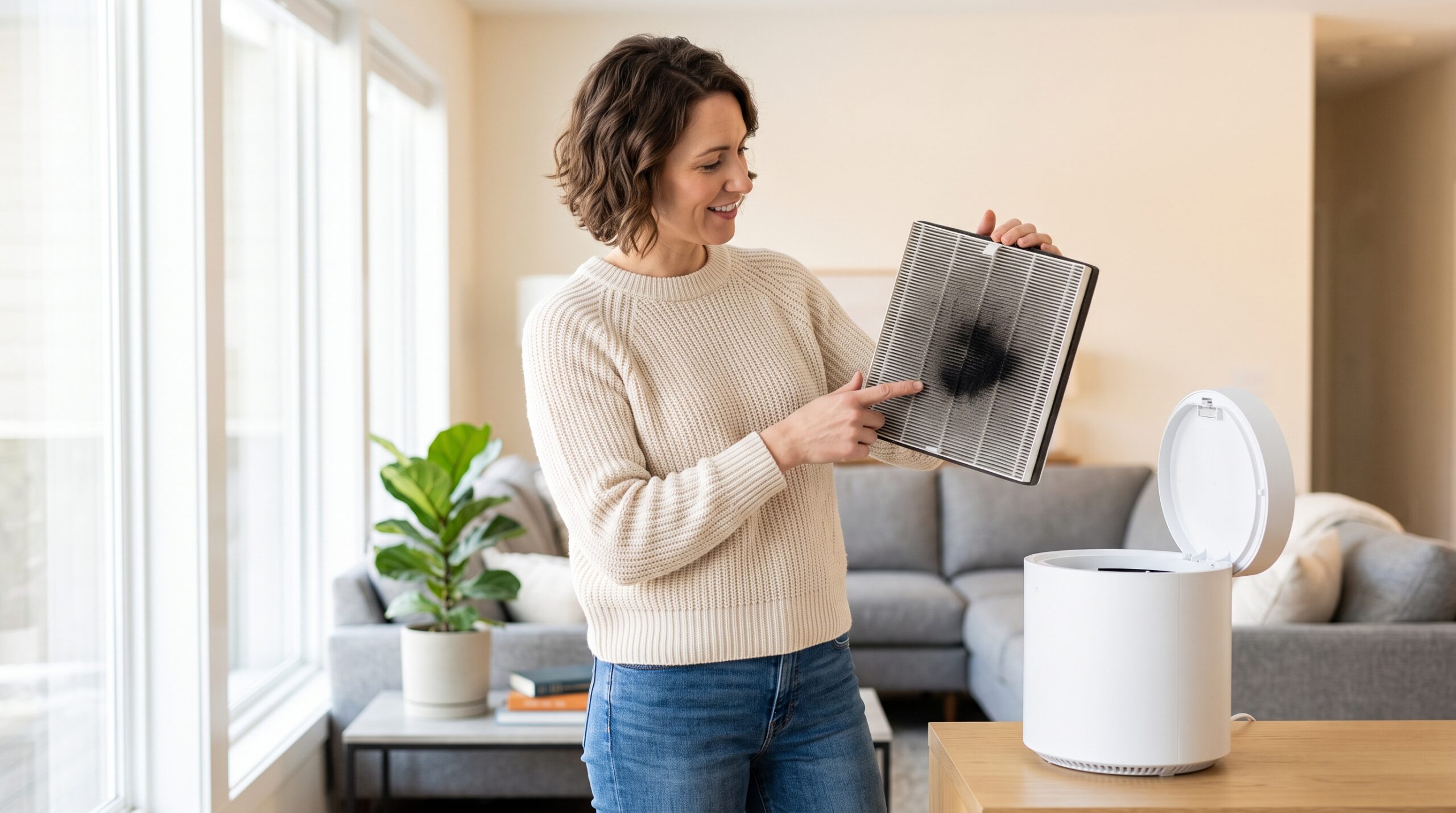
The U.S. EPA identifies cooking, cleaning activities, candles, fireplaces, smoking products, outdoor air, biological material, and other household activities as potential sources of indoor particulate matter. An air purifier can collect some of those airborne particles—but preventing or reducing the source is often more useful than simply replacing filters faster.
That Black Filter Is Evidence—Not a Diagnosis
A purifier moves room air through its filter over and over. If particles reach the intake and the filter captures them, some of that material eventually becomes visible.
That makes a dirty filter partly a record of what passed through the machine. What it cannot tell you by itself is exactly what every particle was, whether every pollutant in the room has been removed, or whether the filter still has useful life remaining.
| What you see | Possible explanation | Best first check |
|---|---|---|
| Light gray, fairly even loading | Ordinary dust and accumulated airborne particles | Check installation date, airflow, pre-filter, and manufacturer maintenance guidance. |
| Dark gray or black loading that appeared quickly | Heavy particle event such as smoke, soot, cooking particles, wildfire smoke, or another combustion source | Ask what changed in the home or outdoor air before the filter darkened. |
| Black layer that looked black when new | Activated-carbon or other dark filter media | Compare it with the manual and a photo of the original filter. |
| Dark patches near one part of the intake | Uneven airflow, nearby source, or intake position | Inspect placement and determine whether a nearby vent, candle, kitchen, fireplace, or doorway lines up with the dark area. |
| Dark filter plus noticeably reduced airflow | Particle loading may be restricting the filter | Follow the approved maintenance and replacement procedure for the exact model. |
| Darkening plus burning odor, smoke, abnormal heat, or appliance problems | Possible source or equipment problem that deserves immediate attention | Stop treating this as routine filter maintenance and investigate the safety issue. |
On a phone, swipe the table sideways if needed.
6 Clues to Check Before You Replace the Filter
1. Make Sure the “Black Filter” Wasn’t Black to Begin With
Many purifier cartridges contain more than one material. A washable or disposable pre-filter may sit in front of a pleated particle filter. Activated carbon may appear as black pellets, dark foam, black honeycomb material, or a dark sheet.
If you recently changed the filter, compare what you see with the manufacturer diagram, the old filter, packaging photos, or the official replacement instructions.
This is especially important with all-in-one cylindrical filters. Looking through the intake can make the carbon stage appear like a suddenly blackened filter even though that layer is supposed to be dark.
2. Ask How Fast the Color Changed
A filter that gradually becomes gray during months of normal operation is different from one that goes noticeably dark after a weekend of wildfire smoke, a smoky cooking incident, fireplace use, heavy candle burning, sanding, renovation work, or another unusual particle event.
Write down the installation date. Then think back to the days immediately before you noticed the change.
During wildfire smoke, the EPA recommends checking air-cleaner and HVAC filters frequently because heavy particle conditions can load filters much faster than ordinary use.
That does not mean every dark filter is wildfire soot. It means time plus context tells you more than color by itself.
3. Look for Particle Sources Before Blaming the Purifier
A purifier is often blamed for what it reveals.
If the filter is collecting more material than expected, walk through the room and ask where those particles could be coming from:
- frequent frying, broiling, searing, or smoky cooking;
- candles or incense;
- a fireplace or wood-burning appliance;
- tobacco smoke or vaping;
- outdoor wildfire smoke or traffic pollution entering the home;
- construction, sanding, drywall, or renovation dust;
- heavy indoor dust that is repeatedly resuspended;
- an HVAC register or doorway delivering particles toward the purifier.
The EPA specifically lists cooking and combustion activities—including candles and fireplaces—among indoor sources of particulate matter.
That changes the solution. A new filter may restore capacity, but it does not stop a continuing particle source.
Dark Filter? Follow the Particle Backward
Which layer actually became darker?
Hours, days, weeks, or months?
What happened in the room during that period?
Control the source, service the approved layer, replace when due, or get support.
A filter replacement solves filter loading. It does not automatically solve the source that loaded it.
4. Compare the Filter With the Rest of the Room
A very dark filter deserves a broader look around the space.
Check nearby walls, ceilings, window coverings, vents, shelves, and surfaces. Is there black or greasy residue elsewhere? Does the darkening occur mostly near one appliance or room?
If ordinary settled dust is the bigger complaint, read Your Air Purifier Is Running—but the Dust Keeps Coming Back. Filtration and surface cleaning solve different parts of the dust problem.
5. Use Airflow, Odor, and the Filter Alert as Separate Clues
A filter can look dirty and still move air normally. It can also become loaded enough to reduce airflow before its appearance seems dramatic.
If airflow has changed, use the site’s seven-check weak-airflow guide.
If the filter indicator has illuminated, see Your Air Purifier Says “Replace Filter”—Should You Trust the Light?.
6. Let the Manual Decide What “Due” Means
Once you know which layer is dark, check the maintenance instructions for the exact purifier model.
- complete purifier model number;
- manufacturer filter code;
- filter installation date;
- normal fan speed and daily runtime;
- recent smoke, cooking, renovation, pet, pollen, or dust events;
- whether airflow changed;
- whether odor changed;
- what the filter reminder currently shows.
When a Black Filter Could Point to a Bigger Source Problem
A dark filter is not a carbon-monoxide detector.
Carbon monoxide is a colorless, odorless gas. A purifier filter cannot tell you that CO is present, and ordinary particle filtration does not replace a working carbon-monoxide alarm.
Never ignore a carbon-monoxide alarm. Follow its instructions and current emergency guidance.
Unexplained soot, combustion problems, abnormal appliance operation, recurring smoke, or visible staining around fuel-burning equipment should be evaluated by an appropriately qualified professional.
Learn more from the U.S. Consumer Product Safety Commission’s carbon-monoxide guidance.
Should You Replace a Filter Just Because It Looks Black?
Not automatically.
Replace it when the instructions for your model call for replacement or when the approved inspection points to a spent, damaged, contaminated, incorrectly functioning, or overly restricted filter.
Compare Replacement Filters at FiltersFast
Affiliate link. Verify the exact purifier model and replacement-filter code before ordering.
Add a “Dark Filter” Record to Your Fit & Filter Planner
The free 15-page Smart Air Purifier Fit & Filter Planner helps you record room fit, filtration, exact replacement-filter information, ownership cost, and maintenance.
- Installed: Date and exact filter code.
- Observed: Date you first noticed the color change.
- Location: Which side or layer became dark.
- What changed: Smoke, cooking, candles, fireplace use, renovation, outdoor pollution, placement, or runtime.
- Result: Airflow, odor, filter alert, approved maintenance, or replacement.
Frequently Asked Questions
Why did my air purifier filter turn black after only a month?
A short timeline can reflect unusually heavy particle exposure, but start by identifying which filter layer is dark and what changed in the room.
Does a black HEPA filter mean my indoor air is dangerous?
Not by itself. Filter color shows that material has accumulated, but appearance cannot identify every particle or determine the room’s current exposure level.
Can candles make an air purifier filter turn black?
They can contribute particles and soot under some conditions. Reducing the source can be more effective than simply accepting faster filter replacement.
Can cooking make an air purifier filter dark?
Yes. Cooking can generate airborne particulate matter, particularly during smoky or high-temperature cooking.
Should I replace my filter when it turns gray?
Not solely because it is gray. Use the manufacturer’s guidance along with filter age, airflow, condition, odor, reminders, and unusual pollution events.
Why is only one side of my purifier filter black?
Uneven loading may reflect purifier placement, intake design, or a nearby particle source.
What Did Your Filter Look Like?
Did yours turn light gray gradually, develop one black patch, or darken surprisingly fast after a specific event?
Share the purifier model, filter code, how long the filter had been installed, and what changed in the room in the comments.