Best Smart Purifiers · Airflow placement check
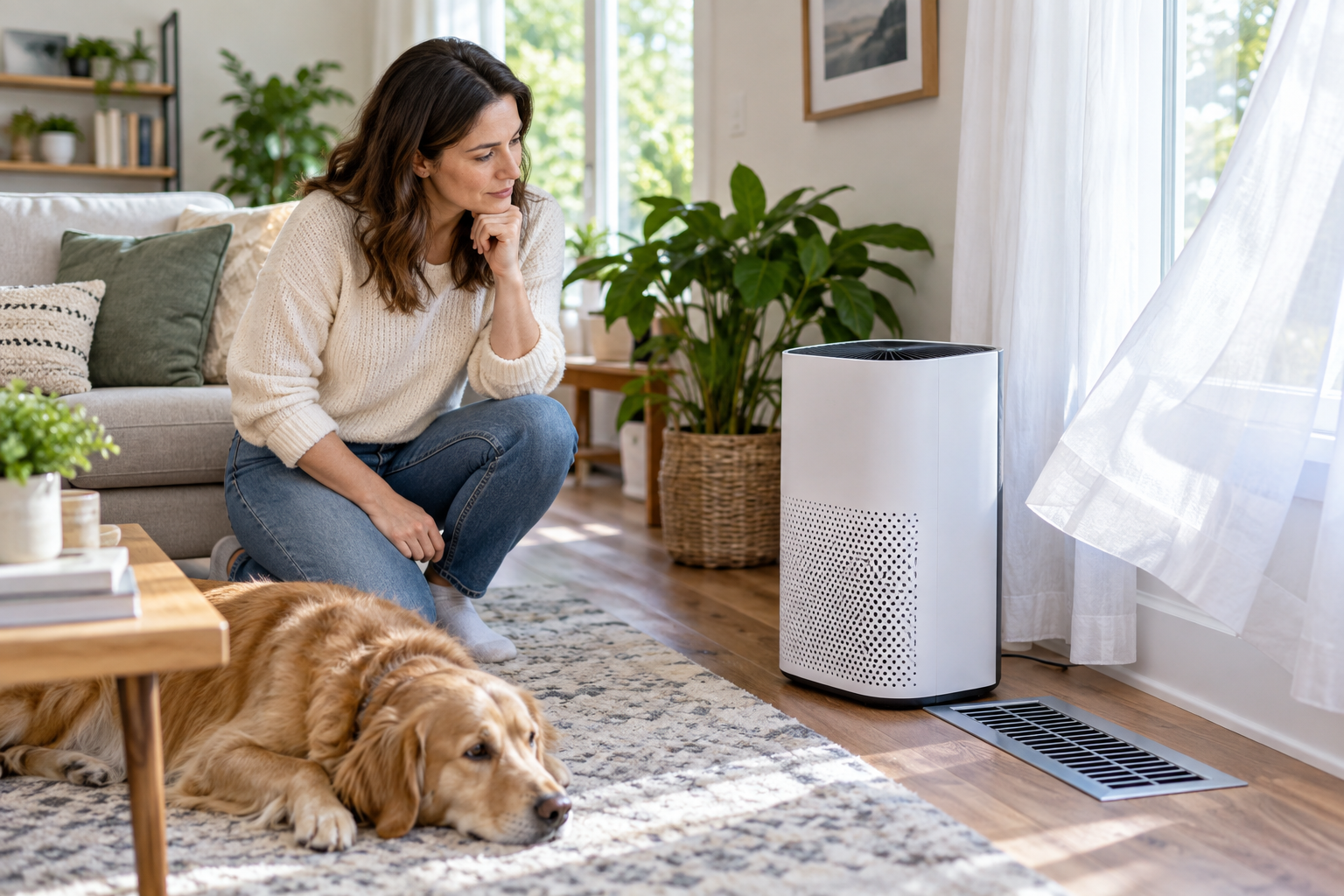
Your air purifier is running beside an HVAC vent. Then the furnace or air conditioner kicks on—and suddenly the purifier’s airflow feels different, its sensor changes, or one part of the room becomes drafty.
That can make the vent look like either the perfect location or the obvious problem. The truth is more useful: the purifier and HVAC system are creating two separate airflow patterns in the same room. Sometimes they cooperate. Sometimes they compete.
Before you move the purifier across the room—or replace a machine that may be working normally—figure out which pattern you actually have.
Quick answer
Can You Put an Air Purifier Near an HVAC Vent?
Yes, but being close to a vent is not automatically better or worse. A supply register can redirect the purifier’s intake or clean-air stream. A nearby return grille can influence airflow close to the grille, but its effect falls off with distance. The actual result depends on the purifier design, vent location, HVAC airflow, room layout, and where people spend their time.
Start by identifying whether the opening is a supply or return. Then make sure the purifier intake and outlet are unobstructed, follow its manufacturer-required clearances, and compare how the room behaves with the HVAC blower on and off.
BestSmartPurifiers takeaway: Do not optimize for “closest to the vent.” Optimize for open airflow, useful room mixing, comfortable placement, and enough clean-air delivery for the room.
Reader-first affiliate disclosure: This guide contains a FiltersFast affiliate link. BestSmartPurifiers.com may earn a commission from a qualifying purchase at no additional cost to you. Placement, room fit, airflow, filter condition, and exact compatibility come before any replacement purchase.
First, Find Out Whether It Is a Supply or Return Vent
A supply register pushes heated or cooled air into the room. A return grille pulls room air back toward the central system.
They are part of the same HVAC system, but they do not affect room airflow in exactly the same way.
| What is nearby? | What it does | What you may notice | First thing to test |
|---|---|---|---|
| Supply register | Pushes conditioned air into the room. | The HVAC stream may redirect purifier output, blow into an intake, change a sensor reading, or create a noticeable draft. | Watch the purifier’s outlet path with the HVAC blower on versus off. |
| Return grille | Pulls room air back toward the HVAC system. | Air motion is strongest close to the grille. Placement may matter if the purifier is immediately beside it or aimed directly toward it. | Move the purifier to another approved open location and compare room circulation. |
| Exhaust opening | Removes air from the space rather than recirculating it. | The exhaust path may dominate local airflow while operating. | Use the exhaust system for its intended source-control job and keep the purifier unobstructed. |
ASHRAE notes that portable air-cleaner performance can depend on location relative to existing supply diffusers and return grilles because those locations affect airflow patterns in the breathing zone.
ASHRAE also explains an important detail that is easy to miss: a return grille generally affects room air motion most strongly near the grille itself. So there is no reason to assume that every purifier sharing a room with a return is losing all of its cleaned air back into the HVAC system.
Authority reference: ASHRAE Handbook — In-Room Air Cleaners and ASHRAE Handbook — Room Air Distribution.
Visual explainer 1
Three Airflow Patterns You May Be Creating
Why “Right Beside the Vent” Is Not a Placement Strategy
An air purifier works by repeatedly pulling room air through its filter system and returning cleaned air to the room. Good placement gives both sides of that process room to work.
An HVAC system introduces another moving stream. When the blower turns on, the direction and speed of room air can change substantially.
If the purifier is directly in that stream, you might see the purifier’s built-in sensor rise or fall, feel a stronger breeze, hear a slight change in sound, or notice that the outlet air no longer travels where it did before.
None of those observations automatically proves that the purifier or HVAC system is defective.
Five Clues That the HVAC Airflow Deserves a Closer Look
The outlet stream changes direction
The airflow feels different as soon as the HVAC blower begins.
The sensor changes with every HVAC cycle
The purifier may be sampling a different stream of room or supply air.
One chair suddenly feels drafty
Two otherwise normal airflow paths may be combining in the occupied zone.
The purifier is crowded against the register
Convenient placement can still restrict the purifier or interfere with the HVAC opening.
The far side of the room feels stagnant
The purifier may be moving plenty of air locally without distributing it well through the space.
Moving it changes the pattern
A repeatable improvement after one controlled move is useful evidence.
If the main complaint is that the purifier makes one part of the room feel cold, use the separate guide to fixing an air-purifier draft without blocking airflow.
The Seven-Step HVAC Vent Placement Test
You do not need smoke machines, airflow meters, or a major room rearrangement. You need a controlled comparison.
1. Find every purifier intake and outlet
Do not assume air enters through the back and exits through the top. Purifier designs vary.
Check the manual for the exact model and identify the intake, clean-air outlet, sensor opening, minimum clearance, approved orientation, and whether the unit is designed for the floor or another surface.
2. Identify the HVAC opening
Determine whether it is a supply, return, or exhaust opening.
If you are unsure, observe the airflow while the system operates without removing the grille or placing objects inside the duct. A supply pushes air outward. A return draws air inward.
3. Record the starting setup
Write down:
- Purifier model and filter code
- Selected purifier speed or mode
- HVAC mode and whether its blower is operating
- Purifier position
- Distance from nearby furniture and openings
- Door and window position
- What you are actually trying to improve
Your last answer matters most. “The room is bad” is difficult to test. “The purifier becomes drafty when the heat starts” or “the PM2.5 display changes every HVAC cycle” gives you something observable.
4. Check for ordinary obstructions first
EPA recommends keeping airflow to and from portable air cleaners clear. Curtains, furniture, bedding, walls, stored items, and a poor floor position can create a problem before the HVAC vent enters the story.
Do not solve a vent-placement question by pushing the purifier behind a sofa or into a tight corner.
Authority reference: EPA — Guide to Air Cleaners in the Home.
5. Compare HVAC off and on
Use the same purifier fan speed. Observe the outlet direction, comfort, sound, and sensor behavior with the HVAC blower off and again when it runs normally.
A purifier sensor is measuring air near the purifier. If an HVAC supply changes the air arriving at that sensor, the display can change without representing an identical change everywhere in the room.
6. Test one alternative location
Turn the purifier off and unplug it before relocating it when its instructions call for doing so.
Choose another stable, manufacturer-approved location in the same room with open intake and outlet paths. Keep the purifier speed, doors, windows, and other conditions as similar as practical.
Change one thing. If you move the purifier, replace its filter, open two windows, change fan speed, and turn on a ceiling fan at the same time, you will not know which change mattered.
7. Keep the location that works for the whole room
The better position should satisfy more than one requirement:
- The intake and outlet remain clear.
- The purifier meets its required clearances.
- The HVAC supply or return remains unobstructed.
- The purifier is stable and its cord is not a trip hazard.
- Filtered air can mix through the occupied portion of the room.
- The purifier does not create an unacceptable draft.
- The location still works during normal HVAC operation.
A portable purifier is not a tool for balancing an HVAC system. If you have unusually weak HVAC airflow, persistent pressure problems, whistling doors, repeated equipment faults, major room-to-room temperature differences, or another building-system concern, have the HVAC system evaluated separately.
Visual explainer 2
Move It or Leave It?
What If the Purifier Is Near a Supply Register?
A supply register can create a relatively strong air jet. Depending on the room and diffuser, that air can travel along a wall or ceiling, spread across the floor, or project directly into the occupied zone.
If the purifier sits in that path, the supply air can redirect the purifier’s clean-air stream or change the air entering its intake.
That is not always bad. The combined airflow may improve room mixing. But you need to judge the result, not the theory.
If a couch, desk, or bed suddenly feels colder when both devices run, the issue may be comfort rather than filtration. See Why Does My Air Purifier Make the Room Feel Cold?
What If the Purifier Is Near a Return Grille?
A return grille draws air toward the HVAC system, but its influence on room air motion is most pronounced near the grille.
That means a purifier sitting immediately beside a strong return deserves a placement check, but there is no basis for assuming that every purifier in the same room is simply sending all of its cleaned air straight back into the ductwork.
Test a second open location. If the purifier produces better circulation or more consistent room readings there, keep the improvement. If nothing meaningful changes, the return grille may not have been the limiting factor.
Do Not Confuse HVAC Interaction With Weak Purifier Airflow
If the purifier itself seems to be blowing less air than it used to at the same manual setting, placement may not be the whole problem.
Check the intake and outlet, pre-filter condition, exact replacement-filter code, packaging removal, filter seating, and operating mode before assuming the motor is failing.
The full process is in Your Air Purifier Is Running, but Barely Blowing Air—7 Checks Before You Replace It.
Could the HVAC Vent Be Confusing the Purifier Sensor?
It can change what reaches the sensor.
A built-in particle sensor samples air at or near the purifier—not every cubic foot of the room simultaneously. A supply register may deliver a different air stream to that sensor when the HVAC fan turns on.
That is why one purifier display should be treated as a local indicator rather than a complete indoor-air diagnosis.
If the room feels dry when the HVAC and purifier operate together, do not assume the purifier is removing moisture. A conventional portable purifier normally filters and recirculates air rather than dehumidifying it. Use the companion guide, Does an Air Purifier Dry Out the Room?, to separate airflow discomfort from a real humidity change.
Placement Cannot Rescue an Undersized Purifier
This is the part that clever placement advice sometimes skips.
If the purifier does not deliver enough clean air for the space, moving it six feet away from the vent will not suddenly give it more capacity.
AHAM’s general room-sizing rule uses a smoke CADR of at least two-thirds of the room’s square footage for typical particle cleaning with an eight-foot ceiling.
A 12 × 15-foot room contains 180 square feet.
180 × ⅔ = about 120 smoke CADR as a general starting point.
Higher ceilings, connected rooms, difficult pollution events, and quieter operating goals can justify more capacity. For wildfire smoke, AHAM recommends a smoke CADR roughly equal to the room’s square footage.
Authority reference: AHAM Verifide — Air Filtration Standards and CADR Sizing.
For a broader refresher on filters, CADR, carbon, smart features, placement, and maintenance, see the Comprehensive Guide to Air Purifiers.
What About Opening a Window Near the Purifier?
That changes the airflow test again.
An open window introduces outdoor air whose particle level, pollen load, temperature, humidity, and direction can change by the hour. The purifier may still filter particles that reach it, but it is no longer working with the same contained room conditions.
Use the separate guide to when to open the windows and when to keep them closed before combining a window experiment with this HVAC placement test.
Put the HVAC Placement Test Into Your Fit & Filter Planner
The free Smart Air Purifier Fit & Filter Planner already gives you a structured place to compare room size, CADR, filter compatibility, maintenance, and first-year cost.
Add a small HVAC placement record:
- Purifier make and exact model
- Approved replacement-filter code
- Room dimensions and ceiling height
- Purifier intake and outlet direction
- Nearest HVAC opening: supply or return
- Normal purifier fan setting
- Normal HVAC mode
- What changes when the blower starts
- Alternative location tested
- Which position gives the better overall result
The goal is not to turn your living room into a laboratory. It is to stop guessing.
Open the Free Fit & Filter PlannerWhen Does the Filter Belong in This Decision?
Not at the beginning.
An HVAC vent cannot be fixed with a new purifier filter. But if the airflow remains unusually weak after the placement test, or your records show that the current filter is due for replacement, then filter condition deserves attention.
Start with the purifier’s exact model number and manufacturer-approved filter code. Verify compatibility, the filter stages included, package quantity, seller information, return terms, and installation instructions.
Compare Replacement Filters at FiltersFast
Affiliate link. Availability, pricing, package contents, and compatibility can change. A replacement filter will not correct poor purifier placement or a blocked HVAC register.
Visual explainer 3
The BestSmartPurifiers Order of Operations
Related Best Smart Purifiers Guides
- Air Purifier Barely Blowing Air: 7 Checks Before You Replace It
- Why Does My Air Purifier Make the Room Feel Cold?
- Does an Air Purifier Dry Out the Room?
- When to Open the Windows—and When to Keep Them Closed
- Your Air Purifier Is Running—but the Dust Keeps Coming Back
- A Comprehensive Guide to Air Purifiers
Four-Question Interactive Knowledge Check
Can you spot an HVAC-placement problem without replacing a purifier that may be working normally?
1. What is the first useful question when an air purifier sits beside an HVAC opening?
2. The purifier feels drafty only when the HVAC blower starts. What should you do first?
3. What does AHAM’s two-thirds rule describe?
4. What is the wrong way to solve a purifier-and-vent airflow problem?
Frequently Asked Questions
Should an air purifier be placed near an air-conditioning vent?
It can be, provided the purifier intake and outlet remain unobstructed and the supply airflow does not create a poor circulation pattern or uncomfortable draft. Compare the purifier with the HVAC blower on and off, and follow the purifier manufacturer’s placement clearances.
Should an air purifier be placed near a return vent?
There is no universal rule requiring it or prohibiting it. Return-air influence is strongest close to the grille. If the purifier is immediately beside the return, compare another manufacturer-approved open location and judge the result in the occupied part of the room.
How far should an air purifier be from an HVAC vent?
There is no single distance that applies to every purifier and HVAC layout. Use the clearance requirements in the purifier manual, keep the HVAC grille unobstructed, and test whether the two airflow streams produce useful circulation rather than relying on a generic number of feet.
Can an HVAC vent make my purifier sensor change?
Yes. When the HVAC blower operates, it can change the air reaching the purifier’s sensor. That does not automatically mean the sensor is defective. Compare the pattern under repeatable conditions and remember that a built-in sensor primarily describes the air near that device.
Can I put an air purifier directly over a floor vent?
Do not block an HVAC supply or return opening with a portable purifier unless an equipment manufacturer specifically designed and approved such an arrangement. Keep both systems’ airflow paths open.
Does an air purifier replace an HVAC filter?
No. A portable purifier filters air in a room or local area as air passes through the unit. An HVAC filter treats air moving through the central system. They can complement each other, but one does not automatically replace the other.
Where is the best place for an air purifier?
Use a stable, manufacturer-approved location in the occupied room with clear intake and outlet paths, adequate space around the unit, safe cord placement, and useful circulation. Room size, purifier CADR, noise, runtime, doors, windows, and other airflow sources all affect the final choice.
Before You Move the Purifier Again, Watch One HVAC Cycle
The next time the heating or cooling system starts, watch what changes.
Does the purifier’s clean-air stream bend? Does one seat become drafty? Does the sensor change? Does nothing noticeable happen at all?
That last result is useful too. Not every nearby HVAC vent is a problem.
Tell me what happens in your room in the comments. Include the purifier model, whether the nearby opening is a supply or return, your normal fan setting, and what changes when the HVAC blower starts. Leave out serial numbers and personal information.
Your real-room observation may help another reader solve the same placement problem without buying a new purifier or filter.
Authoritative Guidance Used for This Article
- U.S. EPA — Guide to Air Cleaners in the Home
- ASHRAE — In-Room Air Cleaners
- ASHRAE — Room Air Distribution
- AHAM Verifide — Air Filtration Standards and CADR Guidance
Fact-check date: September 12, 2026. This article provides general consumer guidance. Purifier airflow, clearances, sensors, filter requirements, and installation instructions vary by model. HVAC systems also vary by building and design. Follow the current instructions for your equipment and use qualified HVAC assistance when the problem involves the central system rather than purifier placement.