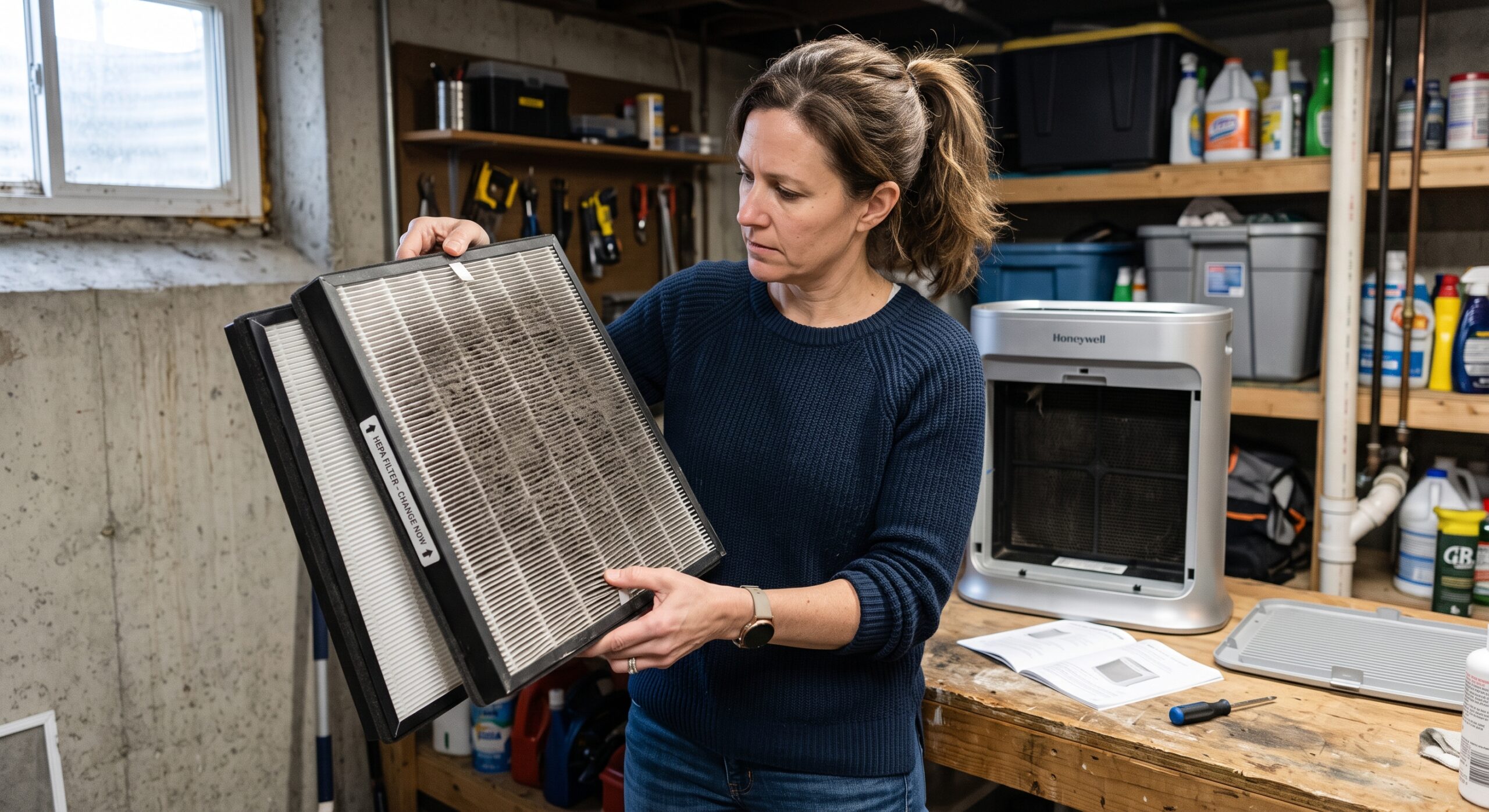
You remove the filter and notice a sharp contrast: one side is gray or dark, while the other side still looks almost new. It is easy to assume the purifier is pulling air incorrectly—or that half the filter has stopped working.
Sometimes uneven dust is a normal result of the purifier’s intake design. Other times, it points to a blocked grille, a nearby particle source, poor placement, or a filter that is not seated correctly. The pattern is useful evidence, but it is not a diagnosis by itself.
Reader-first affiliate disclosure: This guide includes a FiltersFast affiliate link for readers whose inspection and manufacturer instructions confirm that replacement is due. BestSmartPurifiers.com may earn a commission from a qualifying purchase at no added cost to you. Uneven color alone is not presented as a reason to buy a filter.
Quick answer
Why Is My Air Purifier Filter Dirty on Only One Side?
An air purifier filter can become dirtier on one side because more room air reaches that section of the intake, a nearby source is sending particles toward it, furniture or a wall is restricting another side, or the filter is not fitted and sealed as designed. Some unevenness may be normal for the machine’s airflow path.
Turn the purifier off and unplug it as its manual directs. Photograph the filter before moving it, identify which surface faces each intake, and inspect the surrounding grilles, placement, filter code, orientation, and seal. Do not rotate, wash, vacuum, or replace the filter unless the instructions for that exact model permit it.
Uneven Dust Is a Clue—Not a Filter-Life Gauge
A filter records where airborne particles reached its surface. A dark patch can therefore tell you something about airflow direction or a nearby source. What it cannot tell you alone is the identity of every particle, the air quality throughout the room, or the amount of useful filter life remaining.
The first question is not, “How dark is it?” Ask, “Which side of the purifier was this section facing?” A pattern that lines up with a front intake, floor-level opening, HVAC stream, kitchen doorway, fireplace, or dusty pet area gives you a much better starting point.
| What you see | Possible explanation | Best first check |
|---|---|---|
| One broad side is darker | That side may receive more intake airflow or face a stronger particle source. | Map the filter section to the purifier’s intake and room position. |
| A narrow dark stripe | An intake slot, internal airflow channel, or gap may concentrate air through that area. | Compare the pattern with the grille and the filter-installation diagram. |
| Darkness closest to the floor | Floor dust, hair, lint, carpet fibers, or a low intake may load the lower area first. | Check the approved surface, floor clearance, and nearby dust sources. |
| One side dark after the purifier was moved | A wall, couch, curtain, vent, or doorway may have changed the airflow. | Restore open clearances and compare the pattern over time. |
| Dust bypassing an edge | The filter may be incorrect, misoriented, damaged, or poorly seated. | Verify the complete model, filter code, seals, cover, and latch. |
| Uneven loading plus weak airflow | A blocked intake, loaded pre-filter, incorrect filter, or service issue may be involved. | Use the site’s weak-airflow checks before buying parts. |
7 Checks Before You Replace or Rotate the Filter
1. Photograph the Pattern Before You Disturb It
Take a clear photo of the filter in its installed position. Mark which part faced the wall, room, floor, doorway, HVAC register, or other nearby feature. If you remove the filter first and then turn it around several times, you may lose the most useful evidence.
Keep serial numbers and personal information out of public photos. The purifier model and filter code are the useful details.
2. Find Every Intake—Do Not Guess From the Shape
A cylindrical purifier may appear to pull equally from every direction, yet its outer shell, inner fan path, nearby wall, or furniture can change how air reaches the filter. A rectangular model may draw through its front, back, sides, bottom, or a combination of openings.
Use the current manual to locate the intake, clean-air outlet, sensor opening, filter orientation, and required clearances. Uneven loading that matches the designed intake is more understandable than a patch beside an area that should be sealed.
3. Look for a Blocked Side
A sofa, curtain, bedspread, wall, stack of books, or tight corner can limit the air reaching part of the purifier. The U.S. EPA recommends positioning portable air cleaners so airflow is not obstructed. Follow your manufacturer’s clearance instructions rather than relying on one universal distance.
If the purifier sits on carpet, confirm that the model is approved for that surface and that no bottom intake is being restricted. Use the separate guide, Your Air Purifier Is Sitting on Carpet—Is That Blocking the Intake?, for a floor-position check.
4. Follow the Dark Side Back to the Source
Think beyond ordinary settled dust. Cooking, candles, fireplaces, smoking, renovation work, open windows, outdoor pollution, pet areas, and an HVAC supply stream can deliver more particles from one direction.
The EPA identifies cooking, combustion, cleaning activities, biological material, and outdoor air among potential sources of indoor particulate matter. If the dark area points toward a continuing source, replacing the filter may restore capacity—but it will not stop the source from loading the next filter.
If the purifier is beside a supply or return grille, use the HVAC vent placement test before moving the machine at random.
Visual troubleshooting path
Read the Pattern in Four Steps
1. Orient
Which side faced each intake and room feature?
2. Inspect
Is any intake, pre-filter, edge, or seal blocked?
3. Trace
What particle source sits in that direction?
4. Compare
Did one controlled correction change the next pattern?
5. Check the Pre-Filter Separately
Hair and coarse lint often collect on the first serviceable layer. A pre-filter clogged on one side can redirect airflow through the remaining open area and change the pattern on the main cartridge.
Identify the layer before cleaning it. Some pre-filters are washable or vacuumable; others are disposable or attached to a combined cartridge. Permission to clean a screen does not extend to the HEPA-style or carbon layer behind it. See Can You Vacuum an Air Purifier Filter—or Are You Damaging It?
6. Verify the Filter Code, Direction, and Seal
A filter that looks close enough can still differ in dimensions, gasket shape, airflow resistance, or stage arrangement. Compare the full purifier model number with the approved filter code. Confirm that shipping plastic was removed, airflow arrows point as directed, the cartridge sits flat, and the cover closes without force.
Look for dust trails around an edge, a folded gasket, a cracked frame, or a section that never contacts its intended seal. Do not add tape, foam, filter media, or homemade gaskets unless the manufacturer specifies them. Bypass around an edge belongs with manufacturer support, especially when the approved filter is installed correctly.
7. Compare Over Time—Without Rotating the Filter
Do not rotate a cylindrical or panel filter simply to “use the clean side” unless the manufacturer explicitly directs that procedure. Filter seals, airflow direction, structural support, carbon stages, and sensors may depend on a specific installation.
Instead, correct one verified issue—such as restoring the required wall clearance or cleaning an approved pre-filter—then record the date and observe the next inspection. A repeatable pattern is more useful than several changes made at once.
When Uneven Loading Is Probably Normal—and When It Is Not
Monitor the pattern
- It matches the designed intake path.
- All approved clearances are open.
- The correct filter is seated and sealed.
- Airflow, sound, odor, and operation remain normal.
- The manual does not identify a problem.
Investigate further
- Dust is bypassing the filter edge.
- The filter is incorrect, loose, warped, wet, torn, or damaged.
- Airflow has weakened at the same manual speed.
- New rattling, grinding, burning odor, heat, smoke, or shutdowns appear.
- The pattern changed sharply after a move or filter replacement.
If airflow has dropped, use Your Air Purifier Is Running, but Barely Blowing Air—7 Checks Before You Replace It. Stop using the purifier if it produces smoke, sparks, unusual heat, electrical crackling, a burning odor, or repeated breaker trips. Do not open the motor or electrical housing.
Should You Replace a Filter Because One Side Is Dirty?
Not from color alone. Use the manufacturer’s replacement instructions, filter age, runtime, condition, approved maintenance history, airflow, odor performance, filter reminder, and recent particle events together.
If replacement is confirmed, match the complete purifier model and manufacturer filter code before comparing listings. Check included stages, package quantity, seller, delivered cost, and return terms.
Affiliate link. Compatibility, availability, package contents, and pricing can change. Confirm the exact model and approved filter code before ordering.
Add an Uneven-Loading Record to Your Planner
The free 15-page Smart Air Purifier Fit & Filter Planner helps you compare room fit, filter compatibility, replacement cost, and maintenance. Add these notes to the filter record:
- Installed: date, exact filter code, and orientation;
- Observed: inspection date and a photo of the installed pattern;
- Direction: which area faced the wall, floor, doorway, vent, or particle source;
- Condition: airflow, sound, odor, filter alert, seal, and visible damage;
- One change: the approved placement or maintenance correction made;
- Result: what the next inspection showed.
Four-Question Knowledge Check
Choose one answer for each question, then check your score.
Frequently Asked Questions
Is it normal for an air purifier filter to be dirtier on one side?
It can be. The intake design and the purifier’s position may send more air through one section. Confirm the pattern against the manual, clearances, room layout, filter fit, and operating condition before deciding it is normal for your model.
Why is the bottom of my air purifier filter dirtier?
A low intake can encounter floor-level hair, lint, and resuspended dust. Carpet or a crowded floor position may also affect the pattern. Check the approved surface, bottom clearance, intake openings, and pre-filter instructions.
Can I turn the filter around to use the clean side?
Only if the exact model’s instructions tell you to. Many filters have a required orientation, airflow direction, gasket position, or layer order. Rotating one without approval can disturb the designed seal or filtration path.
Does a dark patch mean mold is growing on the filter?
Appearance alone cannot identify mold. A dark patch may be dust, soot, cooking particles, carbon media, or another material. If the filter became wet, smells musty, or the purifier was exposed to a moisture problem, stop improvising and follow the manufacturer’s guidance. Correct the moisture source separately.
Why is dust getting around the edge of the filter?
Possible reasons include an incorrect cartridge, poor seating, damaged frame, failed seal, wrong orientation, or a cover that is not closing correctly. Verify the approved components and installation. Contact the manufacturer rather than adding homemade sealing material.
Should I replace an unevenly dirty filter early?
Not solely because the color is uneven. Use the model’s replacement instructions along with age, runtime, condition, airflow, odor, reminder status, recent particle events, and any damage or bypass.
What Pattern Did You Find?
Was the filter darker near the wall, floor, HVAC vent, kitchen doorway, or one narrow intake slot? Share the purifier model, filter code, room position, and pattern in the comments. That detail may help another reader recognize the same airflow clue.
Sources and Editorial Approach
Editorial note: BestSmartPurifiers.com provides research-based consumer education. This article is not a hands-on test of a particular purifier, a laboratory filter analysis, an HVAC inspection, or a diagnosis of indoor-air safety. Intake design, approved filters, clearances, seals, maintenance, and replacement instructions vary by model and can change. Follow the current manual and manufacturer support for the exact purifier.