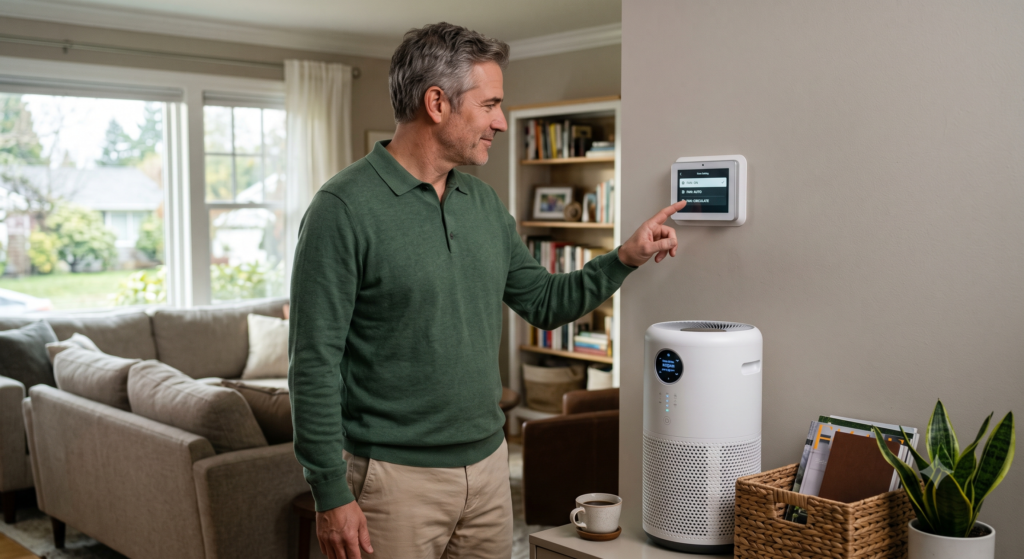
Thermostat fan settings, explained
The ON setting sounds like the obvious choice for cleaner air: more fan time should mean more filtering. That is partly true—but it leaves out filter efficiency, summer humidity, duct condition, blower energy, and the room where you are actually breathing.
Use AUTO for everyday operation—and ON for a specific reason
AUTO is the better default for most homes. It runs the indoor blower while the system is heating or cooling, limits unnecessary electricity use, and can reduce the chance of moisture on a cooling coil being blown back into the home.
ON can increase particle filtration because more air passes through the HVAC filter. It makes the most sense for a temporary smoke or particle event when the system is recirculating indoor air and equipped with an effective, compatible filter. If your thermostat offers CIRCULATE, that may provide a middle ground, but the schedule varies by thermostat.
Affiliate disclosure: This article includes affiliate links. If you buy through these links, BestSmartPurifiers.com may earn a commission at no extra cost to you. Recommendations are chosen for their relevance to the reader’s air-quality problem—not simply because a product is available.
First, Know What the Thermostat Fan Switch Controls
The thermostat’s fan control usually operates the indoor HVAC blower. It does not mean the outdoor air-conditioning compressor will run continuously.
AUTO
The blower normally runs only during a heating or cooling call. Air is filtered while conditioned air is moving.
ON
The blower continues circulating air between heating and cooling cycles. That creates more trips through the central filter.
CIRCULATE
On compatible controls, the blower runs for a minimum amount of time each hour. The exact timing and behavior are model-specific.
This distinction matters because air movement is not the same as air cleaning. The blower can only deliver a meaningful filtration benefit when the filter captures the particles you care about, fits without major bypass, and does not over-restrict the system.
Thermostat Fan ON vs. AUTO vs. CIRCULATE
| Setting | Filtration opportunity | Main tradeoff | Best use |
|---|---|---|---|
| AUTO | Filters while heating or cooling is operating | Fewer filter passes during mild weather or long off-cycles | Normal daily use, especially during humid cooling weather |
| ON | Provides the most continuous whole-home filter passes | More blower energy; possible humidity, noise, or duct-related concerns | Defined particle events with a compatible high-efficiency filter |
| CIRCULATE | Adds periodic filtering between conditioning cycles | Runtime varies, and it is not available on every thermostat | A compromise for mixing, comfort, and moderate added filtration |
Why ON Does Not Automatically Mean Cleaner Air
1. The filter decides what repeated circulation accomplishes
A basic filter may catch larger dust and debris while doing relatively little against finer particles. The U.S. Environmental Protection Agency explains that higher MERV ratings indicate better capture of specified particle sizes and recommends at least MERV 13 when upgrading—or the highest rating the system fan and filter slot can safely accommodate.
Do not force a thick or high-resistance filter into a system that was not designed for it. Reduced airflow can affect comfort and equipment performance. If the safe limit is unknown, check the equipment documentation or ask a qualified HVAC professional.
2. Humidity can change the answer during cooling season
When the air conditioner is cooling, moisture condenses on the cold indoor coil and drains away. In some systems, leaving the blower ON after the compressor stops can re-evaporate part of that moisture into the airstream. The Department of Energy’s Building America guidance recommends AUTO rather than ON for efficient operation in humid climates and warns about moisture on the coil returning to indoor air.
Watch the humidity—not just the purifier’s green light
If indoor relative humidity rises, the house feels clammy, or musty odors become stronger after switching the fan to ON, return to AUTO and investigate the moisture source. An air purifier does not remove meaningful amounts of water vapor. The site’s guide to musty basements and dehumidifiers explains why moisture correction often has to come first.
3. Ducts become part of the cleaning path
Continuous circulation uses the entire return-and-supply pathway. If return ducts are leaky, the filter rack has gaps, or sections pass through a dusty attic, crawlspace, or garage-adjacent area, extra runtime may expose a weakness rather than solve it. New dust streaks near vents, an odor that appears only when the blower starts, or a rapidly dirty filter deserves inspection.
4. More runtime has a cost
ON keeps the blower using electricity even when no heating or cooling is required. The impact varies widely by motor type, speed, duct resistance, utility rate, and thermostat logic. Newer variable-speed or electronically commutated blowers can use less power at low circulation speeds than older motors, but continuous operation is never automatically free.
When ON Is the Better Clean-Air Setting
The strongest case for ON is a temporary, known particle problem—not a vague hope that more airflow will fix every indoor-air concern.
- Wildfire smoke: The EPA advises using MERV 13, or as high as the system can handle, and running the central fan continuously to capture fine smoke particles.
- A short particle cleanup: After the source has stopped—such as dust stirred up by cleaning—additional filtered circulation may help bring suspended particles to the filter.
- A verified whole-home filtration plan: ON may be appropriate when an HVAC professional has confirmed the filter, blower speed, ductwork, fresh-air controls, and humidity strategy are designed for longer runtime.
Smoke-event exception
During wildfire smoke, confirm that the system is recirculating indoor air and close a controllable outdoor-air intake when appropriate for your equipment and local guidance. Pairing the HVAC filter with a properly sized portable purifier in one occupied room can deliver more focused protection. See how to run the AC and air purifier together during wildfire smoke.
When AUTO Is the Smarter Everyday Choice
AUTO usually wins when indoor air is stable, outdoor conditions are acceptable, and there is no specific particle event to manage. It is especially sensible when:
- the air conditioner is actively dehumidifying during warm, humid weather;
- the central filter is designed mainly for equipment protection;
- duct leakage or filter bypass has not been evaluated;
- blower noise is disruptive at night;
- you can clean the occupied room more directly with a properly sized portable purifier.
The EPA describes portable air cleaners and central HVAC filters as useful supplements to source control and clean-air ventilation—not replacements for those measures. Its overview of air cleaners and air filters in the home is a useful reality check when a single thermostat setting is being asked to solve too much.
The BestSmartPurifiers 60-Second Fan Decision
| What is happening? | Starting setting | What to check next |
|---|---|---|
| Normal day; no unusual particle event | AUTO | Filter condition, indoor humidity, and occupied-room air quality |
| Outdoor wildfire smoke; compatible high-efficiency filter installed | ON temporarily | Recirculation, outdoor-air intake, indoor PM2.5, filter loading, and indoor temperature |
| Light mixing or uneven temperatures without an emergency | CIRCULATE, if available | Thermostat runtime logic, energy use, noise, and humidity |
| Hot, humid weather; clammy rooms or musty odor | AUTO | Drainage, coil behavior, duct leakage, humidity control, and moisture sources |
| Bedroom needs cleaner air overnight | AUTO + room purifier | Smoke CADR, quiet-speed performance, placement, and replacement-filter cost |
Try a Controlled Test Instead of Guessing
- Name the problem. Is it smoke, pollen, visible dust, pet dander, odor, uneven temperature, or humidity? A particle filter cannot solve a moisture or gas-source problem.
- Read the installed filter. Record its exact dimensions, MERV rating, airflow arrow, installation date, and visible condition.
- Confirm compatibility. Check the system documentation or ask a qualified technician before moving to a higher-efficiency filter.
- Measure away from clean-air outlets. If you use a PM2.5 monitor, do not place it directly beside a supply register or purifier exhaust where it may sample an unusually clean pocket. Use the site’s three-point sensor placement check to compare the purifier, occupied area, and likely source side.
- Compare like with like. Test AUTO and your alternative setting during similar outdoor weather. Track indoor PM2.5, relative humidity, comfort, noise, and energy use—not just one number.
- Stop if the house gets clammy or airflow weakens. A lower particle reading is not a win if humidity rises, the coil freezes, rooms lose airflow, or the system shows signs of strain.
The Room-First Strategy Often Works Better
Central filtration offers broad coverage, but it depends on the blower, ducts, filter slot, and open pathways between rooms. A portable purifier can deliver higher-efficiency particle filtration directly to a bedroom, office, or other high-priority space without forcing the HVAC blower to run all day.
That is why the most balanced setup is often:
- AUTO for normal thermostat fan operation;
- the highest-efficiency central filter the system can safely accommodate;
- a properly sized portable purifier running consistently in the most-used room;
- ON temporarily when a defined event and system conditions justify it.
Room airflow still matters. If you also use a ceiling fan, read how ceiling-fan direction and purifier placement affect circulation.
Free 15-page workbook
Build the purifier plan around your room
The Smart Air Purifier Fit & Filter Planner helps you measure the actual room, build a practical CADR target, compare filter stages, verify replacement filters, and calculate first-year ownership cost before buying.
Get the Free Fit & Filter PlannerVerify the Filter Before You Order
Begin with the exact HVAC or purifier model and filter code. Confirm the dimensions, MERV rating, package quantity, compatibility notes, replacement interval, and return terms. Readers who have completed those checks can compare replacement-filter availability at FiltersFast.
If you are considering media cabinets, air cleaners, or other HVAC-integrated options rather than a simple one-inch filter change, you can explore Field Controls indoor-air solutions and discuss system resistance, airflow, controls, and installation with a qualified HVAC professional.
Four-question knowledge check
Can You Choose the Cleaner-Air Fan Setting?
Select one answer for each question, then check your score.
Reader Check-In
Which fan setting do you use, and what changed when you tested it? In the comments, include your climate, filter rating, thermostat mode, indoor humidity, and whether you measured particles in the occupied area. A real setup is more useful to another reader than “ON is always better” or “AUTO is always better.”
Frequently Asked Questions
Does leaving the thermostat fan ON reduce dust?
It may reduce some airborne particles because the system gets more filter passes. The result depends on filter efficiency, fit, airflow, duct condition, and the dust source. It will not remove dust already settled on surfaces, and ongoing sources still need to be controlled.
Should I leave the fan ON during wildfire smoke?
The EPA recommends running a central fan continuously during smoke when using MERV 13, or the highest-efficiency filter the system can safely handle. Confirm recirculation and system compatibility, monitor filter loading and indoor heat, and use a properly sized portable purifier in a priority room when possible.
Can the ON setting raise indoor humidity?
Yes, in some cooling systems. Continuous blower operation after the compressor stops may re-evaporate moisture from the wet indoor coil. The effect depends on equipment design, controls, climate, runtime, and drainage. AUTO is generally the safer starting point during humid cooling weather.
Is CIRCULATE better than AUTO?
It can be a useful compromise when you want more mixing and periodic filtration without continuous blower operation. However, thermostat algorithms differ, so check how many minutes per hour your model runs the fan and continue watching humidity, noise, and energy use.
Does a portable air purifier replace the HVAC filter?
No. The HVAC filter protects the system and may provide whole-home particle reduction; the portable purifier targets one room. Used together, they can provide broad baseline filtration plus stronger cleaning where people spend the most time.
Will a higher-MERV filter always make the air cleaner?
Not if it causes excessive airflow restriction or fits poorly. Choose at least MERV 13 when the system can accommodate it, or the highest compatible rating. Proper sizing, sealing, replacement, and system airflow are part of the result.
Final Verdict: AUTO Is the Default; ON Is a Tool
If the question is simply, “Which setting should I use every day?” choose AUTO. If the question is, “How can I get more particle filtration during a specific smoke or dust event?” ON may help—but only after the filter, airflow, recirculation, humidity, and duct pathway have been considered.
Cleaner air does not come from one switch. It comes from matching the air problem to the right combination of source control, clean-air ventilation, compatible central filtration, room-sized purification, and maintenance you will actually keep doing.