Back-to-school air-quality guide
A Small Purifier in the Corner Is Not Automatically a Classroom Air Plan
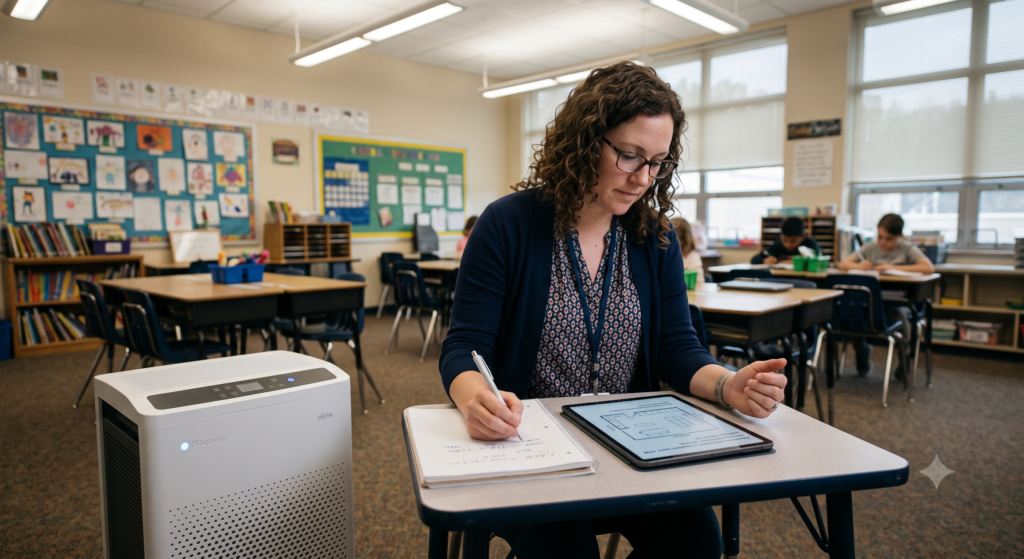
Classrooms are larger, busier, and noisier than bedrooms. They may contain 20 or more occupants, high ceilings, frequently opened doors, art materials, dry-erase products, printers, outdoor pollution, and an HVAC system the teacher does not control. A useful purifier must fit that real room—not a quiet product demonstration.
Quick answer
What makes an air purifier suitable for a classroom?
A classroom purifier needs enough verified clean-air delivery for the room’s volume, a tolerable operating noise, safe placement, accessible controls, and replacement filters the school can identify and fund.
It should supplement—not replace—working ventilation, compatible HVAC filtration, source control, cleaning, moisture correction, and school maintenance. A particle-filtering purifier does not bring in outdoor air or remove carbon dioxide generated by occupants.
For many classrooms, one appropriately selected high-capacity unit or two well-positioned units will be more practical than one undersized desktop purifier running quietly in a distant corner.
Ventilation vs. Portable Filtration
| Approach | What it can do | What it cannot prove or solve |
|---|---|---|
| Outdoor-air ventilation | Dilutes indoor-generated pollutants and carbon dioxide when outdoor air is suitable | May introduce smoke, pollen, heat, humidity, or traffic pollution when conditions are poor |
| HVAC filtration | Filters recirculated building air when the system is operating and compatible filters are installed | May not provide equal airflow or filtration to every classroom |
| Portable purifier | Adds particle-cleaning delivery inside one room or defined area | Does not provide outdoor air or directly remove occupant-generated carbon dioxide |
| Source control | Reduces pollution before it spreads through the room | Does not replace adequate ventilation or filtration |
| CO₂ monitor | May help identify ventilation patterns when correctly used and interpreted | Does not measure every pollutant or prove that particle filtration is adequate |
Eight Checks Before the Purifier Gets Plugged In
Measure room volume
Record length, width, and ceiling height. A 900-square-foot classroom with a 10-foot ceiling contains 9,000 cubic feet of air—not the 7,200 cubic feet assumed by an eight-foot-ceiling calculation.
Check verified clean-air delivery
Compare smoke CADR or another documented clean-air-delivery value. Do not size a classroom from a large “up to” coverage claim without checking its air-change assumption.
Listen at a useful speed
The purifier must move meaningful air without drowning out instruction, conversation, announcements, assistive listening, or quiet work.
Map the airflow
Keep intakes and outlets clear of bookcases, curtains, coats, boxes, desks, papers, displays, and wall-mounted equipment.
Protect the daily routine
The unit should not create a tripping hazard, block accessibility routes, invite students to climb on it, or direct a strong draft at one desk.
Verify replacement filters
Record the exact purifier model, filter code, package quantity, expected interval, current price, and approved purchasing source.
Review optional technologies
Avoid air-cleaning equipment designed to intentionally generate ozone in occupied spaces. Check ionizer, plasma, electrostatic, and UV claims carefully.
Assign maintenance ownership
Decide who inspects the pre-filter, orders replacements, documents changes, cleans surrounding vents, and confirms the unit was not unplugged or moved.
A Practical Classroom Sizing Example
Calculate room volume
A classroom measuring 30 feet by 30 feet with a 10-foot ceiling has a volume of 9,000 cubic feet.
Choose an air-cleaning goal
One air change per hour in this example requires 150 cubic feet per minute of equivalent clean-air delivery. Five air changes per hour would require 750 cubic feet per minute from the combined ventilation, HVAC filtration, and portable-air-cleaning strategy.
Account for existing building airflow
A portable purifier does not operate in isolation. Qualified school facilities staff should evaluate outdoor-air ventilation, HVAC airflow, filter efficiency, room pressure, occupancy, and operating schedules.
Compare one unit with two-unit coverage
Two quieter purifiers positioned in different parts of a long or crowded classroom may distribute clean air more evenly than one distant unit, provided their combined clean-air delivery meets the plan.
One Large Purifier or Two Smaller Units?
| Setup | Potential advantage | Main concern |
|---|---|---|
| One large purifier | Fewer filters, outlets, controls, and maintenance records | May create uneven distribution or excessive noise near one area |
| Two smaller purifiers | Can serve opposite sides of a long, divided, or furniture-heavy room | Requires two safe locations, two filter plans, and combined performance verification |
| Purifier plus HVAC filtration | Combines room-level filtration with a broader building approach | HVAC compatibility and actual room airflow must be confirmed |
| Purifier plus open windows | May combine filtration with outdoor-air dilution when conditions permit | Outdoor smoke, pollen, traffic pollution, temperature, noise, and security may limit window use |
Free 15-page workbook
Put the Classroom Measurements on Paper
The free Smart Air Purifier Fit & Filter Planner helps readers record room dimensions, estimate a CADR target, compare filter stages, verify replacement-filter compatibility, calculate first-year cost, and score final options.
For school use, add the classroom ceiling height, expected operating speed, approved placement, district purchasing requirements, and the staff member responsible for maintenance.
Get the Smart Air Purifier Fit & Filter PlannerWhat Teachers and Parents Can Ask
- How large is the classroom, including ceiling height?
- How much outdoor air does the room receive during occupied hours?
- Which HVAC filter is installed, and is the system operating as intended?
- What is the purifier’s verified smoke CADR or clean-air-delivery value?
- At which fan speed was that performance measured?
- Where will the unit sit without blocked airflow or safety conflicts?
- Who will inspect and replace its filters?
- Does the device use an ionizer or another optional electronic technology?
Make Replacement Filters Part of the School-Year Budget
A classroom purifier can run for long hours around paper dust, outdoor particles, art activities, dry-erase residue, frequent door openings, and high occupancy. Filters may need inspection more often than they would in a quiet bedroom.
Readers who have confirmed the exact purifier model and filter code can check replacement-filter availability through FiltersFast . Verify compatibility, package quantity, seller information, shipping time, specifications, and return terms before ordering.
Affiliate disclosure: This is an affiliate link. BestSmartPurifiers.com may earn a commission at no additional cost to the reader. Its inclusion does not change the classroom-sizing, filter-verification, safety, or reader-first standards used in this guide.
Four-question knowledge check
Can You Read a Classroom Air Plan?
Choose one answer for each question, then check your score.
Reader Check-In
Does your child’s classroom or your teaching space use a portable purifier? Share the room dimensions, ceiling height, purifier model, stated CADR, normal fan speed, placement, and filter-maintenance plan. Real classroom examples can help readers distinguish installed equipment from an operating air-quality strategy.
Frequently Asked Questions
Can one small air purifier clean an entire classroom?
Only when its verified clean-air delivery is sufficient for the classroom’s volume and operating conditions. Many desktop units are designed for much smaller rooms and may provide too little airflow for a full classroom.
Where should a classroom purifier be placed?
Use a stable, approved location with clear intake and outlet airflow. Avoid exits, walkways, heaters, sinks, curtains, bookcases, coat storage, paper displays, and areas where the unit can be knocked over or unplugged.
Should classroom windows remain open when a purifier is running?
The answer depends on outdoor air quality, weather, security, noise, building design, and school guidance. Suitable outdoor air can improve ventilation, while smoke, pollen, traffic pollution, heat, or humidity may make open windows less appropriate.
Does a HEPA purifier replace classroom ventilation?
No. HEPA filtration can reduce suitable airborne particles but does not supply outdoor air or directly remove occupant-generated carbon dioxide.
Should the purifier run only when students are present?
Operating schedules should follow school policy, equipment guidance, room use, noise needs, and the air-quality plan. Starting filtration before occupancy and continuing after certain activities may be useful when permitted.
Can parents donate any air purifier to a classroom?
Not necessarily. Schools may have purchasing, electrical, fire-safety, accessibility, noise, maintenance, technology, and approved-equipment requirements. Coordinate with the school before purchasing or donating equipment.
Continue learning
Related Best Smart Purifiers Resources
Smart Air Purifier Fit & Filter Planner
Measure the room, estimate CADR, compare filters, verify compatibility, and calculate first-year cost.
Get the free plannerComplete Air Purifier Guide
Review room sizing, filtration, airflow, placement, noise, smart controls, and maintenance.
Read the complete guideRoom Coverage Claims Explained
Learn why a large square-foot claim may be based on a slow air-change rate.
Understand coverage claimsSensor Placement Three-Point Check
See why the purifier may measure cleaner air than the occupied side of the room.
Check sensor placementUnderstanding Filter Technology
Compare HEPA-style particle filtration, activated carbon, ionizers, UV, and other approaches.
Compare technologiesTrue Cost of Ownership
Estimate replacement-filter, electricity, maintenance, noise, and long-term ownership costs.
Review long-term costsAuthoritative Guidance
Editorial note: BestSmartPurifiers.com reports on air-cleaning equipment from a consumer-research perspective. This guide is general education, not a school engineering specification or health assessment. Building systems, classroom layouts, occupancy, electrical capacity, fire codes, accessibility requirements, district policies, outdoor air, filters, and product specifications vary. Portable purifiers may reduce suitable airborne particles but cannot remove every pollutant or replace source control, working ventilation, compatible HVAC filtration, moisture correction, certified alarms, medical care, or qualified facilities and HVAC guidance.