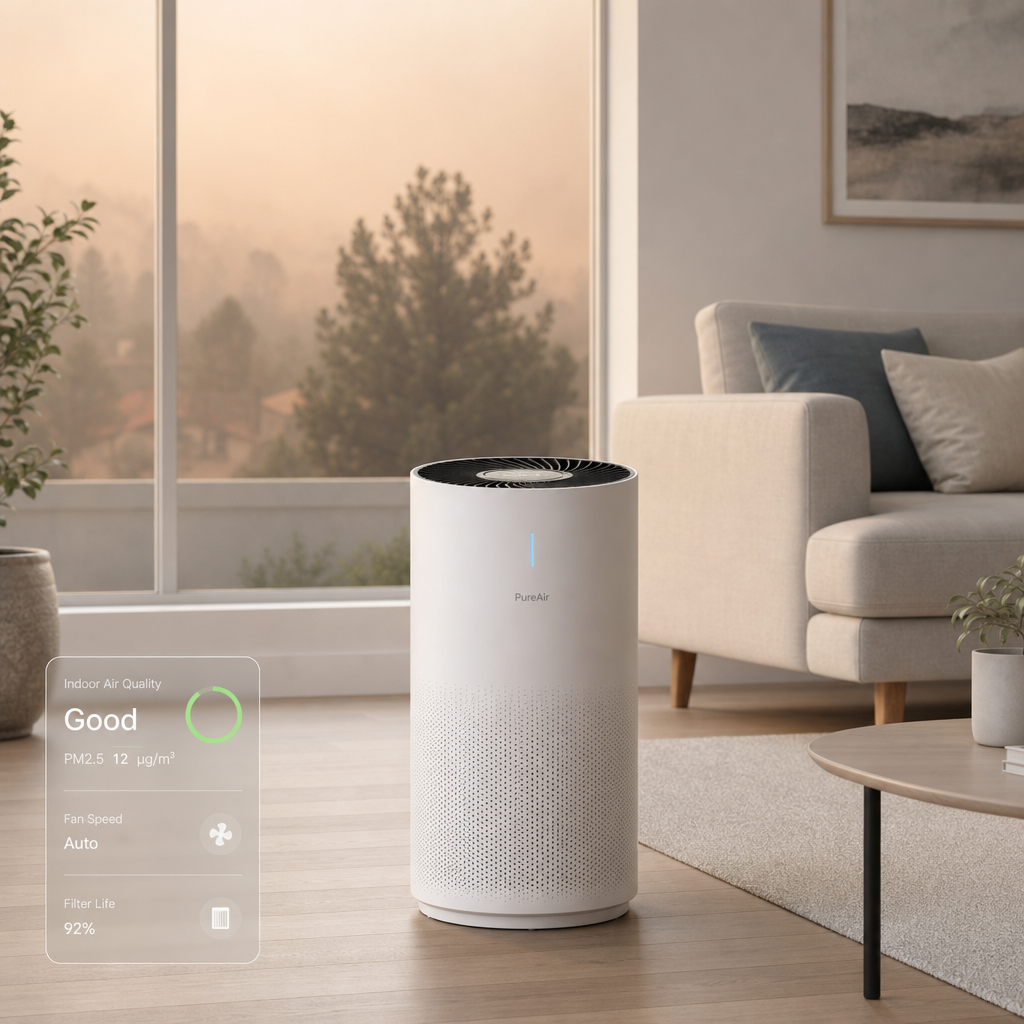
A properly sized air purifier can help reduce airborne smoke particles indoors, but filtration works best when it is prepared before the air-quality alert appears. The right setup starts with smoke CADR, room size, filter availability, placement, and a realistic plan for keeping outdoor smoke from entering.
Research-based guidance reviewed June 30, 2026. Air-quality conditions, product specifications, filter availability, and public-health recommendations can change.
Quick answer: For wildfire smoke, prioritize a portable air purifier with strong particle filtration, a verified smoke CADR appropriate for the room, low-ozone operation, affordable replacement filters, and enough airflow to run continuously. AHAM recommends using a smoke CADR approximately equal to the room’s square footage when wildfire smoke is a serious concern. A 200-square-foot room, for example, points toward a smoke CADR near 200.
Wildfire smoke has a frustrating habit of traveling farther than people expect. A fire can be hundreds or even thousands of miles away while fine particles drift into another region, enter buildings through small gaps, and raise indoor particle levels.
Closing the windows helps, but it does not create an airtight home. Smoke can still enter around doors, through ventilation systems, when people come and go, or through openings in the building envelope. Once indoors, fine smoke particles may remain suspended in the air or settle onto surfaces where activity can stir them up again.
This is where a portable air purifier can become useful. It cannot stop a wildfire, remove every gas in smoke, or make an unsafe building completely safe. It can, however, lower airborne particle concentrations in the room where it operates when it is correctly sized, positioned, maintained, and used consistently.
The important phrase is correctly sized. A compact purifier with an impressive app cannot compensate for weak airflow in a large room. During smoke season, clean-air delivery matters more than a long list of connected features.
Why Wildfire Smoke Requires a Different Air Purifier Strategy
Everyday dust control and heavy wildfire smoke are not the same operating challenge. Smoke can create a much larger fine-particle load, and a purifier may need to run harder and longer than it does during ordinary conditions.
Wildfire smoke is also a mixture rather than a single pollutant. It can include fine particles, gases, water vapor, and combustion byproducts. Most residential portable air purifiers are best at reducing the particle portion of that mixture. Activated carbon or other gas-focused media may help with certain smoke odors and gases, but performance depends heavily on how much media the unit contains and how quickly it becomes saturated.
That distinction matters when evaluating a product labeled “smoke purifier.” A thin carbon-coated sheet may provide some odor support, but it should not be treated as proof that the purifier can remove every gas associated with smoke.
For a deeper explanation of these different filter jobs, read Understanding Air Purifier Technology: HEPA, Activated Carbon, and Beyond.
The Four-Part Wildfire Smoke Buying Check
Choose the room
Measure one closed or closable room where household members can spend time during a smoke event.
Match smoke CADR
For significant wildfire smoke, use a smoke CADR approximately equal to the room’s square footage.
Verify filtration
Prioritize effective particle filtration, clear specifications, and a design that does not intentionally produce ozone.
Prepare maintenance
Confirm the replacement-filter code, price, availability, and expected smoke-season replacement needs.
How Much Smoke CADR Do You Need?
CADR stands for Clean Air Delivery Rate. It combines airflow and particle-removal performance into a number that helps buyers compare how quickly a purifier can deliver filtered air.
Air purifiers may display separate CADR ratings for smoke, dust, and pollen. For wildfire preparation, the smoke CADR is the most useful of the three because smoke particles are relatively small and challenging to remove.
Under ordinary conditions, a commonly used rule is to choose a smoke CADR equal to at least two-thirds of the room’s square footage. Wildfire smoke calls for a more aggressive target. The Association of Home Appliance Manufacturers recommends a smoke CADR approximately equal to the room area in square feet when a home is affected by wildfire smoke.
| Room size | Approximate smoke-season target | What to remember |
|---|---|---|
| 100 square feet | Smoke CADR near 100 | A compact bedroom or office may still need substantial airflow during heavy smoke. |
| 150 square feet | Smoke CADR near 150 | Check whether the published number is a verified smoke CADR rather than a general airflow claim. |
| 200 square feet | Smoke CADR near 200 | A purifier with additional capacity may run more quietly at a useful cleaning rate. |
| 300 square feet | Smoke CADR near 300 | Large bedrooms and family rooms require more clean-air delivery than many compact units provide. |
| 400 square feet | Smoke CADR near 400 | Consider a high-capacity unit or carefully positioned multiple-unit setup. |
| Open floor plan | Calculate the connected area and ceiling height | An open layout can be difficult to protect as effectively as one closed room. |
Do Not Ignore Ceiling Height
Most simple room-size calculations assume a ceiling close to eight feet. A vaulted ceiling, loft, open stairway, or connected room increases the volume of air the purifier must process.
When ceilings are higher than eight feet, choose more capacity than the floor-area calculation alone suggests. The same is true when doors remain open, people frequently enter and leave, or smoke infiltration is difficult to control.
Be Careful With Huge “Coverage” Claims
A purifier may advertise coverage of 1,000, 1,500, or even 2,000 square feet, but that number may represent only one air change per hour under ideal conditions. That may not be enough during a smoke event.
Look for the actual smoke CADR, the air-change assumptions behind the room claim, and independent verification when available. A large room-size number without a supporting smoke CADR should not be the deciding factor.
HEPA, Carbon, and Wildfire Smoke: What Each Layer Does
| Filter or feature | What it may help reduce | Important limitation |
|---|---|---|
| HEPA or high-efficiency particle filter | Fine airborne smoke particles, ash particles, dust, pollen, and other particulate matter | It does not directly remove most gases or odors. |
| Activated carbon | Some smoke odors and certain gases | Results vary with carbon amount, media design, airflow, humidity, pollutant type, and saturation. |
| Pre-filter | Larger dust, hair, fibers, and debris | It does not replace the main fine-particle filter. |
| PM2.5 sensor | Detecting changes in fine-particle concentrations near the purifier | It measures conditions; it does not clean the air itself. |
| Ionization or plasma | May charge particles in some designs | Evaluate ozone emissions and whether the feature can be disabled. |
| App and automation | Schedules, alerts, remote control, trends, and filter reminders | Convenience cannot compensate for weak CADR or an undersized purifier. |
HEPA Is Primarily a Particle Solution
Fine-particle filtration should be the first priority for wildfire smoke. A well-sealed purifier that moves enough air through a capable particle filter can reduce airborne particles in the room where it operates.
However, the filter label is not the entire performance story. A strong filter installed in a low-airflow machine may still deliver too little clean air for the room. That is why the purifier’s smoke CADR matters alongside the filter specification.
Carbon Can Help, but the Amount Matters
Activated carbon works through adsorption, allowing certain gas and odor molecules to adhere to its internal surface. A deeper carbon bed generally offers more potential capacity than a thin carbon-coated sheet, although performance still varies by pollutant and design.
Smoke can exhaust carbon media more quickly than ordinary household odors. When the smoke smell begins returning even though the particle filter still looks usable, the carbon portion may be saturated.
How to Create a Cleaner-Air Room
Trying to clean an entire open house during a severe smoke event can overwhelm a single portable purifier. A more practical approach is to choose one room that can be closed off and concentrate your filtration there.
The room should be large enough for the people who need to use it and comfortable enough for extended periods. A bedroom is often a practical starting point because it has a door, provides a place to rest, and may have fewer exterior openings than a large living area.
Cleaner-Air Room Checklist
- Choose a closable room. Select a bedroom, office, or other comfortable room with a door.
- Close windows and exterior doors. Reduce the paths outdoor smoke can use to enter.
- Set HVAC to recirculate when appropriate. Avoid pulling smoky outdoor air into the home.
- Place a properly sized purifier in the room. Keep the intake and outlet clear.
- Run the purifier continuously. Use the highest tolerable fan speed during significant smoke.
- Reduce indoor particle sources. Avoid candles, incense, smoking, aerosol sprays, frying, and broiling.
- Keep the room cool. Heat can create a separate safety risk during summer smoke events.
- Check the outdoor AQI. Ventilate again when outdoor conditions improve and local guidance says it is appropriate.
Give the Purifier Space to Move Air
A purifier cannot clean air that cannot reach its intake. Do not wedge the machine tightly between furniture, hide it behind a curtain, or push it into a corner unless the manufacturer specifically designed it for that placement.
Follow the manufacturer’s clearance instructions. In general, the intake and clean-air outlet should remain unobstructed, and the purifier should sit where air can circulate through the occupied part of the room.
Run It Before the Room Smells Smoky
Odor is not a reliable early-warning system for fine particles. By the time smoke is easy to smell indoors, particle levels may already have risen.
Watch trusted outdoor-air information, such as the AirNow Fire and Smoke Map, and begin running the purifier before outdoor conditions deteriorate when smoke is expected in your area.
Should Auto Mode Be Used During Wildfire Smoke?
Auto mode can be useful during ordinary daily operation, but it should not always be trusted as the only smoke-season setting.
A purifier’s onboard sensor measures air near the unit, not every corner of the room. Some auto modes are intentionally conservative to reduce noise and energy use. Others lower the fan speed quickly when the nearby sensor reading improves, even though smoke may still be entering elsewhere.
During a substantial smoke event, continuous operation at a higher manual speed may provide more predictable particle removal. EPA guidance recommends running a correctly sized portable air cleaner continuously on the highest fan setting when possible in a cleaner-air room.
Smart features are still useful. An app can help you:
- Start the purifier before arriving home.
- Increase the fan speed when outdoor air quality worsens.
- Review particle trends before and after doors are opened.
- Schedule stronger filtration before bedtime.
- Receive filter-maintenance reminders.
- Confirm that the unit did not lose power or disconnect.
For more on sensor-led automation, read the Smart Air Purifiers Guide to Automation, Sensors, and Home Integration.
Do You Need a New Filter Before Smoke Season?
Filter availability becomes especially important when smoke affects a large region. A purifier that uses a difficult-to-find cartridge may become less useful if the filter loads early and a replacement is backordered.
Before smoke season or an approaching smoke event, check:
- The exact purifier model number.
- The manufacturer’s replacement-filter code.
- Whether the filter is a single cartridge or several separate pieces.
- The current price of a complete replacement set.
- Whether the carbon stage is included.
- Whether trusted sellers currently have the filter in stock.
- The manufacturer’s storage instructions for unopened filters.
Heavy smoke can shorten filter life. EPA guidance notes that portable and HVAC filters may need to be replaced more frequently during smoke events, especially when they appear heavily soiled or airflow drops.
Our guide to the true cost of owning a smart purifier explains how filter prices, energy use, and maintenance can change the long-term value of a machine.
Check Your Replacement Filter Before the Smoke Arrives
Keep the purifier model number and filter code beside you while comparing listings. Similar-looking cartridges are not always interchangeable.
Compare Replacement Filter OptionsAffiliate link. Compatibility, price, and availability can change. Verify the exact purifier model and filter code before ordering.
Can Your HVAC Filter Help With Wildfire Smoke?
A central HVAC filter can provide broader support when the system is operating, while a portable purifier can concentrate filtration in a priority room. For many homes, using both creates a stronger layered approach.
EPA recommends considering a MERV 13 filter, or the highest-efficiency filter the system can safely accommodate. However, not every HVAC system is designed for every high-efficiency filter. A filter that creates too much airflow resistance can reduce system performance or cause equipment problems.
Check the equipment manual or consult a qualified HVAC professional before changing to a more restrictive filter. Make sure the filter fits the slot correctly without large gaps around its edges.
During smoke events, EPA also recommends using recirculation mode when appropriate rather than intentionally pulling smoky outdoor air into the home. Some systems may allow the circulation fan to run more frequently, but operating decisions should account for equipment design, energy use, indoor temperature, and professional guidance.
See Air Purifiers vs. Air Filters: What’s the Difference and Which Is Better? for a clearer comparison of room-level and whole-home filtration.
What About a DIY Box-Fan Air Cleaner?
A well-built DIY air cleaner can provide temporary particle filtration when a commercial purifier is unavailable or unaffordable. These designs usually combine a newer box fan with one or more high-efficiency HVAC filters.
EPA treats DIY units as temporary alternatives rather than permanent replacements for commercial products with known and standardized performance. Results depend on filter quality, fan design, sealing, assembly, and maintenance.
EPA safety guidance includes using a newer box fan—generally a 2012 or later model—with a recognized UL or ETL safety marking, following the fan manufacturer’s instructions, avoiding damaged equipment and extension cords, and maintaining working smoke detectors.
A MERV 13 or higher filter is generally preferred when the fan can handle it. The airflow arrows on the filter should face the correct direction, and gaps between the fan and filter should be sealed. Multi-filter designs and a cardboard shroud may improve airflow and filtration.
Common Wildfire Smoke Air Purifier Mistakes
Buying According to Marketing Coverage Alone
A huge coverage number can be misleading when it represents only one air change per hour. Compare the smoke CADR and the assumptions behind the claimed room size.
Waiting Until Smoke Is Already Indoors
Purifiers and replacement filters can become harder to find during a widespread smoke event. Prepare the purifier, filters, room, and HVAC settings before they are urgently needed.
Using a Purifier That Is Too Small
An undersized machine may need to run at maximum speed while still delivering too little clean air. Extra capacity can provide faster particle reduction and more flexibility with noise.
Expecting HEPA to Remove Every Smoke Odor
HEPA filtration focuses on particles. Smoke odors and gases require meaningful activated carbon or other gas-focused media, and even those filters have limits.
Letting Auto Mode Stay Too Quiet
An energy-saving auto mode may not move enough air during severe smoke. Use a stronger manual setting when conditions require more predictable filtration.
Blocking the Intake
Furniture, walls, curtains, and clutter can restrict airflow. Give the purifier the clearance specified by its manufacturer.
Ignoring the Filter After the Alert Resets
Smoke can load filters faster than normal. Inspect the filter when airflow drops, the filter becomes visibly dirty, or smoke odor returns.
Creating More Particles Indoors
Frying, broiling, candles, incense, smoking, vaping, aerosols, and non-HEPA vacuuming can add particles when you are trying to keep the room clean.
A Simple Smoke-Season Action Plan
| When | What to do | Why it matters |
|---|---|---|
| Before smoke season | Measure the cleaner-air room, verify smoke CADR, order the correct replacement filter, and review HVAC controls. | Preparation reduces rushed purchases and compatibility mistakes. |
| When smoke is forecast | Close windows, reduce outdoor-air intake, install a clean filter, and begin running the purifier. | Starting early may prevent particles from accumulating as quickly. |
| During poor outdoor air | Run the purifier continuously, use a higher fan speed, limit door opening, and avoid creating indoor particles. | Continuous clean-air delivery helps counter ongoing smoke infiltration. |
| After conditions improve | Follow local guidance, ventilate when outdoor air is cleaner, inspect filters, wipe settled dust, and review sensor trends. | The home may need fresh-air exchange and post-event maintenance. |
What to Look for in a Wildfire Smoke Air Purifier
- A verified smoke CADR: Prefer a clear performance number over a vague maximum-coverage claim.
- Enough capacity: For significant smoke, target a smoke CADR close to the room’s square footage.
- Strong particle filtration: Look for a clearly identified high-efficiency filter and a well-sealed airflow path.
- Meaningful carbon: Consider the amount and design of gas-focused media when smoke odor matters.
- Low-ozone operation: Avoid devices designed to intentionally generate ozone in occupied spaces.
- Manageable high-speed noise: The purifier needs to run at a useful speed, not merely look quiet on its lowest setting.
- Available replacement filters: Verify the filter code, cost, seller availability, and complete replacement set.
- Reasonable energy use: Smoke filtration may require continuous operation.
- Clear sensor readings: Numeric PM2.5 data can be more informative than a broad color indicator alone.
- Manual fan control: Make sure you can override a quiet or conservative auto mode.
The Best Purifier Is the One You Can Keep Running
A purifier does not need artificial intelligence, a touchscreen, or a dozen home-automation integrations to reduce smoke particles. It needs enough clean-air delivery for the room, effective particle filtration, clear airflow, and a usable replacement-filter supply.
Smart features earn their place when they make that core performance easier to use. A reliable app, PM2.5 reading, schedule, filter reminder, and remote fan control can help you respond sooner and operate the machine more consistently.
But the order matters:
- Choose the room.
- Calculate the required smoke CADR.
- Evaluate particle and carbon filtration.
- Check noise and energy use at practical fan speeds.
- Confirm replacement-filter availability.
- Add smart features last.
That approach protects you from paying extra for convenience features attached to a purifier that is too weak for the room.
Frequently Asked Questions About Air Purifiers and Wildfire Smoke
What type of air purifier is best for wildfire smoke?
Prioritize a purifier with effective particle filtration, a verified smoke CADR appropriate for the room, low-ozone operation, manageable noise at useful fan speeds, and replacement filters that are affordable and readily available. Activated carbon may provide additional support for certain smoke odors and gases.
What smoke CADR do I need for wildfire smoke?
AHAM recommends choosing a smoke CADR approximately equal to the room’s square footage when wildfire smoke is a serious concern. A 200-square-foot room therefore points toward a smoke CADR near 200. Choose more capacity for high ceilings, open layouts, or heavy smoke infiltration.
Should I run an air purifier all day during wildfire smoke?
EPA guidance recommends continuous operation in a cleaner-air room during smoke conditions, using the highest fan setting you can reasonably tolerate. Continuous filtration is generally more effective than running the purifier only when smoke becomes visible or easy to smell.
Does a HEPA filter remove wildfire smoke?
A properly sized purifier with effective HEPA or high-efficiency particle filtration can reduce fine airborne smoke particles. HEPA does not directly remove most gases or odors, so meaningful activated carbon or other gas-focused media may be needed for additional odor support.
Can an air purifier remove the smell of wildfire smoke?
Activated carbon may reduce some smoke odors, but results depend on the amount and type of carbon, airflow, pollutant mixture, humidity, and how saturated the media becomes. A thin carbon sheet may provide limited support compared with a deeper carbon bed.
Should I use auto mode during wildfire smoke?
Auto mode can be convenient, but some purifiers lower their fan speed too aggressively. During significant smoke, a higher manual speed may deliver more consistent filtration. Monitor outdoor conditions, indoor particle readings, noise, and filter condition.
Will closing the windows keep all wildfire smoke outside?
Closing windows and doors can reduce smoke entry, but most homes are not airtight. Smoke may enter through gaps, ventilation systems, door opening, and other parts of the building. Room-level filtration and appropriate HVAC settings can provide additional protection.
How often should filters be replaced during wildfire smoke?
Follow the manufacturer’s instructions, but inspect filters more frequently during smoke events. Heavy smoke may shorten filter life. Reduced airflow, visible loading, recurring smoke odor, or a heavily soiled filter may indicate that replacement is needed sooner.
- U.S. EPA: Create a Clean Room During a Wildfire
- U.S. EPA: Wildfires and Indoor Air Quality
- AHAM Verifide: Using an Air Cleaner to Manage Wildfire Smoke
- AirNow Fire and Smoke Map
- U.S. EPA: Air Cleaners and Air Filters in the Home
Editorial note: BestSmartPurifiers.com uses a research-first reporting approach. Unless an article clearly states otherwise, product coverage should not be understood as hands-on laboratory testing. Product specifications, certifications, filters, app features, prices, and availability can change.
Safety note: An air purifier is one part of a wildfire-smoke plan. Follow local emergency instructions, evacuation orders, public-health guidance, and qualified medical or HVAC advice when appropriate.