AI-powered air purifiers are becoming one of the clearest smart-home trends of 2026 because they promise something older purifiers never could: air cleaning that reacts to real life.
Instead of running on one speed all day, the newest smart purifiers can read air-quality changes, adjust fan speed, follow room activity, send alerts, and work with connected-home routines. That does not mean AI replaces a good filter. It means the purifier is getting better at knowing when, where, and how hard to clean.
The old air purifier buying question was simple: “Does it have a HEPA filter?” In 2026, that question is no longer enough. Homeowners are now asking whether a purifier can sense particles, respond to cooking fumes, track filter life, lower energy use, connect to a smart home platform, and stay quiet while people sleep.
That shift is why AI-powered purifiers are getting so much attention. They fit the way modern homes actually work. A kitchen can spike with particles after searing food. A bedroom can need quieter overnight cleaning. A living room can fill with pet dander during the day. A basement may need better whole-home air support, not just a tabletop device.
The best AI-powered purifiers are not magic boxes. They are smarter control systems built around proven air-cleaning basics. The winning formula is still strong filtration, proper room sizing, verified CADR, safe operation, and affordable replacement filters. AI simply helps the purifier use those strengths at the right time.
Smart Air Quality Knowledge Check
Before choosing an AI-powered purifier, ask yourself these quick questions. They reveal whether the “smart” features are actually useful or just expensive decoration.
- Do you know the square footage of the room where the purifier will run most often?
- Have you checked the purifier’s CADR, not just the brand’s claimed room size?
- Does the purifier use a particle filter, a carbon filter, or both?
- Can you easily find replacement filters at a fair price?
- Does the purifier improve your routine, or does it simply add another app to your phone?
The Real Reason AI Purifiers Are Winning Attention
AI-powered purifiers are rising because indoor air is no longer viewed as invisible. People now want to see what is happening in their homes. They want real-time air-quality readings, automatic adjustments, and simple answers.
That matters because indoor air can change quickly. Cooking, cleaning sprays, candles, pets, outdoor smoke, pollen, dust, and poor ventilation can all affect the air inside a home. The EPA still frames source control and ventilation as primary ways to improve indoor air, with filtration acting as a helpful supplement. That point is important. A purifier can help reduce airborne particles and some pollutants, but it cannot fix every indoor-air problem by itself.
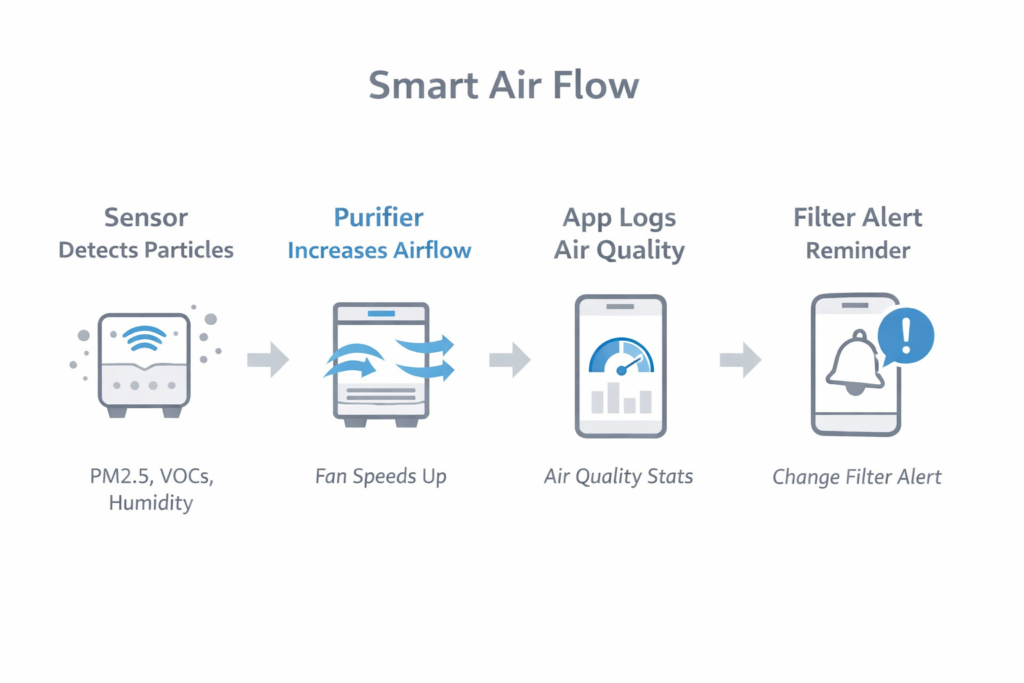
AI fits into this picture by helping a purifier react faster. When a sensor detects a particle spike, an automatic mode can raise fan speed. When air quality improves, the purifier can slow down. When the room is empty, some systems can reduce output. When filter life drops, the app can remind the owner before performance falls off.
This is the smart-home trend in plain English: people want air care that behaves less like a fan and more like a responsive home appliance.
What “AI-Powered” Actually Means in an Air Purifier
The term “AI-powered purifier” can mean several different things. Some brands use AI to describe adaptive fan speed. Others use it for learning routines, air-quality prediction, room presence detection, or app-based automation. That makes the label powerful for marketing, but confusing for shoppers.
For most homes, the most useful AI features fall into five categories.
Adaptive cleaning
The purifier adjusts fan speed based on sensor readings instead of running at one fixed level all day.
Predictive routines
The purifier learns or follows household patterns, such as stronger cleaning during cooking hours or quieter operation at night.
Smarter alerts
The app can notify users about filter life, air-quality spikes, high particle readings, or maintenance needs.
Occupancy awareness
Some newer designs can respond to whether people are in the room, helping direct airflow or reduce wasted operation.
Smart-home routines
Connected purifiers can work with other devices, such as sensors, thermostats, smart plugs, or voice assistants.
Energy-aware operation
A smart purifier can reduce power use by running harder only when air quality demands it.
The key is not whether the box says “AI.” The key is whether the purifier makes better decisions than a basic manual unit.
AI Does Not Replace CADR, HEPA, or Carbon Filtration
This is where many buyers get misled. AI can make a purifier easier to use, but it does not automatically make the machine better at cleaning air.
A purifier still needs enough clean-air delivery for the room. That is where CADR matters. CADR stands for Clean Air Delivery Rate. In simple terms, it helps show how quickly a purifier can deliver filtered air for common particle types such as smoke, dust, and pollen. AHAM’s common sizing rule says the smoke CADR should be at least two-thirds of the room’s square footage. For wildfire smoke, stronger sizing may be needed.
Filter type also matters. A particle filter is important for dust, pollen, pet dander, and smoke particles. Activated carbon can help with certain gases and odors, but carbon performance depends heavily on the amount and quality of carbon used. A thin carbon sheet is not the same as a deep carbon bed.
That is why the smartest purifier on the shelf can still be the wrong choice if it is undersized, expensive to maintain, noisy on useful speeds, or vague about filtration.
| Feature | Why It Matters | What To Watch For |
|---|---|---|
| CADR | Shows how quickly the purifier can deliver clean air for the room. | Avoid relying only on oversized room claims without checking CADR. |
| Particle filtration | Helps with airborne particles such as pollen, dust, smoke particles, and pet dander. | Look for clear filter specifications, not vague “advanced filtration” language. |
| Activated carbon | Helps reduce some odors and gases when there is enough carbon media. | Thin carbon layers may have limited odor capacity. |
| Smart sensors | Allow automatic fan-speed changes when pollution levels rise. | Sensor quality and placement can vary by model. |
| AI automation | Can improve timing, comfort, noise, and energy use. | AI is not a substitute for proper room sizing or good filtration. |
| Replacement filters | Long-term cost depends on filter availability and price. | Check replacement filter cost before buying the purifier. |
Filter replacement is where smart purifier ownership gets real
A purifier can have excellent sensors and automation, but it still needs clean, compatible filters to perform well. Before buying any smart purifier, check the long-term replacement-filter path.
Why 2026 Is Different From Earlier Smart Purifier Years
Earlier smart purifiers often felt like basic purifiers with Wi-Fi added. They could turn on from an app. They could show a colored air-quality ring. Some worked with voice assistants. That was useful, but it was not always transformative.
The 2026 trend is different because smart-home expectations have changed. People are no longer impressed by an app alone. They want devices that work together, make fewer demands, and respond automatically. A purifier that only adds remote control may feel outdated next to one that can connect to routines, react to sensors, or adjust based on real room activity.
The Matter smart-home standard is part of this broader shift. Matter is designed to improve interoperability between smart-home devices from different brands. Matter 1.2 added support for air-quality sensors, and later updates continued expanding smart-home capability. That does not mean every purifier is Matter-compatible today, but it does show where the smart-home category is heading: fewer isolated gadgets and more connected systems.
For air purifiers, that future could mean more useful routines. A purifier might respond when a separate air-quality sensor detects a spike. It might coordinate with a smart thermostat or ventilation routine. It might run stronger after cooking and quieter during sleep. It might help the home react to air quality instead of waiting for the homeowner to notice a problem.
That is why AI-powered purifiers are so Discover-friendly as a topic. They sit at the intersection of wellness, smart homes, energy savings, automation, and practical household comfort.
The Best AI Purifier Features for Real Homes
Not every AI feature deserves equal attention. Some features are genuinely useful. Others are mostly marketing. Here is how to separate the practical from the flashy.
1. Automatic mode that actually responds fast
A good automatic mode should react when air quality changes. If you cook, vacuum, open a window during pollen season, or bring in outdoor smoke particles on clothing, the purifier should notice a change and increase airflow. Once the air improves, it should slow down.
This matters because many people do not run purifiers on high long enough. High speed is often loud. Automatic mode can bridge that gap by running harder when needed and quieter when possible.
2. Clear air-quality readings
A useful smart purifier should show more than a vague green, yellow, or red light. Color rings are helpful at a glance, but numbers and pollutant categories are better. Look for clear particle readings, app history, and simple explanations.
However, do not treat consumer purifier sensors as laboratory instruments. They are best used as trend indicators. If the reading jumps after cooking, that tells you something changed. If the reading improves after filtration, that also tells you something useful.
3. Quiet sleep intelligence
Bedroom air purification is one of the biggest reasons people buy smart purifiers. But a purifier that is too loud will often get turned off. AI-style scheduling and sleep modes can help by lowering brightness, reducing fan noise, and cleaning more aggressively before bedtime.
The ideal bedroom setup is not always “run low forever.” A better strategy may be to clean the room before sleep, then maintain quietly overnight.
4. Filter-life tracking that is easy to trust
Smart filter alerts are helpful when they are based on use, fan speed, and operating time. They are less helpful when they simply count calendar days. A filter used in a dusty, pet-heavy home may load faster than one used in a cleaner room.
Before buying, check whether replacement filters are easy to find. A low purifier price can become less attractive if filters are expensive, hard to source, or frequently out of stock.
5. Smart-home compatibility that solves a real problem
Voice control and app control are convenient, but the best smart-home feature is automation that reduces work. For example, a purifier that runs stronger when indoor particles rise is more useful than one that simply responds when you say, “Turn on the purifier.”
If you are building a connected home, compare Wi-Fi-only models with Matter-ready or Matter-compatible options. For a deeper breakdown, read our guide to Matter vs. Wi-Fi purifiers.
Where AI Purifiers Can Go Wrong
AI-powered purifiers sound exciting, but shoppers should keep a clear head. The wrong smart purifier can cost more while cleaning less.
The first risk is overpaying for automation without enough airflow. A purifier with weak CADR and fancy app features may still be a poor fit for a larger room. The second risk is buying a unit with vague filtration claims. “Advanced purification” sounds good, but buyers should still look for specific information about particle filtration, carbon filtration, room size, and replacement filters.
The third risk is ignoring ozone safety. Some electronic air-cleaning technologies can raise questions about ozone emissions. CARB maintains a certified air-cleaning-device program and requires covered indoor air cleaners sold in California to meet safety and ozone-emission requirements. Even if you do not live in California, checking for CARB certification can be a helpful safety habit.
The fourth risk is privacy. As purifiers add presence detection, cameras, microphones, app accounts, and cloud features, buyers should read the privacy policy. A feature that tracks room activity should clearly explain what is detected, what is stored, and whether data stays on the device.
AI Purifiers and Whole-Home Air Quality
Portable AI-powered purifiers are useful, but they are still room-based appliances. They clean the room or area where they operate. They do not automatically solve air quality across an entire house.
That is why 2026 smart-home air quality is becoming a two-layer conversation. The first layer is portable purification in high-use rooms such as bedrooms, offices, nurseries, kitchens, and living rooms. The second layer is whole-home air support through HVAC filtration, ventilation habits, humidity management, and source control.
For homeowners who already think in terms of smart thermostats, HVAC systems, and connected sensors, this is where the category gets interesting. A smart purifier can handle a bedroom or office. Better HVAC filtration and whole-home air-quality upgrades can support the rest of the house.
That does not mean every home needs a major HVAC project. It means buyers should avoid expecting one small purifier to clean an entire home. Start with the room where the air problem matters most. Then consider whether your HVAC system, filters, and ventilation habits also need attention.
Thinking beyond one room?
Portable purifiers can help in targeted spaces, but some homes may also benefit from HVAC filter upgrades or whole-home indoor-air-quality support.
How To Shop for an AI-Powered Purifier in 2026
Buying an AI-powered purifier should not start with the app. It should start with the room.
Measure the room or estimate the square footage. Then compare the purifier’s CADR and room-size guidance. After that, look at filter type. If your main concern is pollen, dust, smoke particles, or pet dander, particle filtration matters most. If your concern is odors from cooking, pets, smoke, or household sources, activated carbon becomes more important.
Next, check the replacement filter cost. This is one of the most overlooked parts of purifier ownership. A purifier is not a one-time purchase. It is an appliance with ongoing maintenance. If filters are hard to find, expensive, or confusing, the purifier may become a poor long-term choice.
Only after those basics are clear should you compare AI features. The best smart features are the ones you will actually use. For some homes, that means automatic mode and filter alerts. For others, it means Matter compatibility, voice control, or sensor-based routines. For a bedroom, quiet night mode may matter more than advanced app charts.
| Buyer Type | Best AI Features To Look For | Do Not Ignore |
|---|---|---|
| Allergy-focused homeowner | Auto mode, particle sensor, app history, strong bedroom scheduling. | CADR, filter quality, room size, and filter availability. |
| Pet owner | Adaptive fan speed, washable pre-filter alerts, odor-aware settings. | Carbon capacity, hair/dander pre-filtration, replacement filter cost. |
| Smart-home builder | Matter readiness, routines, sensor triggers, voice assistant support. | Privacy settings, local control options, and platform compatibility. |
| Bedroom user | Quiet sleep mode, display dimming, schedule learning, pre-clean routine. | Noise level on effective speeds and light pollution from displays. |
| Cooking odor concern | Fast particle response, odor/VOC trend alerts, kitchen-adjacent routines. | Activated carbon amount and ventilation habits. |
Are AI-Powered Purifiers Worth It?
AI-powered purifiers can be worth it when the smart features help the purifier run more effectively in real life. They are especially useful for people who forget to adjust fan speed, want cleaner bedroom routines, track air quality through an app, or already use smart-home automation.
They may not be worth the extra cost if you only need a simple purifier for one room and you are comfortable running it manually. In that case, a high-CADR purifier with reliable filters may deliver better value than a premium smart model.
The practical answer is this: buy the purifier first and the AI second. A smart purifier should still be a good purifier when the app is ignored. If the filtration, CADR, room fit, noise level, and filter cost make sense, then AI features can be a major bonus.
Why This Trend Is Bigger Than Air Purifiers
The rise of AI-powered purifiers reflects a broader change in smart homes. People are tired of devices that only add control. They want devices that add judgment.
A connected purifier that simply turns on from a phone is convenient. A responsive purifier that notices air-quality changes, adjusts speed, protects sleep comfort, reminds you about filters, and fits into a smart-home routine is more valuable.
That is why air purifiers are becoming part of the wellness-tech conversation. They are not just appliances sitting in the corner. They are becoming home-health dashboards, comfort tools, and automation triggers.
Still, the most trustworthy way to shop is to stay grounded. Look for proven filtration. Match CADR to the room. Avoid ozone-producing shortcuts. Check filter costs. Use AI as a helper, not a guarantee.
That is the real reason AI-powered purifiers are dominating 2026 smart-home trends. They are not replacing air-cleaning fundamentals. They are making those fundamentals easier to use every day.
FAQs About AI-Powered Air Purifiers
Do AI-powered air purifiers clean air better than regular purifiers?
Not automatically. AI can help a purifier respond faster and run more efficiently, but cleaning performance still depends on CADR, filter quality, room size, airflow, and maintenance.
What is the most important feature in a smart air purifier?
CADR and room fit should come before app features. After that, automatic mode, accurate sensor feedback, quiet operation, and affordable replacement filters are among the most useful features.
Can an AI purifier remove VOCs?
Some purifiers with activated carbon or gas-focused filters may help reduce certain odors and gases, but performance varies. A particle-only filter is not enough for many gas or odor concerns.
Should I buy a Matter-compatible purifier?
Matter compatibility may be useful if you are building a connected smart home and want better cross-platform support. However, it should not outrank filtration performance, CADR, safety, or filter cost.
Are smart purifier sensors accurate?
Consumer sensors are useful for spotting trends, such as spikes after cooking or cleaning. They should not be treated like professional lab equipment.
How often should I replace purifier filters?
Follow the manufacturer’s guidance, but also consider your home. Pets, dust, smoke, pollen, and frequent use can shorten filter life. Smart filter alerts are helpful, but visual inspection and airflow changes also matter.