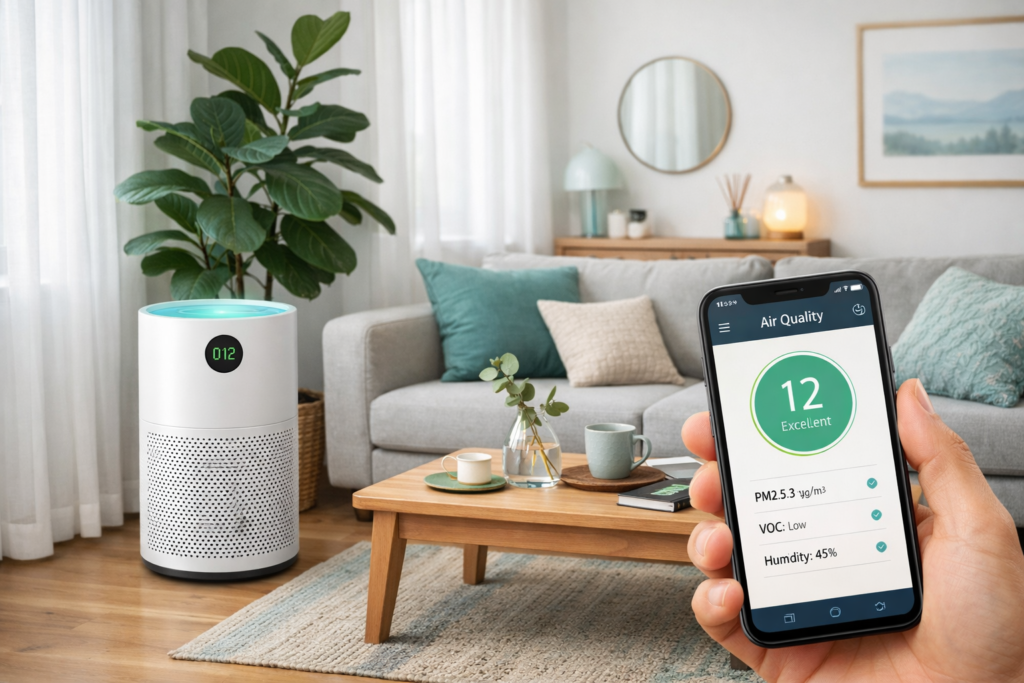
A sustainable smart home is not just about solar panels, efficient appliances, and better thermostats. In 2026, cleaner indoor air is becoming part of the same conversation. The best smart purifiers now help homeowners use less energy, react faster to indoor pollution, replace filters more responsibly, and connect more smoothly with the rest of the home.
Affiliate disclosure: Some links on this page may be affiliate or partner links. If you purchase through those links, SmartAirPurifiers may earn a commission at no extra cost to you. The goal is always to help you make a cleaner, smarter, and more practical buying decision.
A smart purifier used to feel like a regular air purifier with an app attached. That is changing. The newer generation is more connected, more efficient, and more aware of what is happening inside the home. Instead of running at full blast all day, many models now rely on sensors, auto modes, schedules, room-size matching, and home automation to clean when cleaning is needed most.
That matters because air purifiers are often designed to run for long stretches. A device that runs quietly, efficiently, and only as hard as needed can make a real difference over time. It can also make the home feel more responsive. Cooking smoke, wildfire smoke, pet dander, dust, pollen, cleaning fumes, and everyday particle buildup do not always follow a schedule. A smarter purifier can help the home react faster.
Still, the most sustainable choice is not always the flashiest one. The best smart purifier for 2026 is the one that is properly sized, energy-conscious, filter-replacement friendly, quiet enough to actually use, and honest about what it can and cannot do.
In 2026, smarter purifiers are becoming more sustainable through better energy efficiency, improved auto modes, clearer sensor data, longer-lasting filters, Matter smart-home support, and verified performance standards like CADR and ENERGY STAR. The best models clean the right room effectively without wasting power or forcing unnecessary filter changes.
Quick Knowledge Check: Do You Know What Makes a Purifier Truly “Sustainable”?
Before choosing a new smart purifier, test what you already know. These questions help separate useful features from marketing noise.
1. Is the most sustainable purifier always the lowest-wattage model?
Not always. A low-wattage purifier that is too small for the room may need to run harder and longer. Proper room sizing matters.
2. Does a smart air sensor replace a good filter?
No. Sensors help the purifier respond, but the filter and airflow system still do the cleaning.
3. Should you replace filters only when the app says so?
The app is helpful, but it should be balanced with actual use, visible dust, odor performance, airflow changes, and manufacturer guidance.
4. Does Matter support mean every feature works in every smart-home app?
No. Matter can improve compatibility, but advanced brand-specific features may still live inside the manufacturer’s app.
5. Can a purifier solve every indoor air problem?
No. Air cleaning works best with source control, ventilation when appropriate, and regular home maintenance.
What’s Actually New With Smart Purifiers in 2026?
The big shift in 2026 is not one single feature. It is the way smart purifiers are becoming part of a larger home system. A purifier is no longer just a standalone appliance in the corner. It can now work with sensors, routines, smart speakers, thermostats, windows, HVAC awareness, energy schedules, and filter reminders.
That does not mean every device on the shelf is equally advanced. Some “smart” purifiers still offer only basic Wi-Fi control. Others are moving toward better automation, clearer indoor air data, and more efficient long-term operation. The difference matters because sustainable living depends on what happens after the purchase, not just the label on the box.
Better auto modes can reduce unnecessary high-speed operation and help extend filter life when air quality is already good.
Matter support and improved setup tools are making smart-home devices easier to connect across major ecosystems.
Better particle and air-quality readings can help homeowners understand when pollution spikes and what may be causing it.
1. Energy Efficiency Is Now a Front-Line Feature
Energy use matters because air purifiers are not occasional gadgets. Many households run them daily, especially in bedrooms, nurseries, offices, allergy-prone rooms, pet areas, and open living spaces. That makes efficiency one of the most practical sustainability features a purifier can have.
ENERGY STAR-certified room air cleaners are designed to use less energy than standard models while still cleaning indoor air effectively. According to ENERGY STAR, certified room air cleaners are more than 50% more energy-efficient than standard models and can save about 211 kWh per year, depending on size and use. You can review current ENERGY STAR guidance here: ENERGY STAR air cleaners.
The important point is simple. Do not judge a purifier by wattage alone. Look for a model that combines efficient operation with enough cleaning power for the room. A small purifier in a large room may look efficient on paper but disappoint in real life.
2. Auto Mode Is Getting More Important Than Manual Speed Settings
In older purifiers, the user had to guess the right fan speed. Low felt quiet but weak. High cleaned faster but used more power and made more noise. Smart auto modes are designed to reduce that guesswork.
A good auto mode uses sensor feedback to raise or lower fan speed based on indoor air conditions. If cooking particles rise, the purifier can speed up. If the room stabilizes, it can slow down. This helps create a cleaner and more efficient rhythm.
However, auto mode is only as useful as the sensor behind it. Some lower-cost purifiers use limited sensors that may not respond well to every pollutant. For example, a particle sensor may respond to smoke or dust but may not fully explain odors or chemical gases. That is why a strong purifier still needs the right filter design, not just smart controls.
3. Matter Support Is Making Smart Purifiers Easier to Live With
One of the biggest smart-home problems has always been fragmentation. A light bulb works in one app. A thermostat works in another. A purifier has its own app. A sensor needs a hub. The result can feel less like a smart home and more like app clutter.
Matter is designed to improve smart-home interoperability. The Connectivity Standards Alliance added support for air purifiers and air quality sensors in Matter 1.2, which helped move purifiers into the broader smart-home conversation. You can read CSA’s Matter 1.2 announcement here: Matter 1.2 device support.
In 2025, Matter 1.4.1 added setup improvements such as Enhanced Setup Flow, multi-device setup QR codes, and NFC onboarding. That matters in 2026 because easier setup reduces friction for normal homeowners. A smart device that is hard to connect often ends up being used like a basic appliance. You can review CSA’s Matter 1.4.1 update here: Matter 1.4.1 setup improvements.
Even so, shoppers should stay realistic. Matter support does not automatically mean every advanced feature appears in every app. You may still need the manufacturer’s app for detailed filter tracking, deep sensor history, firmware updates, advanced schedules, or custom modes.
4. Smart Purifiers Are Starting to Fit Into Whole-Home Energy Management
Another 2026 trend is the connection between smart-home devices and broader energy management. The Connectivity Standards Alliance and OpenADR Alliance announced a 2026 liaison agreement focused on grid-connected energy management. The basic direction is clear: homes are becoming more aware of when and how energy is used.
For purifiers, this does not mean your device should stop cleaning when air quality is poor. Clean air still comes first. But it does point toward a smarter future where connected appliances can better coordinate with energy gateways, utility signals, and home routines. You can read the CSA announcement here: CSA and OpenADR grid-connected energy management.
In practical terms, homeowners should expect smarter schedules, more efficient default behavior, better off-peak routines, and stronger connections between air quality and energy use. The sustainable smart home is not just about owning efficient devices. It is about helping those devices work together intelligently.
5. CADR Still Matters More Than Most App Features
Smart features are useful, but they do not replace verified cleaning performance. CADR, or Clean Air Delivery Rate, remains one of the most important numbers to check when comparing room air cleaners.
AHAM explains CADR as a measure of how much filtered air a cleaner delivers, with separate scores for smoke, dust, and pollen. Higher CADR numbers generally mean the purifier can clean the air faster for that pollutant category. You can review AHAM’s air filtration standards here: AHAM air filtration standards.
This is where sustainability and performance meet. A purifier that is correctly sized can clean more efficiently because it is not constantly struggling. If the CADR is too low for the room, the purifier may run longer, sound louder, and still underperform.
| 2026 Feature | Why It Matters | What to Check Before Buying |
|---|---|---|
| ENERGY STAR certification | Helps reduce long-term electricity use for a device that may run daily. | Look for ENERGY STAR-certified room air cleaners and compare energy use. |
| Verified CADR | Shows how much clean air the purifier can deliver for smoke, dust, and pollen. | Match CADR and suggested room size to the actual room. |
| Auto mode | Allows the purifier to respond to changing air quality instead of running hard all day. | Check what type of sensor is used and whether readings are shown clearly. |
| Matter support | Can improve compatibility with major smart-home ecosystems. | Look for certified Matter support, not vague “works with smart home” language. |
| Filter-life tracking | Can reduce waste by helping avoid premature replacement. | Look for filter tracking based on usage, not only a fixed calendar countdown. |
| Quiet efficient operation | A purifier only helps if people are willing to keep it running. | Compare noise ratings and airflow performance at lower speeds. |
6. Filter Waste Is Becoming a Bigger Part of the Conversation
When people talk about sustainable purifiers, they often focus on electricity. That is important, but filter waste matters too. Most air purifiers rely on replaceable filters. If the purifier uses expensive, hard-to-find, or short-lived filters, the long-term experience can become frustrating and wasteful.
In 2026, the smarter approach is to think about filter ownership before buying the purifier. Ask how often filters need replacement, what the replacement filters cost, whether they are easy to find, and whether the app gives a realistic filter-life estimate.
Some filter reminders are based mostly on time. Others are based on run hours or air quality conditions. A usage-based reminder is usually more helpful because two homes can use the same purifier very differently. A pet-heavy home near a busy road may load a filter faster than a lightly used guest room.
Need Replacement Filters?
One of the easiest ways to keep a purifier useful is to replace filters on schedule with compatible parts. If you already know your purifier model, you can compare replacement options through trusted filter partners.
7. Better Sensors Are Helping People Understand Their Homes
Smart purifiers are also becoming teaching tools. A visible air-quality display can show how quickly indoor pollution changes. Cooking can spike particles. Candles can affect readings. Opening windows can help or hurt depending on outdoor conditions. Pets, dust, smoke, pollen, and cleaning routines can all change the indoor environment.
This feedback loop is valuable because many indoor air problems are invisible. You may not notice fine particles, but a sensor can reveal patterns. Once you see those patterns, you can make smarter choices.
Still, sensor readings should not be treated like perfect lab measurements. Consumer air-quality sensors can be useful directional tools, but they vary in accuracy and pollutant coverage. The best use is practical: notice patterns, reduce sources, improve ventilation when appropriate, and use filtration consistently.
8. Sustainable Air Quality Starts Before the Purifier Turns On
A purifier is helpful, but it is not the only answer. The EPA identifies three basic strategies for improving indoor air quality: source control, improved ventilation, and air cleaners or filtration. You can review EPA’s indoor air quality guidance here: EPA indoor air quality strategies.
That means the smartest purifier is part of a larger plan. Reducing pollution at the source can lower the burden on the purifier. Ventilation can help in the right conditions. Filtration can reduce airborne particles. Together, these strategies create a more complete indoor air plan.
For example, a purifier can help after cooking, but using a range hood may reduce the pollution source faster. A purifier can help in a dusty bedroom, but washing bedding and reducing dust reservoirs also matters. A purifier can help during pollen season, but keeping windows closed during high pollen periods may reduce the load.
What Sustainable Smart Purifier Shopping Looks Like in 2026
A good 2026 buying decision should feel practical, not overwhelming. You do not need every premium feature. You need the right mix of cleaning power, efficiency, usability, and long-term support.
SmartAirPurifiers 2026 Buyer Checklist
Start with room size. Choose a purifier sized for the room where it will actually be used.
Check CADR. Look for verified airflow performance, especially for smoke, dust, and pollen.
Look for ENERGY STAR. Efficiency matters when a device runs often.
Review filter cost. A great purifier can become a poor value if replacement filters are expensive or difficult to find.
Check app usefulness. Look for clear readings, schedules, filter tracking, and easy controls.
Be realistic about Matter. Matter support can improve smart-home compatibility, but brand apps may still control advanced features.
Prioritize quiet performance. If it is too loud, you may not use it consistently.
Use it as part of an IAQ plan. Pair filtration with source control and ventilation when conditions allow.
Best Rooms to Upgrade First
If you are building a more sustainable smart home one room at a time, start where the purifier will make the biggest practical difference.
Bedroom
The bedroom is often the best first room because people spend long stretches of time there. Quiet operation, dimmable lights, sleep mode, and efficient overnight cleaning matter more than flashy app features.
Home Office
A home office is a strong candidate because cleaner air can support comfort during long work sessions. Look for quiet low-speed performance and real-time air-quality feedback.
Kitchen or Nearby Living Space
Cooking can create particle spikes and odors. A purifier with strong particle filtration and activated carbon can help nearby areas, but it should not replace a good range hood or source-control habits.
Pet Area
Pet dander, dust, hair, and odors can load filters faster. In pet-heavy homes, filter availability and replacement cost become especially important.
Nursery or Child’s Room
For a child’s room, prioritize quiet operation, strong filtration, no ozone-generating features, stable placement, and simple controls. Avoid overbuying based on gimmicks.
What to Avoid When Shopping for a “Green” Smart Purifier
Some sustainability claims sound better than they are. A purifier may look eco-friendly because it uses a soft color palette, quiet marketing language, or a plant-filled product photo. That does not prove it is efficient, well-sized, or filter-friendly.
Be careful with vague phrases like “eco mode” if the brand does not explain how it works. Also be cautious with oversized claims about removing every pollutant. Portable air cleaners can reduce indoor pollutants, but they do not remove every pollutant or solve every indoor air issue by themselves.
Also avoid buying a purifier only because it has Wi-Fi. Smart control is helpful, but airflow, filtration, verified performance, energy efficiency, and filter cost are still the foundation.
| Marketing Claim | What It Might Mean | What to Verify |
|---|---|---|
| “Eco mode” | The purifier may reduce fan speed or power use under certain conditions. | Check whether it still maintains useful airflow and responds to pollution spikes. |
| “Smart sensor” | The purifier may detect particles, odors, VOCs, or general air quality. | Check which pollutants the sensor actually measures. |
| “Works with voice assistants” | The purifier may respond to basic commands. | Check whether it supports your preferred ecosystem and whether advanced features require the brand app. |
| “Large room coverage” | The purifier may be marketed for a big space. | Check CADR, air changes per hour assumptions, and realistic room size. |
| “Long filter life” | The filter may last longer under average conditions. | Check replacement cost, availability, and whether heavy use shortens filter life. |
How Smart Purifiers Fit Into a Sustainable Smart Home
A sustainable smart home should be comfortable, efficient, and easier to manage. Smarter purifiers can support all three goals.
They support comfort by reducing airborne particles and helping rooms recover after pollution spikes. They support efficiency by adjusting fan speed instead of running at maximum power all day. They support better management by showing air-quality trends, filter status, and device activity.
The most exciting part is the direction of the category. As Matter adoption grows and smart-home energy management improves, purifiers may become more coordinated with the rest of the home. A future routine might adjust purification based on cooking, outdoor air quality, occupancy, HVAC operation, time of day, or utility signals.
But the core advice remains simple. Buy the purifier that solves your room’s real problem. Use it consistently. Replace filters responsibly. Keep pollution sources under control. Do not let smart features distract you from clean-air fundamentals.
FAQ: Sustainable Smart Purifiers in 2026
Are smart air purifiers more sustainable than regular air purifiers?
They can be, but only when the smart features reduce waste, improve efficiency, or help the purifier run more effectively. A smart purifier with poor airflow or expensive filters is not automatically more sustainable.
Should I only buy an ENERGY STAR air purifier?
ENERGY STAR certification is a strong efficiency signal, especially for devices that run often. You should still compare CADR, room size, filter cost, noise, and smart features before buying.
Does Matter support matter for air purifiers?
Yes, especially if you want your purifier to work more easily with a broader smart-home ecosystem. However, Matter support does not guarantee that every advanced feature will appear in every smart-home app.
Do smart purifiers save money?
They may help reduce wasted energy if they use efficient motors, good auto modes, and smarter schedules. The bigger savings often come from choosing the right size, replacing filters at the right time, and avoiding underpowered units.
Can a smart purifier improve indoor air quality by itself?
It can help reduce airborne pollutants in a room, but it works best as part of a larger indoor air strategy that includes source control, ventilation when appropriate, cleaning habits, and proper filter maintenance.
The Bottom Line
Sustainable smart homes start with practical choices. In 2026, smarter purifiers are becoming more efficient, more connected, and more useful. But the best purifier is still the one that fits your room, cleans effectively, runs quietly, uses energy wisely, and has replacement filters you can actually maintain.