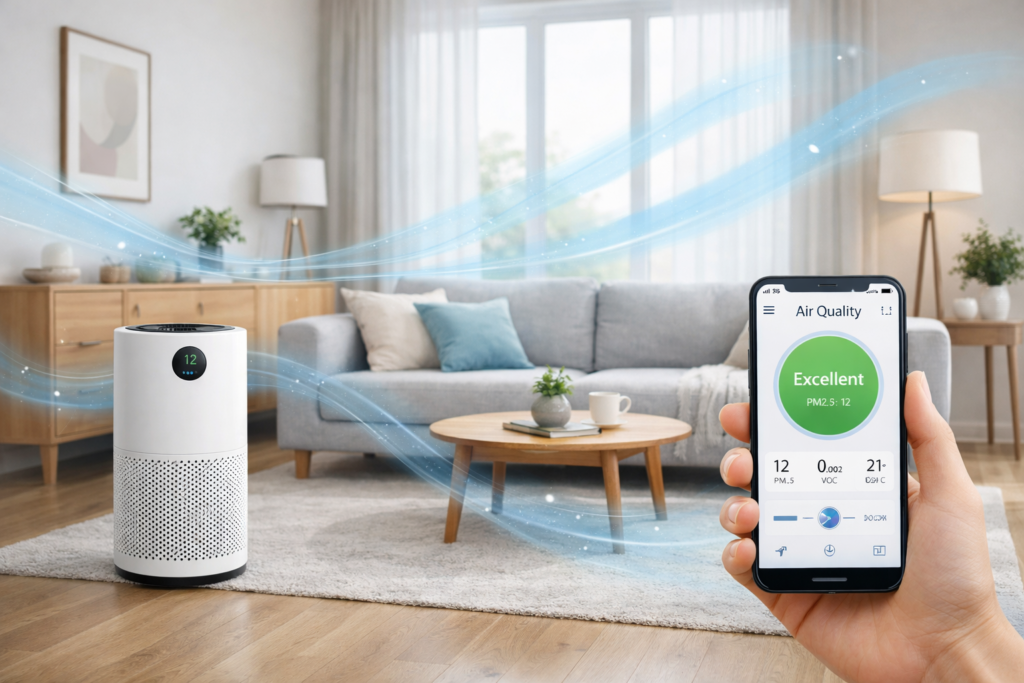
Matter-ready purifiers are becoming more important because clean air is no longer just about turning on a fan. In 2026, the best smart home air quality setups are starting to connect purifiers, sensors, thermostats, kitchens, bedrooms, and HVAC support into one clearer system.
Quick answer: Matter-ready purifiers matter in 2026 because they help smart air cleaners work across major smart home platforms instead of being trapped inside one brand’s app. A Matter-compatible setup can make air quality automation easier, more local, and less dependent on cloud-only routines. However, Matter does not replace the basics. You still need the right CADR, a real particle filter, enough activated carbon for odors or gases, and regular filter replacement.
That is the real story. Matter makes smart control cleaner. It does not magically make a weak purifier strong.
Air Quality Knowledge Check: Are You Shopping for Smart Features or Cleaner Air?
Before choosing a Matter-ready purifier, it helps to separate helpful smart features from marketing noise. Ask yourself these five questions:
- Do I know the square footage of the room where the purifier will run most often?
- Have I checked the CADR rating, not just the “room coverage” claim?
- Do I need odor control, or am I mainly trying to reduce dust, pollen, smoke particles, and pet dander?
- Do I want the purifier to work with Apple Home, Google Home, Amazon Alexa, Samsung SmartThings, or another platform?
- Am I willing to replace filters on schedule, even if the app reminders are annoying?
If you answered “no” to one or more of these, that is not a problem. It simply means the best purifier for you is the one that gets the fundamentals right first and the smart features second.
Why 2026 Feels Different for Smart Air Purifiers
For years, smart air purifiers sounded more advanced than they felt. One purifier worked in one app. A sensor worked in another. The thermostat lived somewhere else. A kitchen fan, window sensor, humidity monitor, or HVAC accessory might not speak the same language at all.
That created a strange problem. People could buy smart devices, but the home still did not feel very smart.
Matter is changing that expectation. Instead of forcing every device to depend on a separate brand cloud, Matter is designed as a shared smart home standard. The goal is simple: a certified device should be easier to set up and control across compatible ecosystems.
For air purifiers, that matters because indoor air quality is not one device’s job. Air changes when someone cooks dinner. It changes when outdoor smoke moves through a neighborhood. It changes when a pet shakes off dander, when pollen season spikes, when windows open, when humidity rises, and when filters get dirty.
A purifier that can talk more cleanly to the rest of the home is more useful than a purifier that only waits for you to open its own app.
What “Matter-Ready Purifier” Really Means
The term “Matter-ready” can mean different things depending on the product. Some devices are already Matter-certified. Some are advertised as Matter-compatible. Some may require a firmware update. Others may work through a bridge, hub, or ecosystem integration.
That is why shoppers should read the fine print. A purifier should not be judged by one logo alone. Look for clear language from the manufacturer that explains how Matter works on that exact model.
| Term you may see | What it usually means | What to verify before buying |
|---|---|---|
| Matter-certified | The product has gone through Matter certification for supported functions. | Check the product page, certification listing, supported platforms, and feature limits. |
| Matter-compatible | The device is intended to work with Matter, but the exact setup may vary. | Confirm whether it works directly, through a bridge, or after a firmware update. |
| Works with Apple Home / Google Home / Alexa / SmartThings | The purifier may integrate with a platform, but not always through Matter. | Look for Matter wording specifically if unified control is important to you. |
| Smart app control | The purifier has Wi-Fi or Bluetooth app features. | Do not assume this means Matter support. App control and Matter support are not the same thing. |
The safest rule is simple: if Matter is a must-have feature, confirm it on the official product page before checkout.
The Big Win: Air Quality Can Become a Whole-Home Signal
The most exciting part of Matter-ready air quality is not that you can turn a purifier on from your phone. Most smart purifiers could already do that.
The bigger shift is that air quality can become a trigger for the rest of the home.
That kind of setup is where smart purification starts to feel practical. The home reacts to conditions, not just commands.
What Matter Does Not Fix
Matter can improve setup, control, and interoperability. It cannot fix an undersized purifier, a weak filter, or a neglected maintenance schedule.
This is where buyers need to stay grounded. The EPA’s consumer guidance still points back to the fundamentals: choose a portable air cleaner with a CADR that fits the room, understand that particle filtration and gas/odor filtration are different jobs, and replace filters when needed.
In plain English, Matter makes the purifier easier to live with. CADR, filter design, carbon amount, run time, and placement determine how well it cleans.
The 2026 Matter-Ready Purifier Buyer Checklist
Use this checklist before buying a smart purifier in 2026:
1. Start with room size and CADR
A purifier should be sized for the room where it will actually run. If it is too small, the app can be beautiful and the automation can be clever, but the unit may still struggle to move enough clean air.
2. Look for true particle filtration
For dust, pollen, smoke particles, pet dander, and fine particulate matter, look for a high-efficiency particle filter and a CADR rating that makes sense for the room.
3. Add activated carbon when odors matter
If cooking odors, VOCs, smoke smell, or pet odors are part of the problem, a particle filter alone is not the full answer. Look for activated carbon or another gas-phase filter designed for odors and gases.
4. Verify the Matter details
Check whether the purifier is Matter-certified, Matter-compatible, or only expected to gain Matter support later. Also check which features are exposed through Matter. Some devices may allow basic control but still reserve advanced settings for the brand app.
5. Check filter availability before you buy
A purifier is only as useful as the filter you can replace. Before choosing a model, make sure replacement filters are easy to find and reasonably priced.
6. Consider ENERGY STAR certified models
Air purifiers often work best when they run for long periods. That makes energy use more important than many buyers realize. ENERGY STAR certified room air cleaners are worth checking when efficiency matters.
7. Avoid ozone-producing shortcuts
Be cautious with air-cleaning technologies that intentionally produce ozone. For most homes, a properly sized mechanical purifier with good filtration is the safer, clearer starting point.
Matter vs. Wi-Fi: The Difference Readers Actually Care About
Many buyers confuse Matter with Wi-Fi. They are related, but they are not the same thing.
Wi-Fi is one way a purifier connects to the network. Matter is a smart home language that helps compatible devices and platforms work together more consistently.
| Feature | Standard Wi-Fi purifier | Matter-ready purifier |
|---|---|---|
| App control | Usually controlled through the brand’s app. | May work through the brand app and supported Matter ecosystems. |
| Automation | Often limited to brand app routines or cloud integrations. | Can be easier to include in cross-platform smart home routines. |
| Setup | Varies by brand. | Designed for a more consistent setup experience across Matter ecosystems. |
| Long-term flexibility | Can feel locked to one app or ecosystem. | Better fit for homes that may change platforms over time. |
For a deeper comparison, you may also want to read: Matter vs. Wi-Fi Purifiers: What’s the Difference and Why It Matters?
The Catch: Not Every Matter Feature Will Be Equal
Matter support does not always mean every purifier feature appears in every app. A manufacturer may expose power, fan speed, mode, filter status, or sensor readings differently depending on the model and ecosystem.
That is not necessarily a dealbreaker. Many buyers only need core control and automation. But it does mean you should avoid assuming that the Apple Home, Google Home, Alexa, or SmartThings experience will match the brand app feature for feature.
For advanced settings, firmware updates, filter registration, warranty features, detailed pollutant charts, or cleaning history, the brand app may still matter.
Best Use Cases for Matter-Ready Air Purifiers in 2026
Open kitchen and living room spaces
Cooking can quickly change indoor particle and odor levels. A Matter-ready setup can make it easier for sensors, purifiers, and other smart home devices to react together.
Bedrooms and nurseries
Quiet automation matters in sleeping spaces. A purifier can run stronger before bedtime, drop into a lower fan speed overnight, and increase again if air quality worsens.
Pet homes
Pet dander, hair, litter odors, and general indoor dust can build up fast. A Matter-connected routine can help the purifier run more consistently instead of waiting until the room smells stale.
Allergy-prone households
During pollen season, smart routines can help create a cleaner indoor routine around entryways, bedrooms, and high-traffic rooms.
Homes with HVAC upgrades
Portable purifiers work room by room, while HVAC filtration can support the broader home. The two approaches are different, but they can work together when planned carefully.
Where Filters and Whole-Home Air Quality Fit In
A smart purifier is only one part of indoor air quality. Replacement filters, HVAC filters, ventilation habits, and source control still matter.
If you already own a purifier, start by checking whether the filter is due for replacement. A dirty filter can reduce performance and make the purifier work harder than necessary.
For replacement filters, you can compare options through FiltersFast. For readers thinking beyond portable units and into broader indoor air quality support, FieldControls may be worth reviewing for whole-home air quality products and HVAC-connected solutions.
As always, match any filter or accessory to your exact model, system, and manufacturer requirements before buying.
A Smart Purifier Should Make Clean Air Easier, Not More Confusing
The best 2026 smart purifier is not the one with the longest feature list. It is the one you will actually run, maintain, and trust.
Matter helps because it lowers the friction. Instead of juggling separate apps and disconnected routines, buyers can start moving toward a cleaner smart home setup where the purifier responds to real conditions.
Still, the smartest air purifier decision starts with old-fashioned questions:
- Is it sized correctly?
- Does it have the right filter type?
- Can I afford and find replacement filters?
- Will it be quiet enough to run often?
- Does Matter support the smart home platform I already use?
Answer those first, and Matter becomes a powerful bonus instead of a distraction.
FAQs About Matter-Ready Purifiers
What is a Matter-ready air purifier?
A Matter-ready air purifier is a smart purifier designed to work with the Matter smart home standard, either directly, through certification, through a supported ecosystem, or in some cases through an update or bridge. Always verify the exact model before buying.
Does Matter make an air purifier clean better?
No. Matter improves smart home control and interoperability. Cleaning performance still depends on CADR, filter design, room size, fan speed, placement, run time, and filter maintenance.
Should I buy a purifier just because it supports Matter?
No. Matter is valuable, but it should not outrank the basics. Choose the right purifier for your room and air quality problem first. Then use Matter support as a smart home advantage.
Will a Matter purifier work with every smart home platform?
Matter is designed to improve cross-platform compatibility, but individual product features and ecosystem support can vary. Check the manufacturer’s official compatibility notes for Apple Home, Google Home, Amazon Alexa, Samsung SmartThings, or any other platform you use.
Do I still need the purifier’s brand app?
Often, yes. Even with Matter support, the brand app may still be needed for firmware updates, detailed sensor history, advanced settings, filter registration, warranty support, or model-specific features.
Is Matter better than Wi-Fi?
Matter and Wi-Fi are different. Wi-Fi is a connection method. Matter is a smart home standard that helps compatible devices communicate across ecosystems. A purifier may use Wi-Fi and still support Matter.
Final Takeaway: 2026 Is the Year Smart Air Quality Starts Feeling Unified
Matter-ready purifiers are not just another gadget trend. They represent a shift from isolated smart appliances to connected air quality systems that can work with the rest of the home.
That matters because clean air is not a one-button problem. It changes by room, season, activity, and household habit. In 2026, the best smart purifier setups are the ones that combine strong filtration with smarter coordination.
So yes, Matter-ready purifiers are worth watching. Just remember the order: clean air performance first, smart home convenience second, and marketing claims last.
Helpful Sources for Readers
For readers who want to verify the technical and air-quality background behind this article, these sources are useful starting points: