Best Smart Purifiers · Bedroom buying guide
At 11 p.m., “whisper quiet” sounds like the feature that matters most. At 2 a.m., you discover the glowing display. The next night, auto mode suddenly speeds up just as you drift off.
A bedroom purifier has to pass two tests at once: you can sleep beside it, and it delivers useful particle cleaning at the setting you actually leave running. The quietest number on the box answers only half the question.
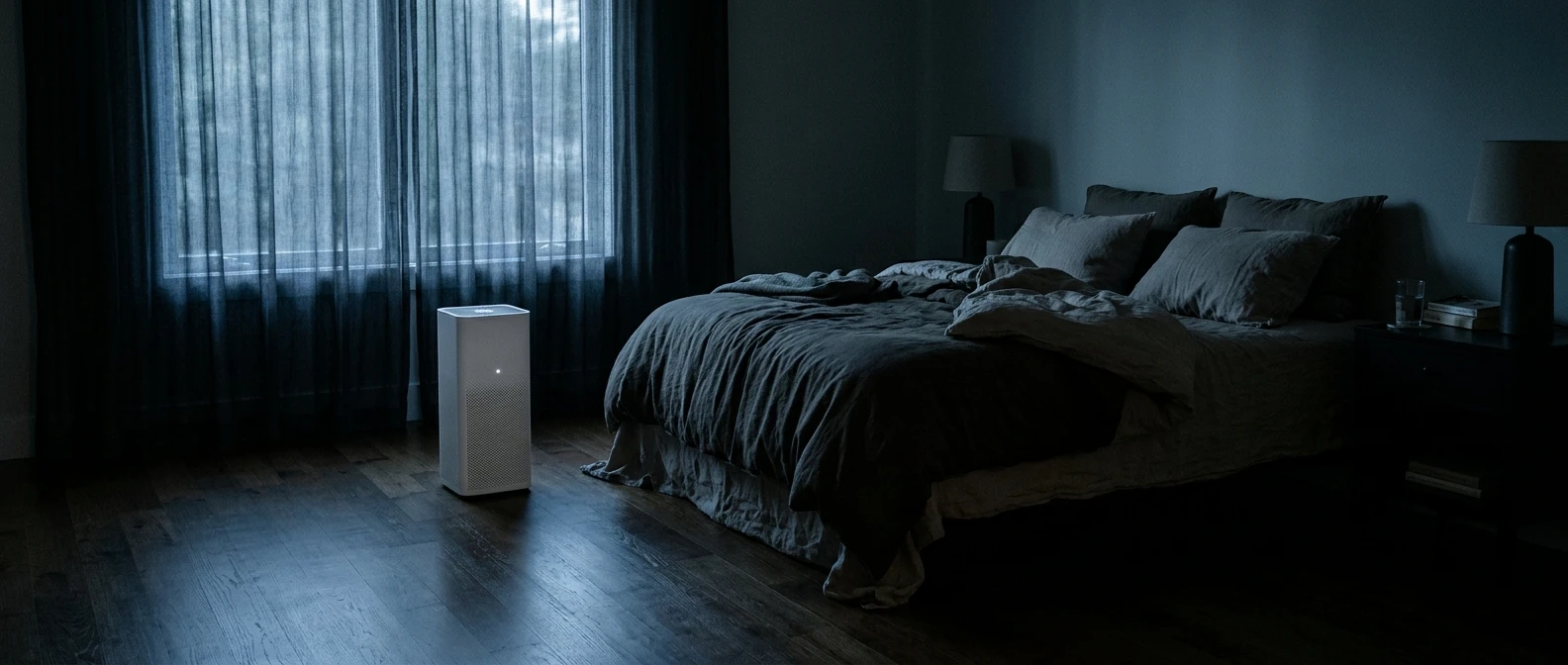
Quick answer: How do you choose a quiet air purifier for a bedroom?
Measure your room, establish a CADR sizing target, and compare noise and clean-air delivery at the same fan speed. Look for a display that switches fully off, predictable overnight controls, and an identifiable replacement filter. If sleep-speed CADR is unpublished, record it as unknown—do not pair the minimum noise rating with the maximum CADR.
Research-based buying guidance, not a hands-on product ranking. The images are illustrative and do not demonstrate tested airflow, noise, or room coverage.
Start with the room where you actually sleep
Write down the room’s length, width, and ceiling height. Then note whether you normally leave the door open. A 12-by-14-foot bedroom has 168 square feet of floor area; with an 8-foot ceiling, its volume is 1,344 cubic feet. An open doorway adds air exchange with nearby spaces, making a single-room estimate less representative.
Next, name your priority. Airborne pollen, dust, and pet-related particles call for particle filtration. An odor concern needs a separate look at the source and gas-removal media; a thin carbon layer is not evidence of strong odor control. CADR rates particle cleaning, not gas removal. See the EPA’s guide to home air cleaners.
Finally, describe your sleep preferences: steady fan noise, total darkness, no beeps, or no changing fan pitch. Those are useful shopping requirements, even though they do not appear in a room-coverage claim.
A practical starting number
AHAM’s general sizing rule calls for a smoke CADR in cubic feet per minute (cfm) of at least two-thirds of the room’s floor area in square feet, with ceilings up to 8 feet. For the 168-square-foot example, that is about 112 cfm. Higher ceilings require additional capacity. This is a sizing guide, not a promise about pollutant levels.
A product that meets that number only on maximum speed may be a poor bedroom fit if you cannot tolerate maximum speed. Your next question is whether a tolerable setting still provides the cleaning delivery you need.
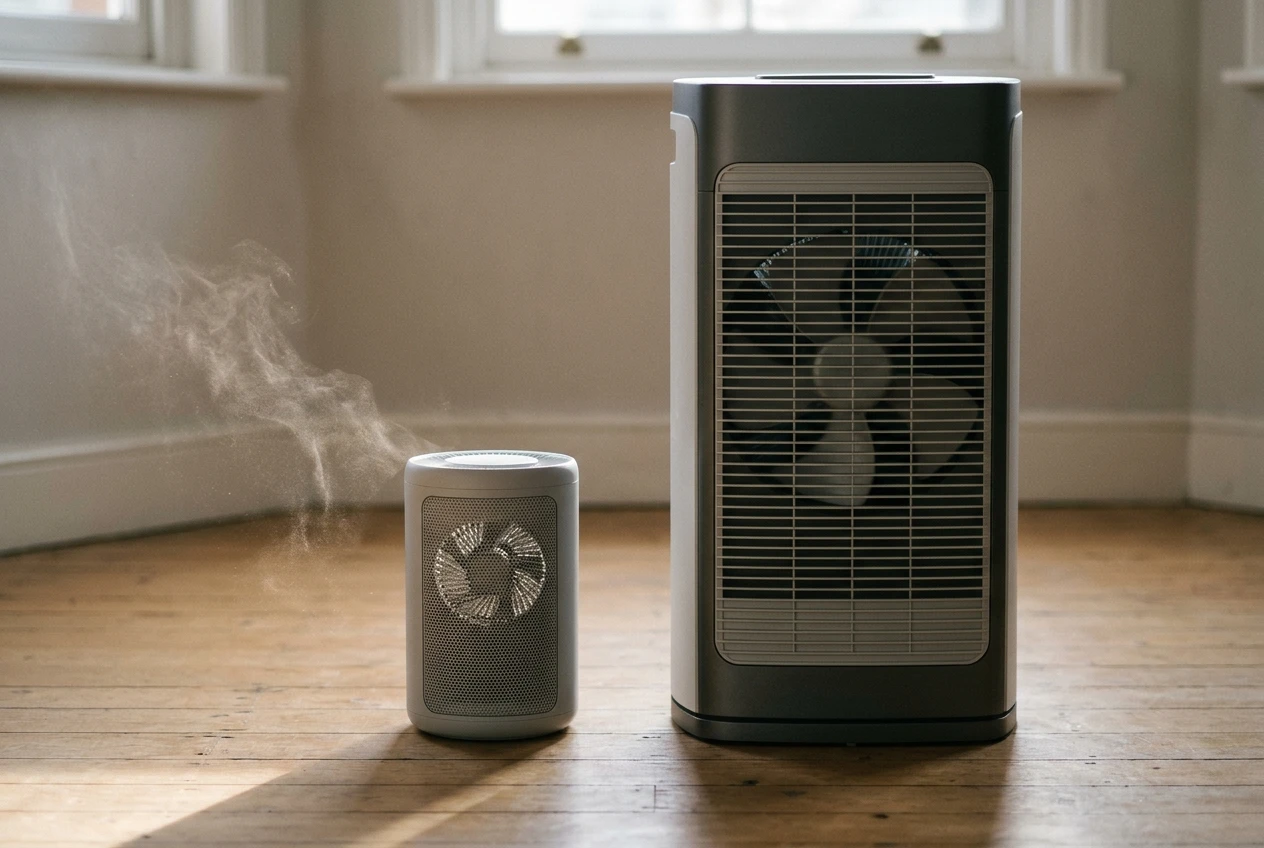
Do not combine two specifications that belong to different settings
Imagine a listing that says “20 dB” and “250 cfm CADR.” It is tempting to picture 250 cfm of cleaning at 20 dB. Unless the manufacturer explicitly ties those figures to the same mode, you have not established that. The EPA notes that published CADR is typically measured at the highest speed.
| Listing detail | Useful follow-up | Buying implication |
|---|---|---|
| Minimum noise level | Which mode, distance, and test conditions? | A minimum alone cannot establish useful quiet cleaning. |
| Maximum CADR | What is the CADR at the intended overnight speed? | Keep maximum and overnight figures separate. |
| Low-speed airflow | Is this airflow or tested CADR? | Air movement is not automatically clean-air delivery. |
| Large room coverage | At how many air changes per hour, and which speed? | Coverage figures need a common basis for comparison. |
| Sleep mode | Does it lock the fan low, dim lights, or still react to a sensor? | The label does not describe a universal behavior. |
Airflow is not a substitute for CADR
Airflow describes air moving through the appliance. CADR describes equivalent clean-air delivery for a tested particle type, incorporating removal performance. Do not insert a raw airflow figure into a CADR calculation and label the result “clean-air changes.” Fan RPM and percentages on a control panel are not CADR measurements either.
Here is a useful message to send before buying:
“What is the tested smoke CADR at the fan speed used for your advertised minimum noise rating? Please include the noise test distance and conditions. If you provide airflow instead, please label it separately from CADR.”
If support cannot supply the answer, keep that field marked unknown. A larger model may offer useful capacity at a tolerable speed, but size alone does not prove it. Look for documented performance at comparable noise levels and check the return terms before making that compromise.
What does low-speed CADR mean in a real bedroom?
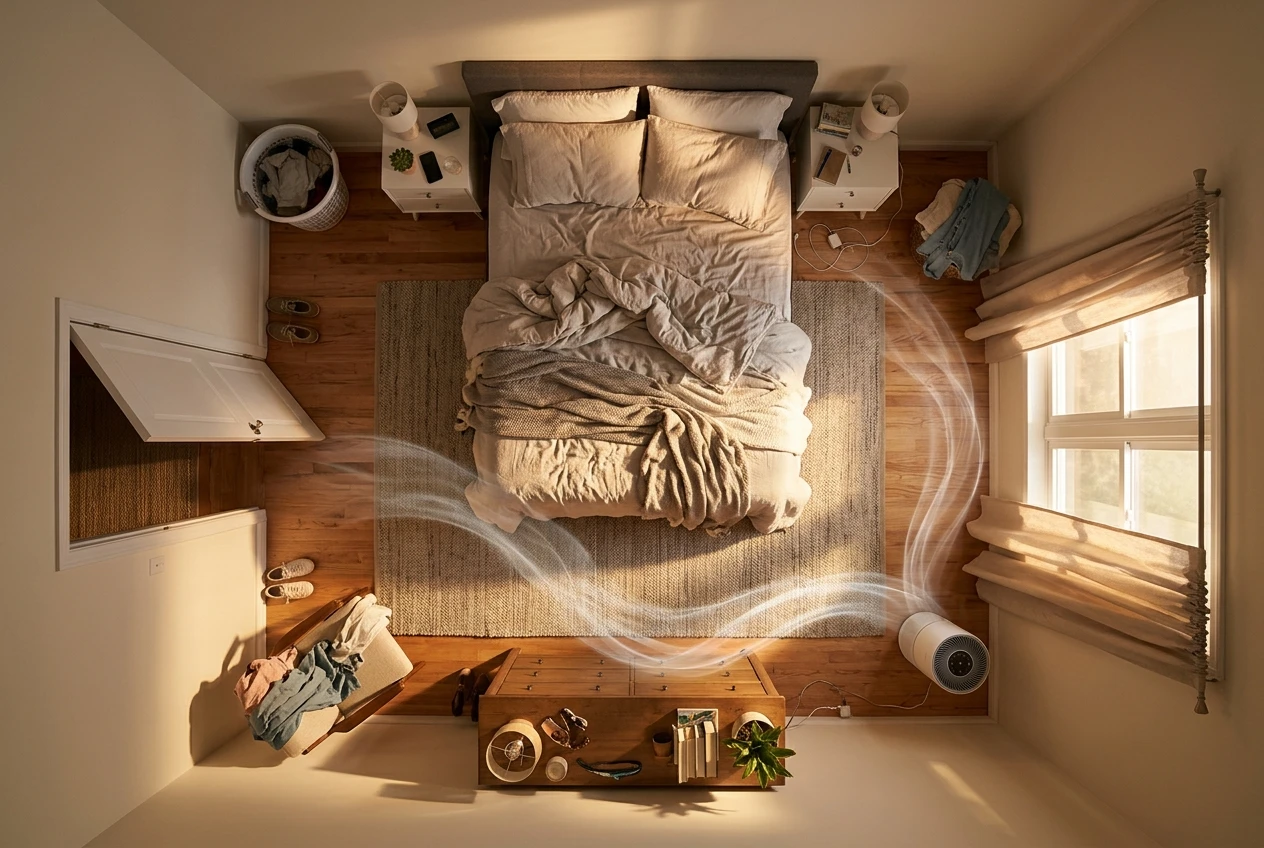
Use this calculation only when you have a CADR in cfm for the setting being compared:
Equivalent clean-air changes per hour = CADR × 60 ÷ room volume
Room volume in cubic feet = length × width × ceiling height, all measured in feet.
| CADR at selected speed | Calculation | Equivalent clean-air changes/hour |
|---|---|---|
| 30 cfm | 30 × 60 ÷ 1,344 | About 1.3 |
| 100 cfm | 100 × 60 ÷ 1,344 | About 4.5 |
| 112 cfm | 112 × 60 ÷ 1,344 | 5.0 |
These are invented examples, not product specifications. The calculation describes equivalent particle-cleaning delivery; it does not mean every parcel of air passes through the filter that many times. Mixing, placement, incoming particles, and filter condition affect the room’s actual results.
AHAM’s certified room-size guidance uses 4.8 air changes per hour. That helps explain why a very large “coverage” claim based on a slower cleaning rate should not be compared directly with an AHAM room-size rating.
Which smart features earn their place beside your bed?
Use the bedside test: Will this feature help at midnight without making you reach for your phone?
- Complete lights-off control. Check the display, air-quality ring, Wi-Fi indicator, and standby light. “Dimmable” may still be visible in a dark room.
- Predictable fan behavior. Find out whether sleep mode holds a fixed speed. Auto mode can change speed; whether that bothers you is something to check in your room.
- Schedules with a named fan setting. Confirm that scheduling can select a speed, not merely switch the unit on and off. A useful routine should survive ordinary day-to-day use.
- Controls on the purifier. Make sure essential operation remains practical when the phone is unavailable or Wi-Fi drops.
- Clear beep and restart behavior. Check the manual for sound settings and what happens after a power interruption. Do not assume the display or mode will return exactly as you left it.
A timer that switches the purifier off stops its active filtration. Running it faster before bed can add cleaning beforehand, but it does not replace filtration while new particles enter or become airborne overnight.
Why a decibel number is not a sleep guarantee
Compare ratings cautiously when brands do not disclose the same measurement conditions. Distance, background sound, and your room all affect what you hear. A tonal whine, rattle, or changing pitch may bother you more than a steady fan. There is no single advertised noise number that guarantees comfortable sleep for everyone.
Reviews can flag recurring complaints about lights or beeps. They cannot establish the noise or cleaning performance you will get in your particular bedroom.
Try this bedtime check while returns are still possible
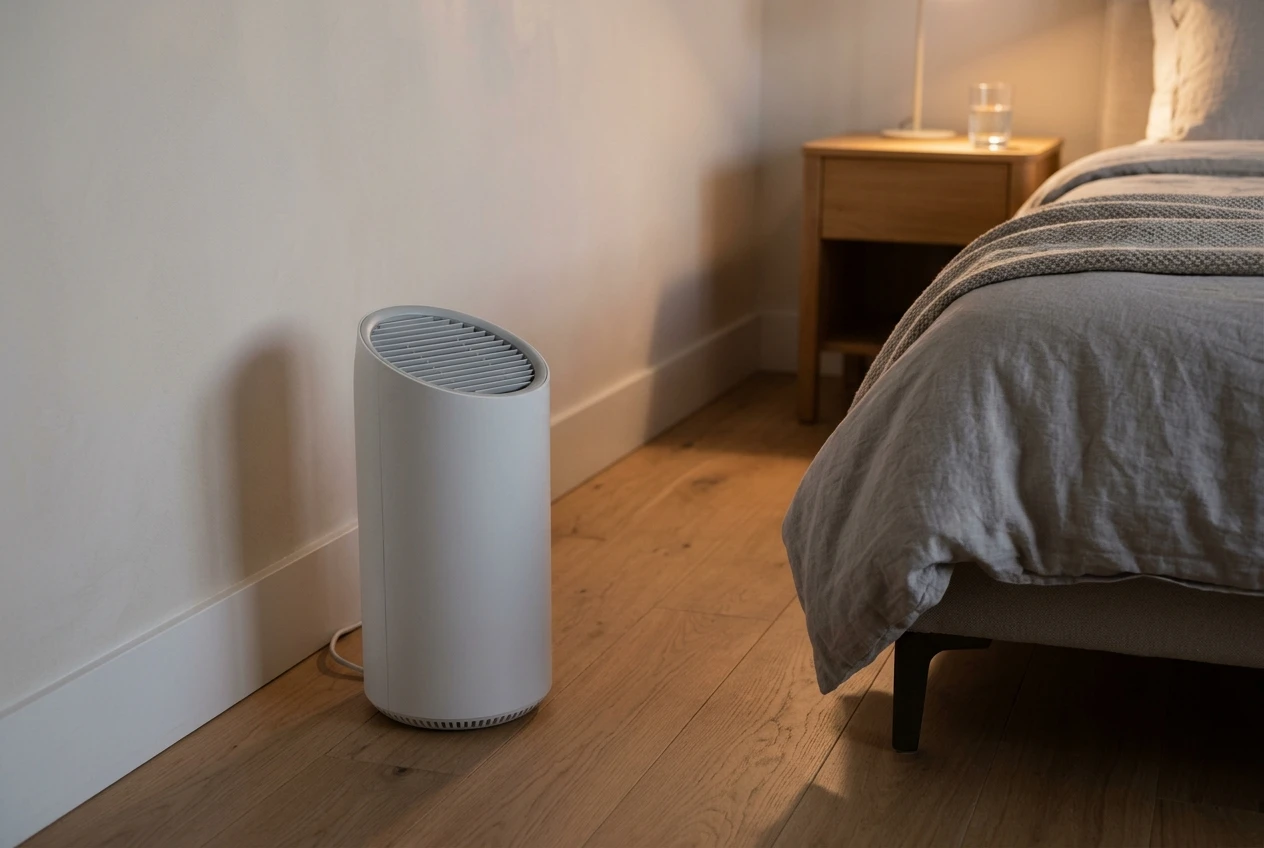
- Set it up as the manual directs. Remove filter packaging, fit the filter correctly, and leave all required intake and outlet clearances. Do not use a pictured wall gap as a specification.
- Use your normal room arrangement. Keep the bedding, curtains, and usual door position in mind. Place the purifier on the stable surface specified for that model, with the cord clear of your nighttime walking route.
- Check from the pillow. With the room dark, listen at the intended fan speed. Look for persistent lights and notice whether the airflow creates an uncomfortable draft.
- Try the controls you will rely on. Check the scheduled transition, display-off setting, and manual controls. Avoid choosing a setting purely because its name includes “sleep.”
- Record the compromise. Write down the setting you tolerate and the CADR evidence for that setting. If cleaning delivery remains unknown, a comfortable night has not resolved that unknown.
This is a comfort and usability check, not a home CADR test. A purifier’s green light or built-in sensor reading does not prove whole-room cleanliness.
Put your bedroom shortlist on paper
Use the free Smart Air Purifier Fit & Filter Planner to record room size, compare candidates, identify replacement filters, and estimate ownership costs. Add two bedroom notes: “speed I can sleep with” and “CADR evidence at that speed.” Leave missing figures marked unknown.
Get the free Fit & Filter Planner
The planner page offers email delivery of the printable workbook.
Before checkout, find the filter you will need later
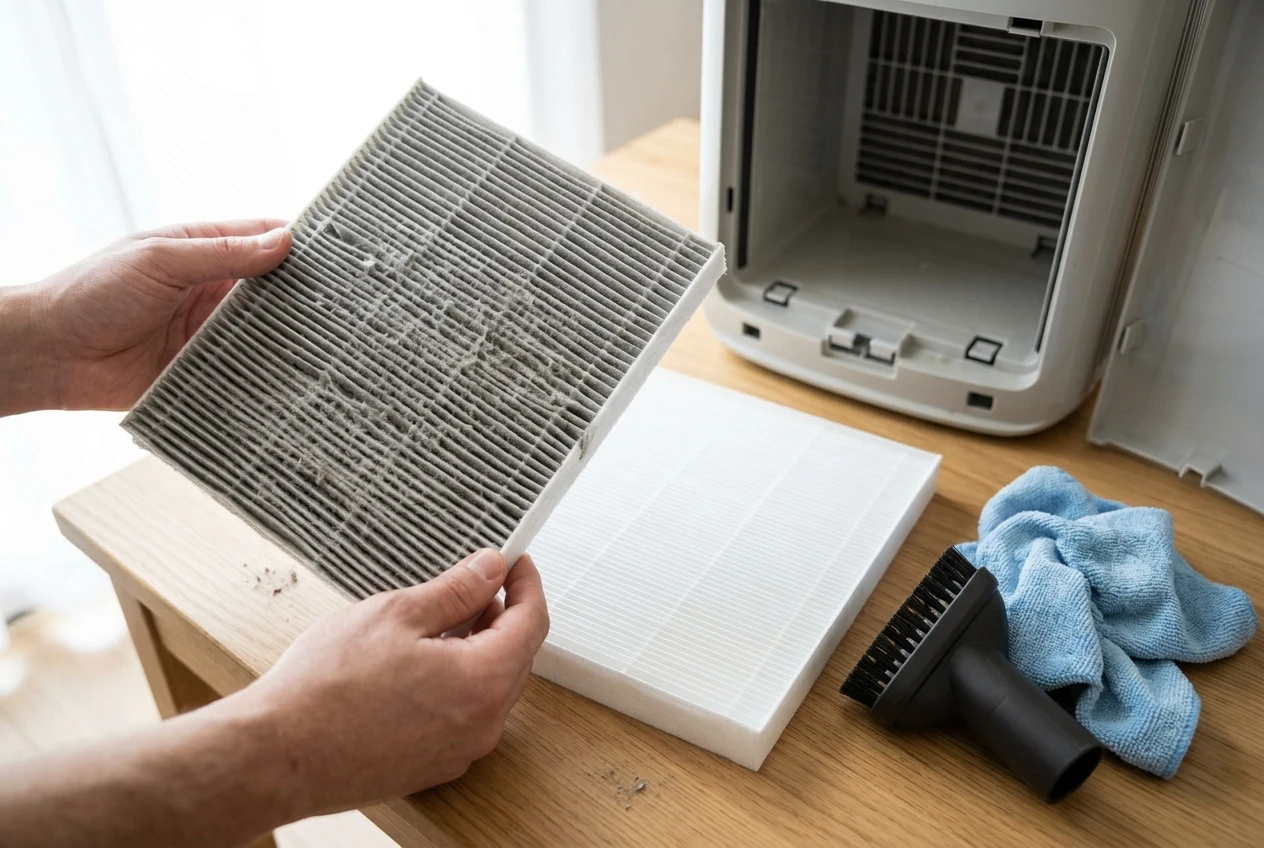
Save the exact purifier model, including its suffix or generation, and the manufacturer’s replacement-filter code. Then record the filter price, package quantity, and replacement guidance. A low purchase price becomes less attractive when the correct filter is expensive or hard to identify.
Follow the manual for prefilter care and replacement intervals. Unplug the appliance before permitted maintenance. Wash or vacuum a filter only when the manufacturer explicitly allows that method for that layer. Do not assume a pleated main filter can be cleaned because the mesh prefilter can.
Loaded filters can reduce airflow, but they do not make every purifier automatically speed up or become louder. New rattling, whistling, or weak output deserves a check of fit, obstructions, and the model’s troubleshooting instructions. Start with these checks for a purifier that barely blows air.
Four-question knowledge check: Would you buy it?
Choose your answer before opening each explanation.
1. A listing shows 20 dB and 250 cfm CADR. Does it deliver both together? A: Yes. B: Not established.
Answer: B. Find the speed and test conditions for each figure. The quietest setting and highest CADR may describe different modes.
2. Support gives you 80 cfm airflow on low. Can you call it 80 cfm CADR? A: Yes. B: No.
Answer: B. Airflow and tested clean-air delivery are different quantities. Keep low-speed CADR marked unknown unless supported by appropriate data.
3. You run high speed before bed, then switch off. Is overnight filtration covered? A: Yes. B: No.
Answer: B. Pre-bed operation adds cleaning beforehand. Switching off ends active filtration while overnight particle sources may continue.
4. A purifier is comfortable on medium, but medium-speed CADR is missing. Is room fit verified? A: Yes. B: No.
Answer: B. You have verified comfort in your room, not cleaning delivery at that speed. Ask for data and keep the uncertainty visible.
Bedroom air purifier FAQs
Is sleep mode always the best setting overnight?
No. A tolerable manual speed with documented cleaning delivery may suit your room better. Check what sleep mode actually changes on the exact model.
Should I buy a larger purifier and run it on low?
It is an option to investigate, not a guarantee. Compare cleaning delivery and noise at the setting you intend to use, plus the space and filter costs. A larger cabinet is not enough evidence.
Can I leave the bedroom door open?
You can, but air exchange with adjoining rooms complicates a closed-bedroom sizing estimate. Record how you actually use the space rather than assuming the bedroom’s floor area describes the entire air-cleaning load.
Should a bedroom purifier have an ionizer?
An ionizer is not a required bedroom feature. The EPA advises avoiding devices that intentionally produce ozone. For optional electronic features, check the model’s emissions information and whether the feature can stay off; the word “smart” does not establish safety or effectiveness.
Will it fix a stuffy room?
Particle filtration does not supply outdoor air or remove accumulated carbon dioxide. Investigate ventilation and the source of odors rather than treating every stuffy-room complaint as a filter-shopping problem.
Choose the setting first, then judge the machine
The useful bedroom question is not simply “How quiet can it get?” It is “What cleaning performance will I get at the speed I will actually use?” Answer that, check the lights and controls, and find the replacement filter before you commit.
What bothers you most at bedtime: fan noise, bright lights, or sudden speed changes? Share your room dimensions, ceiling height, and purifier model in the comments. Include which specifications are missing so the discussion starts with evidence.
Sources checked November 12, 2026: EPA home air-cleaner guidance; AHAM CADR sizing guidance; AHAM air-changes FAQ. Product-specific performance requires the exact model’s documentation.