Best Smart Purifiers · Large-room sizing without the guesswork
The box says “up to 1,000 square feet.” Your living room is smaller than that. So why does the purifier need its loudest setting just when everyone sits down to watch television?
The missing detail may be the cleaning rate behind that coverage claim. Or the nine-foot ceiling. Or the kitchen that shares the same open space. A big square-foot number is only useful when you know what it assumes.
This guide helps you size smart air purifiers for large living rooms using room volume and clean air delivery rate, then check whether the planned setup works with your layout, listening comfort, and replacement-filter budget.
Quick answer: What size air purifier does a large living room need?
Measure the volume of the space you intend to serve, choose a consistent equivalent air-change target, and calculate required CADR in cfm = room volume in cubic feet × target rate ÷ 60. Then verify delivery and noise at the fan speed you intend to use.
For the 552-square-foot, nine-foot-high example below, a 4.8-per-hour comparison target needs about 398 cfm CADR. A five-per-hour target needs 414 cfm. These are sizing estimates, not promises of uniform cleaning or safe air.
Research-based guidance, reviewed November 12, 2026. Worked examples are calculations, not product test results. The supplied illustrations do not show measured airflow.
1. Measure the air above the floor—not just the sofa area
Record length, width, and ceiling height. For a rectangular space, multiply all three to get cubic feet. For an L-shaped layout, divide it into rectangles, calculate each volume, and add them without counting overlapping areas twice.
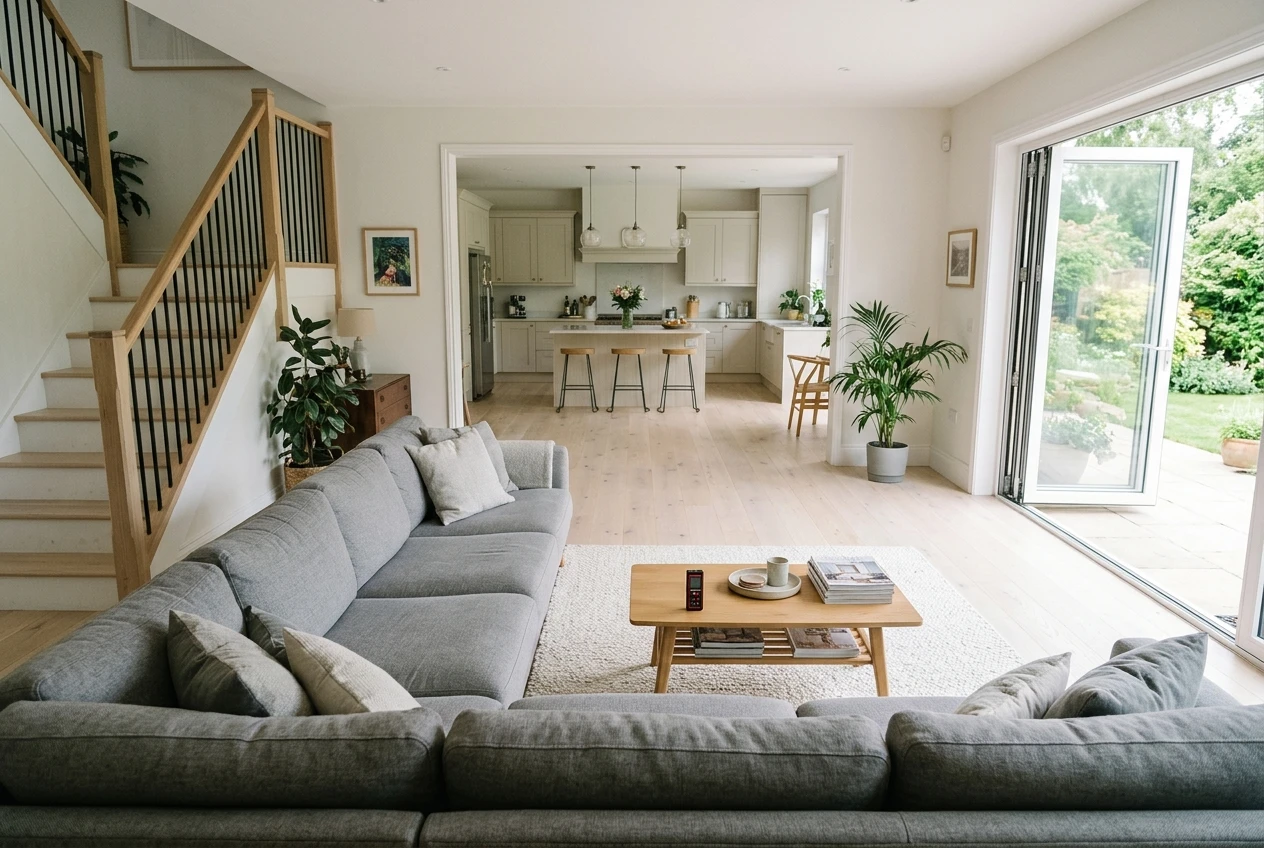
Include the open kitchen, but do not assume the whole house mixes evenly
A broad, doorless connection means the kitchen and seating area cannot be treated as independent closed rooms. Include both in a starting estimate when you intend to serve both. Record stairwells, lofts, narrow passages, and other connections separately.
Air exchange through an opening varies. A staircase does not give you a neat, measurable “extra CADR” requirement, and a doorway count cannot supply a reliable percentage adjustment. Complex layouts may need separately served zones or professional advice rather than one enormous coverage claim.
Also note doors and windows normally left open and the locations of HVAC supplies and returns. These affect air movement, but they do not prove that the purifier reaches every connected room. Even a closed room has leakage; it is not a sealed test chamber.
Our worked example: living room plus kitchen
Living area: 18 × 24 ft = 432 sq ft.
Open kitchen: 10 × 12 ft = 120 sq ft.
Combined area: 432 + 120 = 552 sq ft.
Both have a flat nine-foot ceiling: 552 × 9 = 4,968 cubic feet.
Use this volume for the calculations below. If the two zones have different ceiling heights, calculate each volume separately before adding them.
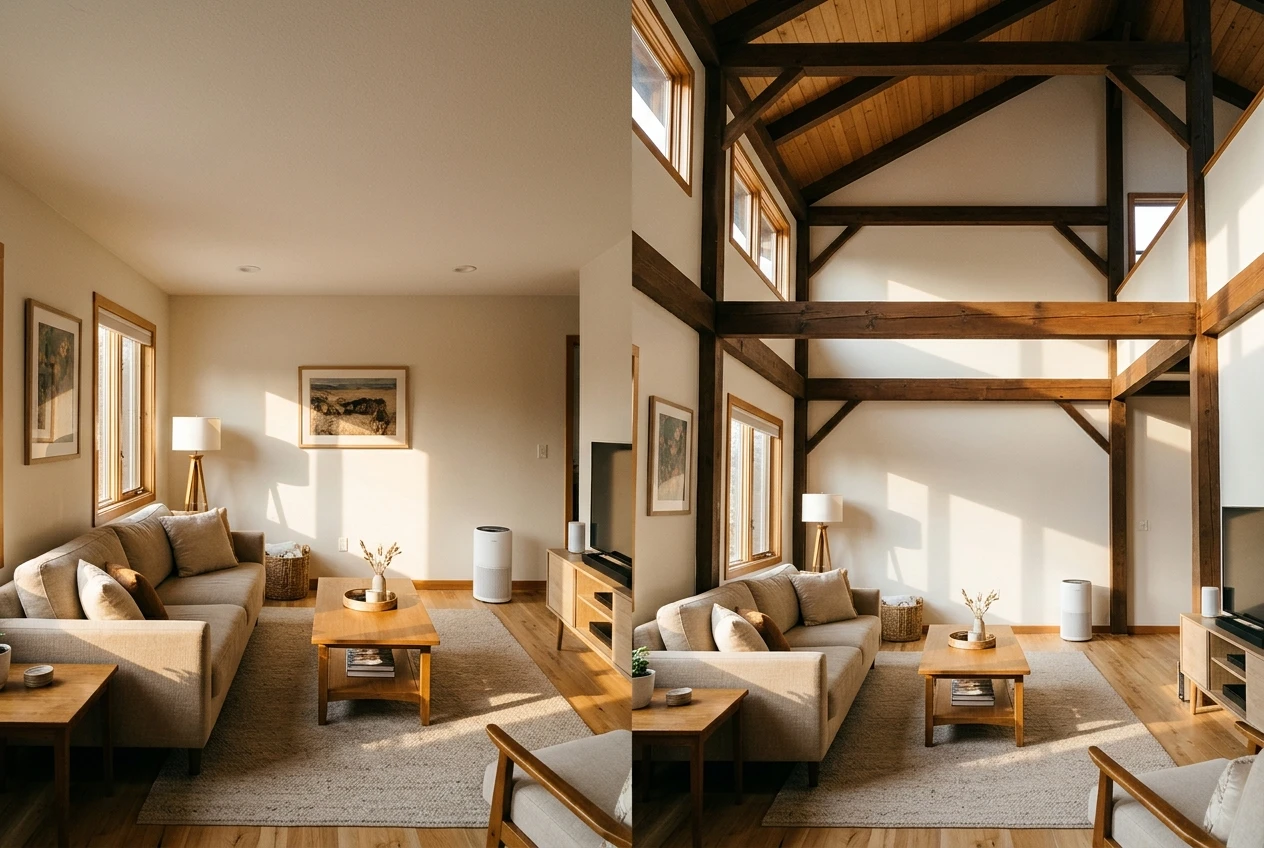
A vaulted ceiling needs average height, not peak height
A 432-square-foot room with a flat eight-foot ceiling holds 3,456 cubic feet. The same area with a flat fourteen-foot ceiling holds 6,048 cubic feet—75% more air.
A vault that only reaches fourteen feet at its peak is different. For a simple ceiling with straight, uniform slopes from eight-foot side walls to a fourteen-foot ridge, the average height is (8 + 14) ÷ 2 = 11 feet. That room holds about 4,752 cubic feet, not 6,048. This shortcut does not apply to every ceiling shape; break complicated geometry into sections.
2. Look for CADR, not simply “airflow”
CADR stands for clean air delivery rate. It describes particle-cleaning delivery by the complete appliance. Raw airflow describes air movement; it does not account for particle removal in the same way. The two numbers are not interchangeable.
AHAM lists separate CADR scores for smoke, dust, and pollen. Record the category as well as the number so that every finalist is compared on the same basis. Smoke CADR is a useful starting point for the sizing guidance discussed here; it does not measure smoke-gas removal.
- Check units: 1 cfm is approximately 1.70 m³/h. A listing of 400 m³/h is about 235 cfm, not 400 cfm.
- Check the setting: identify the fan speed and filter configuration behind the rating.
- Check evidence: distinguish an independently verified rating from an unexplained marketing claim.
- Keep missing data visible: ask support for CADR if the listing supplies only raw airflow or coverage.
The EPA distinguishes particle filtration from gas removal. Odors and gases require separate attention to the filter media and the source. A large particle CADR does not make a purifier a substitute for appropriate cooking ventilation.
Why two “1,000 sq ft” claims can mean different things
Coverage can be calculated at different equivalent air-change rates and ceiling heights. AHAM Verifide suggested room sizes use 4.8 air changes per hour. A headline based on one per hour is not directly comparable.
As a hypothetical example, an eight-foot-high, 1,000-square-foot room contains 8,000 cubic feet. One equivalent clean-air change per hour would require about 133 cfm. At 4.8 per hour, the calculation becomes 640 cfm. The floor area stayed the same; the cleaning-rate assumption changed substantially.
3. Calculate a target you can compare consistently
Here, “equivalent clean-air changes per hour” means the particle-cleaning delivery expressed relative to room volume. It is a sizing model. It does not mean every parcel of air passes through the filter that many times, and it is not a rate of outdoor-air ventilation.
The two formulas
Equivalent clean-air changes per hour = CADR in cfm × 60 ÷ room volume in cubic feet.
Required CADR in cfm = target equivalent changes per hour × room volume in cubic feet ÷ 60.
For metric measurements: CADR in m³/h = target equivalent changes per hour × room volume in m³. Do not divide by 60 when both quantities already use hours.
Use 4.8 as a consistent comparison benchmark tied to AHAM’s room-size basis, rather than as a universal health threshold. Actual needs depend on the pollutant source, layout, incoming air, and operating conditions.
| Comparison rate | Calculation | CADR target |
|---|---|---|
| 4.8 equivalent changes/hour | 4,968 × 4.8 ÷ 60 | 397.44 cfm; round up to 398 |
| 5 equivalent changes/hour | 4,968 × 5 ÷ 60 | 414 cfm |
For the simple vaulted example with 4,752 cubic feet, the same 4.8 comparison target requires about 381 cfm after rounding up. For a flat fourteen-foot ceiling and 6,048 cubic feet, it requires about 484 cfm. Correct ceiling geometry changes the shopping brief.
| Floor area | Flat ceiling height | Room volume | CADR in cfm |
|---|---|---|---|
| 400 sq ft | 8 ft | 3,200 cu ft | 256 |
| 500 sq ft | 9 ft | 4,500 cu ft | 360 |
| 600 sq ft | 10 ft | 6,000 cu ft | 480 |
| 800 sq ft | 10 ft | 8,000 cu ft | 640 |
These are arithmetic examples, not a product ranking, a measured room assessment, or a guarantee that one unit will serve every corner.
Where the familiar two-thirds rule fits
AHAM’s general rule of thumb calls for smoke CADR in cfm of at least two-thirds of room area in square feet for ceilings up to eight feet. It works out to roughly five equivalent changes per hour at that height. Higher ceilings require additional capacity.
AHAM gives separate wildfire-smoke guidance: smoke CADR at least equal to the room’s square footage, with higher ceilings needing additional consideration. Do not treat the ordinary 4.8 comparison table as a complete wildfire plan or a gas-removal recommendation.
4. Match clean-air delivery and sound at the same speed
A purifier that meets your target only on an intolerably loud setting is a poor fit for television, conversation, or work calls. The useful question is: what delivery can I maintain at a sound level I will accept?
- Record your calculated CADR target.
- Find the speed associated with the published CADR.
- Find noise information for that same speed and note the test conditions.
- Ask for CADR at other speeds if you plan to use them.
- Keep quiet-speed performance marked unknown when the manufacturer does not provide it.
A larger model may provide adequate delivery at a quieter setting, but that is not automatic. A “60%” app setting does not establish 60% of maximum CADR. Fan speed, airflow, filtration, and noise do not necessarily scale together.
During the return window, listen from your normal seat at the intended setting. Notice tonal whines, rattles, drafts, and whether you keep turning the fan down. This checks comfort; it does not measure CADR.
5. Let the sensor inform you without declaring the whole room clean
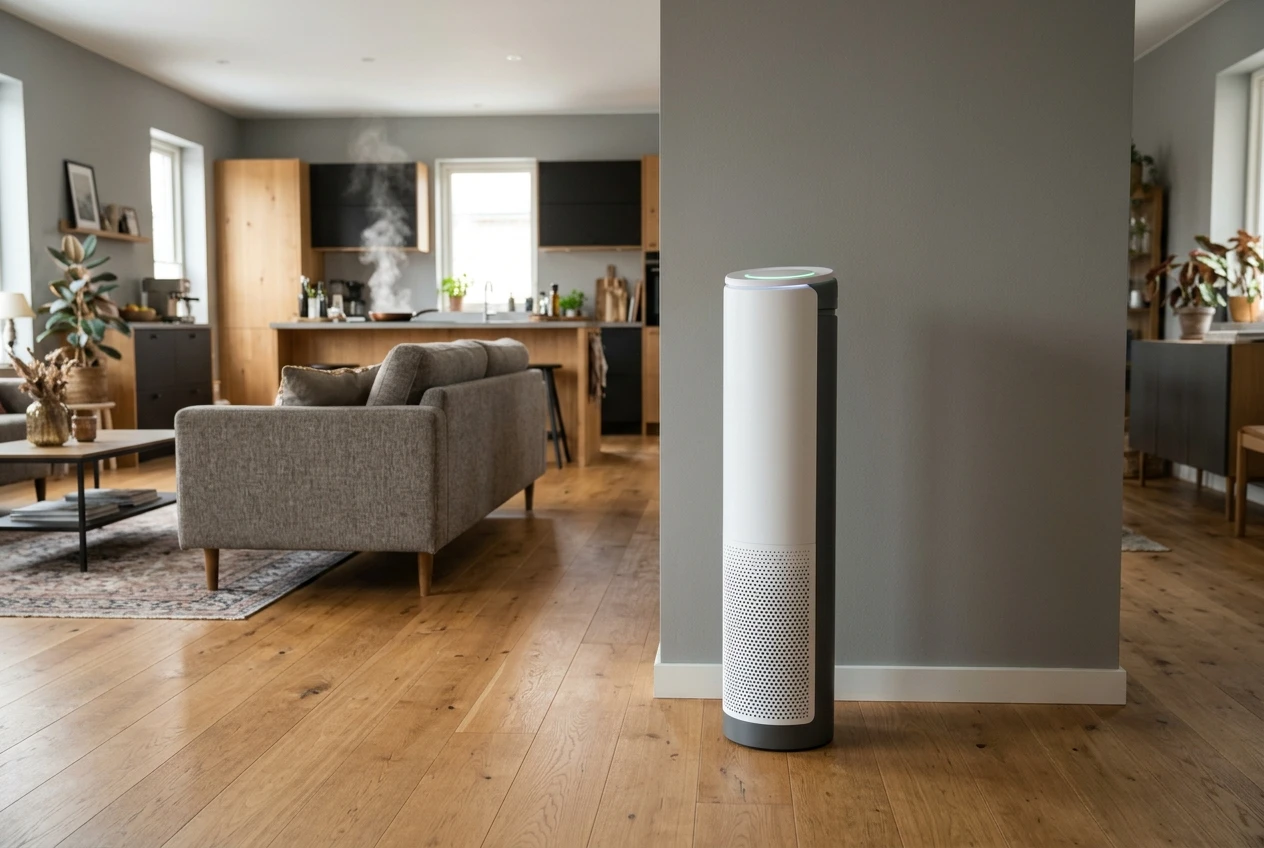
A purifier sensor samples nearby air and has model-specific detection limits. A difference between the kitchen and sofa readings may reflect a real local difference, a sensor limitation, or changing conditions. Neither a green light nor a plausible-looking graph proves accuracy everywhere.
Review what Auto mode measures, how low it can run, and whether it can select the highest fan speed. If you want predictable delivery, use a manual setting with supporting performance data. “Medium” is not a standardized cleaning rate.
Keep the intake and outlet clear, follow the required surface and clearance instructions, and avoid locations exposed to splashes, heat, or direct humidifier mist. Consider HVAC airflow without assuming that every nearby vent helps or harms every purifier.
A separate consumer particle monitor may help you explore patterns in different occupied areas, but it is not a certification test. Do not deliberately create smoke or aerosols to test the purifier. Record normal activities, placement, and operating settings when interpreting trends.
6. Compare one large unit with two units serving different zones
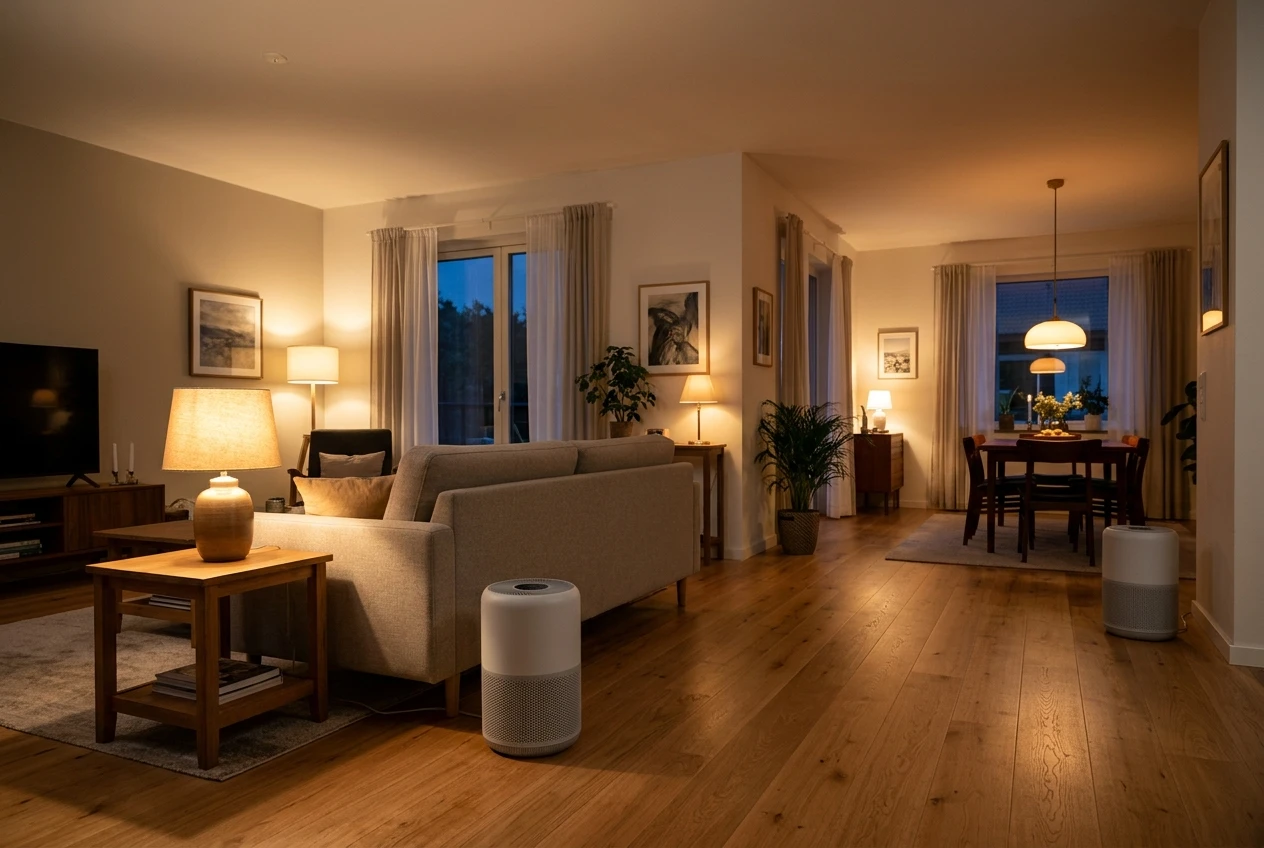
One unit gives you one maintenance location and one set of controls. Two can offer more placement options in a long or L-shaped space. Neither arrangement wins automatically.
| Decision | One larger unit | Two units |
|---|---|---|
| Placement | Needs one suitable spot with the specified clearances. | Needs two suitable spots, outlets, and unobstructed airflow paths. |
| Room shape | May suit a well-connected space with good mixing. | May help serve distinct seating and dining zones. |
| Sound | One sound source; verify the required speed. | Two sound sources; lower individual speeds do not guarantee a quieter overall result. |
| Maintenance | One appliance, potentially multiple cartridges. | Both appliances need filters and permitted cleaning. |
| Flexibility | Capacity remains where the unit is placed. | Moving one elsewhere reduces delivery in the living area. |
In a simplified, well-mixed shared space, CADRs from simultaneous operation can be added for a planning estimate. Two units each delivering 210 cfm at their chosen settings total 420 cfm on paper—about 5.07 equivalent changes per hour in our 4,968-cubic-foot example.
That does not prove equal cleaning around corners or through narrow openings. If 210 cfm is each unit’s maximum, the calculation requires that rated setting, not two quiet modes. For partly separated zones, calculate each zone’s needs and consider the exchange between them instead of relying solely on a combined total.
Build a shortlist you can explain
For each candidate or two-unit setup, record:
- Room fit: measured volume, target rate, and calculated CADR.
- Evidence: exact model, particle category, CADR units, fan speed, and source link.
- Comfort: noise at that setting, physical footprint, and required clearances.
- Replacement filters: exact code, cartridges per change, pack contents, delivered price, and manual’s interval.
- Smart controls: the schedules or remote functions you will use, plus what works without internet.
- Unknowns: missing quiet-speed data, unclear filter availability, or unanswered placement questions.
Compare purchase price, actual filter purchases, electricity, and confirmed fees over the same ownership period. Two purifiers mean accounting for both. Do not compare a pack price with a full-change price or count an included new filter twice.
Use ENERGY STAR’s air-cleaner guidance to consider efficiency alongside delivery. If you are evaluating alternative replacements, our original-versus-compatible filter guide explains why fit and performance need separate checks.
Put your room measurements to work
The free Smart Air Purifier Fit & Filter Planner includes room-fit, filter-match, cost, and maintenance worksheets. Add your connected-space measurements and the fan-speed evidence for each finalist.
Get the free Fit & Filter Planner
The planner page offers email delivery of the printable workbook.
Keep the delivery you paid for
Follow the exact manual’s inspection, cleaning, and replacement instructions. A large room alone does not establish a filter’s lifespan; pollutant loading, runtime, filter design, and operating conditions matter.
Unplug before permitted maintenance. Clean only the parts and layers the manufacturer allows. A washable prefilter does not make the main filter washable, and filter color alone does not establish remaining performance.
If output seems weaker, compare the same manual setting and check for obstructions or installation issues. Use our weak-airflow troubleshooting guide before replacing the whole machine. Revisit placement after furniture changes and record maintenance dates.
Four-question knowledge check
Choose your answer, then open the explanation.
1. Is “covers 1,000 sq ft” enough to compare two purifiers?
No. Find the ceiling-height assumption, equivalent air-change rate, CADR category, units, and fan setting.
2. Our 4,968-cubic-foot space needs what CADR for five equivalent changes per hour?
414 cfm: 4,968 × 5 ÷ 60. This is a sizing calculation, not a guarantee of uniform cleaning.
3. A simple vault rises from eight-foot walls to a fourteen-foot ridge. Do you use fourteen feet everywhere?
No. For the uniform straight-sloped geometry described here, average height is eleven feet. More complex ceilings need a section-by-section calculation.
4. Two units have maximum CADRs of 210 cfm each. Can you count 420 cfm when both run on low?
Not without supporting data. Add the delivery at the actual settings, not maximum ratings from settings you are not using.
Large living room air purifier FAQs
How much CADR does a 600-square-foot room need?
At an eight-foot flat ceiling and a 4.8 comparison rate, the calculation is 384 cfm. At ten feet, it becomes 480 cfm. Include connected space you intend to serve and check the intended fan speed.
Is CADR the same as airflow?
No. CADR describes particle-cleaning delivery. Raw airflow describes air movement and cannot be substituted directly in this sizing method.
Can one purifier serve an entire open-plan floor?
Possibly, depending on volume, layout, delivery, and placement. A combined square-foot figure alone does not establish effective cleaning in every zone.
Does a green indicator mean the far end of the room is clean?
No. It reports a sensor-based status near the appliance, within the limits of that sensor and the manufacturer’s thresholds.
Should I always buy two smaller purifiers?
No. Compare documented delivery, sound, placement options, and ownership costs for both arrangements. Two units can improve flexibility but add maintenance locations.
Choose for the room you have and the speed you will use
A useful shortlist starts with measured volume, a consistent CADR target, and evidence at a tolerable fan setting. The app comes after those decisions.
What makes your living room tricky: a vaulted ceiling, an open kitchen, or an L-shaped layout? Share your measurements and the exact models you are comparing in the comments. Include whether the ceiling height is flat, average, or peak.
Sources reviewed November 12, 2026: AHAM air-change FAQ, AHAM filtration and sizing guidance, EPA home air-cleaner guide, and ENERGY STAR air cleaners. Calculations use the dimensions stated in each example.