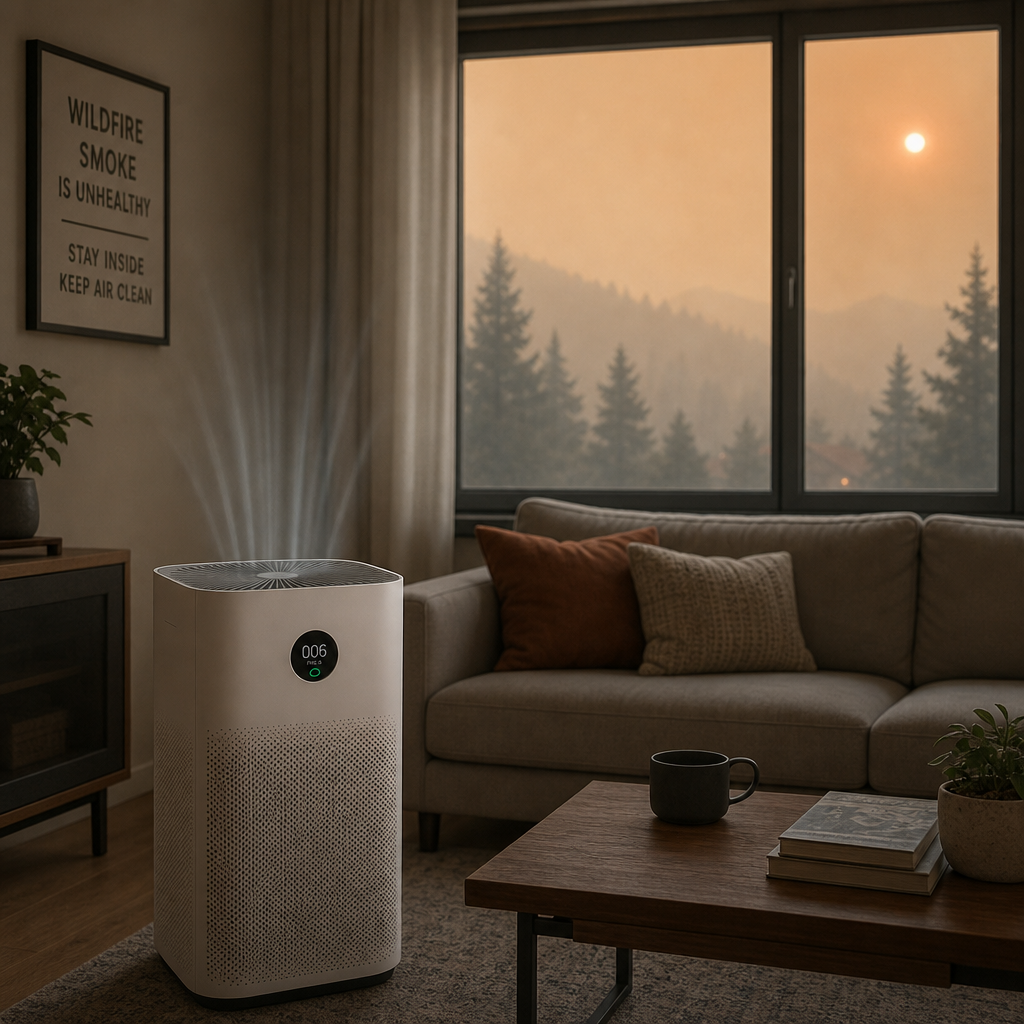
Smoke-ready air purifier guide
Wildfire Smoke Can Move Fast. Your Air Purifier Plan Should Be Ready First.
When smoke is already in the forecast, the best purifier is not just the one with the flashiest app. It is the one that is correctly sized, has a clean filter, can run at a useful speed, and is placed in the room where your household spends the most time.
Quick answer
What should you check before using an air purifier for wildfire smoke?
Check four things first: the room’s square footage, the purifier’s smoke CADR, the condition and exact fit of the filter, and whether the unit can run continuously at a speed you can tolerate. For wildfire smoke, AHAM recommends choosing a smoke CADR roughly equal to the room’s square footage. The EPA also emphasizes that portable air cleaners should be sized for the room and that particle filtration is different from gas or odor control.
A smart purifier can help by automating schedules and fan speeds, but smart features cannot overcome weak CADR, blocked airflow, an overdue filter, or an active indoor pollution source.
The Smoke-Ready Comparison: What Matters Most?
| Feature | Why it matters during smoke | What to verify |
|---|---|---|
| Smoke CADR | Shows how quickly the purifier delivers filtered air for smoke-sized particles. | Look for a smoke CADR close to the room’s square footage during wildfire events. |
| Particle filter | Wildfire smoke contains fine particles that require strong particle filtration. | Confirm the filter type and replacement code for your exact model. |
| Activated carbon | Smoke odor and some gases require different media than particle filtration. | Check whether the purifier has a meaningful carbon stage, not just a thin deodorizing sheet. |
| Noise at useful speed | A purifier only helps when you actually run it. | Choose a model with enough headroom to run below maximum speed when possible. |
| Smart controls | Schedules, reminders, and auto mode can improve consistency. | Use smart features as support, not as a substitute for proper sizing and maintenance. |
A Practical Wildfire Smoke Air Purifier Plan
Pick the clean-room priority first
Start with the room where clean air matters most: usually a bedroom, nursery, home office, or living room. One properly sized purifier in a priority room is often more practical than one weak unit trying to handle the whole home.
Match smoke CADR to the room
For everyday particle concerns, the common CADR shortcut is at least two-thirds of the room’s square footage. For wildfire smoke, use the more protective smoke-ready target: smoke CADR close to the room’s square footage.
Inspect the filter before the air gets bad
A clogged, overdue, or incorrect filter reduces airflow when you need performance most. Similar-looking filters can differ in size, seal quality, airflow resistance, and carbon content.
Move the purifier into open air
Placement matters. A purifier tucked behind furniture, curtains, laundry, or a tight corner may move less room air through the filter.
Use smart features before the spike
Smart scheduling can help you run the purifier harder before bedtime or before smoke levels rise. Filter reminders can also prevent maintenance surprises.
What an Air Purifier Can and Cannot Do During Wildfire Smoke
Can help reduce particles
A properly sized portable air cleaner with strong particle filtration can reduce airborne smoke particles in the room where it runs.
Can support a cleaner room
Used with closed windows, reduced indoor pollution sources, and appropriate HVAC filtration, a purifier can be part of a practical smoke plan.
Cannot solve everything
It cannot remove every pollutant, replace source control, make unsafe smoke exposure safe, or substitute for medical advice or emergency guidance.
Interactive knowledge check
Are You Smoke-Ready?
Answer four quick questions before relying on your purifier during an air-quality alert.
Reader check-in
What Is Your Smoke-Season Setup?
If you already use an air purifier during wildfire smoke, share what has worked: the room size, purifier model, fan setting, filter schedule, and whether you use a smart routine. Real household details help other readers avoid guesswork.
- Which room do you treat first?
- What smoke CADR does your purifier list?
- How often do you inspect the filter during smoke season?
- Do you use auto mode, manual fan speed, or a schedule?
FAQs About Air Purifiers and Wildfire Smoke
Is a HEPA air purifier good for wildfire smoke?
A properly sized purifier with strong particle filtration can help reduce smoke particles in the room where it runs. The key is matching the purifier’s smoke CADR to the room and keeping the filter maintained.
Do I need activated carbon for wildfire smoke?
Particle filtration addresses smoke particles. Activated carbon or other gas-focused media is relevant for certain odors and gases, but the amount and design of the carbon stage matter. A thin deodorizing layer is not the same as a substantial carbon filter.
Should I use auto mode during smoke?
Auto mode can help when the sensor is reliable, but manual control may be better during a known smoke event. If outdoor AQI is poor or smoke is visible or smelled, consider running the purifier at a higher comfortable speed instead of waiting for the sensor to react.
Can one purifier clean my whole house?
Usually not unless the home is small and open, and the purifier is sized for the connected space. Most homes do better by prioritizing one clean room, then adding broader HVAC filtration or additional room units where needed.
What should I do after several smoky days?
Inspect the pre-filter and main filter according to the manual, wipe dust from approved sensor areas, keep airflow clear, and confirm that the filter-life reminder still makes sense based on real conditions.
Continue learning
Related Best Smart Purifiers Guides
Complete Air Purifier Guide
Start here for CADR, room size, filtration, noise, and maintenance basics.
Read the complete guideSmart Air Purifiers Guide
See how sensors, schedules, apps, and routines can support daily air cleaning.
Explore smart featuresHEPA, Carbon, and Beyond
Compare particle filtration, carbon media, and optional technologies without the fluff.
Compare filter technologiesTrue Cost of Ownership
Check filter cost, electricity use, and maintenance before buying or upgrading.
Review ownership costsEditorial note: BestSmartPurifiers.com provides research-based consumer education. Air purifiers can reduce certain airborne pollutants when properly sized, placed, and maintained, but they do not remove every pollutant or replace source control, ventilation when appropriate, public-health guidance, certified safety alarms, medical care, or emergency instructions.