Room-first decisions · S.M.A.R.T. Method
Using one air purifier for two rooms sounds practical: office by day, bedroom by night. But what happens in the room you leave behind?
Moving one purifier can be a workable compromise. The catch is the gap in each room’s filtration schedule. Before buying another machine, check whether your two rooms need cleaner air at different times—or at the same time.
Research-based guidance; no hands-on product testing is claimed. This article includes an affiliate link. We may earn a commission at no added cost to you.
Can one air purifier serve two rooms?
Yes—at different times, provided it has enough clean-air delivery for each room and can be moved safely. Sharing works best when room use happens at different times and you can reliably move, restart, and run the unit. It does not provide continuous filtration in both rooms.
If both rooms are occupied together, moving the purifier is inconvenient, or one room needs sustained filtration, consider keeping it in the priority room or budgeting for a second appropriately sized unit.
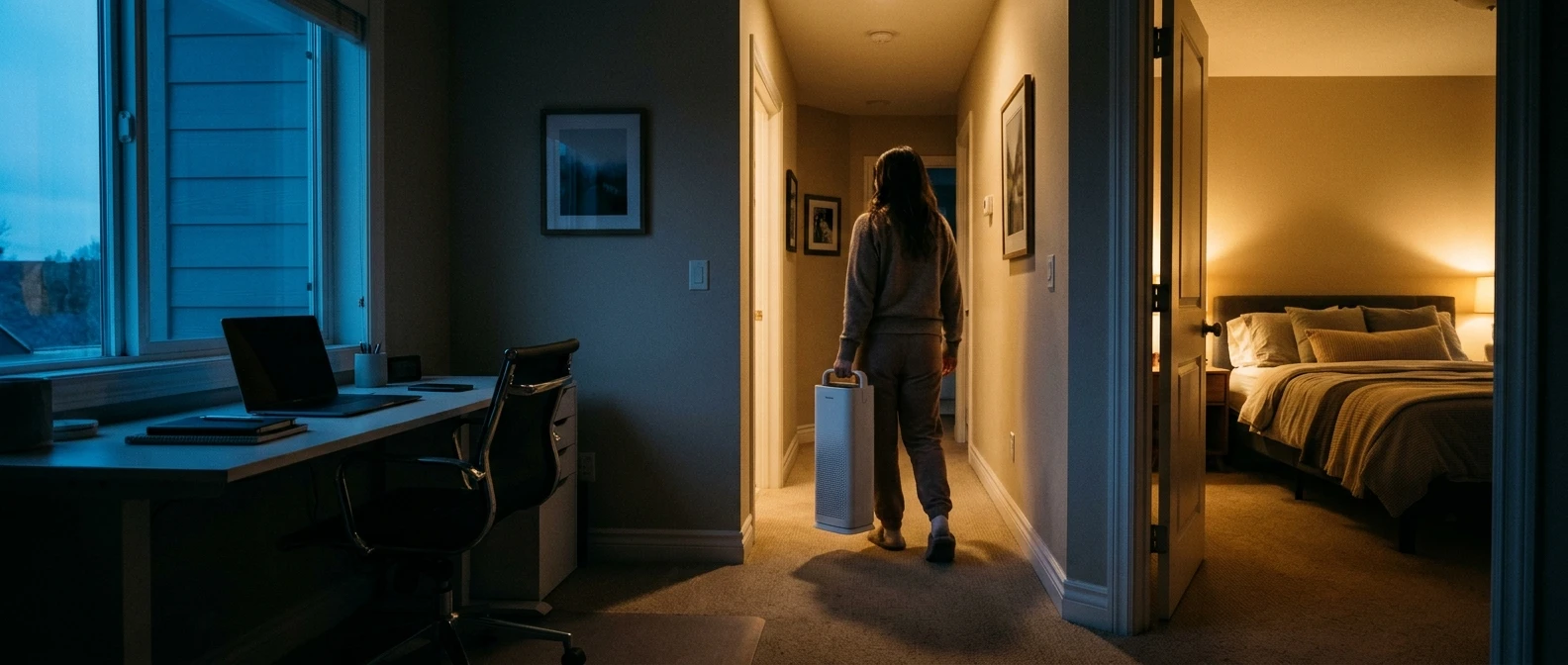
The hidden trade-off: the room without the purifier
A purifier is not a cleaning service that finishes a room and leaves it permanently done. People, pets, household activities, and incoming air can introduce more particles. Once you carry the machine away, that room loses the filtration that particular unit was providing.
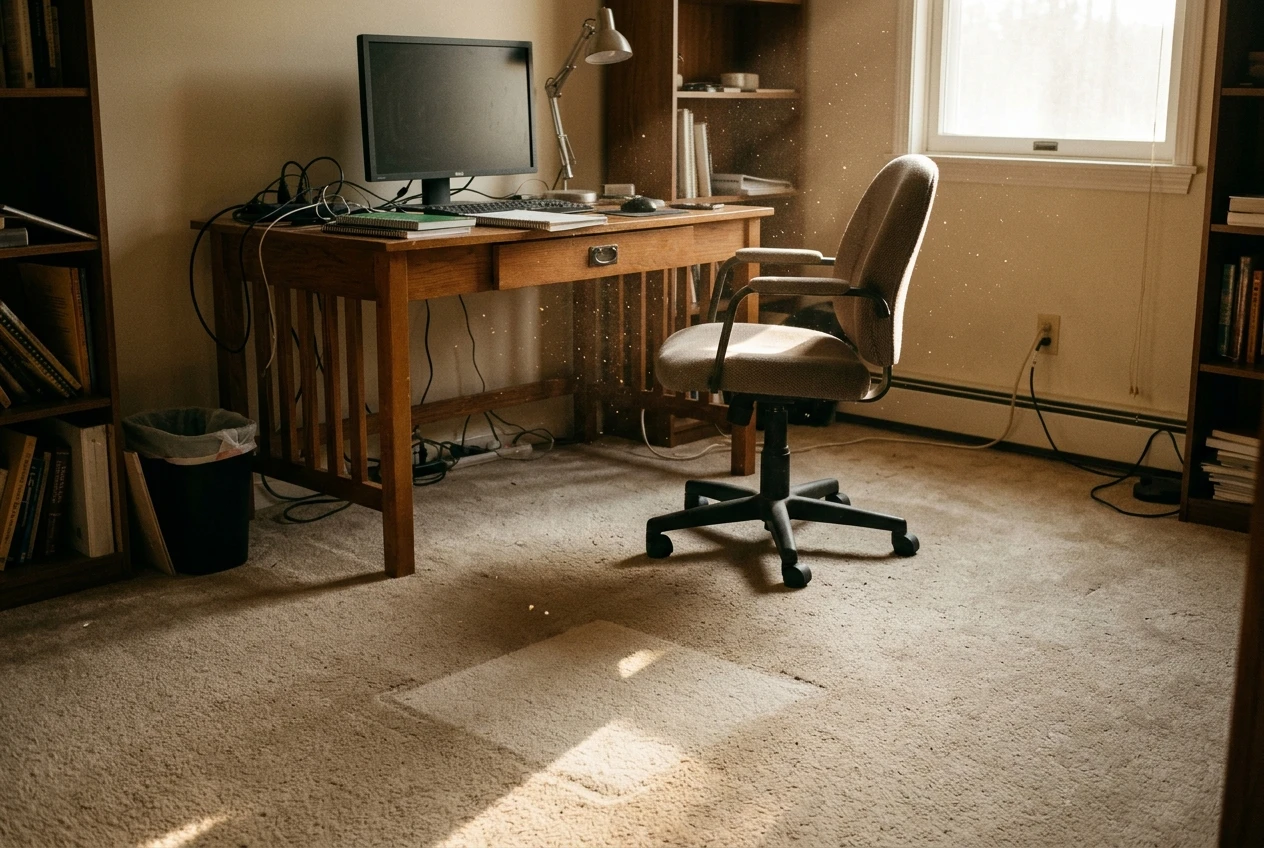
That does not mean particle levels instantly return to where they started. It means you cannot assume the earlier improvement lasts until you return. Other filtration, sources, and air exchange still matter.
The EPA’s home air-cleaner guide describes portable units as tools for a single room or area and explains that longer operation and higher fan speeds generally increase filtration. Moving the unit changes where those operating hours happen.
Move it, leave it, or add a second unit?
| Setup | When it makes sense | Trade-off |
|---|---|---|
| Move one purifier | One person uses an office by day and a bedroom at night. | Each room has gaps; carrying and restarting become daily tasks. |
| Keep one in the priority room | The bedroom or another room matters most, or moving is difficult. | The other room needs its own source-control and filtration plan. |
| Use two purifiers | People occupy separate rooms at the same time. | Two purchases, filter schedules, and electricity costs. |
| Serve one connected area | The rooms function as a genuinely open space. | Size for the connected area; doorways and uneven mixing still limit distribution. |
A hallway is not an automatic compromise. Putting the machine between two rooms does not establish that enough cleaned air reaches either one. Start with your purifier placement and the whole-room coverage check.
Size the purifier for both stops on its route
For separate rooms used one at a time, evaluate each room individually. Do not add their floor areas as though they were one open room—but do not size only for the smaller room either.
As a general starting point for ceilings up to eight feet, AHAM recommends smoke CADR of at least two-thirds of floor area. CADR here is in cubic feet per minute (cfm). Higher ceilings require additional consideration. This is a sizing estimate, not a guarantee of actual room performance.
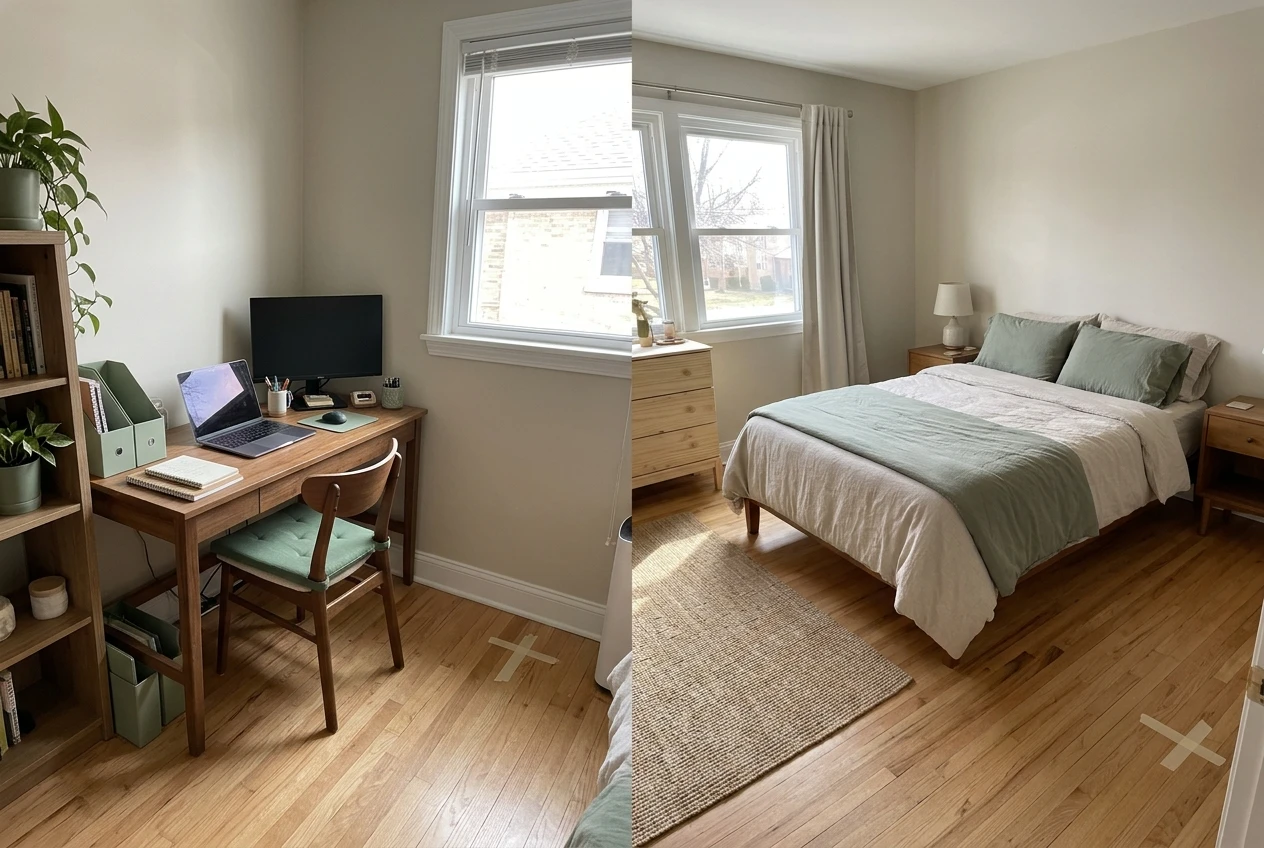
General starting smoke CADR: 80 cfm
General starting smoke CADR: 120 cfm
Check ratings through the AHAM directory page and the manufacturer’s specifications. Also check which speed produced the rating. A machine you tolerate on high at a desk may be too loud at the same setting beside a bed. Your sleep-mode routine belongs in the decision.
Try a three-day “where was it running?” log
This is a routine check, not a laboratory experiment. Its purpose is to find missed filtration time before you spend money.
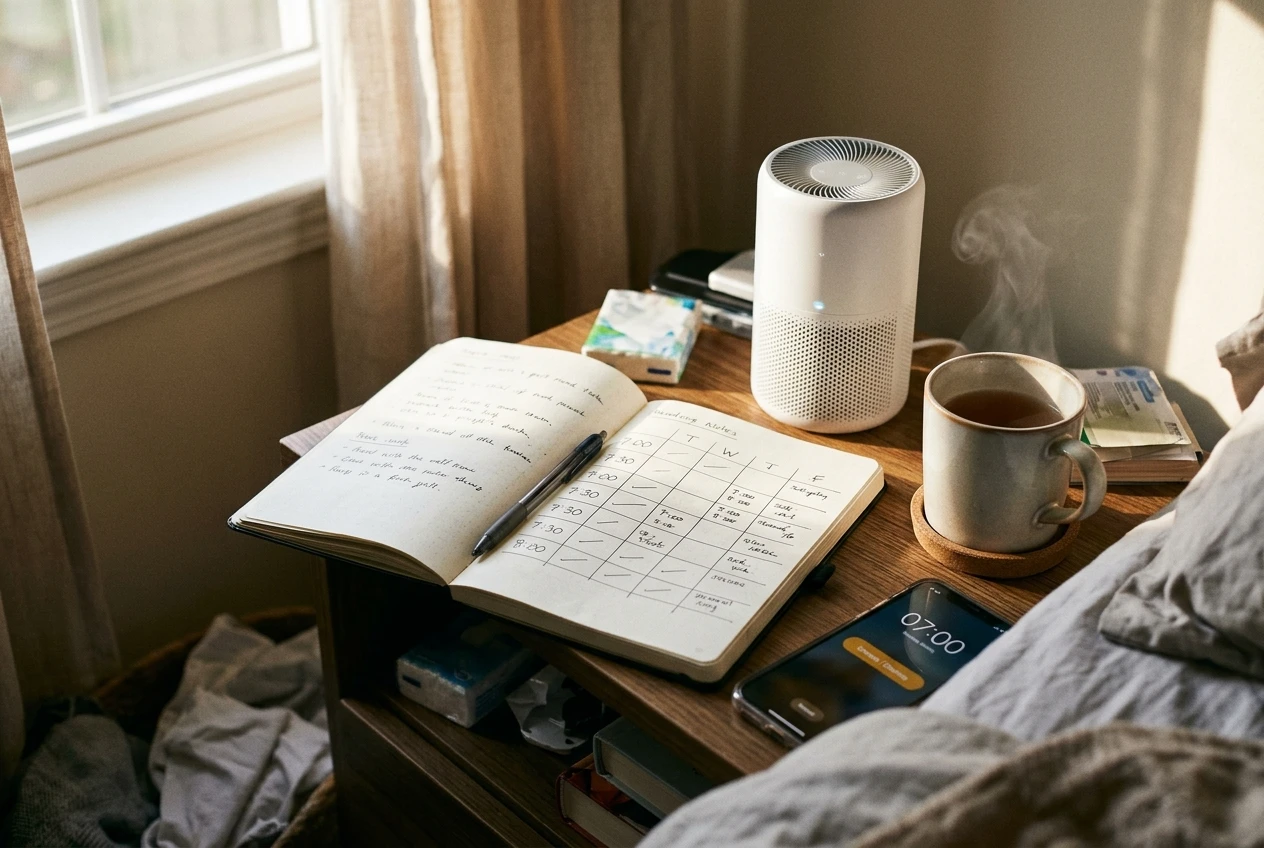
- Choose two safe parking spots. Follow the manual’s placement clearances. Keep the unit stable, vents clear, and cords out of walkways. Turn it off and unplug it before moving; follow its carrying instructions.
- Write down occupied hours. Include other household members. “I leave the living room at ten” is not enough if someone stays there until midnight.
- Set a realistic handoff. Move the purifier when the room priority changes. If practical, start filtering the next room before settling in, while acknowledging the earlier room then loses that unit.
- Check the restart. Confirm that the fan is running at the intended setting. Review timers, sleep settings, and app schedules after unplugging; behavior is model-specific.
- Record what actually happened. Note room, start and stop time, fan setting, door position, household activities, and any forgotten move. Repeat for three ordinary days.
There is no universal “run it for 20 minutes and the room is done” rule. Avoid turning an arbitrary timer into a cleanliness claim. If you already own a separate PM2.5 monitor, use consistent locations away from the purifier’s outlet and compare repeated trends. Do not create smoke or spray aerosols to test the machine.
No monitor? You can still identify scheduling conflicts, blocked airflow, undersizing, and a routine you do not maintain. Those observations are useful; they do not measure particle concentrations.
Know when sharing has reached its limit
Consider a second unit when the log repeatedly shows two occupied rooms needing filtration together, the larger room exceeds the machine’s useful capacity, or carrying the purifier means it often stays switched off.
If the budget allows only one, give it a clear priority. A consistently used unit in the room that matters most may be more practical than a complicated route you abandon.
During wildfire smoke, use a dedicated cleaner-air plan. The EPA’s cleaner-air-room guidance recommends continuous operation on the highest fan setting in the designated room, with doors and windows closed when safe. Do not interrupt that room’s plan just to follow an everyday sharing schedule. Follow local smoke, heat, and emergency guidance.
Filtration also does not replace removing pollutant sources or appropriate ventilation. A purifier is not a carbon-monoxide alarm, and a low particle reading does not establish that every pollutant is absent.
Give each room a page in your planner
Use the free Smart Air Purifier Fit & Filter Planner to record each room’s dimensions, ceiling height, CADR target, and filter details. Add your occupied hours and the three-day log beside the worksheets.
For a second-unit comparison, record purchase price, exact replacement-filter code, expected filter expense, and energy use. For the shared-unit option, record the actual total runtime across both rooms. Moving it does not restart the filter’s service life.
Get the free Fit & Filter Planner
The planner page requests your email to receive the workbook.
Check the filter before blaming the schedule
If performance seems to have changed, inspect the intake, pre-filter, main filter installation, and service reminders according to the exact manual. Do not assume a new unit is necessary before addressing an overdue maintenance task.
If a replacement is due, match the complete purifier model and specified filter code before shopping. Confirm compatibility, package contents, and return terms; appearance alone is not enough.
Check replacement-filter listings at Filters Fast (affiliate link; opens a new tab) .
We may earn a commission at no added cost to you. Availability for your exact model is not guaranteed. A replacement filter will not solve a conflict between two rooms that need the purifier at the same time.
Four-question knowledge check
Choose A or B in your head, then tap each question to reveal the answer. Give yourself one point for each correct choice.
1. Both rooms are occupied at once.
A: Sharing gives continuous filtration in both.
B: Sharing leaves a gap.
Answer: B. One portable unit cannot provide its direct filtration in two separate rooms at the same time. Prioritize a room or evaluate separate units.
2. The office is smaller than the bedroom.
A: Check capacity for each room.
B: Check only the office.
Answer: A. A good fit in the smaller office does not establish adequate capacity in the larger bedroom.
3. You moved and plugged it in.
A: Assume the schedule resumed.
B: Check fan operation and settings.
Answer: B. Restart behavior varies by model. Check that the fan is running at the intended speed and that schedules still match your routine.
4. The purifier leaves the bedroom.
A: Earlier cleaning guarantees low particles all day.
B: Conditions can change afterward.
Answer: B. New particles and air exchange can change conditions while that purifier is elsewhere. Earlier filtration is not a guarantee for the rest of the day.
4/4: ready to plan your routine. 2–3/4: revisit the room-size and timing checks. 0–1/4: start with the quick answer. This self-check works without JavaScript.
Frequently asked questions
Can I move my air purifier every day?
Check the model’s handling instructions, weight, and carrying features. Daily moves are useful only if you can do them safely and consistently. Switch off and unplug it before moving. Use the intended handle or grip; do not lift by a removable filter cover or pull by the cord.
Should I buy two small purifiers or one larger one?
Start with layout and occupied hours. Separate rooms used together favor separately sized units. One larger unit may suit a single open area, but its rating does not guarantee even cleaning through doorways. Compare useful fan speeds, replacement filters, and total ownership costs.
Does opening both doors let one purifier clean both rooms?
Some air may mix, but an open doorway does not guarantee enough exchange to clean both rooms evenly. Reassess the connected area and actual room conditions rather than assuming the original room rating covers both.
Does moving the purifier use up the filter faster?
The number of rooms is not a replacement schedule. Track total runtime, pollutant conditions, and the manufacturer’s maintenance guidance. Running through both the workday and the night creates a different service history from occasional use.
Which room loses out in your routine?
Share your two rooms, approximate sizes, purifier model, and usual occupied hours in the comments. Does your purifier make the trip every day—or does it tend to stay in one room? That detail may be more useful to another reader than the largest coverage number on the box.
Sources are linked beside the relevant guidance. The room-sharing comparison and three-day log are practical planning suggestions, not validated performance tests or guarantees of indoor-air safety.