You pull out a gray filter, reach for the vacuum, and watch the loose dust disappear. The filter looks better in seconds—so cleaning it must have saved the cost of a replacement, right?
Not necessarily. An air purifier can contain several layers, and each one may have different instructions. A mesh pre-filter may be designed for vacuuming or rinsing, while the main particle filter or carbon layer may be disposable. The safe question is not simply whether a vacuum can remove visible dust. It is whether the manufacturer approves that cleaning method for that exact layer in that exact model.
Reader-first affiliate disclosure: This guide includes one FiltersFast affiliate link for readers who have already confirmed that their filter requires replacement. BestSmartPurifiers.com may earn a commission from a qualifying purchase at no added cost to you. The link does not change the clean-versus-replace checks used in this article. Read the full affiliate disclosure.
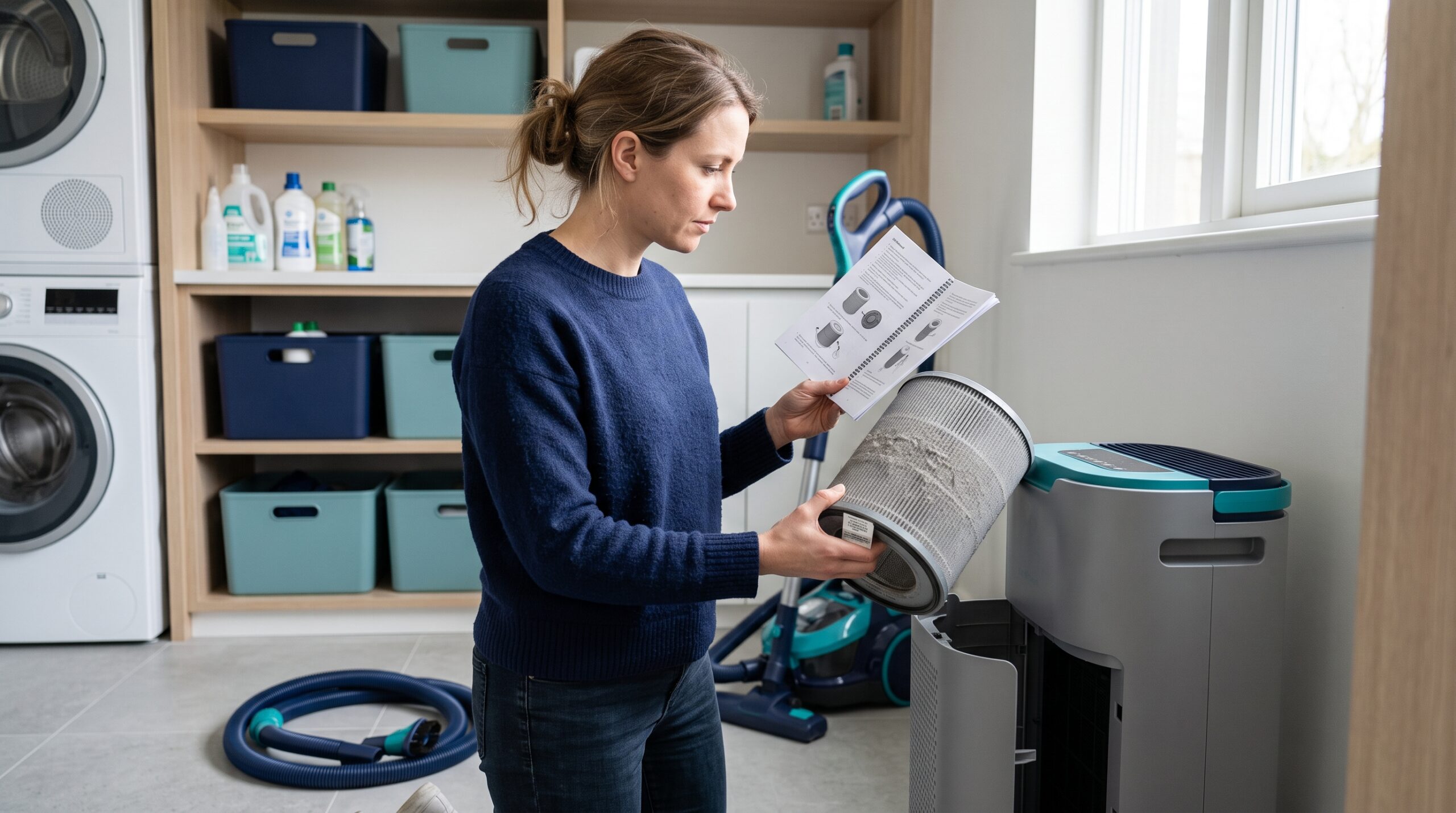
Can You Vacuum an Air Purifier Filter?
Sometimes—but only when the instructions for your exact purifier and filter layer allow it. Many removable mesh, fabric, or screen pre-filters can be gently vacuumed. Some can also be rinsed and fully air-dried. Many main HEPA-style particle filters and activated-carbon filters are designed for replacement, not washing or aggressive cleaning.
Vacuuming an approved pre-filter can remove hair and coarse dust that would otherwise restrict airflow. Vacuuming a disposable main filter does not make it new again, restore odor-saturated carbon, or override its replacement schedule. If the manual does not identify a layer as cleanable, treat that uncertainty as a reason to pause—not as permission to experiment.
BestSmartPurifiers takeaway: Identify the layer first. Follow the exact manual second. Clean only what the manufacturer calls serviceable, and replace what the purifier was designed to discard.
The Filter Is Usually a Stack, Not One Washable Object
Calling the entire cartridge “the filter” hides the decision that matters. A purifier may combine a coarse pre-filter, a fine particle filter, activated carbon, and a rigid frame in one cartridge. Another model may make each stage removable.
That design difference is why a cleaning method that is correct for one purifier can be wrong for a similar-looking unit.
| Layer or part | What it usually does | Possible maintenance | Do not assume |
|---|---|---|---|
| Mesh, screen, or fabric pre-filter | Catches larger hair, lint, and coarse dust before they reach the main filter. | Some models permit gentle vacuuming, wiping, rinsing, or washing. | “Pre-filter” does not automatically mean washable. Some odor pre-filters are disposable. |
| Main HEPA or HEPA-style particle filter | Captures fine airborne particles that pass through the purifier. | Often inspection and replacement. Limited surface vacuuming is allowed only on some models. | A cleaner-looking surface does not prove the media is restored or undamaged. |
| Activated-carbon sheet or granules | Helps adsorb certain odors and gases, depending on the amount and design. | Usually replacement according to the product instructions. | A vacuum cannot restore carbon that has become saturated with adsorbed compounds. |
| Combined cartridge | Packages particle and odor stages into one replacement part. | Follow the cartridge-specific instructions; serviceable layers may not separate. | Do not rinse the whole cartridge because one visible outer layer looks washable. |
| Electrostatic plate or washable collector | Collects charged particles in certain electronic air cleaners. | May require a precise cleaning and drying procedure. | Do not treat electronic collector instructions as directions for a fiber HEPA filter. |
| Sensor opening and purifier housing | Supports sensing and airflow but is not the filter media. | Careful exterior cleaning as directed by the manual. | Do not spray cleaner or blow dust into electronics or the sensor cavity. |
Do not use color alone to identify a layer. Black material may be carbon, dark foam, or a combined stage. White pleats may be a disposable main filter or part of a specialized cartridge. Match the purifier model and filter code before choosing a cleaning method.
Three Manufacturer Pages Prove There Is No Universal Vacuum Rule
The safest answer comes from the exact product manual because manufacturers do not give one shared instruction for every design.
This is not a brand contest. It is evidence that the filter’s construction and the model’s service procedure decide the answer. Even within one brand, instructions can differ by purifier family and filter generation.
The U.S. EPA’s indoor-air guidance makes the broader rule clear: long-term air-cleaner performance depends on maintenance according to the manufacturer’s directions.
Vacuuming Removes Loose Material—It Does Not Reset Filter Life
A vacuum can make a serviceable pre-filter look dramatically cleaner because hair and coarse dust sit on its exposed surface. That cleaning may reopen the intake and protect the more expensive filter behind it.
The main filter has a different job. Fine particles can load the pleated media throughout its usable area, not just where you can see a gray patch. Cleaning the visible face does not prove that original airflow, capture performance, seals, or remaining service life have returned.
Carbon creates a second limit
Activated carbon works through adsorption. When the available surface becomes loaded, odor performance can decline even if the filter still looks relatively clean. Vacuuming the surface does not remove the gases already held in the carbon or turn a thin carbon sheet into a higher-capacity odor filter.
The filter reminder is not a cleaning certificate
Some filter indicators are based on runtime, fan speed, or a manufacturer algorithm. They may be useful reminders, but they do not identify which layer is washable or prove that vacuuming has extended the main filter’s intended service interval.
If the alert itself is confusing, start with the site’s exact-model replacement-filter check. It explains how model number, filter code, fit, stages, and airflow matter before you reset the light or order a replacement.
Use This Eight-Step Check Before You Clean Any Filter
This sequence keeps visible dust from rushing you into the wrong maintenance method. It is a decision check, not a substitute for the owner’s manual.
Low-mess handling matters. The EPA advises removing used filters gently, avoiding shaking or banging, and bagging filters for disposal so captured material is not needlessly released back into the room. Follow any additional precautions in the purifier manual, especially after heavy smoke, renovation dust, or an unusual contamination event.
Six Signs You May Need Replacement, Not Another Cleaning
- The manual identifies the layer as disposable. A cleaning experiment does not override that design.
- Airflow remains weak after the approved pre-filter cleaning. The main filter may be loaded, incorrectly installed, damaged, or overdue.
- Odors return quickly. The carbon stage may be saturated, too small for the source, missing from a replacement cartridge, or facing a continuing odor source that filtration cannot solve alone.
- The media, frame, gasket, or tabs are damaged. Tears, crushed pleats, loose edges, or a poor seal can allow air to bypass the intended path.
- The filter became wet even though it is not washable. Follow the manufacturer’s instructions for replacement and inspect why moisture reached the purifier.
- The filter was heavily loaded during wildfire smoke, construction, or another unusual event. Real conditions can shorten useful life, so inspect more often and follow event-specific guidance.
The EPA’s Guide to Air Cleaners in the Home recommends replacing filters according to manufacturer instructions and adjusting the timing when filters become heavily soiled sooner than expected.
Do not keep reusing a musty or wet non-washable filter. A purifier does not correct the moisture source that caused the problem. Investigate leaks, condensation, high humidity, or damp materials, and use the site’s air purifier versus dehumidifier guide when mustiness—not airborne dust—is the real clue.
Pet Hair Makes the Pre-Filter More Important, Not the Main Filter Washable
Pet homes can load an outer screen quickly with fur, hair, lint, and coarse dust. That makes an accessible pre-filter valuable because approved maintenance can keep the intake open and slow the amount of large debris reaching the main filter.
It does not change the care instructions for the particle or carbon layers behind it. After grooming, vacuuming floors, changing bedding, or cleaning a litter area, check the pre-filter more often if the manual recommends condition-based inspection. Keep the purifier running at a useful speed, but do not use strong airflow as a substitute for source cleaning.
If pet odor is the main concern, remember that particle filtration and activated carbon do different jobs. A clean pre-filter can support airflow, but it cannot renew carbon that no longer controls odor effectively.
Put the Clean-or-Replace Decision Into the Fit & Filter Planner
The free 15-page Smart Air Purifier Fit & Filter Planner is useful after purchase, not just while shopping. Add these details to the maintenance page for each purifier:
- Purifier brand and exact model number
- Main filter code and package quantity
- Each filter layer and whether it is vacuumable, washable, or replaceable
- The manual URL or page number containing the maintenance instructions
- Date the pre-filter was cleaned and the main filter was replaced
- Normal fan speed, household conditions, and any unusual smoke or dust event
- Observed airflow, noise, odor, and filter condition before and after service
- Replacement cost and seller details for first-year ownership planning
That record prevents the most common maintenance problem: remembering that something was cleaned, but forgetting which layer, which method, or which filter code the machine actually requires.
When the Manual Says Replace, Verify Before You Buy
A replacement should match more than the purifier’s shape. Confirm the full model number, manufacturer filter code, dimensions, seal, filter stages, package quantity, seller identity, and return terms. If odor control matters, verify that the replacement includes the intended carbon stage instead of assuming every lookalike cartridge is equivalent.
Already confirmed the exact replacement code?
Compare the listing against the purifier label and manual before ordering. Compatibility, construction, inventory, and seller details can change.
Check FiltersFast Availability Use the Seven-Step Filter Match CheckAffiliate link. BestSmartPurifiers.com may earn a commission at no added cost to you. Verify exact compatibility before purchasing.
Can You Tell What to Clean and What to Replace?
Reader Check-In: What Does Your Manual Actually Say?
Does your purifier use a vacuumable screen, a washable mesh pre-filter, a replaceable carbon sheet, or one combined cartridge? Share the purifier model, filter code, exact maintenance wording, and what changed after cleaning in the comments. Avoid posting serial numbers or personal information.
Real model-specific examples can help another reader stop treating every gray filter the same way.
Frequently Asked Questions
Can I vacuum a HEPA air purifier filter?
Only if the instructions for that exact purifier and filter permit it. Some manufacturers allow gentle surface vacuuming for particular filters, while others limit vacuuming to the pre-filter and require the HEPA filter to be replaced. Vacuuming does not automatically restore a disposable filter’s original performance or service life.
Can I wash an air purifier pre-filter?
Some pre-filters are washable; others should be vacuumed, wiped, or replaced. Follow the model-specific directions. If rinsing is allowed, let the component dry completely by the approved method before reinstalling it. Do not assume that a combined filter cartridge can be washed because its outer layer resembles mesh.
Does vacuuming an air purifier filter extend its life?
Approved cleaning of a serviceable pre-filter can keep coarse debris from blocking airflow and reaching the main filter. That can support the system’s maintenance plan. Vacuuming a disposable main filter does not create a new replacement interval or renew saturated activated carbon.
Why does the filter still look clean after months of use?
Visible color is only one clue. Fine-particle loading, fan speed, runtime, room conditions, placement, filter fit, and the type of particles present all affect appearance. Check airflow, installation, filter code, and the manufacturer’s schedule instead of waiting for every filter to turn dark.
Should I reset the filter light after vacuuming the pre-filter?
Reset only the indicator associated with the completed maintenance action, and only when the manufacturer’s instructions say to do so. Some purifiers track the pre-filter and main filter separately. Resetting a main-filter countdown after cleaning only the pre-filter can hide a replacement that is still due.
Can I use compressed air to clean a purifier filter?
Do not use compressed air unless the manufacturer explicitly approves it for that component. A strong air stream can spread captured dust, disturb delicate media, or push debris deeper into the purifier. Use only the cleaning tools and method named in the exact manual.
Authoritative and Manufacturer Guidance Used
Clean the Serviceable Layer—Do Not Experiment With the Expensive One
A dusty pre-filter is often a maintenance task. A loaded main filter is often a replacement task. The difference is not obvious from color, shape, or the sound of dust entering a vacuum hose.
Find the purifier model. Match the filter code. Identify every layer. Follow the exact cleaning verb in the manual. Then record what you cleaned, what you replaced, and when the next check is due.
That small pause protects airflow, filter fit, odor performance, and your replacement budget—and it is much smarter than making every filter look clean at any cost.
Editorial note: BestSmartPurifiers.com provides research-based consumer education and does not imply hands-on testing unless an article says so. Filter construction, maintenance instructions, apps, replacement schedules, seller inventory, and product specifications can change. Always follow the current manual for the exact purifier and filter. Air cleaning can reduce some airborne pollutants, but it does not replace source control, appropriate cleaning, safe ventilation when outdoor air is suitable, moisture correction, certified safety alarms, medical guidance, or qualified HVAC service when those are needed.