Air purifier odor troubleshooting guide
Your purifier is supposed to make the room feel cleaner—not send you searching for a burning wire, damp filter, forgotten wrapper, or mysterious chemical smell. The odor itself is a clue, but the safest response depends on when it started, where it is strongest, and whether the purifier is hot, wet, damaged, or newly serviced.
A burning or rubbery odor calls for a different response than a faint scent from a newly opened replacement filter. A musty smell may point beyond the purifier to a moisture problem, while returning pet, cooking, or smoke odors may mean the carbon stage is exhausted or too small for the source.
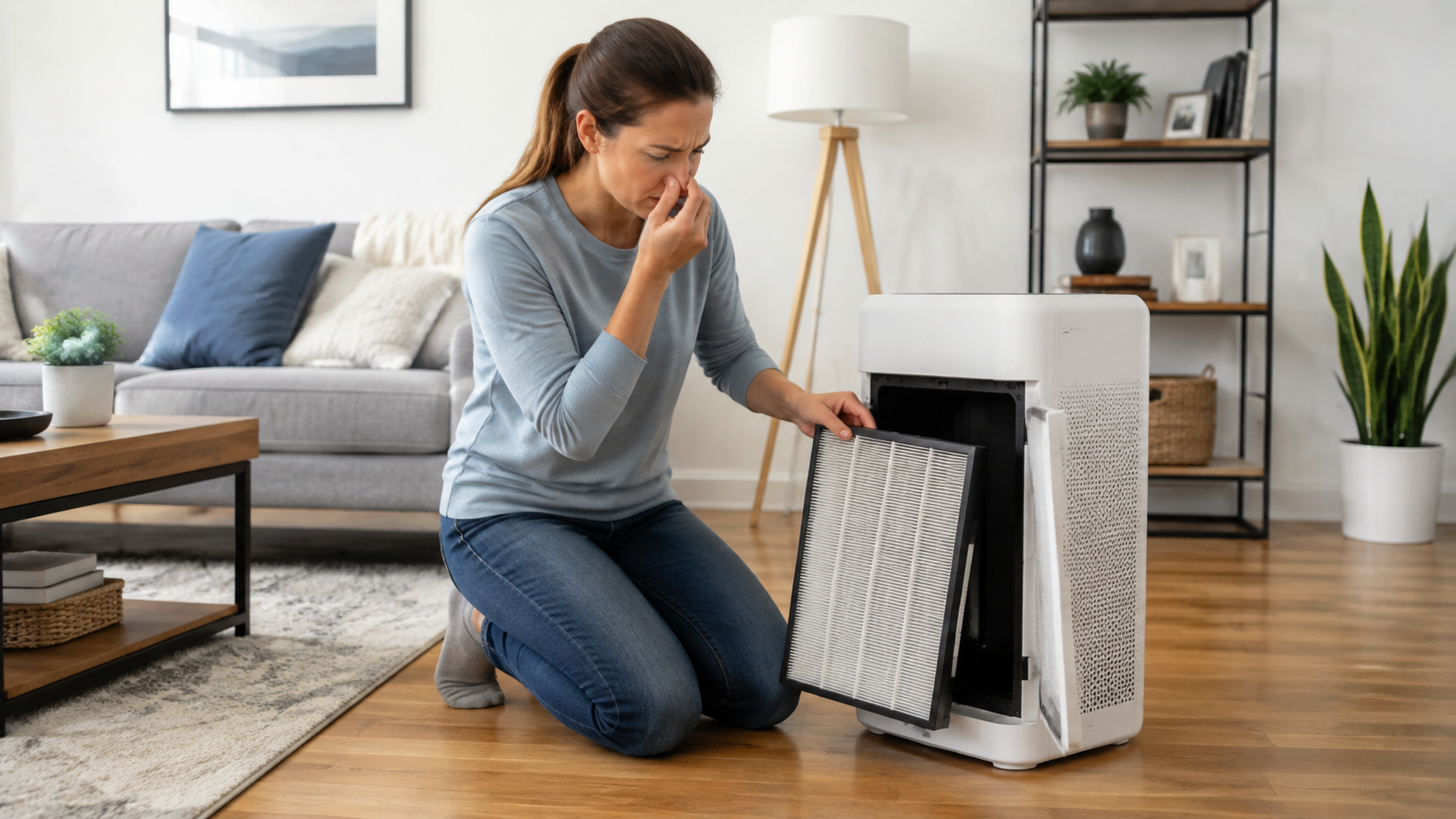
Quick Answer: Why Does My Air Purifier Smell Strange?
A musty odor usually calls for a moisture inspection. A sour or stale smell after cleaning may mean a washable component was reinstalled damp or the wrong part was washed. A mild scent that begins immediately after installing a filter calls for a packaging, filter-code, fit, and manual check. Household odors blowing back from the outlet often point to a continuing source or a carbon stage that is missing, loaded, or undersized.
Do not use your nose as an ozone meter. The U.S. Environmental Protection Agency explains that the ability to smell ozone varies and fades with exposure; noticing no odor does not prove that a level is safe.
Air Purifier Odors Compared: What to Do First
This table is a triage tool, not a diagnosis. The exact model manual and current manufacturer support instructions decide whether a filter can be cleaned, whether an ionizer can be disabled, and whether the appliance needs service.
| What you smell | Possible direction | First response | Decision level |
|---|---|---|---|
| Burning, rubbery, melting plastic, or electrically hot | Motor, wiring, plug, outlet, blocked fan, overheated component, or other electrical fault | Stop operation. Disconnect power only if safe. Do not run another test cycle to “see if it clears.” | Stop |
| Rotten egg or suspected fuel-gas odor | Possible gas leak unrelated to the purifier | Leave immediately. Do not use switches, plugs, or a phone until outside. Contact emergency or gas authorities. | Leave |
| Musty, damp, basement-like, or mildew-like | Wet filter, damp housing, nearby moisture, mold growth, leak, or high humidity | Power down, inspect for moisture, check humidity, and correct the water source. Replace wet disposable media as directed. | Inspect |
| Sour or stale after washing a component | Part reinstalled damp, residue left behind, or a non-washable layer was wetted | Stop and identify the exact layer. Follow the drying, cleaning, or replacement instructions for that model. | Maintain |
| New plastic, packaging, adhesive, or filter scent | Packaging left on, wrong filter, first-use material odor, or a stronger fault that only appears new | Check every wrapper, model number, filter code, fit, airflow direction, and manufacturer note before continued use. | Verify |
| Pet, cooking, smoke, or stale-room odor from the outlet | Continuing source, saturated or missing carbon, insufficient carbon capacity, or too little airflow | Control the source, ventilate when outdoor air is suitable, and inspect the carbon stage and replacement timing. | Source |
| Sharp, metallic, chlorine-like, or “after a storm” scent | Possible ionization or ozone-related concern, electrical issue, cleaning residue, or another room source | Stop use and verify the technologies and instructions for the exact model. Do not identify or dismiss ozone by smell alone. | Pause |
In-article graphic: the four odor decisions
Stop
Burning, heat, smoke, sparks, melting, or a sharp electrical odor.
Inspect
Mustiness, dampness, a wet filter, cleaning residue, or a new unexplained scent.
Maintain
An approved washable pre-filter is dirty, a disposable filter is loaded, or the housing needs manual-approved care.
Control the source
Pet, cooking, smoke, moisture, or chemical odors continue entering the room.
Burning, Rubbery, or Hot-Plastic Smell: Stop the Purifier
A burning or rubbery smell is not a filter-maintenance reminder. The National Fire Protection Association lists a burning or rubbery smell from an appliance among the warning signs of an electrical problem.
Turn the purifier off. If there is no smoke, flame, sparking, melted material, or other immediate danger and the plug is safely reachable, disconnect it by the plug—not by pulling the cord. Do not open electrical compartments, bypass a safety switch, substitute another power adapter, or repeatedly restart the purifier.
Check without turning it back on
- Look for discoloration, warping, melted plastic, a damaged cord, bent prongs, or a loose plug.
- Notice whether the odor is strongest at the outlet, plug, cord, control panel, motor area, or air outlet.
- Check whether curtains, furniture, dust mats, pet hair, or a wall blocked the intake or clean-air outlet.
- Record the model, serial information, purchase date, and what the purifier was doing when the smell began.
- Review current recall information and contact the manufacturer or a qualified service professional.
A dirty filter can restrict airflow on some designs, but replacing it is not proof that a burning smell is fixed. The motor, electronics, cord, plug, and outlet still need the response specified by the manufacturer or a qualified professional.
Musty or Damp Smell: Find the Moisture Before Blaming the Filter
A musty odor may be strongest near the purifier simply because its fan is moving room air past your nose. The source could be a damp filter, condensation, a nearby humidifier, a leak, wet carpet, a basement wall, a drain, or another material in the room.
The EPA’s Guide to Air Cleaners in the Home is direct on this point: a portable air cleaner may remove some airborne particles, but it does not correct the moisture source that causes mold and musty odors.
Use a moisture-first inspection
- Turn off and unplug the purifier before opening it when the manual instructs you to do so.
- Inspect the floor, wall, filter compartment, intake, and nearby furniture for dampness or staining.
- Check whether mist from a humidifier, open window, bathroom, kitchen, or HVAC register has been reaching the purifier.
- Measure room humidity instead of guessing from comfort alone.
- Identify whether the pre-filter is washable, vacuumable, wipeable, or disposable.
- Replace a wet non-washable filter according to the manufacturer’s instructions; do not reinstall it to “dry while running.”
- Correct the leak, condensation, humidity, or damp-material problem that caused the odor.
For a room-level decision, use the air purifier versus dehumidifier guide. It separates particle filtration from moisture removal and shows why a higher CADR cannot dry a damp room.
Sour or Stale Smell After Cleaning: Was the Right Part Washed?
Air purifier filters are often stacks of different materials. A screen or fabric pre-filter may be serviceable, while the main particle media and activated-carbon layer may be disposable. Washing the whole cartridge because the outer surface looks washable can leave moisture deep inside the media or damage its structure.
Before cleaning again, find the exact instruction word in the manual: vacuum, wipe, rinse, wash, or replace. Those actions are not interchangeable.
If rinsing is approved, follow the specified water, cleaning-product, drying-time, and reinstallation directions. Manufacturer instructions can differ even within one brand. The site’s guide, Can You Vacuum an Air Purifier Filter—or Are You Damaging It?, walks through that layer-by-layer decision.
New-Filter or Plastic Smell: Verify Before You Decide It Is Normal
A smell that begins immediately after a filter change gives you a useful timeline. It does not tell you the cause by itself.
Check the simple installation mistakes first
- Was every plastic wrapper, bag, cardboard insert, tape strip, and protective sheet removed?
- Does the replacement list the exact purifier model and filter code?
- Is the filter facing the correct airflow direction and seated without gaps?
- Does the cartridge include the same particle and carbon stages as the original?
- Is the door closing normally without bending or compressing the filter?
- Does the current manual or manufacturer support page mention an initial filter scent for that exact part?
Some manufacturers disclose that a light scent may occur with a particular new carbon filter. That product-specific note should not be turned into a universal rule. A strong, worsening, irritating, burning, or persistent odor deserves a stop-and-contact response, especially when heat or electrical symptoms are also present.
If the replacement only looks correct, use the seven-step replacement-filter match check. A near-fit filter can change the seal, airflow, carbon amount, or filter stack even when the door closes.
Pet, Cooking, Smoke, or Stale Odor From the Outlet
Sometimes the purifier is not creating the odor. Its fan is pulling an existing room odor through the filter and returning air that still carries part of it.
A particle filter and activated carbon do different jobs. Particle media can capture airborne dust, dander, pollen, and smoke particles that pass through it. Gas-phase odor control depends on appropriate sorbent media, often activated carbon, and its amount, design, contact time, remaining capacity, and fit.
The EPA notes that there is no widely used residential rating equivalent to particle CADR for gas removal. A strong smoke CADR does not prove that a purifier contains enough carbon for persistent cooking, pet, chemical, or smoke odors.
When household odor keeps returning
- Control the source: Clean the litter area, pet bedding, grease, smoke residue, trash, damp material, or spilled product that keeps releasing odor.
- Ventilate carefully: Bring in outdoor air when outdoor conditions are suitable. Keep windows closed during unhealthy smoke or pollution events.
- Inspect the carbon stage: Confirm that it is present, correctly installed, appropriate for the filter design, and within the manufacturer’s service guidance.
- Check airflow: Make sure the purifier is not undersized, blocked, or running so quietly that it cannot move enough air for the room.
- Reset expectations: A purifier can reduce some airborne odor compounds; it does not clean surfaces or stop an active source.
Use the pet-odor source-and-carbon guide for animal odors, or the windows-open-or-closed guide when ventilation is part of the decision.
Sharp, Metallic, or Ozone-Like Smell: Do Not Trust the “Clean” Scent
People describe ozone in different ways—sharp, metallic, chlorine-like, or similar to the air after a storm. Those descriptions are not a reliable test. A smell may come from ozone, an electrical problem, cleaning residue, a new material, or another source in the room.
The EPA advises avoiding air cleaners that intentionally produce ozone in occupied spaces. It also notes that some ionizers, electrostatic precipitators, plasma devices, or poorly coated UV designs may have the potential to emit ozone. Read the site’s filtration-technology guide to separate mechanical filters, carbon, ionization, UV, and ozone claims.
If a sharp odor begins when an optional ionization or similar feature operates, stop using the purifier and consult the exact manual and manufacturer. Do not assume that lowering a setting until you no longer smell anything establishes safety. If anyone experiences breathing difficulty, chest pain, severe irritation, or other urgent symptoms, move to fresh air and seek appropriate medical or emergency help.
Where Is the Smell Strongest?
Location helps narrow the next check. Power the purifier down before putting your face or hands near any opening, and do not touch a hot, wet, sparking, smoking, or visibly damaged appliance.
| Strongest location | What it may tell you | Next check |
|---|---|---|
| Wall outlet, plug, or cord | Electrical connection, damaged cord, loose outlet, heat, or another power problem | Stop use and seek manufacturer or qualified electrical guidance. Do not move the purifier to another outlet as a casual test. |
| Motor, control panel, or upper housing | Internal component, blocked fan, electronics, or overheating | Stop use, document symptoms, and contact the manufacturer or service provider. |
| Filter compartment | Wet, dirty, wrapped, wrong, damaged, loaded, or odor-saturated filter | Identify each layer, filter code, packaging, condition, and approved service action. |
| Air outlet only while cooking, cleaning, or pets are active | Room odor passing through faster than the carbon stage can reduce it | Control the source, improve safe ventilation, and review carbon capacity and airflow. |
| Entire room, even with purifier off | The purifier may not be the source | Inspect moisture, drains, gas appliances, furnishings, cleaners, HVAC, trash, and outdoor-air entry as appropriate. |
Use the S.N.I.F.F. Check Before You Restart
This five-step check turns “the purifier smells weird” into information a manufacturer, technician, or future-you can use.
- S — Stop for danger signsPower down for burning, heat, smoke, sparks, melting, strong chemical irritation, water exposure, or any alarm. Leave immediately for a suspected gas leak or fire.
- N — Note the timingWrite down whether the odor began after a filter change, cleaning, spill, humidity event, smoke event, power interruption, move, or change in fan speed.
- I — Identify the strongest locationWithout energizing a questionable machine, distinguish the room, filter compartment, air outlet, housing, cord, plug, and wall outlet.
- F — Follow the exact manualMatch the purifier model and filter code. Use only the approved cleaning, drying, replacement, reset, and service procedure.
- F — Fix the source—not just the smellCorrect moisture, residue, ongoing pet or cooking sources, a wrong filter, depleted carbon, blocked airflow, or an appliance fault before resuming normal operation.
Add the Odor Event to Your Fit & Filter Planner
The free 15-page Smart Air Purifier Fit & Filter Planner can also serve as a maintenance record. Add:
- Purifier brand, exact model, filter code, and filter stages
- Date and time the odor started
- How you described it before reading anyone else’s description
- Where it was strongest and which fan speed was running
- Recent filter changes, cleaning, spills, humidity, smoke, or room changes
- Plug, outlet, cord, housing, filter, airflow, noise, and temperature observations
- The manual page or manufacturer response that directed the next action
- Cleaning, replacement, service, or source-control result
That record helps you avoid resetting an alert, replacing a filter, or restarting a machine without knowing which action actually changed the smell.
Did the Manual Confirm You Need a Replacement?
Keep the purifier model number and filter code beside you. Verify the supported models, dimensions, included stages, package quantity, seller, and return terms before ordering.
Check FiltersFast Availability Use the Filter-Match CheckAffiliate link. Compatibility, pricing, construction, and availability can change. Do not replace a filter as a substitute for electrical inspection, moisture correction, source control, or manufacturer-directed service.
Four-question interactive knowledge check
Can You Choose the Safe First Response?
1. What should you do first if the purifier smells like burning rubber and the plug feels hot?
- Turn it to sleep mode and wait 20 minutes.
- Stop using it and disconnect power only if it is safe to do so.
- Reset the filter light.
Check answer
Correct answer: B. A burning or rubbery odor combined with heat is a stop-use warning, not a filter-light problem.
2. A musty odor returns after a fresh filter is installed. What should you investigate next?
- Moisture, humidity, leaks, and damp materials.
- A brighter app display.
- A louder fan setting only.
Check answer
Correct answer: A. A fresh filter cannot correct the moisture source that causes a recurring musty odor.
3. What should you verify when a smell begins immediately after a filter change?
- Packaging removal, exact filter code, fit, direction, and manufacturer instructions.
- Only whether the filter is the same color.
- Only whether the purifier turns on.
Check answer
Correct answer: A. Timing points to the installation, but compatibility, packaging, fit, and model-specific guidance still decide the response.
4. Does the absence of an ozone-like smell prove the air is safe?
- Yes, everyone detects ozone at the same level.
- Yes, as long as auto mode says the air is clean.
- No, odor is not a reliable measure of ozone safety.
Check answer
Correct answer: C. People vary in ozone detection, and the ability to smell it can fade during exposure.
Reader Check-In: What Changed Right Before the Smell?
Did the odor begin after a filter replacement, approved cleaning, humidifier use, smoke event, pet accident, move, power outage, or unexplained change? Share the purifier model, filter code, odor description, timing, and the manufacturer-directed solution in the comments.
Do not post a serial number, address, or other personal information. If the odor involved heat, smoke, fire, a suspected gas leak, or physical symptoms, handle the safety issue first—not the comment.
Frequently Asked Questions
Why does my air purifier smell musty?
The purifier may contain a damp filter or housing, but it may also be moving odor from a humid or mold-affected room. Inspect the machine and the surrounding area, measure humidity, correct leaks or condensation, and follow the exact filter-care instructions. A purifier cannot remove the moisture that allows mold to grow.
Is a new air purifier or replacement-filter smell normal?
Some exact products may disclose a temporary first-use material or carbon-filter scent, but there is no universal rule. Remove all packaging, verify the model and filter code, check fit and airflow direction, and read the manufacturer’s current instructions. Stop using the machine for any strong, worsening, irritating, burning, or heat-related odor.
Why does my air purifier smell like burning plastic?
A burning, rubbery, melting-plastic, or electrically hot odor can indicate an appliance, cord, plug, outlet, motor, or other electrical problem. Stop operation and disconnect power only if safe. Do not keep restarting it or assume a new filter solves the fault. Contact the manufacturer, a qualified service provider, or emergency services as the situation requires.
Can a dirty air purifier filter smell bad?
Yes. A loaded filter can retain smoke, cooking, pet, or other odors, and activated carbon can lose useful odor-control capacity. A wet filter can also develop a musty smell. Follow the condition and replacement guidance for the exact filter; do not wash or deodorize disposable media unless the manufacturer explicitly permits it.
Can I spray air freshener into an air purifier?
No, unless the purifier manufacturer explicitly designed and approved a specific product for that purpose. Sprays, oils, powders, and fragrances can coat filters, damage sensors or materials, add airborne chemicals, and hide the warning odor you need to investigate.
Does an ozone-like smell mean the purifier is working?
No. A sharp scent is not evidence of effective filtration or safe operation. EPA guidance advises against intentional ozone generators in occupied spaces, and the absence of a smell does not prove a safe ozone level. Check the exact technology, certification information, manual, and manufacturer instructions.
Why does the purifier blow pet or cooking odor back into the room?
The continuing room source may be stronger than the purifier’s gas-removal capacity, or the carbon stage may be missing, thin, loaded, incorrectly fitted, or overdue. Clean the source, ventilate when outdoor air is suitable, verify the carbon filter, and confirm that the purifier has enough useful-speed airflow for the room.
Can an air purifier detect a gas leak or carbon monoxide?
Do not rely on a typical purifier, particle sensor, VOC reading, or human nose for either hazard. Leave immediately for a suspected fuel-gas leak and contact authorities from outside. Carbon monoxide is odorless and requires properly installed, working CO alarms.
Authoritative and Manufacturer Guidance Used
- U.S. EPA: Guide to Air Cleaners in the Home
- U.S. EPA: Ozone Generators Sold as Air Cleaners
- U.S. EPA: Ionizers and Other Ozone-Generating Air Cleaners
- National Fire Protection Association: Electrical Safety in the Home
- U.S. Consumer Product Safety Commission: Gas, Fire, and CO Safety Guidance
- Levoit: How to Clean Your Air Purifier
- Coway: Product Manuals
Final takeaway
Do Not Cover the Smell—Classify It
A strange air purifier odor is not one problem with one fix. Burning and gas-like smells demand immediate safety action. Mustiness demands a moisture investigation. A new-filter scent demands packaging, compatibility, fit, and manual checks. Returning household odors demand source control and the right carbon expectations.
Use the S.N.I.F.F. check: stop for danger, note the timing, identify the location, follow the exact manual, and fix the source. That sequence protects the machine, the replacement budget, and—most importantly—the people in the room.
Editorial note: BestSmartPurifiers.com provides research-based consumer education and does not imply hands-on testing unless an article says so. Product designs, filter materials, maintenance directions, app features, certifications, replacement schedules, recalls, and support policies can change. Follow the current instructions for the exact purifier and filter.
Air cleaning can reduce some airborne pollutants, but it does not replace source control, safe ventilation when outdoor air is suitable, moisture repair, certified smoke and CO alarms, fire or gas-leak procedures, medical guidance, or qualified electrical and HVAC service.