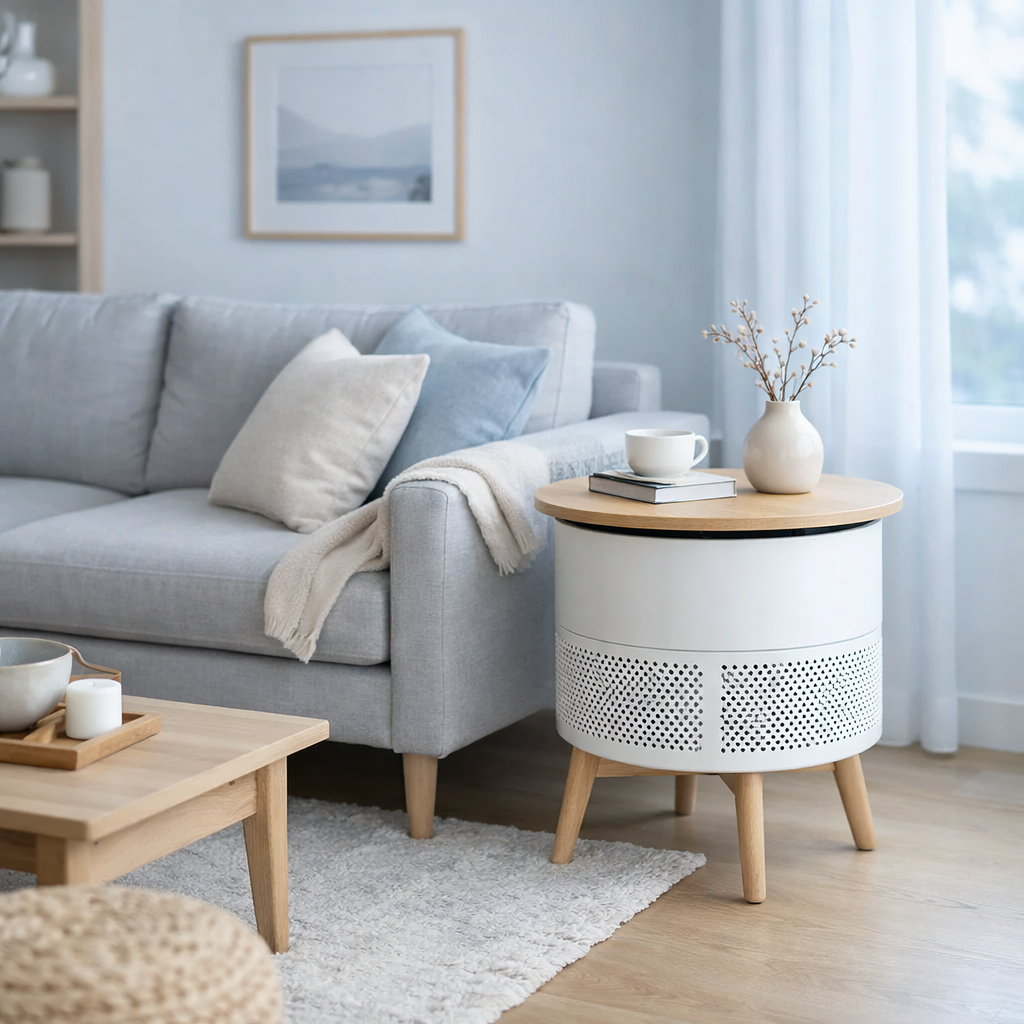
The best smart air purifiers in 2026 are not trying to look like plastic towers anymore. They are turning into side tables, sculptural objects, quiet bedroom companions, and living-room-friendly pieces that clean the air without ruining the room.
Quick Answer: What Makes a Smart Purifier “Design-First” in 2026?
A design-first smart purifier is an air purifier that blends into your room instead of looking like a medical device. The best examples use furniture-like shapes, soft fabrics, wood finishes, hidden displays, app control, auto mode, quiet operation, and cleaner cable management. The trend is not only about looks. A design-first purifier still needs the basics: enough CADR for the room, a proper particle filter, an odor-control layer if needed, easy filter replacement, and smart controls that do not make the product harder to use.
For years, most air purifiers looked like something you tolerated. They sat in the corner, worked hard, and quietly ruined the look of a carefully planned living room. That is changing fast.
The 2026 smart-home trend is moving toward technology that feels less obvious. Homeowners still want cleaner air, better sensors, voice control, app routines, and energy-conscious automation. But they also want appliances that look like they belong next to a sofa, nightstand, media console, reading chair, or home-office desk.
That is where design-first smart purifiers are starting to stand out. These models are not just “pretty air purifiers.” The best ones solve a real problem. If a purifier looks good enough to stay out in the open, you are more likely to place it where it can actually circulate air properly. That matters because an air purifier hidden behind furniture or shoved into a dead corner cannot perform at its best.
Smart Purifier Knowledge Check
Before choosing a beautiful purifier, test yourself with these quick questions. The right answer is not always the most stylish one.
- Is the purifier sized for the room where it will actually run?
- Does it have a particle filter strong enough for dust, pollen, smoke, or pet dander?
- Does the design allow open airflow, or does the furniture shape block intake and exhaust?
- Can you replace the filter easily without moving a heavy table or disassembling the room?
- Will you still like the design six months from now when it becomes part of the furniture?
Why Design-First Purifiers Are Trending Now
Smart homes used to be sold around control. Turn this on. Automate that. Ask a voice assistant to do something. In 2026, the bigger trend is comfort without clutter. People want devices that improve daily life while staying visually quiet.
Air purifiers fit this trend perfectly because they are not occasional-use gadgets. They often run for hours a day. Some run nearly all the time. That means the old “hide it when guests come over” approach does not work very well. A purifier needs room to breathe, so the design has to earn its place in the open.
The new design-first category is answering that problem in a few interesting ways. Some models double as side tables. Some use wood-look finishes or fabric panels. Some lean into sculptural shapes. Others add soft ambient lighting, app-based displays, or hidden controls so the purifier does not visually shout from across the room.
Best Design-First Smart Purifiers to Watch in 2026
This is not a lab-tested ranking. Think of it as a design-focused shortlist for readers who care about both cleaner air and a cleaner-looking room. Always confirm current pricing, filter availability, room coverage, and certifications before buying.
| Model | Best Fit | Why It Looks Different | Smart/Practical Notes |
|---|---|---|---|
| IKEA STARKVIND Table With Air Purifier | Small rooms, bedrooms, apartments, design-conscious budget buyers | It functions as both a side table and air purifier. | Works with IKEA smart-home products when connected through the appropriate IKEA hub. |
| SwitchBot Air Purifier Table | Bedrooms, pet spaces, small living rooms, smart-home users | Combines purifier, tabletop, wireless charging, and ambient lighting. | Good fit for people who want one device to do several everyday jobs. |
| Windmill Air Purifier Max | Modern living rooms, design-led apartments, larger single-room spaces | Clean rectangular shape with real bamboo, white, or navy finish options. | Uses a laser-based air-quality sensor and app-friendly smart features. |
| Blueair Blue Signature / Table-Style Models | Living rooms, open spaces, Scandinavian-style interiors | Furniture-inspired form that looks less like a traditional purifier tower. | Some Blue Signature models include particle sensing for PM1, PM2.5, and PM10 readings. |
| Rabbit Air A3 | Art-forward homes, offices, bedrooms, wall-mounted setups | Custom art panels turn the purifier into wall décor. | Wi-Fi control and customizable panels make it one of the most decor-friendly options. |
| Coway Airmega Icon / IconS | Premium rooms where the purifier sits beside furniture | Designed as a subtle home object instead of a utility appliance. | IconS adds smart features and the top surface can serve as a wireless charging pad. |
| LG PuriCare AeroFurniture | Small spaces, bedside areas, design-forward apartments | Part table, part purifier, with lighting-style lifestyle appeal. | Availability can vary by country, so confirm local support and filter access first. |
| Dyson Purifier Big+Quiet Formaldehyde | Premium buyers, large rooms, modern spaces | Sculptural, bladeless-looking form with a more architectural presence. | Premium price, advanced sensing, and formaldehyde-focused filtration features. |
IKEA STARKVIND Table With Air Purifier
The IKEA STARKVIND table model is one of the clearest examples of the new purifier trend. It does not ask for extra floor space in the same way a tower purifier does because it replaces a small side table. That makes it appealing for apartments, bedrooms, reading corners, and simple living rooms where every square foot counts.
The design is also easy to understand. It looks like a small table first and a purifier second. That is the point. It can sit near a chair, sofa, or bed without making the room feel more technical. The tradeoff is room size. STARKVIND is better suited to smaller spaces than large open-concept rooms, so buyers should not choose it only because it looks good.
SwitchBot Air Purifier Table
The SwitchBot Air Purifier Table leans into the 2026 smart-home idea of fewer visible gadgets doing more jobs. It is a purifier, side table, ambient light, and wireless charging spot in one product. That makes it especially interesting for bedrooms, pet areas, small apartments, and people who already like SwitchBot-style smart-home routines.
The design feels practical because it solves a clutter problem. A bedside table often collects a phone charger, a lamp, a purifier, and random cables. This product tries to combine several of those needs into one cleaner-looking object.
Windmill Air Purifier Max
Windmill has already built a design reputation in the air-conditioning space, and its purifier lineup follows a similar idea: clean lines, friendly finishes, and a product that does not look overly industrial. The Air Purifier Max is especially interesting because it comes in finishes that feel more like home décor than appliance plastic.
The bamboo finish is the standout for design-first shoppers. It helps the purifier fit warm, modern, natural, or minimalist interiors. For people who dislike glossy white appliance boxes, this is a major advantage.
Blueair Blue Signature and Table-Style Models
Blueair has been moving deeper into the design-first category with products that look softer, more compact, and more furniture-aware than traditional purifiers. The Blue Signature direction is especially relevant because it combines a more refined look with sensor-based air-quality awareness.
This is the type of purifier that fits the “quiet luxury” side of smart-home design. It does not need bright lights or complicated controls to feel premium. The appeal is in the form, finish, and the way it can sit in a room without demanding attention.
Rabbit Air A3
The Rabbit Air A3 takes a different design approach. Instead of pretending not to be there, it turns the purifier into wall art. That makes it one of the best options for people who want an air purifier in a visible location but do not want it sitting on the floor like another appliance.
The artist-panel concept gives the A3 an advantage in offices, bedrooms, music rooms, studios, and living spaces where wall décor already matters. It can also help with placement because wall-mounting can free up floor space.
Coway Airmega Icon / IconS
The Coway Airmega Icon line was ahead of the design-first trend because it treated the purifier as a home object, not just a box with a fan. The IconS version adds smart features, while the overall design feels more like a refined furniture accessory than a utility appliance.
This is a good fit for people who want a purifier that can sit beside a sofa, chair, or bed without looking temporary. The wireless charging feature on top also makes the product feel more integrated into daily routines.
LG PuriCare AeroFurniture
The LG PuriCare AeroFurniture concept shows where the category is heading: purifier as lifestyle furniture. It works visually because it looks more like a small table or lamp-like home object than a traditional purifier.
The main caution is availability. Depending on where readers live, AeroFurniture models may not be as easy to buy or support as mainstream U.S. purifier brands. That makes filter availability, warranty support, and replacement parts especially important to confirm.
Dyson Purifier Big+Quiet Formaldehyde
Dyson takes a different route from the furniture-table trend. The Purifier Big+Quiet Formaldehyde does not hide as a table. It looks like a premium piece of technology, but in a more architectural way. For some homes, that is exactly the right design language.
This model is not for bargain shoppers. It is for readers who want premium sensing, a refined modern look, and a purifier that can sit in a larger room without feeling like a basic plastic tower.
How to Choose a Beautiful Smart Purifier Without Making a Bad Buy
A purifier can look perfect and still be wrong for your room. That is the biggest trap in this category. Design should help you live with the purifier, but performance still has to come first.
Start with room size and CADR
Before comparing finishes, look for CADR or verified room coverage. CADR stands for Clean Air Delivery Rate. In plain English, it helps you understand how quickly a purifier can deliver cleaner air for a specific type of particle. For smoke and fine particles, a higher CADR generally means faster cleaning in the right room size.
A helpful rule of thumb from AHAM is that the purifier’s CADR should be at least two-thirds of the room’s square footage. For example, a 300-square-foot room usually needs a smoke CADR of about 200 or higher. For wildfire smoke, AHAM recommends an even stronger match, with Smoke CADR closer to the room’s square footage.
Make sure the design does not block airflow
Furniture-style purifiers are appealing, but airflow still matters. Look for clear intake and exhaust paths. Avoid placing a purifier under a closed shelf, tight against a wall, behind a sofa, or inside a decorative basket. A purifier that cannot pull in room air cannot clean that room well.
Check filter access before buying
Design-first products can sometimes make filter replacement feel like an afterthought. Before buying, ask a boring but important question: how easy is it to replace the filter? If the purifier doubles as a table, will you have to remove lamps, books, chargers, and décor every time the filter needs changing?
Think about lights in bedrooms
Ambient lighting sounds great until it glows beside your bed at 2 a.m. If you are buying a purifier for a bedroom, check whether the display and lighting can be dimmed or turned off. Sleep mode should mean more than a quiet fan. It should also mean a visually calm room.
Look beyond the app
Smart features are useful, but they should not make the purifier annoying. A good smart purifier should still have simple manual controls. Apps change. Wi-Fi disconnects. Voice assistants get confused. The best smart-home products work well even when you just want to press one button and move on.
Best Places to Use a Design-First Smart Purifier
Design-first purifiers make the most sense in rooms where traditional appliances feel distracting. They are especially useful in living rooms, bedrooms, home offices, nursery spaces, reading corners, studio apartments, and open areas where guests will see the unit every day.
They may not be the best choice for garages, workshops, unfinished basements, or heavy-duty smoke situations where raw CADR, ruggedness, and filter cost matter more than looks. In those spaces, a more basic high-performance purifier may be the smarter buy.
Where Replacement Filters Fit Into the Decision
The best-looking purifier in the world becomes a bad purchase if replacement filters are expensive, hard to find, or confusing to match. Before choosing any design-first model, check the replacement filter model number and the expected replacement schedule.
For general home filter shopping and maintenance planning, readers can compare options through FiltersFast. Just remember to verify compatibility with your exact purifier model before ordering. If your home needs a broader indoor-air-quality solution beyond one portable unit, you can also explore whole-home air-quality options through FieldControls.
The Bottom Line: The Best Purifier Is the One You’ll Actually Keep in the Room
Design-first smart purifiers are popular because they solve a very real problem. People want cleaner air, but they do not want another ugly appliance sitting in the middle of a carefully designed room.
The best 2026 models understand that. They look like side tables, art panels, soft furniture pieces, or premium home objects. But the smartest choice still starts with performance. Match the purifier to your room size, confirm filter availability, check noise levels, and make sure the smart features fit the way you actually live.
FAQs About Design-First Smart Purifiers
Are design-first air purifiers as effective as regular air purifiers?
They can be, but looks do not guarantee performance. Compare CADR, room coverage, filter type, noise level, and replacement filter access before buying. A beautiful purifier that is undersized for your room will still disappoint.
Do table-style air purifiers work well?
They can work well in the right room size if the intake and exhaust are not blocked. The main advantage is placement. If the purifier looks like furniture, you may be more likely to keep it out in the open where airflow is better.
What is the biggest mistake people make with smart purifiers?
The biggest mistake is choosing based on app features or appearance before checking room size. Smart controls are helpful, but the purifier still needs enough cleaning power for the space.
Are Matter-compatible purifiers worth it?
Matter compatibility can be useful if you want smart-home devices from different brands to work together more easily. However, not every purifier feature may be exposed through every smart-home platform, so confirm the exact controls you care about before buying.
Should I buy a purifier that looks like furniture?
Yes, if the performance fits your room and the filter replacement process is easy. Furniture-style design is especially useful in bedrooms, living rooms, and apartments where the purifier needs to stay visible.