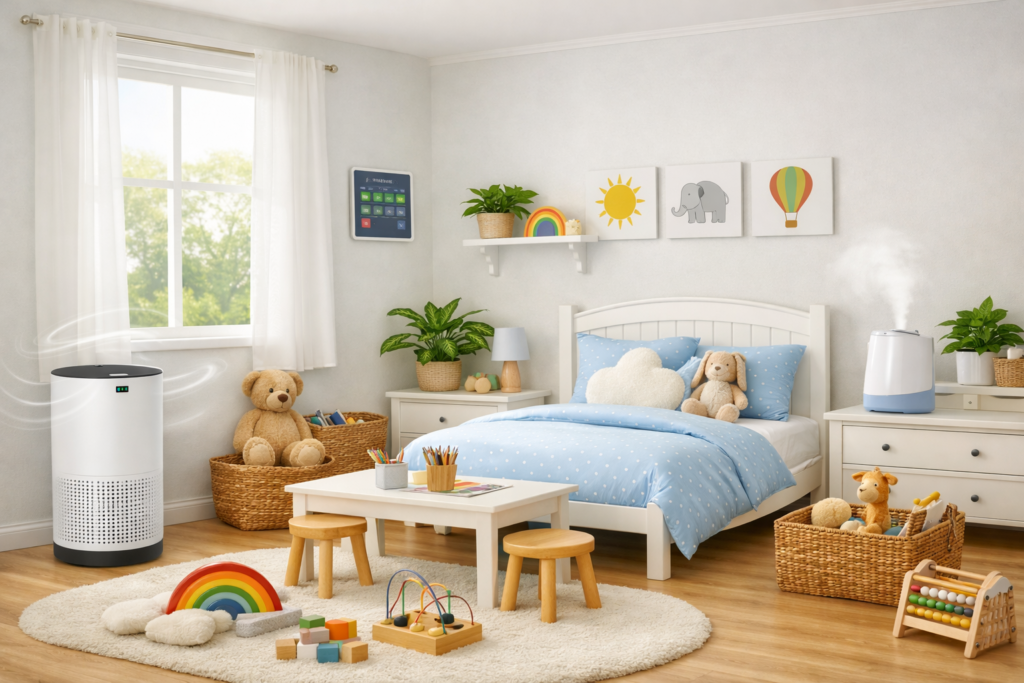
Children are not just smaller adults. Their lungs, immune systems, and breathing patterns are still developing, which makes clean air a bigger deal than many families realize.
That does not mean every parent needs to panic or buy the biggest purifier on the shelf. It means indoor air quality deserves a thoughtful plan, especially in bedrooms, nurseries, playrooms, and the rooms where kids spend the most time.
Air quality can affect kids more because their lungs are still growing, they breathe more air for their body size, and children with asthma or allergies may react more strongly to smoke, pollen, dust, mold, ozone, and fine particles. A good indoor air plan starts with source control, ventilation when outdoor air is safe, regular cleaning, HVAC filter maintenance, and a properly sized HEPA-style air purifier where children spend the most time.
Health note: Air purifiers can support cleaner indoor air, but they are not medical treatment. If your child has asthma, frequent wheezing, breathing trouble, chronic coughing, or severe allergies, use this guide alongside advice from your child’s pediatrician or asthma/allergy specialist.
Kids’ Air Quality Knowledge Check
Before choosing a purifier or changing your home routine, test what you know about children and indoor air.
- Are children affected by air pollution the same way adults are?
No. Children can be more vulnerable because their lungs and bodies are still developing. - Can one small purifier clean an entire house?
No. Portable purifiers are designed for a room or area, not a whole home. - Is a HEPA-style filter mainly for odors?
No. HEPA-style filtration is mainly for particles like dust, pollen, smoke particles, and fine particulate matter. - Should you use an ozone-producing air cleaner in a child’s room?
No. Ozone can irritate the lungs and should be avoided around children. - Does an air purifier replace cleaning, ventilation, and source control?
No. It works best as one layer in a broader clean-air plan.
Why Children’s Lungs Deserve Extra Protection
It is easy to think of air quality as an adult problem. We picture traffic fumes during a commute, office air that feels stale, or wildfire smoke drifting across a city. Yet children often carry a bigger risk because their bodies are still building the systems that help them breathe, grow, learn, and recover.
Children breathe more air for their body size than adults. They also spend time close to floors, carpets, rugs, bedding, stuffed animals, and play areas where dust, pet dander, and particles can collect. Add asthma, allergies, smoke exposure, mold, pollen, or nearby traffic, and the air inside a home can become a real daily concern.
This is why indoor air quality is not just a comfort issue for families. It can affect sleep, breathing comfort, allergy symptoms, school-day energy, and how often parents find themselves wondering why their child keeps coughing in one room but not another.
The goal is not fear. The goal is awareness. When parents know what makes kids more vulnerable, they can take practical steps that make the home feel cleaner and calmer.
The Invisible Triggers Hiding in Homes, Bedrooms, and Playrooms
Outdoor pollution gets the headlines, but children spend much of their time indoors. That means the air inside bedrooms, nurseries, classrooms, and play spaces matters.
Dust and Dust Mites
Dust can collect in carpets, bedding, curtains, stuffed animals, and vents. For sensitive children, it can become a frequent breathing or allergy trigger.
Pollen and Outdoor Particles
Pollen can enter through windows, shoes, clothing, pets, and HVAC systems. Bad outdoor air days can quickly become indoor air problems.
Smoke Particles
Wildfire smoke, tobacco smoke, cooking smoke, candles, and fireplaces can produce fine particles that are especially concerning for children’s lungs.
Mold and Dampness
Leaks, humid rooms, damp carpet, and poor bathroom ventilation can create conditions where mold and musty odors become a problem.
Pet Dander
Pets can be part of the family and still contribute dander, hair, and particles that bother sensitive kids.
VOCs and Odors
Cleaning products, air fresheners, new furniture, paints, adhesives, and some household materials can release gases or odors indoors.
For families, the most important shift is simple: do not judge indoor air by smell alone. Some pollutants have strong odors. Others are invisible and odorless. A room can smell clean because of fragrance while still containing particles or chemical irritants.
How Air Purifiers Help — and What They Cannot Promise
A portable air purifier pulls room air through a filter system and sends cleaner air back into that same room or area. A good purifier can reduce airborne particles when it is properly sized, placed, maintained, and run long enough.
That can be helpful in a child’s bedroom, nursery, playroom, or family room. These are the places where children sleep, recover, read, play, and spend long stretches of time.
However, an air purifier should not be treated like a magic shield. It cannot remove every pollutant. It cannot fix active mold growth. It cannot solve a moisture problem. It cannot make smoking indoors safe. It cannot replace a child’s asthma action plan. It is one tool in a layered strategy.
HEPA-style filtration helps with particles
HEPA-style filters are designed to capture particles such as dust, pollen, smoke particles, pet dander, and fine particulate matter. For kids’ rooms, particle filtration is often the first feature to consider.
Activated carbon helps with some odors and gases
Activated carbon can help reduce some odors and certain gases, depending on the type and amount of carbon used. This can be useful in homes dealing with cooking smells, traffic odors, wildfire smoke odor, or household chemical smells. Carbon filters do wear out and need replacement.
Ozone-producing devices should be avoided
For children’s rooms, avoid air cleaners that intentionally produce ozone. Ozone can irritate the lungs. Be cautious with ionizers, plasma features, and aggressive “air sanitizing” claims unless the product clearly shows it meets safety standards and does not emit concerning levels of ozone.
Best Rooms to Prioritize for Children
Most families do not need to buy a purifier for every room at once. Start where the child spends the most time and where the air quality concern is clearest.
| Room | Why It Matters | What to Focus On |
|---|---|---|
| Child’s Bedroom | Kids spend many hours sleeping, resting, and recovering there. | Quiet operation, HEPA-style filtration, proper room sizing, no ozone. |
| Nursery | Babies and toddlers need a calm, safe sleep environment. | Low noise, stable placement, child-safe controls, clean filters. |
| Playroom | Play areas often contain rugs, toys, dust, fabric, and floor-level particles. | Particle filtration, easy maintenance, airflow that is not blocked by toys. |
| Family Room | Shared rooms can collect pet dander, food odors, dust, and outdoor particles. | Higher CADR, larger room coverage, activated carbon if odors matter. |
| Basement Room | Basements may have humidity, musty smells, or dust concerns. | Moisture control first, then filtration. Do not use a purifier to hide mold problems. |
If your child has asthma or severe allergies, the bedroom is often the smartest first room to address. Sleep matters, and a cleaner sleep space can be easier to control than the entire house.
Need Replacement Filters for Your Family’s Air Purifier?
A purifier is only as useful as the filter inside it. Before ordering, confirm the exact purifier brand, model number, filter size, and replacement schedule. Compatibility matters, especially for children’s rooms where you want reliable airflow and filtration.
Partner link. Always verify filter compatibility before buying.
A Kid-Safer Indoor Air Plan Parents Can Actually Follow
The best air quality plan is practical. It does not depend on fear, guesswork, or one expensive gadget. It uses simple layers that work together.
Step 1: Control the source first
Remove what you can before filtering what remains. Avoid smoking or vaping indoors. Use lower-odor cleaning products when possible. Store chemicals away from children’s rooms. Fix leaks quickly. Keep pets out of a child’s bedroom if dander is a major trigger. Wash bedding regularly.
Step 2: Ventilate when outdoor air is safe
Fresh outdoor air can help dilute indoor pollutants, but timing matters. On high-pollen days, wildfire smoke days, or poor AQI days, open windows may make the indoor problem worse. Check local air quality before airing out a room.
Step 3: Use the right purifier in the right room
Choose a purifier sized for the room where your child spends the most time. Look for a strong CADR, HEPA-style particle filtration, quiet sleep-friendly operation, no ozone production, and replacement filters that are easy to buy.
Step 4: Keep airflow clear
Do not hide the purifier behind furniture, curtains, toy bins, or bedding. The unit needs space to pull air in and push cleaner air back out. Follow the manufacturer’s placement instructions and keep cords safely managed.
Step 5: Replace filters on schedule
A dirty filter can reduce airflow and performance. If your child’s room is dusty, if you have pets, or if the purifier runs every night, check filters more often. Filter reminders help, but a quick visual check can be useful too.
How to Choose an Air Purifier for a Child’s Room
Parents often ask which purifier is “best for kids.” The better question is: which purifier is safest, quietest, properly sized, easy to maintain, and designed for the room you actually need to clean?
| Feature | Why Parents Should Care | What to Look For |
|---|---|---|
| CADR | Shows how much clean air the purifier can deliver. | Choose a CADR appropriate for the room size, not just a vague “large room” claim. |
| HEPA-Style Filter | Helps capture airborne particles like dust, pollen, pet dander, and smoke particles. | Look for true particle-filtration specs and clear replacement filter information. |
| Activated Carbon | Can help with some odors and gases. | Useful for homes with cooking odors, smoke odors, traffic smells, or VOC concerns. |
| No Ozone | Ozone can irritate the lungs. | Avoid ozone generators and be cautious with ionizer-heavy marketing. |
| Quiet Sleep Mode | A loud purifier may disturb bedtime or get turned off. | Compare noise ratings and choose a unit your child can sleep through. |
| Child Lock | Curious hands can change settings. | Helpful for toddlers, nurseries, and shared play spaces. |
| Filter Cost | Long-term cost matters. | Check replacement filter price and availability before buying the purifier. |
A smart purifier can be helpful if it gives you app control, scheduling, filter alerts, and air quality trend awareness. But smart features should come after the basics. For a child’s room, filtration quality, safety, noise, and maintenance matter more than flashy tech.
Air Purifier vs. Window, Fan, Plant, or HVAC Filter
Parents often try several air-cleaning ideas before buying a purifier. Some are useful. Some are limited. The best approach depends on what problem you are trying to solve.
Opening a Window
This can help when outdoor air is clean, but it can backfire during pollen spikes, wildfire smoke events, high ozone days, or heavy traffic pollution.
Using a Fan
A fan moves air but does not filter it unless paired with a proper filter system. It may also stir up settled dust.
Houseplants
Plants can make a room feel calmer, but they should not be treated as a serious replacement for ventilation, source control, or mechanical filtration.
HVAC Filters
Central filters can help when the system runs and the filter is appropriate for the equipment. Some systems can use higher-efficiency filters, but compatibility matters.
A portable purifier is most useful when you need targeted filtration in a specific room. A child’s bedroom is a perfect example because it is easier to manage one sleep space than the entire home at once.
What Parents Should Avoid
When it comes to kids and indoor air, what you avoid can be just as important as what you buy.
Avoid Ozone Generators
Do not use ozone-producing air cleaners in children’s rooms. Ozone can irritate the lungs.
Avoid Fragrance Cover-Ups
Air fresheners, scented sprays, and heavy fragrance products may make a room smell “clean” while adding irritants.
Avoid Ignoring Moisture
If a room smells musty or has visible mold, fix the moisture problem. A purifier cannot solve active mold growth.
Also avoid treating purifier marketing as medical advice. Terms like “sanitizes,” “kills germs,” or “hospital-grade” can sound impressive, but parents should look for practical proof: CADR, filter type, room size, safety certifications, ozone information, and replacement filter availability.
Internal Reading for Cleaner Family Air
If you are building a cleaner-air plan for bedrooms, nurseries, or family spaces, these related guides can help you go deeper.
Understand HEPA
Compare Filter Types
Understanding Air Purifier Technology: HEPA, Activated Carbon, and Beyond
Trusted Air Quality Resources for Parents
For families who want to read beyond product recommendations, these public-health resources are helpful starting points.
CDC Air Quality
EPA Air Cleaners
American Lung Association
FAQs About Kids, Air Quality, and Air Purifiers
Why does air quality affect children more than adults?
Children’s lungs and bodies are still developing, and they breathe more air for their body size than adults. That can make pollutants like smoke particles, ozone, dust, pollen, and mold more concerning for kids, especially those with asthma or allergies.
Can an air purifier help a child with asthma?
A properly sized HEPA-style air purifier may help reduce airborne triggers such as dust, pollen, pet dander, and smoke particles in a room. However, it should not replace medical care, medications, or an asthma action plan from your child’s healthcare provider.
What kind of purifier is safest for a child’s bedroom?
Look for a properly sized purifier with HEPA-style particle filtration, quiet operation, no ozone production, stable placement, child-lock features if needed, and easy-to-find replacement filters.
Should I run an air purifier all night in my child’s room?
Many families run a bedroom purifier during sleep because children spend many hours in that room. Follow the manufacturer’s directions, place the unit safely, keep airflow clear, and use a quiet setting your child can sleep through.
Can plants clean the air in a child’s room?
Plants may make a room feel pleasant, but they should not be relied on as the main air-cleaning strategy. Source control, ventilation when outdoor air is safe, HVAC maintenance, cleaning, and mechanical filtration are more practical for meaningful indoor air improvement.
Do I need activated carbon in a child’s room purifier?
Activated carbon can be useful if odors, smoke smells, cooking odors, or VOCs are a concern. For basic dust, pollen, and dander control, HEPA-style particle filtration is usually the first priority.
Tiny Lungs Need a Cleaner-Air Routine
Parents cannot control every breath their child takes outside the home. But inside the home, small choices can add up: cleaner bedrooms, fewer indoor irritants, better filters, smarter ventilation, and a purifier that actually fits the room.
That is the real promise of smart air care. Not fear. Not perfection. Just a cleaner, calmer place for kids to sleep, play, heal, and grow.
Air quality and its impact on children is such a crucial topic, especially given their vulnerability during developmental years. One aspect I find intriguing is the role of indoor air quality, particularly in schools and homes where children spend most of their time. Are there specific air pollutants, like volatile organic compounds or particulate matter, that pose a greater risk to kids compared to adults? Also, considering the rise in urbanization, what are some practical steps parents or educators can take to mitigate exposure in densely populated areas? Air purifiers are often recommended, but how do we ensure they are effective for specific pollutants? Finally, I wonder how much of a difference outdoor air quality improvements, such as green spaces and cleaner energy sources, can make in the long term.
Hi Slavisa,
You’ve highlighted some critical points about air quality and kids. This topic needs more attention, especially since children spend much time indoors.
It’s crucial to focus on indoor air quality. Schools and homes can contain pollutants, which can worsen the air inside. Some contaminants are especially harmful to children.
Volatile organic compounds (VOCs) are found in paints, cleaning supplies, and furniture. They can trigger asthma and allergies in kids, and some are linked to developmental issues.
Particulate matter– includes tiny bits of dust, soot, and smoke. Since kids have developing lungs, these particles can get deep inside and cause inflammation and breathing problems.
In cities, the problem is even more serious. Here’s what parents and educators can do:
1. Ventilation: Good airflow is essential! Open windows regularly when outdoor air quality is acceptable to improve the air quality.
2. Source Control: Use low-VOC paints, cleaning products, and furniture. Avoid strong scents and harsh chemicals.
3. Air Purifiers: Look for purifiers with HEPA filters to trap tiny particles. You might need a purifier with an activated carbon filter to reduce VOCs.
Your point about outdoor air quality is also essential. Green spaces and cleaner energy sources help improve air quality in the long term. Trees act as natural air filters, and reducing pollution from cars and industries is necessary for everyone, especially kids.
Thanks for raising these critical questions, Slavisa!