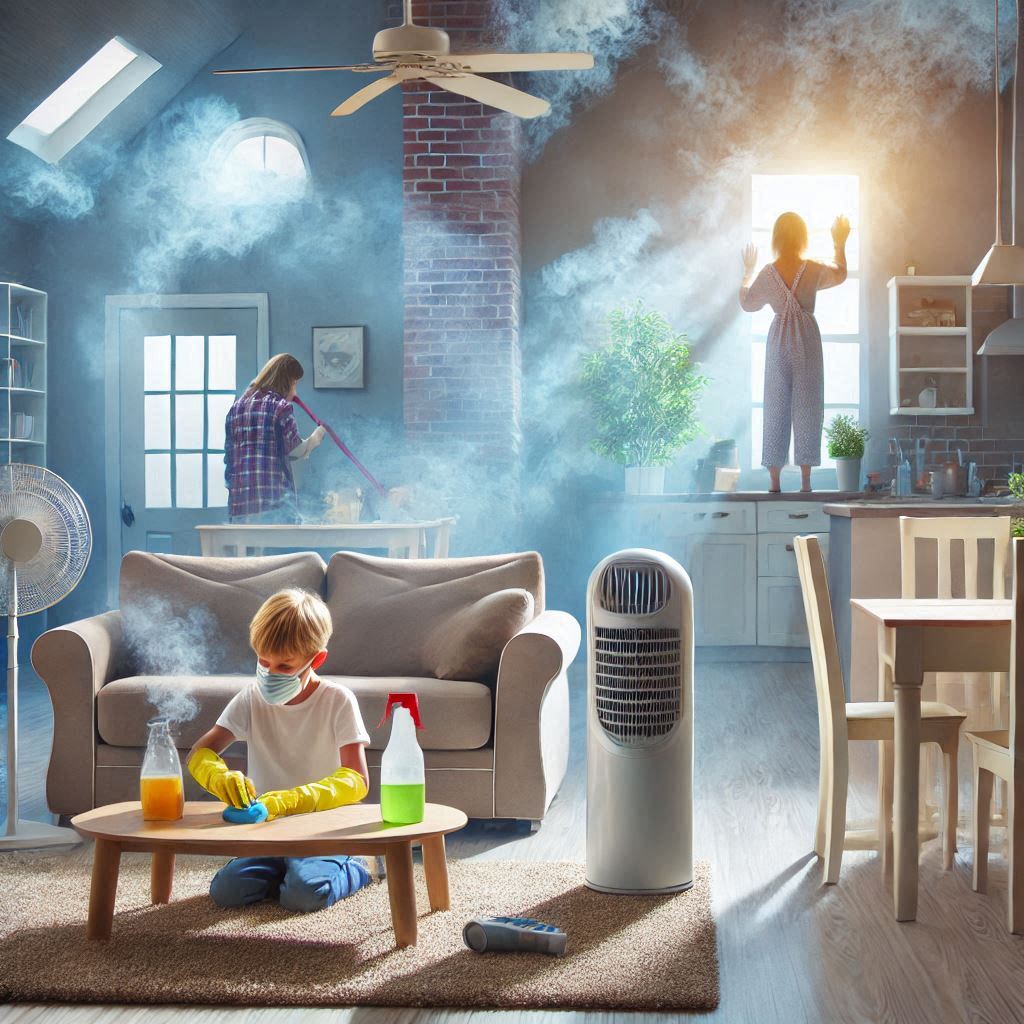
HEPA and activated carbon filters are often placed inside the same smart purifier, but they do very different jobs. HEPA-style filters focus on particles. Activated carbon filters focus on certain gases and odors.
That difference matters. If your main problem is pollen, dust, smoke particles, pet dander, or mold spores, you need strong particle filtration and enough CADR for the room. If your main problem is cooking odor, smoke smell, pet odor, traffic fumes, or VOC concerns, activated carbon becomes more important.
HEPA-style filters are best for airborne particles such as pollen, dust, pet dander, mold spores, and smoke particles. Activated carbon filters are best for some odors and gases, including certain VOCs, cooking smells, smoke smells, and pet odors. For most homes, the best smart purifier uses both: a strong particle filter for allergens and fine particles, plus enough activated carbon to help with odors and gases.
Reality check: No air purifier filter removes every indoor pollutant. A purifier works best when paired with source control, ventilation when outdoor air is safe, regular cleaning, and timely filter replacement.
Smart Filter Knowledge Check
Before choosing a purifier or replacement filter, test what you know about HEPA and activated carbon.
- Does HEPA filtration remove odors?
Not very well. HEPA-style filters focus on particles, not gases or smells. - Does activated carbon remove pollen?
No. Carbon is mainly used for certain gases and odors, not pollen, dust, or dander. - Is CADR mainly a particle-filtration rating?
Yes. CADR is used for particle removal, such as smoke particles, dust, and pollen. - Can a thin carbon sheet handle heavy odor problems?
Usually not. Carbon works better when the filter contains enough carbon material for the job. - Should most homes consider both HEPA-style and carbon filtration?
Yes, especially if the home has both particles and odors to manage.
Why This Comparison Matters
Air purifier marketing can make every filter sound like it does everything. That is where shoppers get into trouble. A purifier may say it helps with allergens, smoke, odor, VOCs, pets, dust, germs, and cooking smells all at once. But inside the machine, different filter layers are doing different jobs.
HEPA-style filtration is the particle layer. It is the workhorse for airborne dust, pollen, pet dander, mold spores, and fine particles. Activated carbon is the gas-and-odor layer. It helps adsorb some gases and smells as air passes through the filter.
Once you understand that split, choosing a smart purifier becomes easier. You stop asking, “Which filter is better?” and start asking, “Which pollutant am I trying to reduce?”
HEPA vs. Activated Carbon Filters: The Simple Comparison
HEPA and activated carbon filters are not rivals. They are specialists. The best choice depends on the problem in your room.
| Filter Type | Best For | Not Best For | Buyer Tip |
|---|---|---|---|
| HEPA-style filter | Pollen, dust, pet dander, mold spores, smoke particles, fine particulate matter. | Odors, VOCs, gases, chemical smells. | Look for strong CADR, room-size fit, and replacement filter availability. |
| Activated carbon filter | Some odors, cooking smells, smoke smells, pet odors, and certain gases or VOCs. | Pollen, dust, dander, mold spores, and most airborne particles. | Look for enough carbon material, not just a thin deodorizing sheet. |
| HEPA + activated carbon | Homes with both particles and odors, such as pets, cooking, smoke exposure, traffic pollution, or mixed indoor air concerns. | Major mold problems, severe chemical sources, or pollutants that require source removal. | Often the most practical setup for modern smart purifiers. |
What HEPA Filters Actually Do
HEPA stands for High-Efficiency Particulate Air. In plain English, that means a HEPA-style filter is built to capture particles as air moves through the purifier.
For homes, this matters most when the problem is visible or invisible particles. Dust floating in sunlight, pollen drifting in through windows, pet dander from a favorite chair, fine smoke particles after a cooking mishap, and mold spores from a damp area all fall into the particle conversation.
A smart purifier with a good HEPA-style filter can help reduce these particles in the room where it runs. However, filter quality is only part of the story. The purifier also needs enough airflow for the space. That is where CADR matters.
Why CADR matters with HEPA filters
CADR stands for Clean Air Delivery Rate. It tells you how much filtered air a purifier can deliver for particles such as smoke, dust, and pollen. A strong filter inside a weak machine may still underperform if the purifier cannot move enough air for the room.
For shoppers, this means you should compare the purifier’s CADR against the actual room size. A purifier for a small bedroom may not be enough for an open living room, even if the filter itself is impressive.
What Activated Carbon Filters Actually Do
Activated carbon filters work differently. Instead of trapping particles the way a HEPA-style filter does, carbon uses a process called adsorption. Gases and odor molecules stick to the surface of the carbon material as air passes through.
This is why activated carbon is useful for certain smell and gas problems. Cooking odors, pet odors, smoke smells, traffic-related odors, and some VOC concerns may call for a purifier that includes meaningful carbon filtration.
But carbon has limits. A thin carbon-coated layer may help lightly with odors, but it is not the same as a deep bed of carbon pellets or a filter designed for stronger gas removal. Carbon also becomes saturated over time. Once it is full, it can stop helping much with odors even if the purifier still turns on.
Why carbon filters are harder to compare
Particle filters can often be compared using CADR. Gas and odor filtration is harder because there is no widely used consumer rating system for portable air cleaners that measures gas removal the same way CADR measures particles. That means shoppers need to look more carefully at the amount of carbon, filter design, replacement cost, and real use case.
Which Filter Do You Need Most?
The easiest way to choose is to start with the air problem you actually notice.
Choose HEPA First If…
You struggle with pollen, dust, pet dander, mold spores, smoke particles, or allergy-season air. Particle filtration should be your first priority.
Choose Carbon First If…
Your biggest complaint is odor, cooking smell, smoke smell, pet smell, or chemical-type indoor air concerns. Carbon becomes more important.
Choose Both If…
You have a normal real-world home with dust, pets, cooking, outdoor pollution, and occasional odors. Most households benefit from both layers.
For most smart purifier shoppers, the best answer is not HEPA or activated carbon. It is HEPA plus activated carbon, matched to the room and maintained correctly.
Best Filter Match by Household Problem
Use this table as a fast decision guide before buying a new purifier or replacement filter.
| Indoor Air Problem | Best Filter Priority | Why |
|---|---|---|
| Spring pollen | HEPA-style filtration | Pollen is a particle, so CADR and particle filtration matter most. |
| Dusty bedrooms | HEPA-style filtration | Dust and dust mite particles are particle problems, not odor problems. |
| Pet dander | HEPA-style filtration, plus carbon if odors are present | Dander is a particle. Pet smell may call for carbon support. |
| Cooking odors | Activated carbon, plus source ventilation | Cooking odor is often a gas-and-odor issue, though cooking can also produce particles. |
| Wildfire smoke | High-CADR HEPA-style filtration, plus carbon for smoke odor | Smoke includes fine particles and odor-causing gases. |
| Traffic pollution near the home | HEPA-style filtration plus meaningful carbon | Outdoor pollution can include both particles and gases. |
| VOC concerns from products or materials | Activated carbon and source control | VOCs are gases, so source reduction and gas-focused filtration matter. |
| Mold and musty odors | Moisture repair first, then HEPA and carbon as support | A purifier cannot fix active mold growth or the moisture that causes it. |
Need Replacement Filters for Your Smart Purifier?
Before replacing a working purifier, check the filter. A clogged HEPA-style filter can reduce airflow, and saturated carbon can stop helping with odors. Always confirm the exact purifier brand, model number, filter code, and filter size before ordering.
Partner link. Filter compatibility varies by purifier model. Always verify fit before purchasing.
How Smart Purifiers Use HEPA and Carbon Together
Most modern smart purifiers use a layered filter system. Air enters the unit, passes through a pre-filter, then moves through a particle filter and sometimes through activated carbon before returning to the room.
The smart part usually comes from sensors, app controls, schedules, auto mode, and filter-life reminders. Those features can be useful, but they do not replace filter quality. A smart purifier with weak carbon may still struggle with odors. A smart purifier with low CADR may still struggle in a large room.
So, when comparing smart purifiers, look at the physical filter system first and the app second.
Useful Smart Features
Filter-life alerts, scheduling, app controls, auto mode, air quality trend history, child lock, display dimming, and fan-speed control.
Features That Need Scrutiny
Vague “odor removal” claims, thin carbon sheets, unclear CADR, hidden replacement-filter costs, and ionizer features that do not clearly address ozone concerns.
HEPA vs. Carbon Maintenance: What Changes?
Both filters need replacement, but they age differently.
A HEPA-style filter becomes loaded with particles. As it fills, airflow can drop. You may notice weaker output, more noise, or a filter alert from the app. In homes with pets, dust, smoke, or high pollen exposure, particle filters may need closer attention.
Activated carbon becomes saturated. That means it can stop adsorbing odors and gases effectively. The purifier may still move air, and the HEPA layer may still capture particles, but the room may start smelling stale again.
| Maintenance Question | HEPA-Style Filter | Activated Carbon Filter |
|---|---|---|
| What causes performance loss? | Particle buildup and reduced airflow. | Carbon saturation from gases and odors. |
| Can it usually be washed? | Usually no, unless the manufacturer clearly says it is washable. | Usually no. Washing typically does not restore saturated carbon. |
| How do you know it needs attention? | Filter alert, weak airflow, visible buildup, or manufacturer schedule. | Odors return, filter alert appears, or manufacturer schedule is reached. |
| What is the best habit? | Check the pre-filter and replace the main filter on schedule. | Replace on schedule and use source control for strong odors. |
One important reminder: do not wash disposable HEPA or carbon filters unless the manufacturer specifically says you can. Water can damage filter media, reduce airflow, create odor issues, or break down the filter structure.
Why Thin Carbon Filters Often Disappoint
Many smart purifiers include a carbon layer, but not all carbon layers are equal. Some are thin deodorizing sheets attached to a main filter. Others use thicker carbon pellets or a larger amount of carbon material.
That difference matters because carbon has a finite capacity. The more odor and gas exposure it handles, the faster it becomes saturated. In a home with heavy cooking odors, smoke smell, strong fragrance products, or VOC concerns, a thin carbon layer may not be enough.
If odor control is your main reason for buying a purifier, do not judge by the word “carbon” alone. Look for the amount of carbon, filter thickness, replacement cost, and whether the purifier is designed for your room size.
Where HVAC Filters Fit Into This Conversation
Portable smart purifiers clean a single room or area. HVAC filters can help filter air moving through the home’s heating and cooling system. These are related tools, but they are not the same thing.
For particles, a properly selected HVAC filter can support whole-home filtration when the system is running. For many systems, higher-efficiency filters may help, but the filter must fit the equipment properly. A filter that is too restrictive or poorly fitted can create airflow problems.
For homes thinking about furnace or HVAC filter upgrades, it is smart to check what the system can handle and replace filters on schedule. A snug fit matters because air leaking around the filter reduces real-world performance.
Replacing Furnace or HVAC Filters Too?
If your indoor air strategy includes your central HVAC system, make sure the replacement filter fits snugly and matches what your system can handle. A professional HVAC technician can help if you are unsure about moving to a higher-efficiency filter.
Partner link. Always verify compatibility before changing HVAC filter type or efficiency.
Common Myths About HEPA and Activated Carbon
Filter confusion often leads to bad purchases. These are the myths worth clearing up before you buy.
Myth: HEPA Removes Everything
HEPA-style filters are excellent for particles, but they are not designed to remove gases or most odors.
Myth: Carbon Solves Allergies
Activated carbon can help with some odors and gases, but pollen, dust, and dander require particle filtration.
Myth: Smart Sensors Prove the Air Is Perfect
Built-in sensors are useful, but they vary by model and often focus on particles rather than every gas or odor.
Myth: A Filter Lasts Until It Looks Dirty
Carbon can become saturated without looking dirty. Follow the replacement schedule and watch performance.
Myth: Bigger Coverage Claims Always Win
Check CADR and room size. Marketing coverage numbers are not always equal across brands.
Myth: Odor Means the Air Is the Only Problem
Strong odors may point to a source problem, such as smoke, dampness, cleaning products, or poor ventilation.
What to Look For Before Buying Replacement Filters
Replacement filters can make or break your purifier’s long-term value. A smart purifier with expensive, hard-to-find filters may become frustrating after the first year. A purifier with easy-to-find, correctly fitted filters is easier to keep running.
| Before You Buy | Why It Matters |
|---|---|
| Exact purifier model number | Many brands have similar-looking models with different filter sizes. |
| Filter code or part number | The correct code reduces the risk of buying a filter that almost fits but leaks air. |
| Filter layers included | Some replacements include HEPA and carbon together. Others require separate filters. |
| Replacement schedule | All filters need regular replacement, and heavy use can shorten filter life. |
| Trusted supplier | Low-quality filters may reduce airflow or fail to match expected performance. |
Internal Reading for Smarter Filter Decisions
If you are building a complete indoor air strategy, these related guides can help you go deeper.
Go Deeper on Filter Technology
Understanding Air Purifier Technology: HEPA, Activated Carbon, and Beyond
Understand HEPA Better
Choose a Smart Purifier
Smart Air Purifiers Guide: Automation, Sensors & Home Integration
Trusted Sources for Filter Research
For more technical reading, these public and standards-based resources are helpful starting points.
EPA Air Cleaner Guide
AHAM CADR Standards
EPA Indoor Air Quality
FAQs About HEPA vs. Activated Carbon Filters
Is HEPA better than activated carbon?
HEPA is better for particles such as pollen, dust, pet dander, mold spores, and smoke particles. Activated carbon is better for some gases and odors. One is not universally better than the other because they solve different problems.
Do I need both HEPA and activated carbon in a smart purifier?
Most homes benefit from both. HEPA-style filtration handles particles, while activated carbon helps with odors and certain gases. This combination is especially useful in homes with pets, cooking odors, smoke exposure, or mixed indoor air concerns.
Can activated carbon remove VOCs?
Activated carbon can help reduce some VOCs, depending on the filter design and amount of carbon used. It will not remove every gas equally, and source control is still important.
Can HEPA remove cooking smells?
HEPA-style filters may capture some cooking particles, but they are not designed for odor removal. Cooking smells are usually better handled with ventilation and activated carbon support.
How often should HEPA and carbon filters be replaced?
Follow the manufacturer’s schedule for your purifier. HEPA-style filters become loaded with particles, while carbon filters become saturated with gases and odors. Heavy use, pets, smoke, dust, or cooking exposure may require more frequent replacement.
Are smart purifier filter indicators accurate?
They are useful reminders, but they are not perfect. Some are based on run time, while others use sensor data. You should still check the manual, inspect the filter area, and replace filters when performance drops.
The Best Filter Choice Starts With the Problem
If the problem is particles, choose strong HEPA-style filtration and enough CADR for the room. If the problem is odors or gases, choose meaningful activated carbon. If your home has both, choose a purifier that handles both and keep the filters fresh.
Cleaner air is not about chasing the flashiest smart feature. It is about matching the filter to the pollutant and maintaining the system long enough for it to keep working.