Disclosure: This post contains affiliate links. If you make a purchase through these links, I may earn a commission at no additional cost to you. I recommend products based on their technical specifications and real-world performance.
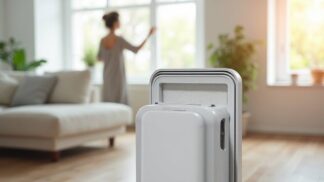
Is your bedroom secretly making you tired? You might invest in the best mattress and blackout curtains, yet wake up with a “sleep hangover,” a scratchy throat, or a stuffed nose. Most people assume their indoor air is a safe haven, but scientific data suggests that air quality in the bedroom often plummets during the night.
Why is bedroom air quality worse at night?
Bedroom air quality deteriorates at night due to limited ventilation, temperature inversions that trap outdoor pollutants near the ground, and “off-gassing” from mattresses and bedding. Without airflow, carbon dioxide (CO2) levels can triple, while movement during sleep stirs up dust mites and pet dander that settle in fabrics.
The Invisible Nighttime Pollution Peak
While you sleep, several environmental factors converge to create a “perfect storm” for poor respiratory health.
1. The Ventilation Trap
Most of us sleep with the door and windows closed for security, noise reduction, or temperature control. This creates a sealed box. Throughout the night, your own breath increases CO2 concentrations. High CO2 levels are linked to fragmented sleep and reduced cognitive function the following morning.
2. Temperature Inversions
At night, the ground cools faster than the upper atmosphere. This creates a “lid” of warm air that traps vehicle exhaust and industrial pollutants near the Earth’s surface. If you live in an urban area, the outdoor air you bring into your home through HVAC systems or window cracks is often at its most toxic between 2:00 AM and 6:00 AM.
3. Your Mattress is Moving
Research into “Dusty Dozing” shows that body heat and physical movement during sleep cause mattresses and pillows to release volatile organic compounds (VOCs) and microscopic skin cells. These particles remain suspended in your “breathing zone”—the few inches of space directly above your pillow.

How Smart Purifiers Solve the Sleep Crisis
Standard air purifiers require manual adjustment, but human lungs are most vulnerable when we are unconscious and unable to react to changing conditions. This is where smart technology changes the game.
Automation and Real-Time Response
Smart purifiers utilize laser-based PM2.5 sensors to detect invisible spikes in dust or smoke. If a neighbor starts a fireplace or a dust cloud moves through your HVAC, a smart unit like those found at FiltersFast or FieldControls will automatically ramp up fan speeds before you ever wake up.
Quiet Operation (Sleep Mode)
Modern smart units integrate with ambient light sensors. When you turn off the bedroom lights, the purifier dims its display and enters a “Whisper-Quiet” mode, often operating below 22 decibels. This provides the benefits of Understanding Air Purifier Technology: HEPA, Activated Carbon, and Beyond without the disruptive noise of a traditional fan.
Technical Comparison: Filtering Your Sleep
To effectively clean the air in your bedroom, you need a multi-stage approach. A single filter type is rarely enough for a restorative night’s rest.
Table 1: Filter Technology Comparison
| Filter Type | Primary Target | Benefit for Sleep |
|---|---|---|
| True HEPA | Dust, Pollen, Dander, Spores | Eliminates morning congestion and sneezing. |
| Activated Carbon | VOCs, Odors, Cooking Fumes | Removes chemical smells from furniture and bedding. |
| Pre-Filter | Hair, Large Dust Particles | Extends the life of expensive HEPA filters. |
| UV-C Light | Bacteria, Viruses, Mold | Reduces the risk of airborne illness transmission. |
Table 2: Smart vs. Traditional Purifiers
| Feature | Traditional Purifier | Smart Purifier |
|---|---|---|
| Control | Manual Buttons | Mobile App & Voice (Alexa/Google) |
| Sensors | None or Basic | Precision Laser PM2.5 & VOC Sensors |
| Scheduling | None or Basic Timer | Custom “Bedtime” Routines |
| Filter Tracking | Visual Inspection | Automatic Notification via App |
| Auto-Mode | Fixed Speeds | Dynamic Speed Adjustment |
Optimizing Your Bedroom Sanctuary
To truly master your environment, integration is key. As detailed in our Smart Air Purifiers Guide: Automation, Sensors & Home Integration, connecting your purifier to your broader smart home allows for advanced logic. For example, you can program your purifier to run at 100% power for 30 minutes before you enter the room, ensuring the air is pristine the moment your head hits the pillow.
Pro-Tip: Placement Matters
Never hide your air purifier behind a curtain or under a desk. For the best results, place it at least two feet away from walls to allow for 360-degree air intake. If you have severe allergies, placing the unit near the head of the bed (but not directly on your face) can create a “clean air bubble.”
Common Bedroom Air Quality Concerns
Should I leave my air purifier on all night?
Yes. Leaving an air purifier on throughout the night ensures that the air is continuously cycled and cleaned as new pollutants are introduced by movement or external infiltration. Most smart units have an “Auto” or “Sleep” mode designed specifically for low-energy, quiet nighttime use.
Does a purifier help with snoring?
If snoring is caused by nasal congestion or inflammation due to allergens like dust mites or pet dander, a HEPA-equipped air purifier can significantly reduce these triggers, potentially leading to clearer airways and reduced snoring.
How do I know if the air in my bedroom is bad?
Common signs of poor Indoor Air Quality (IAQ) include waking up with a dry mouth, persistent morning headaches, visible dust on surfaces shortly after cleaning, or a “musty” smell upon entering the room.
Can air purifiers cool a room?
Air purifiers move air, which can create a slight wind-chill effect, but they do not contain cooling elements like an air conditioner. However, by removing heavy particulates, the air may feel “fresher” and less oppressive during humid nights.
Final Thoughts
Investing in a smart air purifier is not just about “cleaning the air”—it is about protecting the eight hours your body spends recovering. By utilizing the automation found in modern systems from FieldControls and FiltersFast, you can automate your health and finally wake up feeling truly refreshed.