Most people assume an air purifier is just a fan blowing air through a single piece of paper. In reality, high-performance systems use a sophisticated, multi-stage defense strategy. By layering different types of media, these machines can tackle everything from heavy pet hair to invisible chemical fumes.
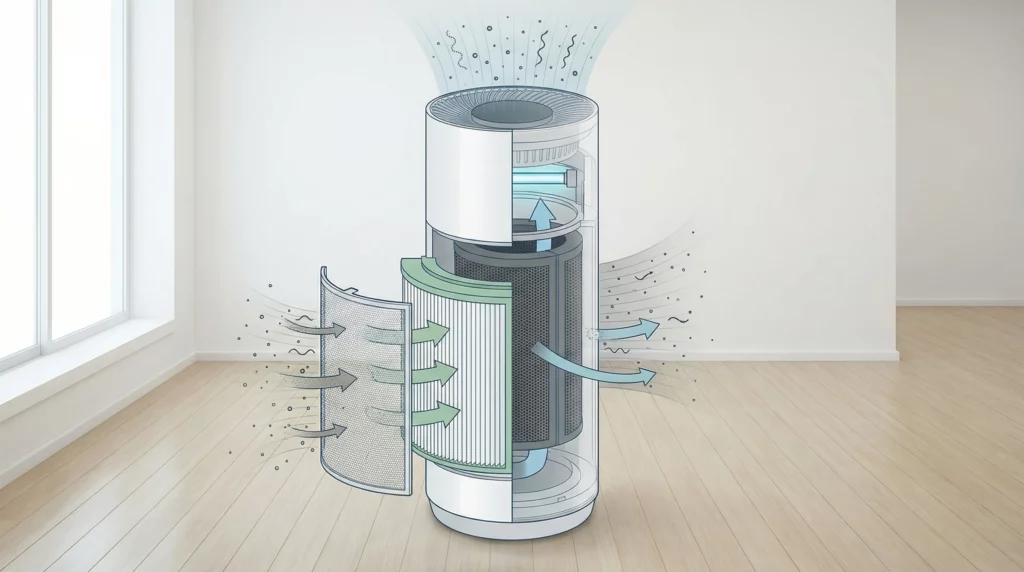
Understanding how these layers interact is the key to choosing the right system for your home and ensuring you aren’t overpaying for replacement filters.
The Strategy of Sequential Filtration
The “multi-stage” approach is about efficiency and protection. If you sent raw, dusty air directly into a high-end HEPA filter, it would clog within weeks. By using a graded system—moving from coarse to fine—the system ensures that each layer handles only the specific pollutants it was designed to handle.
Comparison: Single-Stage vs. Multi-Stage Filtration
| Feature | Single-Stage Filter | Multi-Stage Filter System |
|---|---|---|
| Primary Goal | Basic dust removal | Comprehensive air “polishing” |
| HEPA Lifespan | Short (clogs quickly) | Long (protected by pre-filters) |
| Odor Removal | Rare / Minimal | Excellent (via Carbon stage) |
| Maintenance | Frequent total replacement | Staggered (replace only what is full) |
| Air Quality | Basic | Medical-grade / Professional |
Layer 1: The Pre-Filter (The Shield)
The pre-filter is the first line of defense. It is typically made of a washable foam or a thin mesh. Its job is “impact filtration”—catching the big stuff before it enters the sensitive internal components.
- Targets: Pet hair, lint, large dust bunnies, and insects.
- The Benefit: By capturing these “heavy” particles, the pre-filter prevents the more expensive secondary filters from becoming physically blocked.
Layer 2: Activated Carbon (The Deodorizer)
While the pre-filter stops physical debris, the activated carbon layer handles gases. Carbon is “activated” through a process that opens up millions of tiny pores. It works through adsorption—gas molecules stick to the surface of the carbon like a magnet.
- Targets: Volatile Organic Compounds (VOCs), cooking smells, smoke, and chemical fumes from cleaning products.
- The Benefit: This is the only stage that effectively removes odors and hazardous gases that would pass right through a standard dust filter.
Layer 3: HEPA Filtration (The Specialist)
HEPA stands for High-Efficiency Particulate Air. This is the heart of the system. To be classified as True HEPA, a filter must capture 99.97% of particles as small as 0.3 microns.
- Targets: Pollen, mold spores, fine dust, and many bacteria.
- The Benefit: This layer is essential for allergy and asthma sufferers, as it removes the microscopic triggers that other filters miss.
Layer 4: Optional Post-Filters (The Finishers)
Some advanced systems, such as those from Field Controls, include a fourth stage. This might be a UV-C light to neutralize airborne pathogens or a specialized catalytic filter designed to break down formaldehyde.
- Targets: Viruses, bacteria, and specific industrial pollutants.
- The Benefit: Provides an extra layer of biological protection for high-risk environments.
Questions: Multi-Stage Filtration Explained
What is the best order for air filters?
The industry standard is: Pre-filter → Activated Carbon → HEPA. However, some high-end manufacturers place the Carbon after the HEPA to prevent fine dust from clogging the Carbon’s pores, allowing for maximum gas adsorption.
How often should I replace multi-stage filters?
Pre-filters should be cleaned monthly. Carbon filters typically need to be replaced every 3–6 months. True HEPA filters can last 12–24 months, depending on the environment and the effectiveness of the pre-filter.
Can I run an air purifier without the pre-filter?
It is not recommended. Running without a pre-filter will cause your expensive HEPA filter to clog with hair and large dust, significantly reducing its lifespan and increasing your long-term costs.
Strategic Maintenance for Cleaner Air
To keep your system running efficiently, it is vital to source high-quality replacements. Cheap, generic filters often lack the density required for True HEPA performance or the weight of carbon needed for odor control.
For high-quality replacement filters and specialized IAQ solutions, we recommend exploring these trusted providers:
- FiltersFast: A comprehensive source for nearly every brand of air and water filter. Shop FiltersFast Replacements
- Field Controls: Professional-grade systems designed for deep-layer air purification. Explore Field Controls Systems
For further reading on maintaining a healthy home, see our guides on [Understanding Air Purifier Technology: HEPA, Activated Carbon, and Beyond] and [Smart Air Purifiers Guide: Automation, Sensors & Home Integration]. For data on health standards, consult the official resources on [Indoor Air Quality (IAQ)].
Affiliate Disclosure: This post contains affiliate links. If you purchase through these links, I may earn a small commission at no extra cost to you. I only recommend products and services that meet high standards for air quality and filtration performance.